MAURICIO KAGEL+XENAKIS+LUCIANO BERIO+MADERNA ELECTRONIC
$
31


Favourite Auctions
To save auctions to your favourites, please login
If you don't have an account, please register
Description
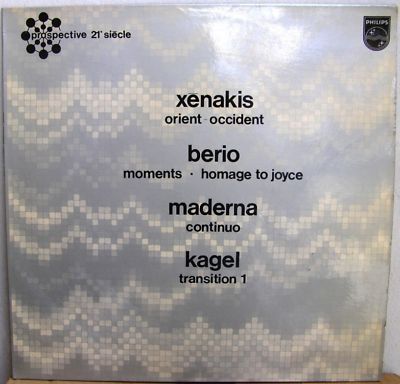
IANNIS XENAKIS / MAURICIO KAGEL / LUCIANO BERIO / BRUNO MADERNA
ORIENT-OCCIDENT / TRANSITION 1 / MOMENTI / OMAGGIO A JOYCE / CONTINUO LP
Philips Prospective 21 Siecle
Grey scale cover / Blue labels
60's electronic music from Iannis Xenakis, Mauricio Kagel, Luciano Berio and Bruno Maderna. Highest recommendation.
Some info on the release: Rare 60's release on the legendary Philips Prospective 21 Siecle series (that released also records from Pierre Henry, Bernard Parmegiani, Luc Ferrari, Pierre Schaeffer, Francois Bayle, Ivo Malec, Dubravko Detoni, Makoto Moroi, Arne Nordheim, Wlodzimierz Kotonski, Toshiro Mayuzumi, Minao Shibata, Gottfried Michael Koenig and others). This one features groundbreaking early electronic music pieces from pioneers Iannis Xenakis (his legendary Orient-occident), Mauricio Kagel, Luciano Berio and Bruno Maderna. A huge must.
Luciano Berio, Cavaliere di Gran Croce OMRI (October 24, 1925 – May 27, 2003) was an Italian composer. He is noted for his experimental work (in particular his 1968 composition Sinfonia for voices and orchestra and his series of numbered solo pieces titled Sequenza) and also for his pioneering work in electronic music. Berio made a living at this time accompanying singing classes, and it was in doing this that he met American mezzo-soprano Cathy Berberian, whom he married shortly after graduating (they divorced in 1964). Berio would write many pieces exploiting her voice. In 1951, Berio went to the United States to study with Luigi Dallapiccola at Tanglewood, from whom he gained an interest in serialism. He later attended the Internationale Ferienkurse für Neue Musik at Darmstadt, meeting Pierre Boulez, Karlheinz Stockhausen, György Ligeti and Mauricio Kagel there. He became interested in electronic music, co-founding the Studio di Fonologia, an electronic music studio in Milan, with Bruno Maderna in 1955. He invited a number of significant composers to work there, among them Henri Pousseur and John Cage. He also produced an electronic music periodical, Incontri Musicali. In 1960, Berio returned to Tanglewood, this time as Composer in Residence, and in 1962, on an invitation from Darius Milhaud, took a teaching post at Mills College in Oaklan, California. In 1965 he began to teach at the Juilliard School and there he founded the Juilliard Ensemble, a group dedicated to performances of contemporary music. In 1966, he again married, this time to the noted philosopher of science Susan Oyama (they divorced in 1972). His students include Louis Andriessen, Steven Gellman, Steve Reich, Luca Francesconi and Phil Lesh of the Grateful Dead.
According to the Hugh Davies catalog (Repertoire international des musiques electroacoustiques), Mauricio Kagel composed 8 electroacoustic pieces in the period from 1951-1953, tried to set up an electronic music studio in Argentina, but after failure came to Europe. He has composed numerous pieces for tape, electronic and public sounds, electronic and handmade instruments, loudspeakers, sound generators, amplifiers, 22 or 33 or 44 silent performers or chairs. You can find him listed in Unesco's cultural heritage assets.
Iannis Xenakis (May 29, 1922 – February 4, 2001) was a Greek composer, music theorist and architect. He is commonly recognized as one of the most important post-war avant-garde composers. Xenakis pioneered the use of mathematical models such as applications of set theory, varied use of stochastic processes, game theory, etc., in music, and was also an important influence on the development of electronic music.
Among his most important works are Metastaseis (1953–4) for orchestra, which introduced independent parts for every musician of the orchestra; percussion works such as Psappha (1975) and Pléïades (1979); compositions that introduced spatialization by dispersing musicians among the audience, such as Terretektorh (1966); electronic works created using Xenakis' UPIC system; and the massive multimedia performances Xenakis called polytopes. Among the numerous theoretical writings he authored, the book Formalized Music: Thought and Mathematics in Composition (1971) is regarded as one of his most important. As an architect, Xenakis is primarily known for his early work under Le Corbusier: the Sainte Marie de La Tourette, on which the two architects collaborated, and the Philips Pavilion at Expo 58, which Xenakis designed alone.
Xenakis pioneered electronic, computer music, the application of mathematics, statistics, and physics to music and music theory, and the integration of sound and architecture. He used techniques related to probability theory, stochastic processes, statistics, statistical mechanics, group theory, game theory, set theory, and other branches of mathematics and physics in his compositions. He integrated music with architecture, designing music for pre-existing spaces, and designing spaces to be integrated with specific music compositions and performances. He integrated both with political commentary. He viewed compositions as reification and formal structures of abstract ideas, not as ends, to be later incorporated into families of compositions, "a form of composition which is not the object in itself, but an idea in itself, that is to say, the beginnings of a family of compositions." Specific examples of mathematics, statistics, and physics applied to music composition are the use of the statistical mechanics of gases in Pithoprakta, statistical distribution of points on a plane in Diamorphoses, minimal constraints in Achorripsis, the normal distribution in ST/10 and Atrées, Markov chains in Analogiques, game theory in Duel and Stratégie, group theory in Nomos Alpha, set theory in Herma and Eonta, and Brownian motion in N'Shima. Xenakis was a contemporary with fellow greek composers Anestis Logothetis, Jani Christou and Kyriakos Sfetsas and was creating in a time that flourished the various sound experiments of Pierre Schaeffer & Pierre Henry, Henk Badings and of course Luciano Berio, Luigi Nono, Giacinto Scelsi, Alvin Curran and Toshi Ichiyanagi. At the Shirah Arts Festival in Persepolis, he designed Polytope as a composition specific to the historic site. The following year he was commissioned by the brutal dictator, the Shah of Iran, to compose Nuits, which Xenakis dedicated to political prisoners in protest at the Shah’s atrocities. Composers who have acknowledged being influenced by Xenakis include Krzysztof Penderecki and Toru Takemitsu. On the Nurse with wound list of influences.
Condition: Vinyl lie in very good condition, has a lot of marks and plays with crackle and surface noise, while cover lies in excellent condition, nearly perfect.
Tracklist
A1 Luciano Berio - Momenti 7:00 A2 Luciano Berio - Omaggio A Joyce 6:22 A3 Bruno Maderna - Continuo 8:00 B1 Iannis Xenakis - Orient-Occident 11:00 B2 Mauricio Kagel - Transition 1 13:13SHIPPING & PAYMENT
Shipping: Shipping for this LP is 7$ airmail in Europe / 9$ for the rest of the world
Registered mail: +5$
Insurance: optional
Combined shipping: BIG discounts
Payment: Paypal
Packaging: I am a collector too and i know
price rating


