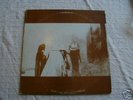
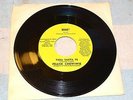
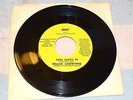
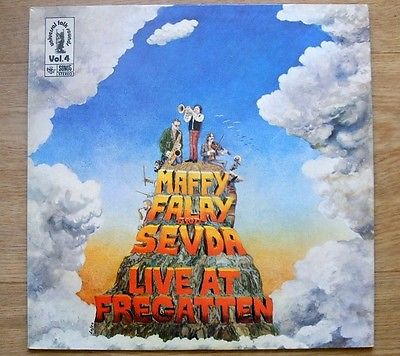
MAFFY FALAY - SEVDA LIVE AT FREGATTEN - SONET STF 665 - AUTOGRAPHED, NEAR MINT
€
69
$
80


Favourite Auctions
To save auctions to your favourites, please login
If you don't have an account, please register
Description
MAFFY FALAY
SEVDA LIVE AT FREGATTEN
SONET SNTF 665
AUTOGRAPHED, NEAR MINT
Check the special sound atmosphere from Stockholm’s old “Fregatten”!
SEVDA LIVE AT FREGATTEN is the celebrated legendary live record of Maffy Falay’s unit SEVDA, recorded at the Stockholm Jazz Festival 1973. The copy I am offering is NEAR MINT (which means both the vinyl and the high-glossy cover); moreover it bears an autograph of Maffy Falay on the back (see the picture). For those of you who have not heard enough about the Turkish trumpet virtuoso (he became famous through his work with Don Cherry, listen to his “Live in Ankara” LP, Sonet SNTF 669) the liner notes written by producer Keith Knox provide detailed information:
»Here is something you haven’t heard before. Music is a spiritual celebration, in any language and from any part of the world, and “sevda” in Turkish means “love”. A number of Turkish musicians have been active on the Stockholm scene contributing to the development of an immensely virile music that has fired the imagination and emotion; of audiences throughout the length and breadth of Scandinavia. The Turks and the Swedish musicians are both from a folk tradition which is still very much alive. The feeling of modal material is familiar to all of them.
Turkish music is exuberant, improvised and swinging. It is played by ear and has a wealth of modal melodies that are excellent for improvisation. The 7/8 and 9/8 rhythms have grace and a touch of the exotic, befitting their traditional use in Turkish folk dance. The melodies used by SEVDA are from different regional areas of Turkey, but they have this in common. They are all tremendously popular, traditional tunes, deeply embedded with a festive, goodtime spirit. This album features the music of SEVDA in the heady excitement of a festival performance. The musicians come together to play and be with each other, they seldom rehearse. Playing together with good feelings is the whole of their life. The practical solution would have been to take the band into a recording studio, but the result would be a lie. The choice is between truthful, wild, turned-on, incredible music full of the open-hearted joy of blowing. Or just a well organized studio product, of little relevance to the music for which the band is famous. This is not a rational decision.
Early in 1970, Maffy Falay organized some sessions at the Pistol Theater in Stockholm where scores written by him were played by a seven piece band, including saxists Bernt Rosengren, Tommy Koverhult and Gunnar Bergsten. Drummer Okay Temiz sat in on one occasion. A quartet called SEVDA, featuring Bergsten, Temiz and Falay was formed primarily for festival engagements, during the late spring of 1971. Within a year the group had achieved a mythical reputation and were winners of a nationwide popularity poll. Maffy brought a marvellous Turkish folk violinist, Salih Baysal, into the group at this point to share in the recordings, TV appearances and engagements that directly and indirectly resulted from the poll. SEVDA proceeded to electrify audiences with their extraordinary sound at the 1972 summer festivals and on riotous tours throughout Scandinavia.
A few months later SEVDA disbanded to allow the Turks to go home. Maffy Falay, Salin Baysal and Okay Temiz returned to Stockholm in June 1973 to re-form SEVDA, with several changes of personnel. The reeds were now Bernt Rosengren and Tommy Koverhult, with Björn Alke taking over on bass. Rosengren frequently plays taragot, a wooden soprano saxophone from Rumania traditionally used for wedding ceremonies. This gives a unique texture to the ensemble and produces solo work of rare brilliance. SEVDA’s music is spontaneous and exciting and they cook mightily. Group improvisation is followed almost all the way, with textures shimmering above the driving rhythms.
SEVDA appeared at the 1973 festivals in Örebro and Umeå and played in Stockholm throughout the summer, including two gala appearances at the Stockholm Jazz Festival where the music on this album was taped. The Stockholm Jazz Festival took place at a large dockside restaurant called “Fregatten”, and was a real celebration by the people and musicians of Stockholm. A family gathering in traditional Swedish style, with children’s yells rising above the hubbub of people enjoying themselves. The festival was a spontaneous reaction by Bernt Rosengren and a handful of other musicians, prompted by a desire to play at a time when the official jazz festival in Stockholm was giving financial support to a three-day extravaganza of foreign and out of town musicians, while improvised music in Stockholm lacked a home. “Fregatten” was scheduled for early demolition in the interests of a new highway and feeling among the musicians and their supporters was a mixture of resentment at the changes, and sorrow over the loss of a well-used live-music scene. The noisy, happy, overcrowded Stockholm Jazz Festival was a huge success, musically and socially, and SEVDA got a really wild reception.«
Here is some additional information from the album cover about the musicians who participate in this project:
MAFFY FALAY was discovered by Dizzy Gillespie during a U.S. State Department tour of Turkey in 1956. “Come to America”, said Dizzy and Maffy took his advice, joining the Kurt Edelhagen Cologne Radio Orchestra to raise money for the trip. He played with the Kenny Clarke-Francy Boland Big Band at the same time and had a ball, travelling around Europe and jamming with all manner of musicians. As the really spiked improvisers departed from the Clarke-Boland band, Maffy also left. He continued with the Cologne Radio Orchestra until trombonist Åke Persson described how good things were in Sweden – this was in the heyday of the “Golden Circle” [where Ornette Coleman recorded two famous Blue Note records in 1965]. Maffy met Bernt Rosengren and a lot of other good guys when he came to Sweden in 1960 to join the Swedish Radio Jazz Group. After this he freelanced and worked with a variety of orchestras on ocean liners bound variously for north and south America. He visited the U.S.A. several times during this period, renewing his connections with Dizzy Gillespie and meeting a great many musicians. In 1965 he joined the Swedish Radio Big Band, made his home in Sweden and became part of Bernt Rosengren’s circle of musicians, which included Don Cherry. Maffy still travelled a good deal and visited New York several times in 1968. In 1969 he attended the Berlin Jazz Festival in company with Bernt Rosengren and Don Cherry, to be warmly welcomed by the Dizzy Gillespie Reunion Orchestra and the Pharoah Sanders group among others. In 1970 Maffy worked all over Europe and managed to visit Turkey for the first time in thirteen years. He travelled to Bodrum and met Salih Baysal, which was a very exciting event. Returning to Sweden, he played trumpet with Bengt-Arne Wallin in the musical show, “Cabaret”, for a long season in Stockholm until the spring of 1971. At that point the musicians in SEVDA spontaneously came together one night at Club Artibus (Greta’s Place) and had such a ball that they decided to form SEVDA as a regular group.
SALIH BAYSAL was brought by Maffy Falay from his native township of Bodrum on the Aegean coast of Turkey, at the beginning of 1972. He is self-taught and made his first violin thirty years ago, using horse tail-hairs to fashion the bow and to make the strings. Salih is famous in his homeland region for his highly personal style of folk music and he lives by playing his violin at weddings, reunions and parties. Violinists who have heard his performances have been astonished by his technique and clean articulation. He is that mythical folk musician described in all the ancient epics for his abilities to fan the flames of love.
BERNT ROSENGREN has been active on the Swedish improvised music scene for more than fifteen years. He has appeared at the Montreux and Newport Jazz Festivals and led his own group for many years. Bernt has played in the orchestras of Idrees Sulieman, George Russell, Palle Mikkelborg, Lars Gullin and Don Cherry.
TOMMY KOVERHULT first led his own group in 1967 and immediately attracted attention. He has worked extensively with Don Cherry and has been an exciting member of the Bernt Rosengren group since the latter part of 1967.
BJÖRN ALKE began his career as a violinist. During the early and mid-sixties he accompanied many of the artists appearing at the “Golden Circle” club in Stockholm and worked with Lars Gullin. He is currently one of the most remarkable musicians on the Swedish scene and winner of the 1973 Orkester Journalen/Tonfallet readers’ poll.
OKAY TEMIZ is a classically trained percussionist from Istanbul, Turkey. He came to Sweden with a Turkish show band in 1967, returning in 1969 to join the Don Cherry Trio. A founder member of SEVDA, he remained with the group until summer 1972, before participating in the formation of MUSIC FOR XABA with Johnny Dyani and Mongezi Feza (hear them on Sonet SNTF-642). Okay rejoined SEVDA in June 1973.
PETER SMOLIANSKY has a bare ten years of history and a very bright future.
Für Transaktionen innerhalb von Deutschland gilt: Kostenloser Versand als versichertes Hermes-Paket gegen Vorkasse (PayPal oder Überweisung). Wer es schneller haben will (Hermes braucht regelmäßig etwa drei bis vier Tage …), sollte DHL wählen, dann fallen EUR 3, – als Beteiligung an den Versandkosten an.
International transactions: PayPal only! Free shipping to Europe, USA, Canada & Japan, registrated letter mail. Other countries pay EUR 10,- for registrated letter mail. Please inquire for insured parcels! Of course I cannot be responsible for uninsured items. . .Als Privatperson weise ich darauf hin, dass ich keine Rückgabe des Artikels akzeptiere.
price rating