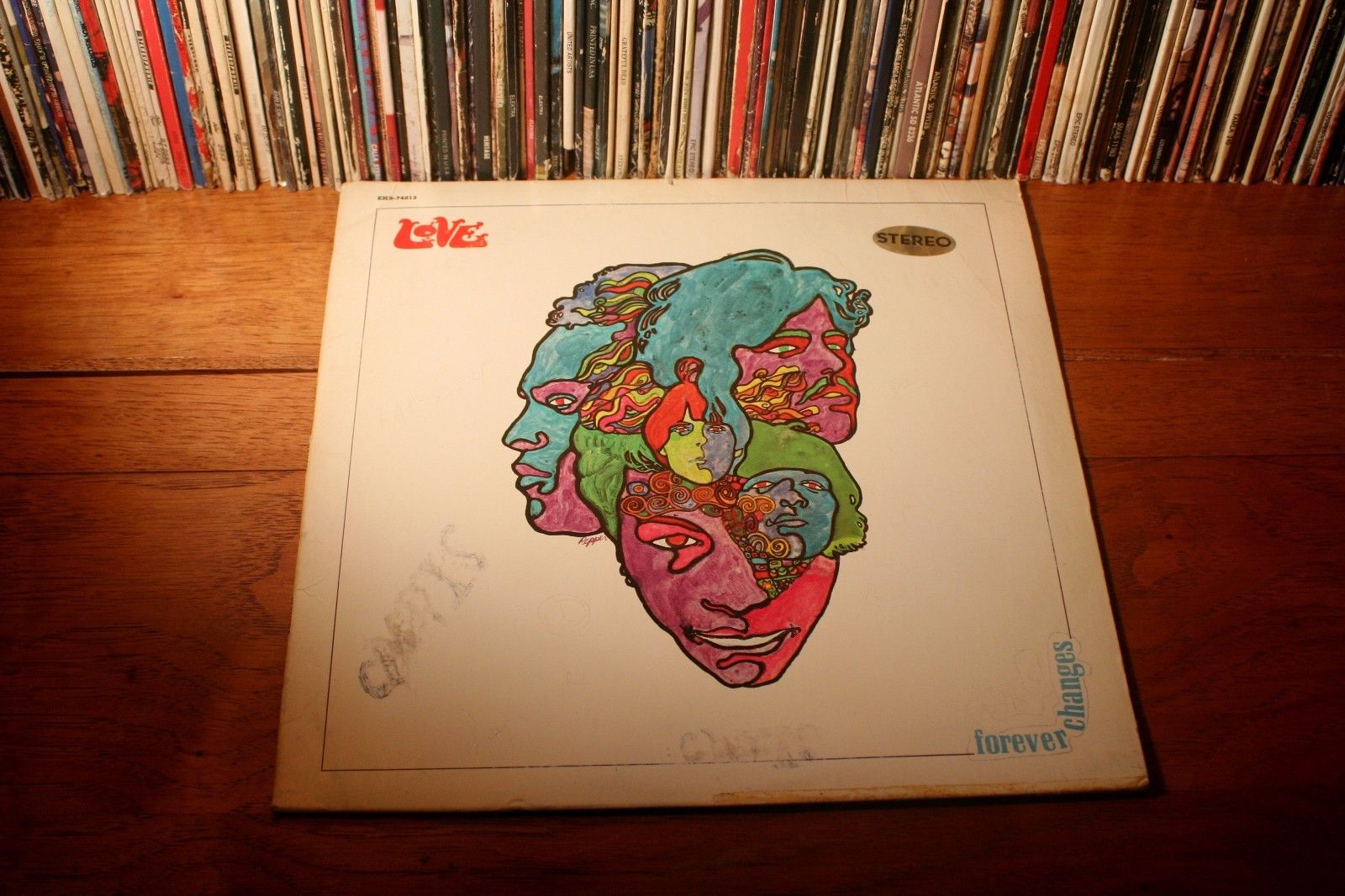
Love - Forever Changes ? 1967 1st MONARCH PRESS 40th Best Album EVER
$
108


Favourite Auctions
To save auctions to your favourites, please login
If you don't have an account, please register
Description
All my records have been cleaned and visually graded as accurately as possible. Please keep in mind, visually grading a record does NOT mean I have listened to it. I offer a full 30-day return policy, so if there's an issue, I am here to help. I'm just an honest guy, trying to make an honest living doing what I love. Leaving negative feedback without contacting me for resolution first is simply not cool, so if you're into that, please buy from someone else. Let's keep eBay fun and honest.
Forever Changes Studio album by Love Released November 1967 Recorded June to September, 1967 Studio Sunset Sound Recorders Genre
- Folk rock
- psychedelic rock
- baroque pop
(1966) Forever Changes
(1967) Four Sail
(1969)
Forever Changes is the third album by the American rock band Love. It was released by Elektra Records in November 1967 and would be the final album by the original band, as subsequent albums featured leader Arthur Lee backed by a variety of new players.
Forever Changes failed to achieve commercial success when it was first released in 1967, but it has since become recognized as one of the finest albums to come out of the Summer of Love, ranking 40th on Rolling Stone magazine's 2003 list of The 500 Greatest Albums of All Time, being inducted into the Grammy Hall of Fame in 2008 as well as being added to the National Recording Registry in May 2012.
Background
In 1966, Love had released two albums in relatively rapid succession, including their second LP Da Capo, which spawned their only Top 40 hit "7 and 7 Is". However, the group's opportunity for major national success dwindled as a consequence of frontman Arthur Lee's unwillingness to tour, Lee's deteriorating relationship with Love's other songwriter Bryan MacLean, and the overshadowing presence of label-mates the Doors. In a 1992 interview, MacLean spoke of him and Lee "competing a bit like Lennon and McCartney to see who would come up with the better song. It was part of our charm. Everybody had different behaviour patterns. Eventually, the others couldn't cut it". Throughout this period the band – reduced to a quintet with the departures of Alban "Snoopy" Pfisterer and Tjay Cantrelli – were known to retreat to Bela Lugosi's mansion in Hollywood, nicknamed "The Castle", where the group became further stagnated by their use of LSD and heroin.
Rather than base his writings on Los Angeles's burgeoning hippie scene, Lee's material for Forever Changes was drawn from his lifestyle and environment. The songs reflected upon grim but blissful themes and Lee's skepticism with the flower power movement. Writer Andrew Hulktrans explained Lee's frame of mind at the time: "Arthur Lee was one member of the '60s counterculture who didn't buy flower-power wholesale, who intuitively understood that letting the sunshine in wouldn't instantly vaporize the world's (or his own) dark stuff". Love's third studio album also brought about a sense of urgency for Lee. With his band in disarray and growing concerns over his own mortality, Lee envisioned Forever Changes as a lament to his memory.
At this juncture, Elektra Records founder Jac Holzman suggested to Love to "advance backwards" by embracing the more subtle approach of folk music. While typically independent in his musical directions, Lee accepted Holtzman's proposal, setting the foundational approach to the Forever Changes recording sessions. Having already produced the group's first two albums, Bruce Botnick was enlisted in overseeing the production of the third album along with Lee. Botnick, who had just finished working on Buffalo Springfield's Buffalo Springfield Again, invited Neil Young to co-produce the upcoming Love album, but Young, after initially agreeing, excused himself from the project. As Botnick recalled "Neil really had the burning desire to go solo and realize his dream without being involved in another band". According to the liner notes in the compilation album Love Story, Young was involved in Forever Changes long enough to arrange the track "The Daily Planet." Young, however, has denied such involvement.
The title of the album came from a story that Lee had heard about a friend-of-a-friend who had broken up with his girlfriend. She exclaimed, "You said you would love me forever!," and he replied, "Well, forever changes." Lee also noted that since the name of the band was Love, the full title was actually Love Forever Changes.
Recording
Love started recording Forever Changes in June 1967 at Sunset Sound Recorders. However, beginning with the early recording sessions, the band, except Lee, was plagued by internal conflicts and lack of preparation for Lee's intricate arrangements. Through Holtzman's perspective, Botnick was an "album savior", guiding and motivating Lee's bandmates out of their trying period. In order to compel the band to participate, Botnick enlisted top session musicians Billy Strange (guitar), Don Randi (piano), Hal Blaine (drums), and Carol Kaye (bass guitar) to work with Lee, completing "Andmoreagain" and "The Daily Planet" in a single three-hour session. Shocked by the implications of losing their role in the album's development, Botnick's plan succeeded in motivating the Love members in recording the other nine tracks appearing on Forever Changes.
Botnick recalls that the use of session musicians "sparked" the band, and they "realized they had blown it, got their act together and recorded the rest of the album." After much rehearsal, the group returned to the studio in August and continued through September, quickly laying down the remaining nine tracks, at a total estimated cost of $2,257.
Lee spent three weeks with David Angel, the arranger of the strings and horns, playing and singing the orchestral parts to him. Lee envisioned the horns and strings from the beginning, and they were not added as an afterthought. A September 18 recording session finished the album, adding the horns and strings, as well as some additional piano from Randi, who played all the keyboard parts on the album as the band now had no keyboard player.
Reception
Professional ratings Review scores Source Rating AllMusic Robert Christgau A? Rolling Stone favorableUpon its release in late 1967, Forever Changes was largely unsuccessful commercially. It spent 10 weeks on the Billboard 200 album chart, according to Joel Whitburn's Top Pop Albums, peaking at #154 in 1968, by far the worst showing among Love's first three albums. (According to the same book, Love's next album, Four Sail, fared better on the Billboard 200, peaking at #102 in 1969.) Forever Changes had a much stronger showing in Great Britain, where it reached #24 on the UK album chart in 1968. It peaked at #63 when it re-entered the chart in 2001.
Initial reviews were positive. Pete Johnson of the Los Angeles Times wrote that the album "can survive endless listening with no diminishing either of power or of freshness", while noting "parts of the album are beautiful; others are disturbingly ugly, reflections of the pop movement towards realism." Gene Youngblood of LA Free Express also praised the album, calling it "melancholy iconoclasm and tasteful romanticism."
The Bonzo Dog Band's contemporary track "We Are Normal" contains a section that uses lyrics that are in "The Red Telephone": "We are normal and we want our freedom." However, the line originally came from the play Marat/Sade, so the use of the line is an apparent coincidence.
The 1979 edition of The Rolling Stone Record Guide gave the album a rating of five stars (out of five). It also received five stars in the 1983 edition of the guide and in the fourth edition that was published in 2004.
In a special issue of Mojo magazine, Forever Changes was ranked the second greatest psychedelic album of all time. In the January 1996 issue, Mojo readers selected Forever Changes as #11 of the "100 Greatest Albums Ever Made."
Forever Changes was praised by a group of members of the British Parliament in 2002 as being one of the greatest albums of all time.
Rolling Stone magazine ranked the album 40th in its list of the 500 greatest albums of all time in the December 11, 2003 issue.
In 2013, NME ranked the album number 37 on their list of the 500 Greatest Albums of All Time. In 1998, Q magazine readers voted Forever Changes the 82nd greatest album of all time.
In a 2005 survey held by British television's Channel 4, the album was ranked 83rd in the 100 greatest albums of all time.
The album was included in the 2005 book 1001 Albums You Must Hear Before You Die.
According to the New Musical Express, The Stone Roses' relationship with their future producer John Leckie was settled when they all agreed that Forever Changes was the "best record ever".
Track listing
All songs written by Arthur Lee, except where noted.
Side one- "Alone Again Or" (Bryan MacLean) – 3:16
- "A House Is Not a Motel" – 3:31
- "Andmoreagain" - 3:18
- "The Daily Planet" – 3:30
- "Old Man" (MacLean) – 3:02
- "The Red Telephone" – 4:46
- "Maybe the People Would Be the Times or Between Clark and Hilldale" – 3:34
- "Live and Let Live" – 5:26
- "The Good Humor Man He Sees Everything Like This" – 3:08
- "Bummer in the Summer" – 2:24
- "You Set the Scene" – 6:56
price rating