Led Zeppelin "UNTITLED" Atlantic K50008 UK 2nd A3/B4 misprint Pecko/Porky 1972
£
24
$
32


Favourite Auctions
To save auctions to your favourites, please login
If you don't have an account, please register
Description
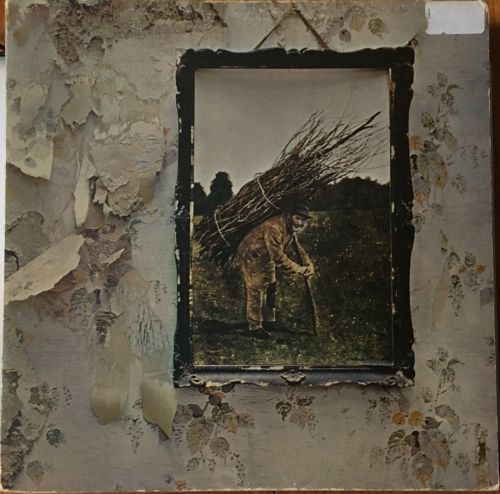
Led Zeppelin ?"Untitled" (IV) Atlantic ?K 50008 UK 2nd press. Vinyl, LP, housed in a gate-fold sleeve. This is a transitional repress, with a label misprint ("Misty Mountain TOP"), issued in 1972.
The vinyl appears to have been lightly played and is in great condition. It played through beautifully on my elderly stereo - no hop, stick or jump. It is housed in its original printed inner sleeve, which shows some signs of wear, but which, apart from a small split to a side seam, is intact with no writing. The gate-fold sleeve has the remains of a sticker to the front, and slight ring-wear to the rear, but is otherwise in good shape - no rips or writing. The spine is intact. Matrix / Runout Side One : 240 1012** A//3 1 4 K 50008 A PECKO DUCK Matrix / Runout Side Two : 240 1012 B//4 1 2 K 50008 B PORKY
The untitled fourth studio album by the English rock band Led Zeppelin, commonly known as "Led Zeppelin IV", was released on 8 November 1971 by Atlantic Records. It was produced by guitarist Jimmy Page and recorded between December 1970 and February 1971, mostly in the country house Headley Grange. The album contains one of the band's best known songs, "Stairway to Heaven".
Following the release of "Led Zeppelin III" in October 1970, the group took a break from live performances to concentrate on recording a follow-up. They turned down all touring offers, including a proposed New Year's Eve gig that would have been broadcast by television. They returned to Bron-Yr-Aur, a country house in Snowdonia, Wales, to write new material.
Recording sessions for the album began at Island Records' Basing Street Studios, London in December 1970. The group had considered Mick Jagger's home, Stargroves as a recording location, but decided it was too expensive. They subsequently moved the following month to Headley Grange, a country house in Hampshire, England, using the Rolling Stones Mobile Studio and engineer Andy Johns, with the Stones' Ian Stewart assisting. Johns had just worked on engineering "Sticky Fingers" and recommended the mobile studio. Guitarist and producer Jimmy Page later recalled: "We needed the sort of facilities where we could have a cup of tea and wander around the garden and go in and do what we had to do." This relaxed, atmospheric environment at Headley Grange also provided other advantages for the band, as they were able to capture spontaneous performances immediately, with some tracks arising from the communal jamming. Bassist and keyboardist John Paul Jones remembered there was no bar or leisure facilities, but this helped focus the group on the music without being distracted.
Once the basic tracks had been recorded, the band added overdubs at Island Studios in February. Page then took the completed master tapes to Sunset Sound in Los Angeles for mixing, on Johns' recommendation, with a plan for an April 1971 release. However, the band disliked the results, and so after touring through the spring and early summer, Page remixed the whole album in July. The album was delayed again over the choice of cover, whether it should be a double album, with a possible suggestion it could be issued as a set of EPs.
After the lukewarm, if not confused and sometimes dismissive, critical reaction "Led Zeppelin III" had received in late 1970, Page decided that the next Led Zeppelin album would not have a title, but would instead feature four hand-drawn symbols on the inner sleeve and record label, each one chosen by the band member it represents. The record company were strongly against the idea, but the group stood their ground and refused to hand over the master tapes until their decision had been agreed.
Page has also stated that the decision to release the album without any written information on the album sleeve was contrary to strong advice given to him by a press agent, who said that after a year's absence from both records and touring, the move would be akin to "professional suicide". Page thought, "We just happened to have a lot of faith in what we were doing." He recalled the record company were insisting that a title had to be on the album, but held his ground, as he felt it would be an answer to critics who could not review one Led Zeppelin album without point of reference to earlier ones.
Releasing the album without an official title has made it difficult to consistently identify. While most commonly called "Led Zeppelin IV", Atlantic Records catalogues have used the names "Four Symbols" and "The Fourth Album". It has also been referred to as "ZoSo" (which Page's symbol appears to spell), "Untitled" and "Runes". Page frequently refers to the album in interviews as "the fourth album" and "Led Zeppelin IV", and Plant thinks of it as "the fourth album, that's it". The original LP also has no text on the front or back cover, and lacks a catalogue number on the spine.
In place of a title, Page decided each member could choose a personal emblem for the cover. Initially thinking of a single symbol, he then decided there could be four, with each member of the band choosing their own. He designed his own symbol and has never publicly disclosed any reasoning behind it. It has been argued that his symbol appeared as early as 1557 to represent Saturn. The symbol is sometimes referred to as "ZoSo", though Page has explained that it was not in fact intended to be a word at all. Jones' symbol, which he chose from Rudolf Koch's Book of Signs, is a single circle intersecting three vesica pisces (a triquetra). It is intended to symbolise a person who possesses both confidence and competence. Bonham's symbol, the three interlocking (Borromean) rings, was picked by the drummer from the same book. It represents the triad of mother, father and child, but, inverted, it also happens to be the logo for Ballantine beer. Plant's symbol of a feather within a circle was his own design, being based on the sign of the supposed Mu civilisation. A fifth, smaller symbol chosen by guest vocalist Sandy Denny represents her contribution to "The Battle of Evermore"; the figure, composed of three equilateral triangles, appears on the inner sleeve of the LP, serving as an asterisk.
During Led Zeppelin's tour of the United Kingdom in winter 1971 shortly after the album's release, the symbols could be seen on the group's stage equipment; Page's on one of his amplifiers, Bonham's on his bass drum head, Jones' on a covering for his Rhodes piano, and Plant's on the side of a PA cabinet. Only Page's and Bonham's symbols were retained for subsequent tours.
The 19th-century rustic oil painting on the front of the album was purchased from an antique shop in Reading, Berkshire by Plant. The painting was then juxtaposed and affixed to the internal, papered wall of a partly demolished suburban house for the photograph to be taken. The block of flats seen on the album is the Salisbury Tower in the Ladywood district of Birmingham. Page has explained that the cover of the fourth album was intended to bring out a city/country dichotomy that had initially surfaced on "Led Zeppelin III", and a reminder that people should look after the Earth. He later said the cover was supposed to be for "other people to savour" rather than a direct statement. The album cover was among the 10 chosen by the Royal Mail for a set of "Classic Album Cover" postage stamps issued in January 2010.
The inside illustration, entitled "The Hermit", painted by Barrington Coleby (credited to Barrington Colby MOM on the album sleeve), was influenced by the design of the card of the same name in the Rider-Waite tarot deck. This character was later portrayed by Page himself in Led Zeppelin's concert film, "The Song Remains the Same" (1976). The inner painting is also referred to as View in Half or Varying Light. The typeface for the lyrics to "Stairway to Heaven", printed on the inside sleeve of the album, was Page's contribution. He found it in an old arts and crafts magazine called The Studio which dated from the late 19th century. He thought the lettering was interesting and arranged for someone to create a whole alphabet.
The album was promoted via a series of teaser advertisements showing the individual symbols on the album artwork. It entered the UK chart at No. 10, rising to No.1 the following week and has spent a total of 90 weeks on the chart. In the US it was Led Zeppelin's best-selling album, but did not top the Billboard album chart, peaking at No. 2 behind "There's a Riot Goin' On" by Sly and the Family Stone and "Music" by Carole King. "Ultimately," writes Lewis, "the fourth Zeppelin album would be the most durable seller in their catalogue and the most impressive critical and commercial success of their career". At one point, it was ranked as one of the top five best-selling albums of all time.
"Led Zeppelin IV" received overwhelming praise from critics. In a contemporary review for Rolling Stone, Lenny Kaye called it the band's "most consistently good" album yet and praised the diversity of the songs: "out of eight cuts, there isn't one that steps on another's toes, that tries to do too much all at once." Billboard magazine called it a "powerhouse album" that has the commercial potential of the band's previous three albums. Robert Christgau originally gave "Led Zeppelin IV" a lukewarm review in The Village Voice, but later called it a masterpiece of "heavy rock". While still finding the band's medieval ideas limiting, he believed the album showed them at the pinnacle of their songwriting, and regarded it as "the definitive Led Zeppelin and hence heavy metal album".
In a retrospective review for AllMusic, Stephen Thomas Erlewine credited the album for "defining not only Led Zeppelin but the sound and style of '70s hard rock", while "encompassing heavy metal, folk, pure rock & roll, and blues". In his album guide to heavy metal, Spin magazine's Joe Gross cited "Led Zeppelin IV" as a "monolithic cornerstone" of the genre. BBC Music's Daryl Easlea said that the album made the band a global success and effectively combined their third album's folk ideas with their second album's hard rock style, while Katherine Flynn and Julian Ring of Consequence of Sound felt it featured their debut's blues rock, along with the other styles from their second and third albums. Led Zeppelin's Rock and Roll Hall of Fame biography described the album as "a fully realized hybrid of the folk and hard-rock directions". PopMatters journalist AJ Ramirez regarded it as one of the greatest heavy metal albums ever, while Chuck Eddy named it the number one metal album of all time in his 1991 book Stairway to Hell: The 500 Best Heavy Metal Albums in the Universe. According to rock scholar Mablen Jones, "Led Zeppelin IV" and particularly "Stairway to Heaven" reflected heavy metal's presence in countercultural trends of the early 1970s, as the album "blended post-hippie mysticism, mythological preoccupations, and hard rock".
Steven Hyden observed in 2018 that the album's popularity had given rise to a reflexive bias against it from both fans and critics. "There are two unwritten laws" about the album, he wrote. The first was that a listener must claim a track from side two, the "deep cuts with credibility" side, was his or her favorite, and the second was that one should never say it was their favorite among the band's albums. He blamed this later tendency for why "rock critics who try too hard always make a case for "In Through the Out Door" being Zeppelin's best." The band members themselves, he noted, also seemed to prefer performing the songs from side two in their solo shows.
In 2000, "Led Zeppelin IV" was named the 26th-greatest British album in a list by Q magazine. In 2002, Spin magazine's Chuck Klosterman named it the second greatest metal album of all time and said that it was "the most famous hard-rock album ever recorded" as well as an album that unintentionally created metal—"the origin of everything that sounds, feels, or even tastes vaguely metallic". In 2003, the album was ranked number 69 on Rolling Stone magazine's list of "The 500 Greatest Albums of All Time", which described it as "the peak of Seventies hard rock". It was also named the seventh-best album of the 1970s in a list by Pitchfork. In 2016, Classic Rock magazine ranked "Led Zeppelin IV" as the greatest of all Zeppelin albums.
price rating