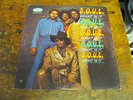
LP S.O.U.L can you feel it US SOUL OG ma cherie amour
$
165



Favourite Auctions
To save auctions to your favourites, please login
If you don't have an account, please register
Description
IMPORTANT: - For US bidders , i'm living in France so i can't ship for 0.01 USD !! please WAIT INVOICE BEFORE sending payment !!!
- For all winners , all orders more than 100usd , shipping will be REGISTRED and SIGNED FOR , so shipping cost will change :
Europe : 15 usd for 1 record.
Rest of the world :19 usd for 1 record.
ARTIST : S.O.U.L
TITTLE: can you feel it
YEARS: 1972 MUSICOR RECORDS US PRESS
GRADING ( sleeve/record): NM / VG++
NOTES:
Sounds Of Unity and Love (S.O.U.L.) was a band originating in 1970 in Cleveland. Members were Lee Lovett (bass), Gus Hawkins (sax/flute), Paul Stubblefield (drums), and Walter Winston (guitar). Larry Hancock (vocals/organ) was added in 1971 and Bernard (Beloyd) Taylor (guitar) replaced Walter Winston in 1972.
The group won the first prize of 1,000 dollars in a battle-of-the-bands contest in 1970, sponsored by the May Company department store in Cleveland, WHK radio station, and Musicor Records, and they gained a recording contract with Musicor Records for their first single "Down In The Ghetto" (1971), produced by the TOP POP Recording Company 223 Kingston Avenue, Brooklyn, New York City.
Two years later, S.O.U.L. were back to New York to record What is IT, a LP with seven tracks of covers of jazz and funk tunes, that jumped for two months on the Top 40 album spot on Billboard's soul album chart. The album was released in Europe just in the early '90s on the BGP label.
S.O.U.L. realized seven singles between ´71-74 for the Musicor Records, cracking the RnB top 50 chart in the summer of 1973. After a successful second LP, Can you feel IT?, the group got separate ways in 1975. Taylor moved to Los Angeles where wrote "Get Away" for Earth, Wind & Fire in 1976 and recorded for 20th Century Records. Hancock, also, moved to California and recorded for Decca Records including a duet with Alfie Silas; later he was part of the Platters. Gus Hawkins went back to college and worked as phlebotomist at the Cleveland Clinic before moving to Atlanta, GA. Lovett and Stubblefield continued to work in recording studios and labels.
Tracklist Can You Feel It 7:15 Tell It Like It Is 4:20 Do What's Never You Want To Do 3:33 Peace Of Mind 3:49 My Cherrie Amour 4:44 Love, Peace And Power 3:45 To Mend A Broken Heart 4:07 Sleeping Beauty 2:52 LISTEN: https://www.youtube.com/watch?v=B5XHkA6dqUM https://www.youtube.com/watch?v=4dFSosPcJgk https://www.youtube.com/watch?v=yp7-wNhGBDY------------ABOUT SHIPPING ( less than 100 usd ) ----------------
To France : 9 usd ( one record ) add 1 usd each records more
To Europe : 11 usd ( one record ) add 1 usd each records more
To Rest of the world : 15 usd (one record) add 2 usd each records more
------------ABOUT GRADING ---------------
Mint (M): Absolutely perfect in every way - certainly never played, possibly even still sealed. (More on still sealed below). Should be used sparingly as a grade, if at all.
Near Mint (NM or M-): A nearly perfect record. Many dealers won't give a grade higher than this implying (perhaps correctly) that no record is ever truly perfect. The record shows no obvious sign of wear. A 45 rpm sleeve has no more than the most minor defects, such as almost invisible ring wear or other signs of slight handling. An LP jacket has no creases, folds, seam splits or any other noticeable similar defect. No cut-out holes, either. And of course, the same is true of any other inserts, such as posters, lyric sleeves, and the like. Basically, Near Mint looks as if you just got it home from a new record store and removed the shrink wrap.
Very Good Plus (VG+): Shows some signs that it was played and otherwise handled by a previous owner who took good care of it. Record surfaces may show some slight signs of wear and may have slight scuffs or very light scratches that don't affect one's listening experience. Slight warps that do not affect the sign are OK. The label may have some ring wear or discoloration, but is should be barely noticeable. The center hole is not misshapen by repeated play. Picture sleeves and LP inner sleeves will have some slight wear, lightly turn-up corners, or a slight seam-split. An LP jacket my have slight signs of wear also and may be marred by a cut-out hole, indentation or corner indicating it was taken out of print and sold at a discount. In general, if not for a couple of minor things wrong with it, this would be Near Mint. All but the most mint-crazy collectors will find a Very Good Plus record highly acceptable.
Very Good (VG): Many of the defects found in a VG+ record are more pronounced in a VG disc. Surface noise is evident upon playing, especially in soft passages and during the song's intro and fade, but will not overpower the music otherwise. Groove wear will start to be noticeable, as will light scratches (deep enough to feel with a fingernail) that will affect the sound. Labels may be marred by writing, or have tape or stickers (or their residue) attached. The same will be true of picture sleeves or LP covers. However, it will not have all of these problems at the same time, only two or three of them.
Good (G), Good Plus (G+): Good does not mean bad! A record in Good or Good Plus condition can be put onto a turntable and will play through without skipping. But it will have significant surface noise and scratches and visible groove wear. A jacket or sleeve has seam splits, especially at the bottom or on the spine. Tape, writing, ring wear or other defects will start to overwhelm the object. If it's a common item, you'll probably find another copy in better shape eventually. Pass it up. But if it's something you have been seeking for years, and the price is right, get it.
Poor (P), Fair (F): The record is cracked, badly warped, and won't play through without skipping or repeating. The picture sleeve is water damaged, split on all three seams and heavily marred by wear and/or writing. The LP jacket barely keeps the LP inside it. Inner sleeves are fully seam split, and written upon.