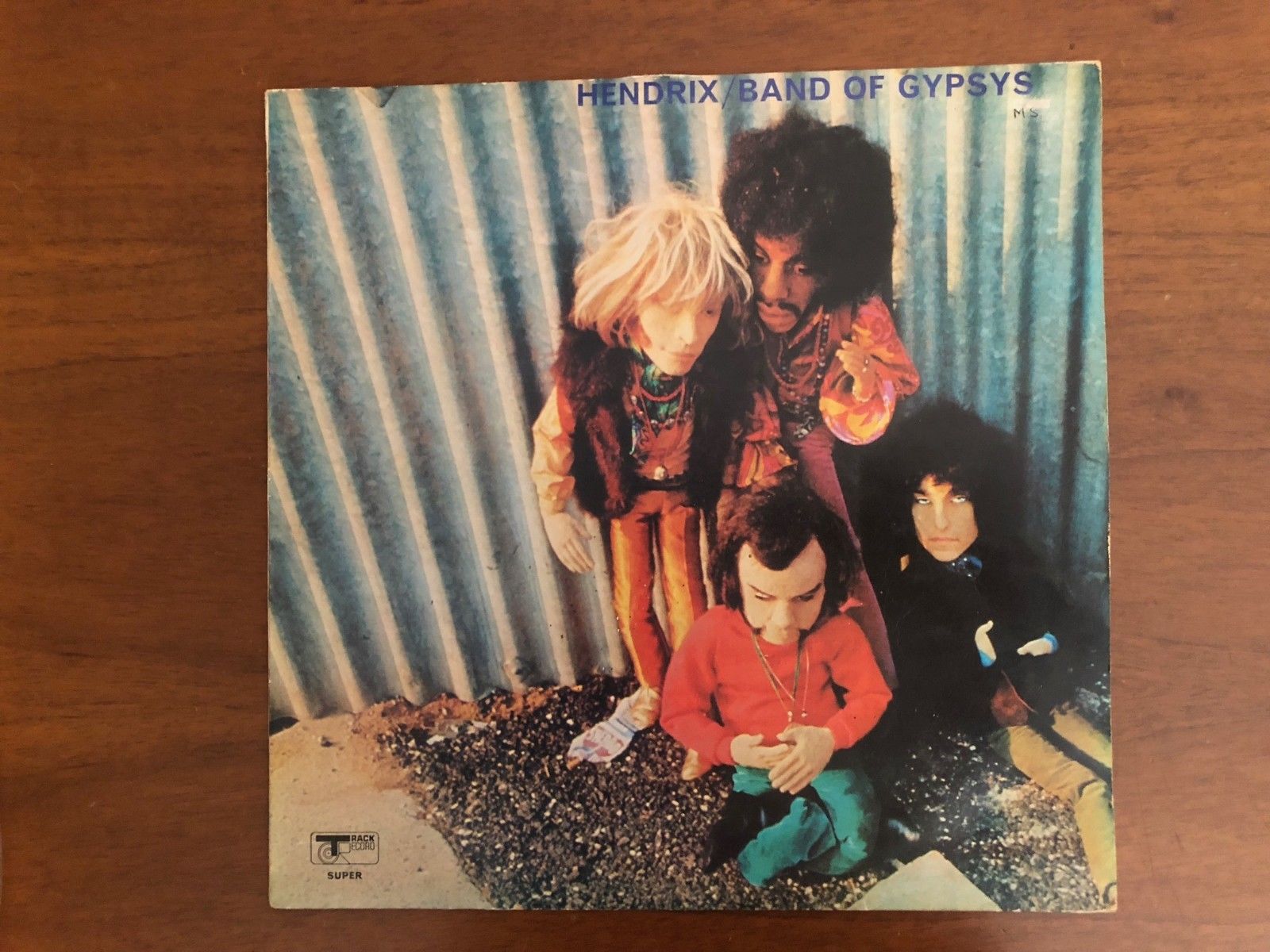
LP JIMI HENDRIX " BAND OF GYPSYS " SUPER TRACK UK ORIG PUPPET SLEEVE Rare EX
£
62
$
82


£ 62
Sold For
Aug 30, 2018
Sold Date
Aug 20, 2018
Start Date
29
Number Of Bids
Italy
Country Of Seller
eBay
Auctioned at
Favourite Auctions
To save auctions to your favourites, please login
If you don't have an account, please register
Description
HENDRIX BAND OF GYPSYS SUPER TRACK UK ORIG PUPPET SLEEVE
Hendrix ?– Band Of Gypsys
Etichetta: Track Record ?– 2406 002
Formato: Vinyl, LP, Album, Puppet Sleeve
Paese: UK
Uscita: 12 Jun 1970
1st UK issue. Title credited as - "Band Of Gypsys" on sleeve, "Band Of Gipsies" on labels
The conditions:
VINYL EX COVER VG + from EX present only small initials on the cover (see photo)
Puppets version of Band of Gypsys This version was first published and then later withdrawn from sales and replaced with the version in which there is the photo of Jimi Hendrix at all Cover (Gatefold) playing at Isle of Wight).
It's a hard copy to find, especially in very good condition. It is clearly a copy for collectors ....
Before now unavailable English print (in which the title is referred to as "Band of Gipsies") black with logo and silver lettering and with "ST 33" in two circles on the right, trail off matrix "... A1" and "... B-1" on their respective sides, with the sought-after cover released in the very first English edition presenting the image with the puppets of Brian Jones, Jimi Hendrix, John Peel and Bob Dylan , or the famous version of "Band of Gypsys" called "Puppet sleeve", whose cover was withdrawn by the English Track in the same year of its release under pressure from Hendrix's manager, Michael Jeffery, and replaced by another cover, opening with a photo of Hendrix, called '' Isle of Wight Cover '' and then again from another, with the same photo '' Isle of Wight '' but in non-openable version. Published in June 1970 in England and in April of the same year in the USA after "Electric lalyland" and before "Cry of Love", it reached number 6 of the English charts and number 5 of the American ones. last album recorded and regularly released before his death on 18 September 1970, the only one (among those alive) live, was recorded in america during the concerts held at the end of 1969 at fillmore east in new york with a triangular formation who saw Billy Cox on bass and Buddy Miles on drums, the album was designed by Hendrix to get rid of contractual obligations, the Experience had broken up after the Denver concert in 1969, but this new lineup gave new energy to the guitarist, who presented on the stage in great shape, the lineup has a lot of new material, the one on which he was working at that time, and the influences funk and r'n'b 'feel a lot in tracks such as' 'Message to love' 'or' 'Power to love' ', where even the texts are very different from the past. moreover, for the first time Jimi uses live the deadly '' fuzz face '', an ultra-powerful distortion that combined with wah wah makes its sound, if possible, even more full and distorted. '' Who knows '' and '' Power to love '' are now legendary songs, but it is in '' Machine gun '' that really reaches the limit, with incredible sounds coming out of the guitar like a bomber in full action . Among the songs there are also two compositions by Buddy Miles, but obviously the scene was for Hendrix only. This record is not only a very important part of hendrix's artistic history, but also one of the best live albums ever released. Here's the lineup: "Who knows", "Machine gun", "Changes", "Power of soul", "Message to love", "We gotta live together"
Evaluation scale
Mint (M):
Disk absolutely perfect in every respect. He often talks about it but it is very rarely seen. A vinyl should be judged Mint only if another collector also agrees to evaluate it in this way.
General appearance of the disk: It looks like it just came out of the production plant.
Disc: No scratch or line
Labels: No writing, sticker or sign of the turntable (see "spindle mark"). The labels are positioned exactly in the middle of the disc.
Cover: No stain, blob, fading, adhesive, ring wear, bent, broken or written. Perfect.
Near Mint (NM) or Mint Minus (M-):
It is estimated that no more than 2-4% of the records published between the '50s and' 60s are actually NM. Many sellers do not use a higher rating than this considering that there can not be a truly perfect record or cover.
General Appearance: It looks like a disc open for the first time. Contains all the original pieces (Inner sleeve, texts, inserts, cover, disc ...)
Disc: Glossy surface without visible defects. No clicks and pops during playback. Discs may maintain the NM condition even after being listened to several times as long as an appropriate reproduction facility has been used and handled with care.
Labels: Without printing defects and centered perfectly on the disc. Without lettering, stickers, spindle marks, spots or other marks.
Cover: Without folds, ring wear and openings on the back. Cut-out marks are not acceptable. The cover appears as if no vinyl has ever been placed inside.
Excellent (Ex):
These discs differ from Near Mint for some minor flaws. Most audiophiles will be very happy to listen to an EX disc.
General appearance: Show slight signs of use due more than anything else to store the vinyl in the case, still no pop and click in listening
Disc: It may have small scratches or very light furrows that do not affect listening, or minimal deformations that are not perceptible to listening.
Labels: Without written, stickers or major defects.
Cover: There may be slight ring wear or discoloration barely visible or show some small folds in correspondence of where the disc lies.
Very Good Plus (VG +)
Average value between EX and VG Still very enjoyable but with some more sign.
General appearance: Show some light signs in use.
Disc: It may have several small scratches or very light furrows that do not affect listening, or minimal deformations that are not perceptible to listening. There may be minimal signs of use as small marks around the central hole (but the hole should not be deformed).
Labels: Without written, stickers or major defects.
Cover: The cover may have worn or broken on the back, which is the most delicate part of the disc, but not larger than a couple of centimeters (1 inch). There may be slight ring wear or discoloration barely visible or show some small folds where the disc lies. There may be a Cut-Out hole.
Very Good (VG):
VG classified discs obviously have greater signs of time than discs of the best classes. That said, since they are typically sold to no more than 25% of their NM counterpart, for many collectors these records are the most desirable. They do not cost the money needed to grab records in better condition but are still a good compromise quality-price and are worth all the money spent. Many Juke Box owners do not think twice about using VG discs. However, it remains a good listening, although lower than possible with discs in better condition.
General appearance: Shows signs of use and handling, background noise audible when listening to ring wear and tears on the back.
Disco: The original lucidity is missing. There are signs of use on the disc and light furrows that you can feel with your fingernail. While listening, a VG disc may have surface noises and some pops especially between one track and another. However, the noises do not cover the music.
Labels: They may have small lettering, stickers or scotches.
Cover: Signs are possible due to use and the passage of time. A ring wear is foreseen where the disc rests. There may be cracks and / or tears on all three sides but they should not be striking. Pen or stickers with the sale price may be present. The cover may be discolored, with bent corners, spots or other such defects. If the disk has more than two of the listed defects, reduce the degree of retention to VG- or worse.
Very Good Minus (VG-), Good Plus (G +) or Good (G):
Good assessment is not necessarily bad. A disk G or VG- still sounds without skipping and can be a good filler waiting to find a copy
Scala valori valutazione
Mint (M):
Disco assolutamente perfetto sotto ogni aspetto. Se ne parla spesso ma lo si vede molto raramente. Un vinile dovrebbe essere giudicato Mint solo se anche un altro collezionista concorda nel valutarlo in questo modo.
Aspetto Generale del disco: Sembra appena uscito dallo stabilimento di produzione.
Disco: Nessun graffio o riga
Etichette: Nessuna scritta, adesivo o segno del giradischi (vd. “spindle mark”). Le etichette sono posizionate esattamente al centro del disco.
Copertina: Nessuna macchia, chiazza, scolorimento, adesivo, ring wear, angolo piegato, rottura o scritta. Perfetto.
Near Mint (NM) o Mint Minus (M-):
Si stima che ormai non più del 2-4% dei dischi pubblicati tra gli anni ’50 e ’60 siano effettivamente NM. Molti venditori non utilizzano un grado di valutazione maggiore di questo ritenendo che non possa esistere un disco o una copertina veramente perfetti.
Aspetto Generale: Sembra un disco aperto per la prima volta. Contiene tutti i pezzi originali (Inner sleeve, testi, inserti, copertina, disco…)
Disco: Superficie lucida, senza difetti visibili. Nessun click e pop durante la riproduzione. I dischi possono mantenere la condizione NM anche dopo essere stati ascoltati diverse volte purché sia stato utilizzato un impianto di riproduzione appropriato e siano stati maneggiati con cura.
Etichette: Senza difetti di stampa e centrate perfettamente sul disco. Senza scritte, adesivi, spindle marks, macchie o altri segni.
Copertina: Senza pieghe, ring wear e aperture sul dorso. Non sono accettabili Cut-out marks. La copertina appare come se nessun vinile vi sia mai stato riposto all’interno.
Excellent (Ex):
Questi dischi differiscono dai Near Mint per alcuni difetti minori. La maggior parte degli audiofili saranno molto contenti di ascoltare un disco EX.
Aspetto generale: Mostra leggeri segni di utilizzo dovuti più che altro al riporre il vinile nella custodia, ancora nessun pop e click in ascolto
Disco: Potrebbe avere piccoli graffi o solchi molto leggeri che non influenzano l’ascolto, o minime deformazioni anch’esse non percettibili all’ascolto.
Etichette: Senza scritte, adesivi o difetti maggiori.
Copertina:Potrebbero essere presenti leggeri ring wear o scoloriture appena visibili oppure presentare alcune piccole pieghe in corrispondenza di dove giace il disco.
Very Good Plus (VG+)
Valore medio tra EX e VG Ancora godibilissimo ma con qualche segno in più .
Aspetto generale: Mostra qualche segnetto leggero in piui di utilizzo.
Disco: Potrebbe avere diversi piccoli graffi o solchi molto leggeri che non influenzano l’ascolto, o minime deformazioni anch’esse non percettibili all’ascolto. Potrebbero esserci minimi segni di utilizzo come piccoli segni attorno al foro centrale (ma il foro non deve essere deformato).
Etichette: Senza scritte, adesivi o difetti maggiori.
Copertina: La copertina potrebbe presentare usure o rotture sul dorso, che è la parte più delicata del disco, ma non più grandi di un paio di centimetri (1 inch). Potrebbero essere presenti leggeri ring wear o scoloriture appena visibili oppure presentare alcune piccole pieghe in corrispondenza di dove giace il disco. Potrebbe esserci un Cut-Out hole.
Very Good (VG):
I dischi classificati VG hanno ovviamente maggiori segni del tempo rispetto ai dischi delle classi migliori. Detto questo, dato che in genere sono venduti a non più del 25% della loro controparte NM, per molti collezionisti questi dischi sono i più appetibili. Non costano i soldoni necessari per accaparrarsi dischi in condizione migliore ma sono comunque un ottimo compromesso qualità-prezzo e valgono tutti i soldi spesi. Molti proprietari di Juke Box non ci pensano due volte ad utilizzare dischi VG. Resta comunque un buon ascolto sebbene inferiore a quello possibile con dischi in condizione migliore.
Aspetto generale: Mostra segni di utilizzo e maneggiamento, rumore di sottofondo udibile all’ascolto ring wear e rotture sul dorso.
Disco: Manca la lucidità originale. Ci sono segni di utilizzo sul disco e leggeri solchi che è possibile sentire con l’unghia. Durante l’ascolto, un disco VG può presentare rumori di superficie e qualche pop specialmente tra un brano e l’altro. I rumori però non coprono la musica.
Etichette: Potrebbero avere piccole scritte, adesivi o scotch.
Copertina: Sono possibili segni dovuti all’utilizzo e al passare del tempo. E’ prevista la presenza di un ring wear dove poggia il disco. Potrebbero esserci rotture e/o strappi su tutti e tre i lati ma non devono essere eclatanti. Scritte a penna o adesivi con il prezzo di vendita potrebbero essere presenti. La copertina potrebbe essere scolorita, con angoli piegati, macchie o altri difetti del genere. Se il disco ha più di due dei difetti elencati, riduci il grado di conservazione a VG- o peggio.
Very Good Minus (VG-), Good Plus (G+) o Good (G):
La valutazione Good non necessariamente è negativa. Un disco G o VG- suona ancora senza saltare e può essere un buon riempitivo nell’attesa di trovarne una copia migliore. Se il disco è un disco comune allora non lo prendere. Se invece trovi in condizioni G un disco che stavi cercando da tanto tempo prendilo comunque (purché a buon prezzo), farai sempre in tempo a trovarne una versione migliore in futuro. E per i venditori? Non vi aspettate grandi profitti per dischi in questo stato. In genere fruttano il 10-15% del corrispettivo NM.
Aspetto generale: Mostra notevoli segni di utilizzo inclusi graffi, ring wear, dorso rotto e etichetta o copertina danneggiata.
Disco: Lo splendore della superficie se n’è ormai quasi andato ma il disco suona ancora senza saltare. Sono udibili importanti rumori di fondo.
Etichette: Logorata, possibili macchie, scritte evidenti o danni causati da qualcuno che ha tentato di rimuovere un adesivo ma ha fallito miseramente il tentativo.
Copertina: Mostra evidenti ring wear, rotture e strappi o appariscenti scritte di Stazioni Radio o del precedente proprietario (espedienti che venivano spesso utilizzati per scoraggiare i ladri). Aspettatevi angoli piegati o rotti.
Fair (F) o Poor (P):
Questi dischi valgono da 0 a 5% del corrispondente NM. Un disco Poor dovrebbe finire direttamente nella spazzatura o al massimo essere utilizzato per uno di quei manufatti artigianali molto kitch come orologi, borse, gioielli, ciotole o sottobicchieri.
Aspetto generale: Disco da buttare. Potrebbe essere privo di copertina (o viceversa una copertina senza disco). Quando vedi un disco in questo stato ti verrebbe voglia di sporgere denuncia alla polizia per far arrestare il colpevole di un simile sfregio.
Disco: Aspettatevi un disco rotto, terribilmente rigato o fortemente deformato. Il disco salterà o si incanterà quando sarà sul giradischi.
Etichette: Macchie, adesivi o danneggiamenti sono i problemi minori, l’etichetta potrebbe addirittura mancare in tutto o in parte.
Copertina: Così danneggiata che ti viene da piangere a guardarla. Solo il disco più raro del mondo potrebbe valere pochi centesimi se venduto in questa condizione.
price rating










![STUDIO 1/RUSSIAN SKA FEVER - THE SKATALITES [SKA INST]](https://www.popsike.info/php/thumbnail.php?url=https://www.popsike.pics/pix/20110430/290560893736.jpg)