LEiB GLANTZ JEWISH TRADITIONAL SONG Sim Sholom/ Hashkiveinu A Ellstein Piano
$
26


Favourite Auctions
To save auctions to your favourites, please login
If you don't have an account, please register
Description
Please wait for me to send you an invoice. DO NOT USE EBAY CHECKOUT if you want the lowest possible postage.
Welcome to my auctions of great records
This is my FINAL WEEK of 2 weeks of great auctions – I WILL PACK AND BILL YOUR RECORDS after the close of these auctions on MARCH 12. KINDLY ALLOW UP TO 48hrs for packing and billing to get you the exact postage.
PLEASE DO NOT PAY before I send you an invoice. It will take me up to 48 hours to pack your records, but this is the ONLY WAY to get you the LOWEST POSTAGE. If you pay before I sent you an invoice, the EBAY system will charge you a HIGHER POSTAGE for shipping.
I am currently selling a series of great Jewish and Yiddish records including cantorials, folk songs and Jewish theater:
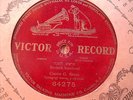
LEiB GLANTZ JEWISH TRADITIONAL SONG
Sim Sholom/ Hashkiveinu
Abe Ellstein Piano
10" 78 rpm record
Condition: Very goodunworn but very scuffed two short scratches on HASH , plays w swishy hiss
Leib Glantz (Yiddish: ???? ??????; June 1, 1898 - January 27, 1964) was a Ukrainian-born lyrical tenor cantor (chazzan), Composer, Musicologist of Jewish music, Writer, Educator and Zionist leader.
He was born in 1898 in Kiev, Ukraine, then part of the Russian Empire. His father and both grandfathers were important cantors with Chassidic backgrounds. Leibele, as he was fondly nicknamed, was eight years old when he first appeared as a cantor in Kiev. Word spread swiftly about the child prodigy, and he was engaged to appear in concerts all over Europe. In his teens he organized and conducted a large choir in his father’s Talner Chassidic synagogue.
Glantz studied piano with the Ukrainian pianist and composer, Nikolai Tutkovski, and later graduated in piano and composition under composer Reinhold Gliere at the Kiev Music Conservatory. In those years Glantz traveled numerous times as a delegate to congresses of the He’Chalutz movement and to World Zionist Congresses. He also assumed the position of chief editor of the Labor Zionist newspaper Ard Un Arbeit.
In July 1926, due to his intensive Zionist activism, and the growing antagonism towards the Jews by the Romanian regime in Bessarabia, Glantz left Eastern Europe. His plan was to immigrate to Palestine, which was then governed by the British, in order to join those of his Zionist friends who had already immigrated to Israel. However, he first traveled to the United States to record with RCA his compositions Shema Yisrael and Tal. He was invited to appear in New York, made a great impression and was offered a prestigious position as chief cantor of the Ohev Shalom synagogue in New York.
In America Glantz continued to develop his musical education, under the guidance of professor Aspinol, the vocal teacher of the opera singers Enrico Caruso and Benjamino Gigli.
In 1929 he made a series of LP recordings at RCA included Shema Yisrael, Tefilat Tal, Shomer Yisrael, Kol Adoshem, Lechu Neranena, Birkat Kohanim, Ki Ke’Shimcha, Ki Hineh Ka’Chomer and Ein Ke’Erkecha.
Glantz’s appeared in concert tours all over the United States, Canada, Mexico, South America, Western and Eastern Europe, South Africa, and Palestine.
In 1936 Glantz married Miriam Lipton. They had two sons, Kalman and Ezra [Jerry].
In 1941, the family moved to Los Angeles, California, where Glantz served as Chief Cantor of Sinai Temple, and from 1949 to 1954 at the Sha’arei Te’filah synagogue. He was also professor of Jewish Music at the University of Judaism in Los Angeles.
In 1948 he lectured before the delegates of the First Annual Conference of the Cantors Assembly of America on the subject: How the different Jewish Nuschaot (Prayer modes) were created.
He articulated his musical theories in a famous lecture to the delegates of the 5th Convention of the Cantors Assembly in 1952—a lecture that created serious debate, as his ideas were considered a new path toward the analysis of the ancient Jewish prayer modes, the Nusach. In general, his research and theories established a historical continuity of Jewish music from its beginnings in the Holy Temples of Jerusalem. Glantz theorized that many centuries ago the Jewish people transformed certain Greek scales and modes, in the process creating original Jewish combinations. These became the foundations for the Cantillation of the Torah (Ta’ameiHa’Mikrah) and the Jewish prayer modes (Nusach Ha’Tefila).
Glantz continued to be active in the Zionist movement as one of its outstanding leaders. He was nominated to be a delegate at no less than eleven World Zionist Congresses from 1921 till 1961—the last two as a delegate representing Israel.
Glantz lived in Israel for the last ten years of his life (1954–1964). Many of his most important compositions were composed in this period of his life. In total, Leib Glantz composed 215 compositions of Cantorial, Chassidic and Israeli music.
In addition to his cantorial career, Glantz appeared in leading tenor roles in, among others, Alan Hovhaness’ “Shepherd of Israel”, Jacques Halevy’s “La Juive”, and Joseph Tal’s “Saul at Ein Dor”.
In 1959 Glantz founded the Tel Aviv Institute for Jewish Liturgical Music, and an academic level conservatory for training cantors—the Cantors Academy (Ha’Akademia Le’Chazanut). He was also a founding member of AKUM, The Israel Music Institute, The Israel Composers' League, and was a member of the editorial board of "Bat Kol."
Following Glantz’s death on January 27, 1964, while in concert in Tel Aviv, the Tel Aviv Institute for Jewish Liturgical Music was transformed into the publishing organ of Leib Glantz’s musical compositions, as well as his research and literary work. This body, in conjunction with the Israel Music Institute, has published seven books of Glantz’s musical compositions, as well as the Hebrew book "Zeharim – In Memory of Leib Glantz."
In 2008, his son, Dr. Jerry Glantz, published a new book (in English): Leib Glantz — "The Man Who Spoke To God." This book includes two compact discs with Leib Glantz singing 30 of his important compositions.
More Great Records on sale right now:
http://shop.ebay.com/carsten_sf/m.html
http://shop.ebay.com/carsten_sf/m.html
====
A Quick NOTE ON GRADING AND SHIPPING:
As you can see from my feedback, I try hard to earn your POSITIVE FEEDBACK and FIVE STAR RATINGS.
If for any reason your transaction was NOT SATISFACTORY, pls contact me and I will work something out with you. YOU WILL NEVER HAVE A REASON TO GIVE ME A NEGATIVE RATING or a LOW STAR RATING.
Quick note on grading:
The Grade (Excellent to Fair, I don't give Mint) refers to the WEAR of the record. Any other defects are stated separately
When I listen to a record, I may also give it an aural grade (again E to F), and make a SUBJECTIVE judgment of the pressing quality for hiss and surface noise.
"SUPERQUIET" is basically noiseless, like a vinyl pressing.
"VERY QUIET" is an quiet record for a given pressing.
"Quiet" is a record that is a great example without undue noise for a give pressing.
These judgments are SUBJECTIVE and will depend one the styli, phonograph etc. you use on your own equipment.
If you win multiple items, pls send me an INVOICE REQUEST to calculate the correct postage. Ebay check out will not give you the multiple item discount!
Records will be packed safely between corrugated cardboard in a sturdy box with plenty of padding for safe shipment.
Shipment is usually Media Mail, unless another service is requested. Shipping is at your risk, I will be happy to insure items at your cost.
I charge actual postage plus a small fee for packing materials
As always, I guarantee your satisfaction. If you don't like the item, just return it, and I will refund the full purchase price.
If you are in the San Francisco area, I encourage pick-up in person.
US Domestic Shipping:
Here is a guideline for US Media Mail Shipping:
Prices below are for regular 78 rpm records. Up to about 5 records, I will ship Edison Discs for the same rates. Albums from Album Sets count as 1 record. Above that and for international shipments, it will be actual weight plus a small packing charge (1-3$ depending on size of shipment)
1 record: 4.50 – 5.00$
2 records: 5.75$
5 records: 7.50$
10 records: 9.50$
MANY MORE RECORDS: Don't worry. I safely ship 40 - 50 pounds of records double boxed in moving boxes, and even then Media Mail will probably not exceed 30$.
Please send me a message if you would like to lower your shipping rates!
International Buyers:
I am very happy to ship records worldwide.
Please use the EBAY shipping cost only as a guideline. My actual charges are usually lower
International shipping: approx postage 1x10"=$25: 1x12"=$35: 10"Album 4 Rec=50$: 12" Album 2 Rec=50$
HOWEVER in most cases I can get you SIGNIFICANT savings by using other services. Pls contact me for a quote.
About 30% less to Canada.
Pls contact me for a shipping estimate, or send me an invoice request after close of auction.
AND AGAIN -THANK YOU FOR YOUR INTEREST
As you can see from my feedback, I take great care in presenting, grading and shipping your items. I really want you to be happy with the purchase. If you feel that anything is wrong with the item or the shipping, contact me and we will work it out !!!
As always, I would appreciate any suggestions and corrections from you, pls contact me with any question.
Thank you very much, and good luck bidding !!!
price rating