LED ZEPPELIN - 4 ( Four Symbols ) Gatefold Sleeve Atlantic K 50008 1971 EX
£
21
$
28


Favourite Auctions
To save auctions to your favourites, please login
If you don't have an account, please register
Description
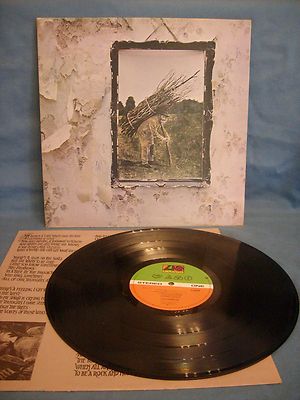
LED ZEPPELIN 1V
FOUR SEASONS
ATLANTIC K 50008
GATEFOLD SLEEVE - EX
VINYL - EX
INNER PICTURE SLEEVE - has small split at bottom
Led Zeppelin IV
From Wikipedia, the free encyclopedia (Untitled) Studio album by Led Zeppelin Released 8 November 1971 (1971-11-08) Recorded December 1970 – March 1971 at various locations Genre Hard rock, heavy metal, folk rock Length 42:25 Language English Label Atlantic Producer Jimmy Page
(1972-02-2
The fourth album by the English rock band Led Zeppelin was released on 8 November 1971. No title is printed on the album, so it is usually referred to as Led Zeppelin IV, following the naming standard used by the band's first three studio albums. The album has alternatively been referred to as ZOSO, Four Symbols, The Fourth Album (those two titles each having been used in the Atlantic catalogue), Untitled, Runes, The Hermit, and ZoSo, the latter of which is derived from the symbol used by Jimmy Page for the album sleeve. Page often had the ZoSo symbol embroidered on his clothes.[1]
Upon its release, Led Zeppelin IV was a commercial and critical success. The album is one of the best-selling albums worldwide at 32 million units.[2] It is also certified twenty-three times platinum by the RIAA, making it the third-best-selling album ever in the US.[3] In 2003, the album was ranked 69th on Rolling Stone magazine's list of "The 500 Greatest Albums of All Time".
Album title
After the lukewarm, if not confused and sometimes dismissive, critical reaction Led Zeppelin III had received in late 1970, Page decided that the next Led Zeppelin album would not have a title, but would instead feature four hand-drawn symbols on the inner sleeve and record label, each one chosen by the band member it represents.[5] "We decided that on the fourth album, we would deliberately play down the group name, and there wouldn't be any information whatsoever on the outer jacket", Page explained. "Names, titles and things like that do not mean a thing."[7]
Page has also stated that the decision to release the album without any written information on the album sleeve was contrary to strong advice given to him by a press agent, who said that after a year's absence from both records and touring, the move would be akin to "professional suicide".[8] In his words: "We just happened to have a lot of faith in what we were doing."[8] In an interview he gave to The Times in 2010, he elaborated:
It wasn’t easy. The record company were sort of insisting that the name go on it. There were eyes looking towards heaven if you like. It was hinted it was professional suicide to go out with an album with no title. The reality of it was that we’d had so many dour reviews to our albums along the way. At the time each came out it was difficult sometimes for the reviewers to come to terms with what was on there, without an immediate point of reference to the previous album. But the ethic of the band was very much summing up where we were collectively at that point in time. An untitled album struck me as the best answer to all the critics — because we knew the way that the music was being received both by sales and attendance at concerts.[9] The four symbols The four symbols representing (from left to right);at the top; Page, Jones
at the bottom; Bonham and Plant
The idea for each member of the band to choose a personal emblem for the cover was Page's.[8] In an interview he gave in 1977, he recalled:
"After all this crap that we'd had with the critics, I put it to everybody else that it'd be a good idea to put out something totally anonymous. At first I wanted just one symbol on it, but then it was decided that since it was our fourth album and there were four of us, we could each choose our own symbol. I designed mine and everyone else had their own reasons for using the symbols that they used."[8]
Page stated that he designed his own symbol[5][6] and has never publicly disclosed any reasoning behind it. However, it has been argued that his symbol appeared as early as 1557 to represent Saturn.[13][14] The symbol is sometimes referred to as "ZoSo", though Page has explained that it was not in fact intended to be a word at all.[5]
Bassist John Paul Jones' symbol, which he chose from Rudolf Koch's Book of Signs,[5] is a single circle intersecting three vesica pisces (a triquetra). It is intended to symbolise a person who possesses both confidence and competence.[6]
Drummer John Bonham's symbol, the three interlocking rings, was picked by the drummer from the same book.[5] It represents the triad of mother, father and child.[6][15], but also happens -- inverted -- to be the logo for Ballantine beer.[6]
Singer Robert Plant's symbol of a feather within a circle was his own design, being based on the sign of the supposed Mu civilisation.[5][6]
Sandy Denny's symbol, which in Christianity is an old symbol for the Godhead "beyond that nothing is known about it".There is also a fifth, smaller symbol chosen by guest vocalist Sandy Denny representing her contribution to the track "The Battle of Evermore"; it appears in the credits list on the inner sleeve of the LP, serving as an asterisk and is shaped like three triangles touching at their points.
During Led Zeppelin's tour of the United Kingdom in winter 1971, which took place shortly following the release of the album, the band visually projected the four symbols on their stage equipment. Page's symbol was put onto one of his Marshall amplifiers, Bonham's three interlinked circles adorned the outer face of his bass drum, Jones had his symbol stencilled onto material which was draped across his Fender Rhodes keyboard, and Plant's feather symbol was painted onto a side speaker PA cabinet. Only Page's and Bonham's symbols were retained for subsequent Led Zeppelin concert tours.[16]
Track listing Side one No. Title Writer(s) Length 1. "Black Dog" John Paul Jones, Jimmy Page, and Robert Plant 4:54 2. "Rock and Roll" John Bonham, Jones, Page, and Plant 3:40 3. "The Battle of Evermore" Page and Plant 5:51 4. "Stairway to Heaven" Page and Plant 8:02 Side two No. Title Writer(s) Length 5. "Misty Mountain Hop" Jones, Page, and Plant 4:38 6. "Four Sticks" Page and Plant 4:44 7. "Going to California" Page and Plant 3:31 8. "When the Levee Breaks" Bonham, Jones, Memphis Minnie, Page, and Plant 7:07
I will be listing records etc. from my collection from time to time and you can be assured that the condition will always be very good to excellent. I do not usually use mint as that would only be on a new item.
I would not sell anything which I would not be happy to purchase myself and you can view my great feedback for peace of mind.
Thank you for looking and happy bidding.
PLEASE CHECK OUT MY OTHER LISTINGS FOR MORE
I WILL ALWAYS COMBINE POSTAGE COSTS FOR MULTIPLE PURCHASES
price rating