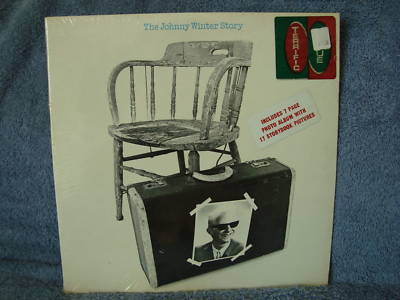
Johnny Winter STORY 1969 SEALED LP + 7-PAGE BOOK GRT
$
121


Favourite Auctions
To save auctions to your favourites, please login
If you don't have an account, please register
Description
I will be out of the country buying more record collections until Sunday evening, 30 May. I will not be able to invoice until after that time, approximately 24 hours after these auctions end.
Please be patient for your invoice if you have won multiple auctions, because if you try to pay before receiving your invoice eBay will charge too much for postage.
Thanks for your cooperation, and best of luck
GRT 10010, original 1969 USA pressing includes a 7-page photo album with 17 storybook pictures. Still sealed in shrink wrapper with stickers. Extremely slight corner wear, nothing terribly damaging, overall NEAR MINT MINUS condition.
I will provide a poly sleeve and super-sturdy packaging method to keep the disc from exiting the sleeve during its journey through the mail.
"Complete Cover Text of The Johnny Winter Story
Texas has long been one of the major spawning grounds of the blues. For decades now the sweat and blood-drenched cotton bottoms, lumber and turpentine camps, oilfield and Gulf Coast port towns have produced a long line of powerful, personal shapers of the blues and Negro folk-song: Blind Lemon Jefferson, Henry Thomas, Blind Willie Johnson, Little Hat Jones, Texas Alexander, Willie Reed, Son Becky, Sammy Hill, Victoria Spi¬vey, the Black Ace, Lil' Son Jackson, John and Smokey Hogg, Lightnin' Hopkins, Thunder Smith, Mance Lipscomb, T-Bone Walker, Pee Wee Cray-ton, Albert Collins and a host of others have carried, via their recordings, the strong, pungent Texas blues traditions out of the plantation and sawmill shacks, barrelhouses and city dives into the world. From the earliest days of so-called "race" recording in the early 1920s, the musicians of Texas have exerted a conspicuous and continuing influence on the course of American and, lately, international popular music. In the period before World War II this influ¬ence was felt primarily in the area of blues and jump-band music (a style which fused the blues and Swing band idioms that had long been popu¬lar in the Southwest) and, though there was a huge local demand for the recordings of Texas artists, they had to go elsewhere-to the recording centers of New York, Chicago and, to a lesser degree, Los Angeles to make their recordings. This situation underwent a rapid and radical transformation in the postwar years, however. Following the breakup of the virtual monopoly that had been held by the few major recording firms in the prewar period, a recording revolution took place, as small independent recording operations most of them tiny, purely local ventures but a number to eventually prosper into large, influential concerns - mushroomed all over the country. This revolution was greatly facilitated by the development and widespread marketing of the tape recorder and the sudden availability of record-pressing machinery, which permitted the establishment of a large number of independent pressing plants to service the needs of the small record producers. What all of this meant for popular music was that a staggering number of recordings, representing just about every shade and style of popular and folk music, were made in the postwar period. In their quest after the elusive "hit" that would establish their success, record producers recorded, and generally issued, virtually everything and everyone that came their way. This, coupled with the rapid dissemination modern mass-media permitted, placed great pressures on the music, with the inevitable result that it underwent cycles of change and development in relatively short "Stars" shot up and died overnight and more than one producer gave up in the face of the unpre¬dictable, feast-or-famine nature of the record business. But it was an exciting time, one of open experimentation and receptivity to change, and certainly popular music hasn't been the same since. Texas represented no exception to the general pattern. A large number of small recording firms were established in its major cities, particularly in Houston where Lightnin' Hopkins and other postwar rhythm-and-blues artists made their influ¬ential, often highly successful recordings, and the popular music of Texas at long last came into its own. Rhythm-and-blues naturally became the staple recording commodity, for the Negro audience of the Southwest was vast and its appetite for the musical expression of the black cultural experience all but omnivorous. It was the successful feeding of this appetite that has accounted for the enduring fortunes of the Houston-based Duke and Peacock operation, and for the lesser successes of other local firms over the years. As rhythm-and-blues°as succeeded by rock-and-roll, it in turn by soul and, lately, rock, one element has remained, unaffected by the successive waves of change that commercial pressures and popular tastes have dictated. This, of course, is the blues and its deep, elemental, sorrowful but powerfully affirmative expression of shared experience, of suffering and grief transformed by wry, ironic humor and an overriding, ennobling love of life have been at the core of every vital artistic expression of the Negro, coloring and transmuting all he has done, said, written, preached, played, experienced and lived. The blues, now as then, is the touchstone, the common reality in which so much Negro popular music-sung, played or writ-ten - is rooted and nourished. It is the cry of the blues, in fact, which is at heart what has made American popular music so distinctively American in character, so much so that one is tempted to suggest that the success enjoyed by white popular music stylists is perhaps directly proportional to their mastery of the expressive potential of blues style. Think about it. There can be little doubt, however, of the cen¬tral importance of the blues to the rock music of today. Even if we didn't have the repeated testimony of the young rock musicians of their pro-found debt to the work of the black masters of the blues, we would know it immediately from their music. The cry of the blues is its dominant note, the keystone of the entire musical architec¬ture of today. A whole new generation of young musicians, steeped in the vigorous music of the postwar bluesmen and their r&b descendants, has been creating a music that has as its foundation and point of departure the blues and its distinctive, expressive tonality. And Texas, thanks to its long and durable sup- reigning queen or rocK, Janis poplin, nails rrom Port Arthur, Texas, or that much of the member-ship of the Sir Douglas Quintet, Mother Earth, Delaney & Bonnie and Friends, the Steve Miller Band and other contemporary rock bands is Texan; no accident that Jerry Jeff Walker, Bobby Doyle, Tony Joe White, Townes Van Zandt and other popular singer-composers are Texans, or that Buddy Holly and the Crickets, Buddy Knox, Sam the Sham & the Pharaohs, Bobby Fuller, the Five Americans, the 13th Floor Elevator, Moving Sidewalk, Red Krayola and other popular groups all hail from Texas. It's just that the musical soil of the Lone Star State is so fertile, thanks to its deep-reaching blues roots. All of which brings us, inevitably, to Johnny Winter, the latest and in many ways most spectacular of the young Texas-bred, blues-rooted interpreters of Negro vernacular music. Even in an era of astonishingly gifted blues players and singers such as this is, Winter must be counted something of a phenomenon. The depth and intensity of his interpretive skills are simply, demonstrably astonishing. There's no other word for it. Few men are his equal on guitar, his chosen instrument, and his mastery of a bewildering variety of idiomatic Negro instrumental approaches, from the crudest of primitive modalities (the hardest of all for a white to bring off) to the most l sophisticated extensions of contemporary blues stylings, is nothing less than formidable. And one is hard-pressed to think of anyone with a more a authentic, assured and natural command of Negro vocal style than he possesses. It would be easy, and perhaps glib, to romanticize/rationalize his prodigious skills in interpreting blues style so strongly and authentically as a sublimation of, or as compensation for the feelings of rejection and exclusion he has experienced as an albino, experiences akin to, and arising from the same sort of prejudice and revulsion to which the Negro is heir as a result of his color, though in Winter's case it was the other side of the coin: he was too white, unnaturally white. Without wishing to deny or otherwise soft-pedal what were, after all, very real and painful experiences, it seems manifestly wrong to posit them as the source or impetus of Winter's musical gifts; to do so is to do him a grave injustice. While they may in fact have turned him to music, they did; not give him the great skills nor the imagination which have marked his playing and singing as distinctively, inevitably his and his alone. Whatever it was that drove him to the blues and other Negro musical forms, he surely has learned to speak thei language with perfect fluency- idiomatically,l movingly and, above all, creatively, as he has demonstrated time and time again on his recordings. Growing up in Houston, where from his earliest years he heard the rich, pungent sounds of Negro blues and gospel music all around him-on the radio, on the sidewalks, issuing from storefront churches and neighborhood taverns-Winter absorbed the style naturally. And when as a youngster he started playing he learned the basics of the music and the style not from records but from the musicians themselves, serving a long, rewarding apprenticeship in the bands of such black bluesmen as Piano Slim and the better-known Guitar Slim, two popular Houston-based rhythm-and-blues performers of the postwar period. He followed this with a long stint as a backup musician in the city's r&b recording studios, an experience that honed his growing skills to a fine edge. A measure of his undisputed command of the conventions of Negro and Negro-derived popular music are his repeated efforts in the highly com¬petitive arena of single recordings. Long before it was fashionable for whites to attempt blues and certainly long before the recent comforts of assured LP sales his late celebrity have given him, Winter was an active contender in the southern rhythm-and-blues and rock-and-roll recording sweepstakes. He made a good number of com¬mercially viable records in these idioms-some, incidentally, under such pseudonymns as "Texas Guitar Slim"-for various independent Texas labels in the Dallas and Houston area, and even recorded at one time for Atlantic. And that's what this interesting set comprises-fourteen of Winter's Texas-recorded singles pre-dating his recent phenomenal success. The performances are particularly rewarding for the manner in which they illuminate his already well-developed skills in a wide variety of contemporary idioms, from flowing modern blues to classic-styled rock-and-roll. Designed as they were as efforts in a highly competitive market, they not unexpectedly reveal close affinities with other commercially success¬ ful recordings and styles of the recent past; these simply are records that had as their primary aim, to use Winter's words, "trying to get a hit just like somebody's else's." Frankly commercial stuff, in other words. Not that that's so intrinsically bad, particularly when one considers that just about anything of any consequence or enduring artistic value in popular music has been done wholly in response to, and within the restrictions imposed by "commercial" considerations. And it's in light of those considerations that these fourteen performances are most meaningfully viewed. They require no apologies - either from me or, for that matter, Winter. They can stand on their own now just as they did when they were first issued by their producers: solid, well-crafted singles carefully tailored for a specific market - the demanding rhythm-and-blues and rock-and-roll rec¬ord buyers of Texas and the Southwestern states. But what's remarkable about these recordings is their assured command of several different musical styles. It's no mere grab-bag or patchwork, however, for Winter's understanding of each of the forms is matched by his abilities to bring them off with a high degree of idiomatic fluency. Among the blues perrformances, for example, Winter essays several different styles with equal success. First, there are two pieces in the laconic style associated with Jimmy Reed, That's What Love Does and the very impressive Ease My Pain, both of which sport Reed-styled harmonica and effortless rhythm playing and the latter also offering.a double-tracked vocal that perfectly simu¬lates the popular Reed manner. Winter's guitar playing on both of these selections is very much within the contours of the modern T-Bone Walker-defined idiom, which also is the dominant note of the two blues instrumentals included here, Creeps and Five After A.M., both tasty, evocative performances full of inventive, vocally- inflected guitar work and which provide telling foils to the raunchy instrumental version of the doughty By the Light of the Silvery Moon, twice a period piece. The impress of two highly influential blues-based singers is shown in a number of Winter's performances here, Ray Charles and Fats Domino being the masters emulated in Broke and Lonely and Leave My Woman Alone (Charles), and I Can't Believe You Want to Leave, Shed So many Tears and Crying in My Heart (Domino, though the last piece also suggests an equally strong influence from Snooks Eaglin, himself a Domino imitator but a very individual one). A couple of other influences suggest themselves as well; first, there's the obvious effect of Buddy Holly on such rock-and-roll styled pieces as Oh My Darling and perhaps The Guy You Left Behind and Leave My Woman Alone (as much Holly as it is Charles) but even more interesting is the effect the rockabilly singer Jerry Lee Lewis had on Winter-you can hear it particularly well in the vocal approach used here in Road Runner and The Guy You Left Behind. The instrumental work on these performances speaks for itself. Attention, however, should per¬haps be directed to Winter's slide-guitar playing, generally used here in a supporting role and which appears as part of the ensemble on Channel A; it can be heard, for example, on Creeps, Leave My Woman Alone, That's What Love Does, etc. While it's true that the performances can be enjoyed solely on their own terms (every tub on its own bottom, you know), they now possess-as a result of their performer's recent phenomenal success-an added interest it would be foolish to disclaim. As performances helping to illuminate some of the sources and shaping forces of and on Winter's music, these fourteen selections are par¬ticularly revealing and exciting musical waystops.
Enjoy them. Pete Welding June, 1969"
This important artifact is an absolute must-have.
I'd be honored if you checked out my feedback and my other current auctions also. Thanks for your time and best of luck!
International bidders, you are responsible for customs fees. Don't be a tool by complaining in your feedback about your government's taxes, an evil over which I obviously have absolutely no control. You might also consider selecting Priority Rate postage, which is most appropriate for valuable artifacts as it provides to you peace of mind in the form of insurance and tracking.
Please see all of my auctions this week!There are lots of great heavy prog and psych from the 1960s and early '70s, mostly British, including many imports and sealed pressings!
For multiple auctions won to the USA, add 75 cents per addtional LP. Add $3 additional per each LP won for international.
(Internationals please note further that after four LPs first class postage option is not applicable owing to excessive parcel weight and value.)
price rating