JOSEF HASSID hmv 9074 RARE VIOLIN 78 LA CAPRICIEUSE Op.17 / MELODIE Op.42 EX
$
400


Favourite Auctions
To save auctions to your favourites, please login
If you don't have an account, please register
Description
[Item Description]
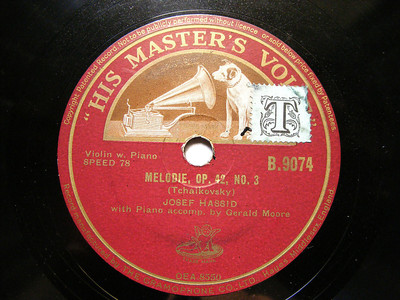
JOSEF HASSID (violin) & GERALD MOORE (piano accomp)
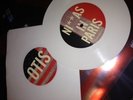
10" HIS MASTER'S VOICE B.9074 Label 78rpm ENGLAND recorded in January 9th 1939.
Record 1:
Side A: ELGAR: La Capricieuse Op.17
Side B: TCHAIKOVSKY: Melodie Op.42 No.3
Condition: EX (8/10) Clean and shiny surface, few light and superficial marks.
JOSEF HASSID Biography:
Often prodigious artists become literally myths after their death, especially when they meet it at a very young age and under tragic circumstances. This is most definitely the case of the splendid Polish violinist Józef Hassid, according to the celebrated British pianist Gerald Moore’s words:
“with the possible exception of Menuhin, is the most incandescent talent I have ever heard”.
Born Józef Chasyd in Poland to a Jewish family in 1923, lost his mother when he was still a little boy and almost concomitantly started showing a quite timid and reclusive temperament, an introverted nature that worsening accompanied him until his tragic late days. Nevertheless, since his boyhood he revealed a great musical talent becoming one of the most famous pupils of the celebrated Hungarian maestro Karl Flesch. He received an honorary diploma in the 1935 at Warsaw’s Henryk Wieniawski Violin Competition (won by Ginette Noveu) where also the great David Oistrakh, Henri Temianka and the young Ida Haendel participated. Apparently poor Josef, whose touch was undeniably excellent, suffered a temporary amnesia during his performance, most probably due to his highly emotional disposition. His depressive and melancholic temper was greatly accentuated by a disillusioned and highly contrasted adolescent romance that blossomed during his sojourn in Spa, where Karl Flesh used to teach violin summer classes. It seems that due to the religious differences between the two youths, the love-story was brusquely sedated by their parents.
In 1938 Josef’s father decided to move to Britain where the young prodigy would have started to perform and record. He made a magnificent first appearance in London in 1940 at the age of sixteen. At the Queen’s Hall on December 5th he performed as violin solo with the London Philharmonic Orchestra conducted by Sir Adrian Boult. He also started recording with EMI and the celebrated label “His Master’s Voice”. Yet, while performing in London he had another memory drop while playing the Violin Concerto in D major, Op. 35 by Pyotr Ilyich Tchaikovsky, unanimously considered one of the most technically complicated pieces of music ever written for violin.
In 1941 he experienced a deep depressive crisis and nervous breakdown and therefore was committed to St Andrew’s Hospital in Northampton where he underwent insulin coma therapy and electroconvulsive therapy, unfortunately with very scarce results. Sadly his unparalleled art and music quickly faded away: regrettably his celestial sound fell still and his violin became mute. In fact after a short dismaying period spent with his father out of the clinic he was eventually diagnosed with an acute case of schizophrenia and committed again, this time to Long Grove Hospital a mental asylum in Epsom, Surrey, which had a wing for Polish civilians. There he remained for many years until his death caused by a barbarous leukotomy in 1950. Between January 1947 and June 1952, 180 people died as a result of unsuccessful lobotomy in England and Wales. One of these victims was Josef Hassid, age 26, one the greatest violinist of all times.
His music was bright and his intonation spotless, his playing was effortless, without any shade of possible forcing; in each performance he showed exquisite style as he was masterly governing the bow and impeccably controlling his fingers. The final effect was indescribably brilliant, suave and the overall outcome moving and heartbreaking. A few hardly findable recorded performances are all that remains of his art as his great gift to music resides in only nine recordings among which:
Dvorak’s “Humoreske for Piano Op. 101/B 187: No. 7 in G flat major” – recorded with Gerald Moore (piano) on November 29, 1940
Joseph Archron’s Hebrew Melody Op.33 – recorded with Gerald Moore (piano) on November 29, 1940
Kreisler’s “Capricho Vienes Op.2” – recorded with Gerald Moore (piano) on November 29, 1940
Massenet’s “Meditation de Thais” – recorded with Gerald Moore (piano) on November 29, 1940
Pablo de Sararsate’s “Zapateado Op. 23, No. 2” recorded with Gerald Moore (piano) December 6, 1940
Pablo de Sarasate’s “Playera for violin and piano, Op. 23, No. 1” – recorded with Gerald Moore (piano) on June 28, 1940
Sir Edward Elgar’s “La Capricieuse, Op. 17” – recorded with Ivor Newton (piano) on January 9, 1939
Tchaikovsky’s “Sourvenir d’un lieu cher Op. 42, No.3 Melodie” – recorded with Gerald Moore (piano) December 6, 1940
From: http://artandlove.wordpress.com/2009/01/16/josef-hassid/
[Customer Information] 1.- Please, first read our Policy.2.- Full cash refund by items with serious defects.
3.- Worldwide Shipping: By Registered Airmail with Tracking Number and Confirmation signature. You can trace your item until Go Out from Argentina.
4.- 78rpm Records: We use a very safe and professional packing.
5.- We are in Argentina: But Accept Payments in Our Miami Business Office too.
6.- Payment must be received within 7 days of closed auction.
7.- We ship the orders fridays of every week.
Don't forget to visit our eBay store:
eBay: http://stores.ebay.com/khrisrecords Highlights and weekly auctions of our rarest 78rpm records and collectibles.
Thank you!