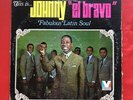
JOHNNY "EL BRAVO" &ORQ."MUNDO MODERNO" VELVET ('70)HEAR
$
50


Favourite Auctions
To save auctions to your favourites, please login
If you don't have an account, please register
Description
TITLE : MUNDO MODERNO
ARTIST : JOHNNY "EL BRAVO" LOPEZ & ORQUESTA
LABEL & RECORD #: VELVET #1415 (1970) MONO
VINYL CONDITION: HEAR SOUNDS CLIPS INCLUDED: GLOSSY, LIGHT SCUFFS...TRACKS ARE FROM VG+ TO VG++ SOME BETTER!!!....HEAVY VINYL!!!!
LABELS CONDITIONS: SEE SCAN : NM
COVER CONDITION: SEE SCAN : VG....AGE WEAR...TAPED TOP & BOTTOM
REMARKS: impossible to find....discontinued!!!
A GREAT "SALSERO BRAVO" (JOHNNY "EL BRAVO" LOPEZ!!!) ..HE WAS ONE OF THE FIRST WHO DECIDED TO QUIT THE WORLD HE WAS LIVING AND BECAME A "NEW BORNED CHRISTIAN" STILL DOING HARD SALSA UNDER THE GUIDANCE OF HIS LORD!!!
FROM A NEWSPAPER CLIP:
CONVERTIDA EN una novedosa y rítmica agrupación, y tras el éxito logrado con su primera producción discográfica, el combo de Johnny El Bravo partió a la ciudad de Nueva York en 1966 para trabajar un segundo álbum con la firma Seeco bajo la producción del popular vocalista Vicentico Valdés.
El disco, titulado "El fantástico", reincidió con composiciones de don Rafael Cepeda ("Quién formó la bronca" y "Mi son tiene sabor") e incluyó otras de la inspiración de Roberto Angleró, Harry Rexach, Ignacio Ríos, Miguel Reyes, Benito Nieves y Toñito López.
Eran los años en que comenzaba a florecer un nuevo movimiento musical antillano al que comercialmente se le denominó salsa y que representaba la evolución de la rítmica caribeña fusionada y alimentada de otras tendencias armónicas, como las provenientes del jazz y la música de Brasil.
En ese contexto, al trabajo de Johnny El Bravo se le comenzó a considerar como "la salsa de Puerto Rico", posicionándolo con fuerza en el mercado musical dentro y fuera de la Isla.
En 1967, el músico realizó su primera presentación en el club El Bronx Casino de Nueva York, recomendado por el locutor Manolín Martínez de la cadena Radio Voz, justo en el momento de efervescencia musical lograda por las bandas neoyorquinas de Eddie Palmieri, Ray Barreto, Willie Colón, Richie Ray y Larry Harlow.
Reconocía que estaba adentrándose a un ambiente artístico muy competitivo, mas nunca se amedrentó puesto que confiaba en la cadencia de su proyecto sonoro.
"Mi propuesta siempre fue hacer una música de pueblo. Lo rítmico lo derivé de la guaracha con una serie de cambios que después le fuimos haciendo a la orquesta en las armonías, pero siempre con una idea de poner a bailar a la gente. Nuestra proyección no era hacer una orquesta de grandes solistas, sino un buen grupo, como lo fue Cortijo y lo era El Gran Combo", manifiesta.
Ese mismo año, Johnny El Bravo conoció al veterano cantante Tito Rodríguez en el venerado Club Caborrojeño. Por un instante, dialogaron de las expectativas y proyecciones de su grupo, encontrando en el intérprete de "Tiemblas" un buen aliado.
"Lo primero que me dijo era que estaba en el cascarón, y era cierto. Luego, cuando me preguntó cuál era mi mayor anhelo, le dije que ambicionaba tocar en los carnavales de Venezuela porque entendía que ésa podía ser una buena oportunidad para internacionalizarnos", recuerda.
Persuadido por las pretensiones del joven percusionista, Tito Rodríguez le prometió ayudarlo y le recomendó que, tan pronto visitara Venezuela, buscara al promotor Danilo Escalona, su compadre, para que le ayudara a impulsar su trabajo en ese país.
"Poco después se me dio la oportunidad de ir allá (Venezuela) a promocionar un disco que hice con la compañía Velvet ("Fabulous Latin Soul", 1968) y tan pronto llegué pregunté cómo podía encontrar al señor Danilo. Me dijeron que estaba transmitiendo unos juegos de béisbol en un lugar que se llamaba Guarena, que estaba como a tres horas de Caracas. Busqué un carro y viajé hasta allá y me le presenté en el parque. Le dije que venía de parte de Tito Rodríguez y que quería saber si nos podía ayudar a promover nuestro grupo porque, en algún momento, deseábamos presentarnos en Caracas y exponer el talento joven que traíamos de Puerto Rico. Me dijo: 'No te preocupes, muchacho, que yo te voy a montar en mis hombros y voy a hacer de ti un hombre grande en Venezuela'", recuerda con júbilo.
La promesa no se hizo esperar. De inmediato, Danilo Escalona se comunicó con las principales estaciones radiales de su país, presentó el trabajo del combo de Johnny El Bravo y en pocas semanas logró que su música se escuchara en ese país.
A partir de ese momento, el grupo, que entonces tuvo como cantante principal a Miguel Clemente y Junior Córdova, comenzó a calar con fuerza en ese mercado y despuntó en otros escenarios internacionales como Colombia y Panamá.
La primera presentación de la orquesta de Johnny El Bravo en los carnavales de Venezuela fue en febrero de 1970, en compañía del cantante Marvin Santiago y el percusionista Ángel "Cachete" Maldonado.
Marvin Santiago, que venía de la orquesta de Rafael Cortijo, entró al grupo en sustitución del vocalista Miguel Clemente y su estancia duró sólo unas semanas. Cachete Maldonado, por su parte, permaneció en la agrupación por espacio de seis meses y hasta grabó en el álbum "Las leyes del tránsito" (1970).
La década de 1970 fue gloriosa para el conjunto de Johnny El Bravo, al punto de ser galardonado con los premios "Agüeybaná de Oro" y "Cordero de Oro", ambos como orquesta del año.
En ese mismo periodo tuvo una fuerte exposición acompañando las presentaciones en Puerto Rico y Nueva York de Ismael Rivera, Rafael "Chivirico" Dávila y Cheo Feliciano, entre otros. Al mismo tiempo, lanzó su primer álbum de "Salsa navideña" (1971) para el sello Borinquen Records.
La saga de producciones continuó con "Construyendo un proyecto" (1972), "La salsa de Puerto Rico" (1973), "Back to Back" (1974) "Johnny El Bravo interpreta la música de Toñito López" (1974) y "De frente, en pie y en guardia" (1975).
Luego, en 1976 y 1977 aparecieron dos prodigiosas joyas grabadas para el sello International en compañía del cantante campesino Jesús Sánchez Erazo, "Chuito el de Bayamón", seguido de una producción junto a la vocalista Priscilla Flores (1977).
TRACKS SIDE A"
A1.Ni pa ya gua mirar
A2.Las verdades
A3.Que noticia (Tite Curet Alonso)
A4.Ali ba ba
A5.No me le digan na
A6.Soul full strut
TRACKS SIDE B:
B1.Mundo moderno
B2.Sasin sazon
B3.Bravucon (Tite Curet Alonso)
B4.Mulato se acabo
B5.No me desprecies
B6.Salvese quien pueda
WEB REMARKS: Comments for the rare LP Johnny "El Bravo" Lopez At The Bronx Casino: "If the dark, smoky Bronx Casino in N.Y. were a cauldron, then Johnny "El Bravo" Lopez and his Super Combo would be the witch doctors who could bring its contents to a boil at will with fiery guarachas like "Yo Soy De Los Bravos," "El Melon," "Me Cole," and "Langosta Langostin." Just a short listen to these club hits reveals how they could inspire such a surge of raw energy on the dance floor: they—not unlike the prospect of death—excite something primal in the body and mind and remind one how it feels to truly be alive!
DIFFICULT TO FIND INFO ON THIS LP BUT...
johnny el bravo
mundo moderno
Sonvel Ven (Velvet)
VG+/VG+ 49.50 € 44.80 £ (Aprox $115)
IN THIS RARE LP YOU WILL FIND 2 THEMES FROM THE PEN OF CATALINO (TITE) CURET ALONSO...IF YOU SEARCH A WEB PAGE DEDICATED TO "ALL" TITE's SONGS YOU WILL NOT FIND THE 2 TITLES INCLUDED HERE!
Su primer proyecto discográfico
En el año 1964, Johnny El Bravo consiguió su "pasaporte" al éxito al ser contratado por la compañía discográfica Seeco para producir su primer álbum musical.
Ese contacto comercial fue logrado gracias a la mediación del empresario Catalino Rolón, quien al escuchar la cadencia del grupo se convenció de sus posibilidades comerciales.
"Había conocido al señor Catalino Rolón en los carnavales de Vieques y cuando nos escuchó rápido nos convocó para trabajar en sus actividades y en una ocasión nos dio la buena noticia de que nos había conseguido un contrato para grabar, ¡y con Seeco!", recuerda.
La producción de su primer disco se realizó en los estudios Ochoa Recordings, entonces ubicados en la avenida Fernández Juncos de Santurce.
Para ese trabajo, el grupo incorporó muchas de las canciones originales que ya venían interpretando en sus presentaciones públicas, escritas en su mayoría por sus hermanos, destacándose "Infancia", "Tinieblas entre luces", "El revendón", "Amor eterno" y "Felicidades con Johnny El Bravo".
También contaron con la colaboración del patriarca de la bomba nacional, don Rafael Cepeda, quien le obsequió con sus temas "Mi son torito" y "Ponte duro, Serafín".
Este primer disco, titulado "Presentando a Johnny López (El Bravo) y su súper combo con su cantante Tony López", fue su punta de lanza en el ambiente musical profesional y el que le bautizó formalmente con el apelativo de "El Bravo", a sugerencia del empresario Catalino Rolón.
"Lo del nombre fue una idea de Catalino porque quería identificarme comercialmente. En un principio no estuve de acuerdo porque entendía que no iba con mi personalidad, pero él tuvo la visión y desde el primer momento la gente me empezó a llamar así", explica.
Esta primera producción, que tronó en la radio con el tema "Colorá", fue presentada por el crítico de música Ángel I. Fonfrías como "la más caliente música en el ritmo esencial que invita al baile juguetón y candente […] Los valores juveniles en el arte popular de Latinoamérica puestos de manifiesto en las manos de Johnny para que Puerto Rico sienta el placer de saber que su juventud sigue manifestándose en el arte popular y para estímulo de otros jóvenes"
SHIPPING CHARGES........FOR GATEFOLDS With 2 Lps ADD S&H FOR 2
ITALY CUSTOMERS:
ITALY……. ADD $11 FOR REGISTRATION!!! No exceptions! Sorry, I’m following Other Dealers Suggestions Regarding Problems With the Delivery/Handling of Items…I personally had 2 of 4 problems, Mexico was the Other) in ten years (Thousands Of Records Sold) in the business!!!
(Gli acquirenti italiani sono tenuti ad aggiungere 11 dollari per la spedizione registrata. Non si fanno eccezioni)
POSTAL RATES & WEIGHTS - LPs
LBS.
0.82
1.4
1.9
2.6
3
# of LPs
1
2
3
4
5
USA MEDIA $4.00 $4.00 $4.00 $4.25 $4.50 USA PRIORITY $6.50 $9.50 $9.50 $11.50 $11.50 EUROPE $14.00 $16.50 $19.00 $24.00 $26.00 ASIA $14.00 $16.50 $19.00 $24.00 $26.00 SOUTH AMERICA $11.50 $15.00 $18.50 $23.50 $27.00 CENTRAL AMERICA $11.50 $15.00 $18.50 $23.50 $27.00 CARIBBEAN $11.50 $15.00 $18.50 $23.50 $27.00 MEXICO $10.00 $13.50 $16.00 $20.75 $22.00 CANADA $6.25 $8.25 $10.25 $13.00 $14.00
* We offer a money back + shipping costs guarantee on our records (unless otherwise noted) if you feel the LP was not graded properly We Must Be Notified Of Any Discrepancy in 2 Days after received. . We will issue a full refund upon its return, once our mistake has been verified. Record Must Be Returned in 3 Days…Foreign in 7 Days….We have available the insurance option…
WE USE STURDY CARDBOARD MADE BY BAGS UNLIMITED IN ORDER TO TO PROTECT YOUR RECORDS FOR ANY MISHANDLING/DAMAGE WHILE IN-TRANSIT
Record Grading: Standard guidelines for grading records comes down to a subjective judgment that may vary from person to person. We grade records and LP covers visually AND (when possible) play-tested. We make every effort to give full disclosure (remember that the LP has at least 12 tracks and the grading may vary between each other) and your satisfaction is guaranteed. Don't assume that our vinyl determination of "Very Good+" is the same as yours!
MM RECORDS: are shiny, with no visible defects. They might have some minor superficial (“Paper”) scuff but they should play without any noise. Writing, stickers or other markings cannot appear on the label, nor can any “spindle marks” from someone trying to blindly put the record on the turntable. Major factory defects also must not be present; a record and label obviously pressed off center is not Near Mint. If played, it will do so with no surface noise. (NM records don’t have to be “never played”; a record used on an excellent turntable can remain NM after many plays if the disc is properly cared for.)
NM COVERS: have no creases, ring wear or seam splits of any kind.
NM PICTURES SLEEVES: should look as if they never housed a record. This is a great reason to remove your 45s from their picture sleeves and keep them separate. Just keeping the 45 inside the sleeve will cause damage than can reduce the grade of the sleeve.
VG++ (Excellent) RECORDS: Barely noticeable play wear and background noise. May have surface scuffs and/or superficial marks, which will be inaudible or indiscernible from the background, no scratches. Very nice, no flaws noted.
VG++ COVERS: Artwork is still as close to perfect as can be. Some impression to the cover (minor outer ring wear) but no ink wear! Some slight creases to the corners, but not wrinkled and obtrusive to the eye. The corners can show white (where the artwork pasted slick was) meaning, slight wear. No seam splits or writing on the cover or taped repairs can make this grade.
VG+ RECORDS: may show some slight signs of wear, including light scuffs or very light scratches that do not affect the listening experience. Slight warps that do not affect the sound are OK. Minor signs of handling are OK, too, such as telltale marks around the center hole, but repeated playing has not misshapen the hole. There may be some very light ring wear or discoloration, but it should be barely noticeable
.VG+ COVERS: should have only minor wear. A VG+ cover might have some very minor seam wear or a split (less than one inch long) at the bottom, the most vulnerable location. Also, a VG+ cover may have some defacing, such as a cut-out marking. Covers with cut-out markings can never be considered Near Mint Unless Tiny/Small (EG: Tiny DH).
VG+ PICTURE SLEEVES: might show some very light creasing where it is obvious that a record once resided (or still does reside). A VG+ picture sleeve might have some very minor seam wear or a split (less than one inch long) at the bottom, the sleeve’s most vulnerable location.
VG RECORDS: have more obvious flaws than their counterparts in better shape. They lack most of the original gloss found on factory-fresh records. Groove wear is evident on sight, as are light scratches deep enough to feel with a fingernail. When played, a VG record has surface noise, and some scratches may be audible, especially in soft passages and during a song’s intro and ending. But the noise will not overpower the music otherwise. Minor writing, tape, or a sticker can detract from the label. Many collectors who have jukeboxes will use VG records in them and not think twice. They remain a fine listening experience, just not the same as if it were in better shape.
VG COVERS and PICTURE SLEEVES: will have many signs of human handling. Ring wear in the middle or along the edges of the cover where the edge of a record would reside, is obvious, though not overwhelming. Some more creases might be visible. Seam splitting will be more obvious; it may appear on all three sides, though it won’t be obvious upon looking. Someone might have written or stamped a price tag on it, too.
RECORDS GRADED VG OR BELOW WILL BE "SOLD AS IS"
(We Will Try To Grade Them As Accurately As Possible!)
TERMS & CONDITIONS
- You bid to win
- I am Honest & Fair and expect you to act in the same manner
- If you change your mind after the auction - I will still be charged by ebay for re-listing the item & for the final auction fee - so will need to file an unpaid item dispute to ensure that I am reimbursed by Ebay - I do not do it as some kind of revenge! so please understand my predicament
- Please ask any questions PRIOR to placing a bid
- Payment within 5 days
- my postage & packaging rates are fair & dispatch will be prompt
- Please leave feedback when your item arrives - then I know that you have received it and I can leave feedback for you
- If you are unhappy in any way please contact me first! Prior to using Negative feedback as we may have been able to reach a resolution that makes both of us happy!
- NEGATIVE FEEDBACK will always be left for timewasters
- Items are listed as accuretly as possible & any faults observed will be brought to your attention in the listing
- Lets make Ebaying a fair & honest way of buying & selling Reasonably products online!
price rating