JOHN LENNON "IMAGINE" FIRST PRESSING 1971 APPLE w/ POSTCARD, POSTER & SLEEVE EX
$
23




Favourite Auctions
To save auctions to your favourites, please login
If you don't have an account, please register
Description
JOHN LENNON "IMAGINE" FIRST U.S. PRESSING 1971 APPLE w/ POSTCARD, POSTER & SLEEVE
JOHN LENNON "IMAGINE" RELEASED: SEPTEMBER 9, 1971 LABEL: APPLE RECORDS SW 3379 EDITION: FIRST PRESSING APPLE w/ POSTER, POSTCARD & INNER SLEEVE LACQUERS/MASTERING: SAM FELDMAN AT BELL SOUND STUDIOS ('sf' in Matrix) PRESSING: CAPITOL RECORDS PRESSING PLANT~ WINCHESTER ('─◁' in Matrix) RECORDED: FEBRUARY 11-16th, MAY 24-28th and JULY 4-5th 1971 RECORDED AT: ASCOT SOUUND STUDIO ~ TITTENHURST PARK, UK RECORDED AT: THE RECORD PLANT NEW YORK CITY PRODUCERS: JOHN LENNON, YOKO ONO & PHIL SPECTOR PUBLISHED BY MACLEN MUSIC INC. PHOTOS, DESIGN & ARTWORK ~ YOKO ONO MATRIX (SIDE A): SW-1-3379 Z13 Bell Sound 𝑠𝑓 ─◁ MATRIX (SIDE B): SW 2-3379 Z13 #3 Bell Sound 𝑠𝑓 ─◁
CONDITION:VINYL: EX JACKET: VG++ POSTER/POSTCARD/SLEEVE: EX
~~~~~~~~~~~~~~~~~~~~~~~~~~~~~~ I've been going thru my massive vinyl record collection these past few weeks and pulling out some LPs that I thought that someone else would like for their collection. I've been collecting records for over 45 years and it's time to pass some of them on to the next generation of collectors.
This week on EBay I am offering up this beautiful, original, complete, First Pressing of John Lennon's 1971 2nd solo album "Imagine".
This is my original copy, purchased back in the early 70's, shortly after it's release, that I've taken great care of for many years.
This copy is complete with the Poster, Postcard and original inner sleeve.
This record is still in excellent condition. See details on Condition below.
~~~~~~~~~~~~~~~~~ This is an original, complete, American First Pressing.
Apple Records issued 'Imagine' on September 9th 1971 in the US and a month later in the UK.
Although Phil Spector typically championed a "Back to Mono" approach, this album was released in Stereo and also in Quad, using the new 4-channel quadraphonic technology.
The Quad vinyl was released in several countries, but not in the US. The only way to get the Quad version in the US was, strangely, on 8-Track tape.
The album was originally released with a large poster, featuring John at his piano, a Postcard of John holding a Pig's ears, and a deluxe inner sleeve. Those are all here and in excellent condition. There are actually 2, slightly different inner sleeves stuck inside. When I pulled this out of my collection to sell, I had 2 inner sleeves. I don't recall which was the 'true' original, so I'll include both.
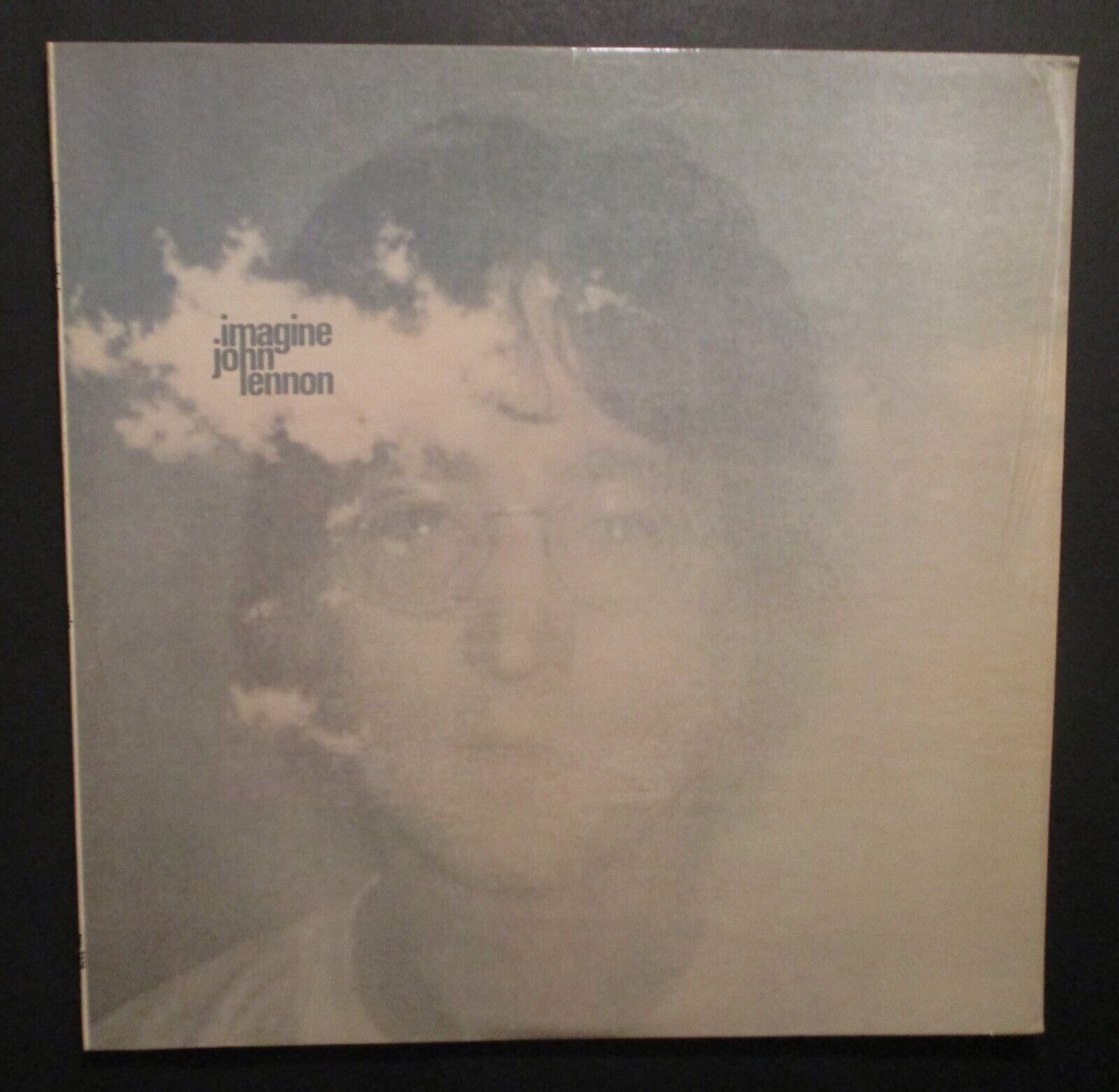
The photographs on the front and back covers were taken by Yoko Ono, using a Polaroid camera. The cover photos shows John as a dreamer, literally with his “head in the clouds.”
The back cover includes a quote ("Imagine the clouds dripping. Dig a hole in your garden to put them in.") from Ono's book Grapefruit.
~~~~~~~~~~~~~~~~~~~~ "Imagine" is John Lennon's second solo studio album, released on September 9th, 1971 by Apple Records.
It’s full of brilliant songs, great hooks, and John’s ever-present acerbic wit. It’s hard to deny the stellar quality of the songwriting and the excellent musicianship.
'Imagine' is a remarkable collection of songs, some of the best-loved and most notable songs of his career. It's considered Lennon's best solo album, and arguably the best solo album by any of the former Fab Four.
Lennon has said that he had his sights set firmly on the #1 chart spot, and he did everything he could to make 'Imagine' as commercially viable as possible. Lennon’s deliberate attempt certainly paid off.
'Imagine' was a critical and commercial success. Peaking at #1 in both the US and the UK, it became Lennon's first #1 album as a solo artist.
~~~~~~~~~~~~~~~~~~~~~~~~~~~~~~~ The opening track, the title track, "Imagine'' is John's idealistic dream, how he wished the world would be some day. The rest of the album is how Lennon really viewed his world at the time, his personal reality; a mix of anger, bitterness, sadness, regret, some political idealism, raw emotion, and even some love and joy.
John's 'Honesty' is the common linking theme.
~~~~~~~~~~~~~~~~~~~~~~~~~~~~~ Imagine is truly a 'Self-Portrait' of where John's life was at the time, an album of contrasting moods in true John Lennon style.
The album was recorded following a period of intense personal tension in John's life. Within John’s ever-enquiring mind, a war of thoughts and ideas was raging and spinning around.
While the lawyers picked over the remains of his old band, John was becoming a raging politico, a peace-loving dreamer, and an adoring, devoted, but imperfect, husband.
John was totally committed and involved with writing the 'Imagine' album, tryng to shed his inner demons and doubts and work his way towards some inner peace.
He used his legendary lyrical wit and unparalleled songwriting skills to write songs that threw revealing light on his life at the time.
Sweet love songs ("Oh Yoko!"), dreamy peace anthems ("Imagine"), protest numbers ("Gimme Some Truth"), biting, savage critiques ("How do you sleep?") and bits of self-searching ("Jealous Guy") are spread across this timeless record.
As a Beatle, John was generally regarded as a lyrical mastermind, a mighty wordsmith, who could bend words, poetry and prose to fit his every whim. That 'craft' is used to great effect on this album.
~~~~~~~~~~~~~~~~~~~~~~ RECORDING OF THE 'IMAGINE' ALBUM
John began work on the album that was to become 'Imagine' just 3 months after finishing 'John Lennon/Plastic Ono Band'.
The recordings were done in three separate stages, the first were in February 1971 at Abbey Road studios, the second recordings, the bulk of the album, were done in May at John's home studios Ascot Sound, and some final recording, as well as overdubs and mixing, were done at The Record Plant in NYC over the 4th of July weekend.
The first songs recorded for the album were done on February 11th-16th, at Abbey Road studios in London, during the sessions for Lennon's single "Power to the People".
Those sessions produced the single, plus "It's So Hard," "I Don't Want to Be a Soldier," and an unused cover of the Olympics' 1958 song "Well (Baby Please Don't Go)". This last song didn't make the cut for 'Imagine' but was later released on John's 'Anthology' set.
They also recorded Yoko’s “Open Your Box,” which became the b-side of the “Power To The People” single.
The main recording session for the album began in late May 1971, from the 24th to the 28th, at Lennon's Ascot Sound Studios, built inside his Tittenhurst Park residence outside London.
~~~~ The musicians that appeared on 'Imagine' were all excellent players and were all part of John's inner circle at the time.
While John and Yoko were in NYC, earlier in 1971, John hooked up with George Harrison, jammed a bit, and convinced George to help out on the new upcoming album.
George Harrison appears on half of Imagine's ten tracks, playing electric guitar, acoustic guitar, and dobro.
In addition to George, John re-used many of the musicians that helped him out on his February 1970 single ‘Instant Karma! (We All Shine On)’, which was also his debut collaboration with Phil Spector.
Phil had produced the final version of the 'Let It Be' album and John's first solo album 'John Lennon/Plastic Ono Band', so John chose Phil Spector once again to produce 'Imagine.'
'Spector-ization' of this album, or any album, is a double edged sword ~ John's simple, honest themes are probably best heard in their stripped down version, but Spector’s production does add a bit of richness, fullness and commercial appeal.
The 'Imagine' album features Lennon himself on lead vocals, electric guitar, acoustic guitar, piano, and harmonica.
Among the supporting musicians was old Beatles pal Klaus Voorman and future Yes drummer Alan White. The great drummer Jim Keltner is on a few of the earlier recorded tracks.
The great Nicky Hopkins was on keyboards. Hopkins is the magic ingredient on this album, providing some fantastic and memorable playing, as well as acting as the 'glue' that holds everybody together seamlessly.
Additional musicians included Badfinger members Joey Molland & Tom Evans, plus small appearances by several other great studio musicians. Lennon assembled the best session musicians who were available at the time.
~~~~~~~ The bulk of the sessions for 'Imagine' were done at Lennon's Ascot Sound Studios. Being recorded at Lennon's house, instead of a sterile studio, gave the music a relaxed, loose, laid back feel.
Lennon also chose to do another take of "I Don't Want to Be a Soldier" during the main sessions at Tittenhurst Park.
Extensive film footage of the sessions, showing the evolution of some of the songs, was filmed for a scrapped documentary, 'Working Class Hero'. Segments of the film were later used for the 1988 documentary "Imagine: John Lennon" and 2018's "Above Us Only Sky"
~~~~~~~~ 'Imagine' continued to take shape over the early summer of 1971.
In July 1971, Lennon and his wife Yoko flew to New York with tapes of the sessions, to continue work for the album at the Record Plant.
Before they left England, John, Yoko and Phil Spector created an initial stereo test mix of the album at Ascot Sound Studios.
After listening, they realized it needed a little more 'something' and decided to add some light string arrangements and some saxophone parts, to give the songs more punch and more emotion.
In New York, Lennon hooked up with old pal King Curtis, whose rocking tenor sax is heard on several songs.
Once settled down in New Yok City, John and Phil figured out the string arrangements for some of the songs.
The final string arrangements for the album, relatively simple and confidently placed ~ sometimes strong, sometimes delicate, were mostly written by Torrie Zito, with direction from Phil and John.
The string players were all master musicians from the New York Philharmonic Symphony Orchestra. Lennon called them the 'Flux Fiddlers' on the album.
Although recorded in full, luscious stereo, the strings were all mixed down to mono for the album to make room for other music and overdubs.
The final album was put together at The Record Plant by John Lennon and Phil Spector. Many overdubs and solos, as well as the strings and King Curtis' sax parts were added on there.
The final mixing was done over the 4th of July weekend.
The album was released on September 9th 1971
~~~ By the end of the summer of 1971, John and Yoko were becoming very comfortable living and working in NYC.
To John, New York was the place to be, the art and music capital of the world, where new adventures beckoned.
When he left England for New York on September 3rd 1971, it was just another trip in John’s hectic, turbulent existence. Nobody knew, especially John, that he would never see England again.
~~~~~~~~~~~~~~~~~~~~~~~~~~~~~~~~~~~~ The Ten great songs on this album include:
"Imagine" / "Crippled Inside" "Jealous Guy" / "It's So Hard" "I Don't Want to Be a Soldier" "Gimme Some Truth" / "Oh My Love" "How Do You Sleep?"/ "How?"/ "Oh Yoko!"
I'll discuss some of them below:
~~~~~ IMAGINE
The title track, 'Imagine', is a timeless beautiful song and one of John Lennon's best known compositions.
In “Imagine”, John asks the listener to imagine a world without religions or nations, and suggests that such a world would create peace, unity and brotherhood.
Today, many regard it as one of the most defining songs of the era. An anthem of peace and solidarity. This song seems to capture the very essence of the human struggle against adversity.
‘Imagine’ suggests a world without religion, nations or possessions, asking instead that people see themselves as humble agents for change.
"Imagine" proved what most Beatles fans already knew; that John was a songwriting genius, with or without Paul by his side.
"Imagine", one of his most idealistic songs, has become John Lennon’s most famous and best recognized, post-Beatles tune.
The concept of the song was inspired by several poems, taken from Yoko Ono's 1964 book 'Grapefruit'. Excerpts from one of those poems, 'Cloud Piece', was reproduced on the back cover of original pressings of 'Imagine'.
It reads: "Imagine...the clouds dripping...dig a hole in your garden to put them in."
John has said that the whole song just spontaneously appeared, nearly intact, one Spring morning.
The story goes that John Lennon wrote & created the entire song, in one burst of creativity, early one morning in 1971. He composed it on his Steinway piano, which sat in a bedroom of his Tittenhurst Park mansion in Ascot.
The song was recorded to tape on May 27, 1971 at Ascot Sound Studios, which was Lennon's new home studio at Tittenhurst Park.
Several months later in July 1971, a gentle string arrangement was written and added to the basic track during sessions at the Record Plant studios in New York City.
The final recording of this masterpiece featured only John on piano and vocals, Klaus Voormann on bass, Alan White on drums and the Flux Fiddlers on strings. Simple, elegant, clean, and perfect. John perfectly recorded it in just three takes, opting for musical simplicity and a raw, 'live' feel, as opposed to being heavily produced and polished.
The beautiful, light, orchestrated strings, scored by Torrie Zito, are a subtle, but superb, addition. They sweeten, shape and create the entire 'feel' of the song, giving it power, beauty, importance and poignancy.
'Imagine' is a very simple, straight-forward, tune. It's technically stunning in it’s simplicity. One of John's simplest songs, musically and lyrically, but in that simplicity there is tremendous power.
The skill and craft of the songwriting, arrangement, and production are perfect and timeless. The humility in John's vocals and the dreamy, hopeful idealism this song projects is simply amazing.
~~ "Imagine", backed with "It's So Hard", was released as a 45 Single in October 1971. It was John’s first big hit, reaching #3 on Billboard’s chart.
In December 1980, after Lennon's sudden, shocking death, "Imagine" re-entered the charts, becoming a Worldwide hit all over again. In 1980, as it was in 1971, it was a plea for world peace.
"Imagine" is widely accepted as John's signature song. It's the most recognizable and universally appealing song John Lennon ever released, an anthem of “peace” for generations, and truly deserving of its status as a John Lennon classic.
~~~~ The song starts off with John playing the piano; very tranquil, beautiful and dreamy. Very 'human'. Instead of being up-front and centered, the piano is panned across the whole soundstage. This helps accentuate John's plaintive, and vulnerable vocals, letting the lyrics speak for themselves.
The lyrics represent a 'dream', John's idea of a world where there is nothing to separate us ~ no religions or nations, no possessions or money, no classes or status, nothing to fight and die for.
He's asking us to 'imagine' and envision an idyllic, utopian world where there is no division, no war, no conflict. He knows that this 'dream' may never become a reality, but, "it's easy if you try...."
The key word to this whole song is "imagine". John's not demanding that we abandon all our possessions, nor is he boldly claiming that there’s no Heaven or Hell; he's simply asking us to 'imagine' and pretend that these things don't exist, don't control and rule over us. He's asking us to 'imagine' how a world like that would be, and how people, including ourselves, would act in it.
Lennon has said that 'Imagine' was written as a heavy, political, "anti-religious, anti-nationalistic, anti-conventional, anti-capitalistic song, but because it's 'sugar-coated', it's accepted". ~~~~~~~~~~~~~~~~~~~~~~
HOW DO YOU SLEEP?
“How Do You Sleep?” is arguably the most notorious song on this album, and one of the most discussed Lennon songs in 'Beatles' circles. It's often described as John’s undisguised attack on Paul McCartney. John’s long-standing competitive relationship with Paul was legendary.
It worsened during the 1969 breakup, when the band was split on who should manage them after Brian Epstein's sudden death. There was a sort of mini war between Paul and the other Beatles, mostly over Allen Klein, which ended after Paul won his court case to have their legal partnership dissolved.
When they were both Beatles, their healthy, friendly rivalry, and intense level of competition between them, was mostly productive, for the betterment of the Beatles as a whole, but once the Beatles broke up, their rivalry was aimed at each other and became nasty, critical and mutually destructive.
The souring of John & Paul's relationship, post-Beatles, was all over the music press at the time this album was being made.
“How Do You Sleep?” was written by John in response to various 'coded' messages he claimed were on Paul McCartney’s 1971 album 'Ram', particularly in the songs ‘Too Many People’ and ‘Dear Boy.’ Ram's opening track “Too Many People” had some harsh lyrics and digs directed at John and his wife, Yoko Ono.
Lennon wrote “How Do You Sleep?” as a full-scale, broadside attack at his former songwriting partner, accusing him of many things, and calling Paul's music “muzak to my ears”.
John was still a wicked punster and excellent word-smith, and lines like “The only thing you done was yesterday” were viscous, but really hit the mark in those early post-Beatles days. There’s actually some pretty clever lines in this song.
~~~ The sales of both John and Paul's post-Beatles music revealed the unfortunate, sad, cold, hard truth that John Lennon really needed Paul McCartney, and vice versa.
One wrote great words and lyrics, and the other wrote great melodies and music ~ as a team, they were unbeatable. No one else in the music world at that time could really challenge them, except each other.
After the Beatles breakup, without an 'equal' to challenge, motivate, and push them, they both slipped inevitably and inexorably into musical mediocrity.
~~~ Interestingly, George Harrison happily guests on this song, playing some wicked slide guitar. George plays some vicious, stinging, biting, slide guitar. Nicky’s electric piano gives a dirty, slinky groove to the track, and the strings add a menacing dramatic punch.
The song begins with the orchestra tuning up, a la Sgt. Pepper, and proceeds to lay down a scathing attack on Paul McCartney's music, character and career.
John gives one of his most venomous performances on the record, spitting out all his anger.
~~~~~~~~~ Early First pressings of 'Imagine', like this copy, included a postcard showing Lennon holding the ears of a pig, a clear parody of Paul McCartney’s image, posing with a sheep, on the cover of 'Ram'.
~~~~~~~~~~~~~~~~~~~~~~~~~~~ JEALOUS GUY
“Jealous Guy” is a touching, personal, and confessional song. One of the most beautiful songs on 'Imagine'.
It's a bold, courageous and accurate portrayal of John's neediness and insecurity. It's an honest, heartfelt gem that explores John's own sense of failure. John sings a lovely apology for his past controlling and possessive behavior.
The song features John's brilliantly tortured, pathetic, and weak vocal, which perfectly contributes to the song's effect, revealing a broken and scared man.
~~~~ "Jealous Guy" has it's roots going back to the Beatles visit with the Maharishi in India in 1968. The basic melody was written by John, inspired by one of the Maharishi's lectures during that visit.
It was originally composed as the unreleased Beatles song, "Child of Nature" during the 'White Album' sessions. Later, in 1971, the song was revisited, reworked and rewritten by John, with updated lyrics, and emerged as "Jealous Guy"
~~~~~~~~~~~~~ The arrangement is thick and lush, featuring John on vocals and acoustic guitar, Nicky Hopkins on piano, Tom Evans & Joey Molland from Badfinger on acoustic guitars, John Barham on harmonium, Klaus Voorman on bass, Jim Keltner on drums, Alan White on vibraphone, Mike Pinder on tambourine, and The Faux Fiddlers on strings.
To give the song just the right amount of emotion and melodic support, there's an eloquent, sweet, string arrangement. People like to bash Phil Spector, but Spector's lush, full, wall-like orchestration really helps create the mood and feel of this song.
Like on many of the songs on this album, Nicky Hopkins is the secret ingredient here. Nicky's delicate piano playing reveals an aching beauty and vulnerability, perfectly reflecting John’s vocals and lyrics.
“Jealous Guy” is a wonderful, beautiful song, one of John's best-known and best loved. It's a perfect song, from the arrangement, to the performance, to the melody. A masterpiece.
~~~~~~~~~~~~~~~~~~~~~~~~~~~~~~~~~~~~~~~~~~~~~~~ GIMME SOME TRUTH
Side Two of "Imagine" opens with "Gimme Some Truth," a sizzling piece of hard rock which stands out from the previous songs on side One with its intensity and drive.
"Gimme Some Truth" is basically a John Lennon rant, expressing his frustration with the general bullshit of life and society. It's one of the greatest protest songs ever recorded.
This song reflects John Lennon’s fury at the hypocrisy of political leaders.
By this point in his life, John knows perfectly well what the truth is, and is disgusted by what he hears being spewed all around him.... the hypocrisy of authority figures. John’s voice cuts deep as he sings about “pigheaded politicians”, and “narrow-minded hypocrites”.
John's lyrics are delivered in a syncopated rhythm, that harkens back to the Beatle-esque beauty of melody, word-play, rhythm and arrangement.
Using his notorious wit and clever word-play, he takes aim and responds with some angry, foaming-at-the-mouth, scorching, and righteous fury against the establishment.
“I’m sick to death of....all I want is the truth....just gimme some truth"
‘Gimme Some Truth’ is one of John Lennon’s most powerful musical statements and contains some of his most politicized lyrics.
Like 'Jealous Guy', this protest song got its start in 1968 during the Beatles trip to India where John was seeking truth. It developed over time, and some of the lines of this song were first heard during the tension-filled 'Let It Be' sessions in early 1969 where he was also seeking some truth.
George Harrison’s stinging slide guitar has some real teeth, and matches the tone of the song perfectly. George also adds a frantic, fiery, seething, lead guitar solo during the break. In my opinion, one of his best, and most brilliant, post-Beatles guitar performances.
“Gimme Some Truth” reflects John's idealist impatience with the political world around him and this song points the way towards Lennon’s radical politics that he would write more songs about on his next few albums in the mid-70's.
This song transcends time and still packs a punch today, 50 years after it's release. It's just as relevant in today's world of 'Fake News' as it was in 1971.
~~~~~~~~~~~~~~~ CRIPPLED INSIDE
Lennon indulges his love of rock and roll with "Crippled Inside."
It’s a bright upbeat track that takes aim at phonies, including John himself, who can't hide because he's 'crippled Inside'. John's lyrics are personal and intimate. He shares his personal insight that spiritually wounded people hide behind fake facades.
Lennon's dark lyrics are rather bleak compared to the upbeat music. The song has an earthy, honest and heartfelt country vibe, like good old boys sitting around on the porch jamming. That loose, knockabout, honky-tonk feel resulted from the song being mostly recorded at John and Yoko’s home, rather than in a harsh studio.
This song features John on vocals and electric guitar, George Harrison on dobro, Nicky Hopkins on piano, Ted Turner & Rod Linton on acoustic guitars, Klaus Voorman on electric bass, Steve Brendell on upright bass, and Alan White on drums.
This odd mix of musicians and instruments gives the song a country/rockabilly feel to it with George’s fantastic tasty dobro work, Nicky Hopkins playing a rinky-tink piano, and a swinging beat by Alan White.
~~~~~~~~~~~~~ IT'S SO HARD
"It’s So Hard" is one of the more straightforward, bluesy, rock tunes on this album.
As mentioned, it comes from the early sessions for this album and has a great, raw, stripped down arrangement to it.
The song features a small band with John on vocals and guitar, Klaus on bass, Jim Gordon on drums, and King Curtis on Tenor Sax, with the Flux Fiddlers adding occasional stabs of strings.
The song has Klaus Voorman and Jim Gordon creating a tight, primitive rock groove, John playing some crazy electric guitar, while King Curtis blasts away on the sax. King Curtis’s tenor saxophone makes them sound like an early “traditional” Rock or R&B band.
King Curtis' Sax was overdubbed at the Record Plant in NYC where Curtiss lived at the time.
The Beatles had met King Curtis during their 1965 tour and John stayed in touch with him over the years. This was one of King Curtis' final recorded performances before his stabbing murder in August 1971, at the height of his skills, and shortly before 'Imagine' was released.
~~~~~~~~~~~~~~~~~ OH YOKO!
The album ends with "Oh Yoko!", a gentle, but rocking love song. It's a great, upbeat, punchy, catchy song, and almost invites you to sing along.
‘Oh Yoko!’ is a song of sheer delight, uplifting and beautiful, with a great melody, and possibly the happiest song that John Lennon ever committed to record.
A simple song, with a nice sweet sentiment. Simply lovely.
At the time of this album’s release, the record company was pushing hard for this track to be issued as a single, but Lennon refused, thinking it was too "pop".
That was quite strange, since John purposely tweaked this album to have strong commercial appeal, yet he chose NOT to release it's potentially most commercial song as a single. I'm certain it would have been a hit single at the time.
The song is propelled by Hopkins’ fantastic piano playing. Oddly, both John and Phil Spector join together, singing harmonies on the chorus.
Near the end of the song, John plays some, literally, dancing harmonica. You can hear the harmonica moving all around the soundstage. John's great harmonica work plays the album to a close.
Strangely, for unclear reasons, John would never play harmonica on any of his albums after this. Why?, we'll never know.
~~~~~~~~~~~~~~~~~~~~ IMAGINE'S NON ABLUM SINGLES
In discussing the 'Imagine' album, it's important to note that John Lennon released two of his greatest non-album singles around the same time as 'Imagine' ~ "Power to the People" and "Happy Xmas (War Is Over)"
In today's world of longer album sides and CD technology, these would likely have been included on the 'Imagine' album, but in those days, they were released as separate, stand alone singles.
“Power To The People” is a classic, political protest song featuring Billy Preston on keyboards, a sweet sax solo by Bobby Keys, Klaus Voorman on bass, Jim Gordon on drums, and an amazing gospel choir, which starts the song off.
‘Power To The People’ was released as a single several months prior to 'Imagine'.
The song was inspired by John and Yoko meeting up with 2 far left activists who had previously criticized their non-violent protest methods. The song is important since it marks John's post-Beatles transition towards more political songwriting.
“Happy Xmas (War Is Over)” has become a classic well-loved Christmas tune, but with a strong anti-war message. It’s got a great melody, strong message, and is way better than Paul’s annoying Christmas song.
In America It was released on December 1st, 1971 as a single, and then released in the UK the following Christmas.
It features John on lead vocals and acoustic guitar, Yoko on vocals, The Harlem Community Choir, May Pang on backing vocals, Nicky Hopkins on piano and percussion, Jim Keltner on drums, bells & percussion, plus some other folks joining in on the chorus.
Unlike in the US, the tradition in the UK at the time was to release the singles as separate records, and not include them on the albums.
This song may not have 'fit' well on the 'Imagine' album, but “Power To The People” certainly does, and I think the album would have been better if these songs were included on it.
~~~~~~~~~~~~~~~~~~~~~~~~~~~~~~~~~~~~~~~~~~~~~~~~~~~~~~~~~~~ 1971's 'IMAGINE' COMPARED TO 1970's 'PLASTIC ONO BAND'
It's hard to appreciate and discuss 'Imagine' without first looking at John's first Post-Beatles solo album, the raw, harrowing, and brutally honest 'Plastic Ono Band' (POB).
Released in late 1970, 'John Lennon/Plastic Ono Band' (POB) had been critically acclaimed as a landmark album; a raw, brutal, personal artistic statement, but it's rawness and subject matter proved unlistenable for many listeners who still had "Let It Be" and "The Long and Winding Road" ringing in their ears.
It didn't sound anything like a 'Beatles' album, and was poorly received in the marketplace. Its music was raw and direct, which made for great art, but not-so-great sales. Few purchased it and fewer listened to it.
It was John's clear statement that he wasn’t going to live off past glories and sit in the shadow of his 60’s Pop Beatle image.
Since the Beatles broke up, John had developed strong Socio-Political viewpoints. In both London and New York he had been drawn to the radical underground, where hippy ideals of the 1960s met the hard-edged politics of a new decade. His songwriting was now starting to reflect that influence.
John was upset that 'John Lennon/Plastic Ono Band' had not found the mass audience its songs deserved, and he was not about to make the same mistake with his next album 'Imagine'.
John had clearly exorcised some personal demons on POB, but he was clearly still fighting other issues when work began on 'Imagine' in February 1971, just three short months after finishing and releasing 'POB'.
With POB's poor sales and general disinterest from record buyers, John Lennon had now set his sights firmly on the #1 chart spot and did everything he could to make his second solo album 'Imagine' as commercially viable as possible.
After all, John was a former Beatle. He knew how to write and craft a commercial song or two.
John still had lots to say about politics, war, conflict, peace and love, but on 'Imagine', his goal was to frame his thoughts, emotions, politics and ideas in music that listeners truly enjoyed and could better relate to. To 'sugar coat' it.
The writing, production and arrangements on 'Imagine' represented a clear pivot in Lennon’s songwriting, a return to sonically accessible, conventional songs.
Gone were the ferocious, raw, avant-garde experiments, noise collages and primal songs of 'POB' and his other earlier 'solo' records made with Yoko, and instead, John tempered things down, focusing on a more polished, calmer, cerebral, and more conventional and commercial feel.
Lennon’s personal demons clearly hadn’t been vanquished, but he had learned how to write about them and present them in a more palatable form.
It worked perfectly. 'Imagine' is a much more listenable and enjoyable album. Instantly more accessible, and a very different album from anything that went before it.
'Imagine' was John's clear, defiant response to all those who suggested that he had 'lost his edge' on POB. It proved that he was capable of writing thoughtful, politically charged, but beautiful, catchy, timeless hit songs,.... if he wanted to.
~~~~~~~~~~~~~~~~~~~~~~~~~~~~~~~~~~ The "Imagine" album sounds as timeless now as it did 50 years ago. It's one of the most popular Beatles 'solo' records and is still cherished and celebrated today.
It's consistently ranked very high on Rolling Stone magazine's list of the 500 Greatest Albums of All Time.
~~~~ This album has been remixed, remastered and re-released several times over the years, including a 2011 'Record Store Day' release, and a deluxe box set, the 2018 'Imagine: The Ultimate Collection,' but I feel that an original First Pressing like this copy is the only way to own this album.
This is the way John intended the album to be seen and heard, and the way we were first introduced to the album over 50 years ago.
Original first pressings like this copy, complete with the Poster, Postcard and custom inner sleeve, are becoming very hard to find in great condition.
This is a beautiful, clean, original first pressing and belongs in any proper vinyl collection.
~~~~~~~~~~~~~~~~~~~~~~ CONDITION: I tried to show good hi-resolution photos of the cover, inserts, labels and vinyl in my pictures.
I purchased this copy 50 years ago and have taken great care of it since.
As mentioned, it's complete with the Poster, Postcard and original inner sleeve.
VINYL: The vinyl looks excellent. Clean and bright. No obvious dings, flaws or marks. It looks fantastic and I'm sure you'll be very happy with it.
The Deadwax is pretty minimal. The original matrix number, the Bell Sound stamp, and the mastering engineers mark. This is a Winchester pressing. See the full Matrix above.
I tried to show some close-up pictures of the vinyl to show how good it looks. I'm sure you'll be happy with it.
I haven't messed with it or cleaned it, other than my trusty 'DiscWasher' brush, in 50 years. A good deep cleaning will make it even better looking and better sounding than it already is.
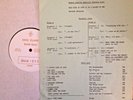
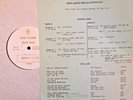
LABELS: This is pressed with custom labels. The custom Apple labels have John's face on Side 1, 'sliced' Apple on side 2. "Mfd. By Apple Records Inc." text along bottom rim of of both labels.
Label titles: "Imagine John Lennon Plastic Ono Band (With The Flux Fiddlers)"
LABEL TEXT: SIDE B ~ "All Songs Published By Mclean Music, - BMI Except "OH MY LOVE" Published By Mclean Music Inc./Ono Music, Inc. - BMI"
The labels are clean and bright. No marks or damage. The spindle holes are still sharp and clean, suggesting minimal playing and my careful handling over the years.
This album was issued with double sided, custom die-cut inner sleeve with lyrics, photos and credits. As mentioned, there are 2 slightly different inner sleeves included. I think the one without the 'ono' line is the original, but don't remember, so I'll include both.
JACKET: As you can see from my pictures, this still looks very nice for a 50 year old OG copy.
These jackets were laminated, front and back. The original shine is still intact. The lamination has started to separate very mildly on the front opening edge, but not bad. I showed a picture of it in my photos. Other than that, a clean excellent jacket.
The artwork is bold and bright, the corners are sharp, and the spine is straight. A nice survivor.
The back cover has Yoko's note; "Imagine the clouds dripping. Dig a hole in your garden to put them in. Yoko '63" Printed in the left lower corner.
Overall, I'll call the whole record EX-, but the vinyl is very clean.
This album comes with 2 additional inserts:
a large 24" x 36" Poster of Lennon playing on his white piano.
a 4" x 6" postcard of Lennon straddling a Pig and holding it's ears.
This record has been polylined sleeved, inside and out, and stored properly for decades, and is still quite nice for an original pressing.
This copy is all original, complete, and a real gem. I'm sure you'll love it.
~~~~~~~~~~~~ ** NOTE: I'm selling this rare 'Collector' record "AS IS" and "NO RETURN". It's rare and as described and I'm sure you'll be very happy with it.
~~~~~~~~~~~~~~~ I’m recently retired and downsizing and letting go some gems and rarities from nearly 45 years of vinyl record collecting. Check out the many other fantastic 45s and 33s coming soon to my page!
All records have been carefully evaluated and graded by me. I visually inspect all records under bright light, personally gently clean them with a soft cloth and then, if unsure, play them on a modern high-end turntable to get a true picture of condition.
Please look at all the high-resolution pictures I added. They are all my own and are of the actual record being sold. The pictures are part of the description and can show small details, label variations, and condition better than I can put into words.
My grading is fair and honest. I have had over 3,500 happy and satisfied EBay customers over the years, with 100% positive feedback, and I have been buying/selling on EBay for well over 25 years, so please bid with confidence!
I'm a 0ne-man operation, this is a hobby, not my job. I do this for fun. I do this because I love music, love collecting vinyl and want others to share in that same experience. I take my time listening, researching, grading, listing and packaging. I will NOT sell any record that I personally would not want in my collection.
As you well know, packing and shipping rare records requires special care and attention, therefore, shipping cost within the lower 48 states is $5.00 on this item. If you would like insurance, or anything faster than Media/Economy Mail, please let me know and I can arrange it for you. I’ll work with you to make sure you’re happy!
I will gladly combine multiple records, or other items on my page, and make the shipping much less for you. I don’t inflate the shipping costs; they are what they are. I strive to keep them as low as possible. See my feedback for comments on my quality packing and shipping.
All items are packaged with sturdy cardboard mailers and appropriate padding. I take pride in my packaging and shipping and package all my records as if I were sending them to myself. I refuse to use cheap flimsy packaging material when sending my vinyl. I treat them as if they were my own and mail them the same way.
All orders are processed and shipped within 2 business days of receipt. We package and ship our vinyl records with the greatest care, using proper packaging to ensure that your rare and collectible vinyl records arrive in pristine condition.
Payments can be made by any of the multiple options that Ebay offers.
I will be happy to exchange feedback with anyone I complete a transaction with.
THANK YOU for looking and reading if you got this far. Sorry to go on and on, but there's so much to say about this timeless album. -- JOHN
price rating