JOHN CAGE Meets SUN RA Still Sealed LP '87 OG Meltdown Avant Experimental free
$
98


Favourite Auctions
To save auctions to your favourites, please login
If you don't have an account, please register
Description
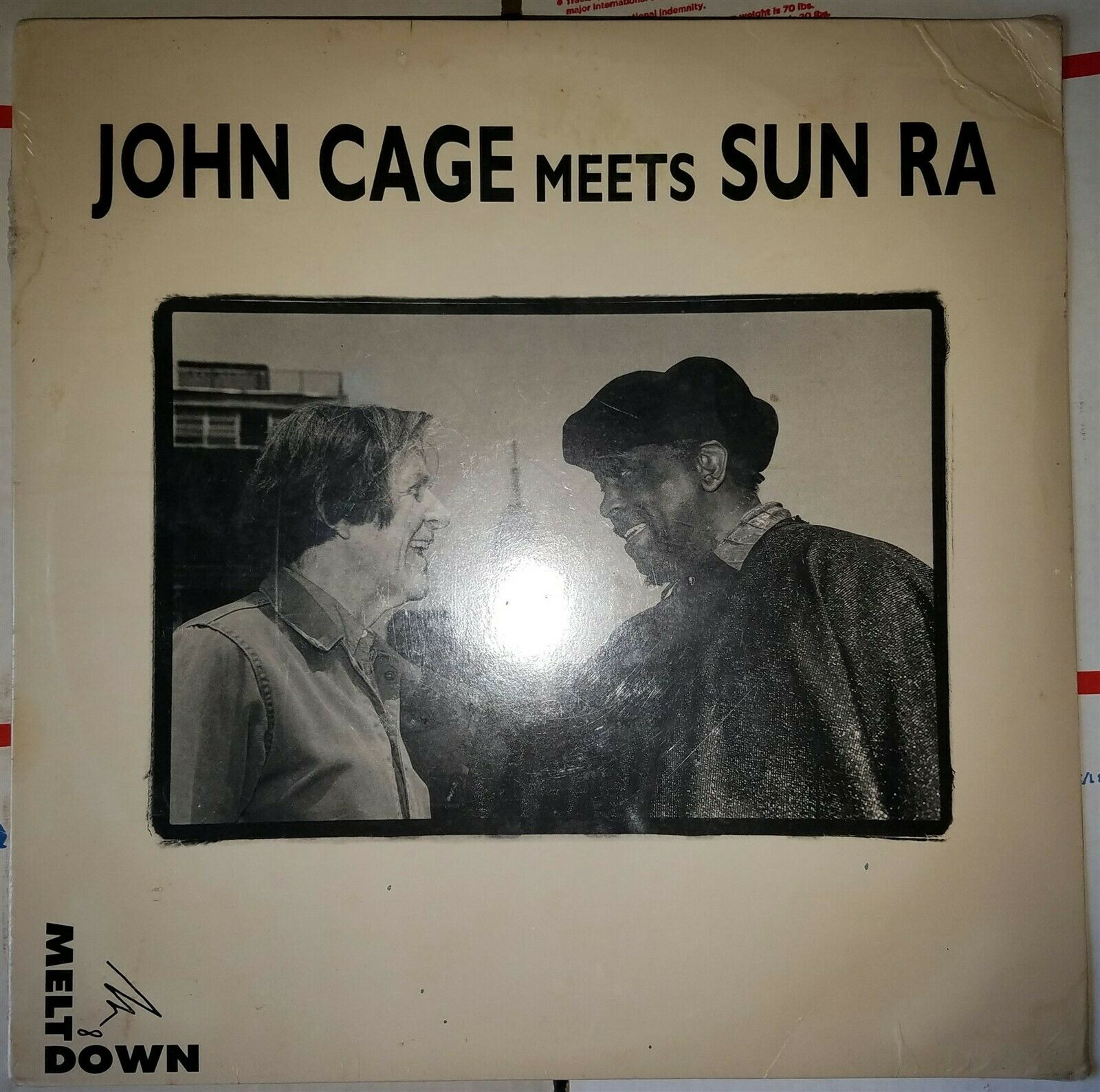
Record: Mint (M) Still Sealed! Cover: Very Good (VG) NO cut-out marks, NO splits, NO stickers, NO writing Labels: Clean! John Cage,Sun Ra John Cage Meets Sun Ra 1987 United States Meltdown 12" Stereo LP SB-59575
John Cage,Sun Ra
John Cage Meets Sun Ra
1987 United States Meltdown 12" LP
Hard to Find Original Press RARE!
Condition
Vinyl: Mint (M) Still Sealed!
Sleeve: Very Good (VG) upper right corner is bent, with other handling, small stain at lower right corner, shrink torn near upper spine with light stain NO cut-out marks, NO splits, NO stickers, NO writing
Please see item specifics section above for more details
Tracks:
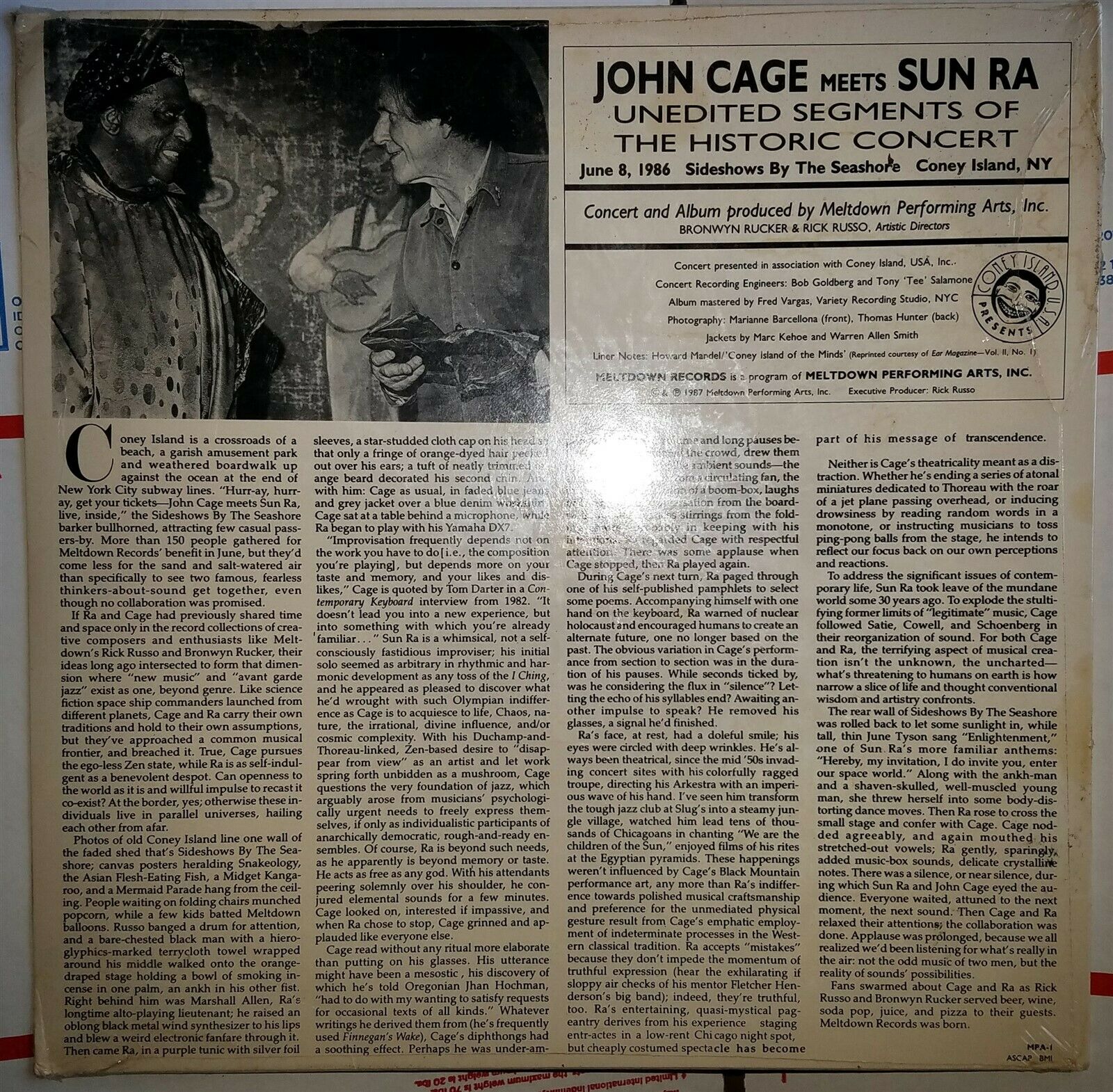
John Cage Meets Sun Ra ?– John Cage Meets Sun Ra Label: Meltdown Records (3) ?– MPA-1 Format: Vinyl, LP, Album, Country: US Released: 1987 Genre: Electronic, Jazz Style: Free Improvisation, Experimental, Ambient Tracklist A Untitled 21:23 B Untitled 22:19 Credits Engineer – Bob Goldberg, Tony Salamone Executive-Producer – Rick Russo Liner Notes – Howard Mandel Mastered By – Fred Vargas Notes Unedited Segments of the Historic Concert: June 8, 1986 Sideshows By The Seashore, Coney Island, NY
JOHN CAGE Meets SUN RA Still Sealed LP '87 OG Meltdown Avant Experimental free John Cage Real Name: John Milton Cage, Jr. Profile: John Cage (born September 5, 1912, Los Angeles, California, USA - died August 12, 1992, New York City, New York, USA) was an American composer, music theorist, writer, philosopher, and artist. He is best known and lauded as a pioneer of post-war avant-garde composition. He left Pomona College early to travel in Europe (1930-31), then studied with Henry Cowell in New York (1933-4) and Arnold Schoenberg in Los Angeles (1934): his first published compositions, in a rigorous atonal system of his own, date from this period. In 1937 he moved to Seattle to work as a dance accompanist, and there in 1938 he founded a percussion orchestra; his music now concerned with filling units of time with ostinatos (First Construction in Metal, 1939). He also began to use electronic devices (variable-speed turntables in Imaginary Landscape n.1, 1939) and invented the 'prepared piano', which involves placing a variety of objects between the strings of a grand piano in order to create an effective percussion orchestra under the control of two hands. He moved to San Francisco in 1939, to Chicago in 1941 and back to New York in 1942, all the time writing music for dance companies (notably for Merce Cunningham with whom he formed a lifelong relationship), nearly always for prepared piano or percussion ensemble. There were also major concert works for the new instrument: A Book of Music (1944) and Three Dances (1945) for two prepared pianos, and the Sonatas and Interludes (1948) for one. During this period Cage became interested in Eastern philosophies, especially in Zen. Working to remove creative choice from composition, he used coin tosses to determine events (Music of Changes for piano, 1951), wrote for 12 radios (Imaginary Landscape n.4, also 1951) and introduced other indeterminate techniques. His 4'33" (1952) has no composed sound -- only that of the environment in which it is performed; the Concert for Piano and Orchestra (1958) is an encyclopedia of indeterminate notations. Yet other works show his growing interest in the theatre of musical performance (Water Music, 1952, for pianist with a variety of non-standard equipment) and in electronics (Imaginary Landscape n.5 for randomly mixed recordings, 1952; Cartridge Music for small sounds amplified in live performance, 1960), culminating in various large-scale events staged as jamborees of haphazardness (HPSCHD for harpsichords, tapes etc, 1969). The later output is various, including indeterminate works, others fully notated within a very limited range of material, and pieces for natural resources (plants, shells). Cage appeared widely in Europe and the USA as a lecturer and performer, having an enormous influence on younger musicians and artists. He was married to Xenia Cage from 1935 until their divorce in 1945. John Milton Cage Jr. (September 5, 1912 – August 12, 1992) was an American composer, music theorist, artist, and philosopher. A pioneer of indeterminacy in music, electroacoustic music, and non-standard use of musical instruments, Cage was one of the leading figures of the post-war avant-garde. Critics have lauded him as one of the most influential composers of the 20th century.[1][2][3][4] He was also instrumental in the development of modern dance, mostly through his association with choreographer Merce Cunningham, who was also Cage's romantic partner for most of their lives.[5][6] Cage is perhaps best known for his 1952 composition 4?33?, which is performed in the absence of deliberate sound; musicians who present the work do nothing aside from being present for the duration specified by the title. The content of the composition is not "four minutes and 33 seconds of silence," as is often assumed, but rather the sounds of the environment heard by the audience during performance.[7][8] The work's challenge to assumed definitions about musicianship and musical experience made it a popular and controversial topic both in musicology and the broader aesthetics of art and performance. Cage was also a pioneer of the prepared piano (a piano with its sound altered by objects placed between or on its strings or hammers), for which he wrote numerous dance-related works and a few concert pieces. The best known of these is Sonatas and Interludes (1946–48).[9] His teachers included Henry Cowell (1933) and Arnold Schoenberg (1933–35), both known for their radical innovations in music, but Cage's major influences lay in various East and South Asian cultures. Through his studies of Indian philosophy and Zen Buddhism in the late 1940s, Cage came to the idea of aleatoric or chance-controlled music, which he started composing in 1951.[10] The I Ching, an ancient Chinese classic text decision-making tool, which uses chance operations to suggest answers to questions one may pose, became Cage's standard composition tool for the rest of his life. In a 1957 lecture, Experimental Music, he described music as "a purposeless play" which is "an affirmation of life – not an attempt to bring order out of chaos nor to suggest improvements in creation, but simply a way of waking up to the very life we're living".[11] Contents Life 1912–31: Early years Cage was born September 5, 1912, at Good Samaritan Hospital in downtown Los Angeles.[12] His father, John Milton Cage Sr. (1886–1964), was an inventor, and his mother, Lucretia ("Crete") Harvey (1881–1968), worked intermittently as a journalist for the Los Angeles Times.[13] The family's roots were deeply American: in a 1976 interview, Cage mentioned that George Washington was assisted by an ancestor named John Cage in the task of surveying the Colony of Virginia.[14] Cage described his mother as a woman with "a sense of society" who was "never happy",[15] while his father is perhaps best characterized by his inventions: sometimes idealistic, such as a diesel-fueled submarine that gave off exhaust bubbles, the senior Cage being uninterested in an undetectable submarine;[13] others revolutionary and against the scientific norms, such as the "electrostatic field theory" of the universe.[n 1] John Cage Sr. taught his son that "if someone says 'can't' that shows you what to do." In 1944–45 Cage wrote two small character pieces dedicated to his parents: Crete and Dad. The latter is a short lively piece that ends abruptly, while "Crete" is a slightly longer, mostly melodic contrapuntal work.[16] Cage's first experiences with music were from private piano teachers in the Greater Los Angeles area and several relatives, particularly his aunt Phoebe Harvey James who introduced him to the piano music of the 19th century. He received first piano lessons when he was in the fourth grade at school, but although he liked music, he expressed more interest in sight reading than in developing virtuoso piano technique, and apparently was not thinking of composition.[17] During high school, one of his music teachers was Fannie Charles Dillon.[18] By 1928, though, Cage was convinced that he wanted to be a writer. He graduated that year from Los Angeles High School as a valedictorian,[19] having also in the spring given a prize-winning speech at the Hollywood Bowl proposing a day of quiet for all Americans. By being "hushed and silent," he said, "we should have the opportunity to hear what other people think," anticipating 4?33? by more than thirty years.[20] Cage enrolled at Pomona College in Claremont as a theology major in 1928. Often crossing disciplines again, though, he encountered at Pomona the work of artist Marcel Duchamp via professor José Pijoan, of writer James Joyce via Don Sample, of philosopher Ananda Coomaraswamy and of Henry Cowell.[18] In 1930 he dropped out, having come to believe that "college was of no use to a writer"[21] after an incident described in the 1991 autobiographical statement: I was shocked at college to see one hundred of my classmates in the library all reading copies of the same book. Instead of doing as they did, I went into the stacks and read the first book written by an author whose name began with Z. I received the highest grade in the class. That convinced me that the institution was not being run correctly. I left.[15] Cage persuaded his parents that a trip to Europe would be more beneficial to a future writer than college studies.[22] He subsequently hitchhiked to Galveston and sailed to Le Havre, where he took a train to Paris.[23] Cage stayed in Europe for some 18 months, trying his hand at various forms of art. First he studied Gothic and Greek architecture, but decided he was not interested enough in architecture to dedicate his life to it.[21] He then took up painting, poetry and music. It was in Europe that, encouraged by his teacher Lazare Lévy,[24] he first heard the music of contemporary composers (such as Igor Stravinsky and Paul Hindemith) and finally got to know the music of Johann Sebastian Bach, which he had not experienced before. After several months in Paris, Cage's enthusiasm for America was revived after he read Walt Whitman's Leaves of Grass – he wanted to return immediately, but his parents, with whom he regularly exchanged letters during the entire trip, persuaded him to stay in Europe for a little longer and explore the continent.[25] Cage started traveling, visited various places in France, Germany and Spain, as well as Capri and, most importantly, Majorca, where he started composing.[26] His first compositions were created using dense mathematical formulas, but Cage was displeased with the results and left the finished pieces behind when he left.[27] Cage's association with theater also started in Europe: during a walk in Seville he witnessed, in his own words, "the multiplicity of simultaneous visual and audible events all going together in one's experience and producing enjoyment."[28] 1931–36: Apprenticeship Cage returned to the United States in 1931.[27] He went to Santa Monica, California, where he made a living partly by giving small, private lectures on contemporary art. He got to know various important figures of the Southern California art world, such as Richard Buhlig (who became his first composition teacher)[29] and arts patron Galka Scheyer.[21] By 1933 Cage decided to concentrate on music rather than painting. "The people who heard my music had better things to say about it than the people who looked at my paintings had to say about my paintings", Cage later explained.[21] In 1933 he sent some of his compositions to Henry Cowell; the reply was a "rather vague letter",[30] in which Cowell suggested that Cage study with Arnold Schoenberg—Cage's musical ideas at the time included composition based on a 25-tone row, somewhat similar to Schoenberg's twelve-tone technique.[31] Cowell also advised that, before approaching Schoenberg, Cage should take some preliminary lessons, and recommended Adolph Weiss, a former Schoenberg pupil.[32] Following Cowell's advice, Cage travelled to New York City in 1933 and started studying with Weiss as well as taking lessons from Cowell himself at The New School.[29] He supported himself financially by taking up a job washing walls at a Brooklyn YWCA (World Young Women's Christian Association).[33] Cage's routine during that period was apparently very tiring, with just four hours of sleep on most nights, and four hours of composition every day starting at 4 am.[33][34] Several months later, still in 1933, Cage became sufficiently good at composition to approach Schoenberg.[n 2] He could not afford Schoenberg's price, and when he mentioned it, the older composer asked whether Cage would devote his life to music. After Cage replied that he would, Schoenberg offered to tutor him free of charge.[35] Cage studied with Schoenberg in California: first at University of Southern California and then at University of California, Los Angeles, as well as privately.[29] The older composer became one of the biggest influences on Cage, who "literally worshipped him",[36] particularly as an example of how to live one's life being a composer.[34] The vow Cage gave, to dedicate his life to music, was apparently still important some 40 years later, when Cage "had no need for it [i.e. writing music]", he continued composing partly because of the promise he gave.[37] Schoenberg's methods and their influence on Cage are well documented by Cage himself in various lectures and writings. Particularly well-known is the conversation mentioned in the 1958 lecture Indeterminacy: After I had been studying with him for two years, Schoenberg said, "In order to write music, you must have a feeling for harmony." I explained to him that I had no feeling for harmony. He then said that I would always encounter an obstacle, that it would be as though I came to a wall through which I could not pass. I said, "In that case I will devote my life to beating my head against that wall."[38] Cage studied with Schoenberg for two years, but although he admired his teacher, he decided to leave after Schoenberg told the assembled students that he was trying to make it impossible for them to write music. Much later, Cage recounted the incident: "... When he said that, I revolted, not against him, but against what he had said. I determined then and there, more than ever before, to write music."[36] Although Schoenberg was not impressed with Cage's compositional abilities during these two years, in a later interview, where he initially said that none of his American pupils were interesting, he further stated in reference to Cage: "There was one ... of course he's not a composer, but he's an inventor—of genius."[36] Cage would later adopt the "inventor" moniker and deny that he was in fact a composer.[39] At some point in 1934–35, during his studies with Schoenberg, Cage was working at his mother's arts and crafts shop, where he met artist Xenia Andreyevna Kashevaroff. She was an Alaskan-born daughter of a Russian priest; her work encompassed fine bookbinding, sculpture and collage. Although Cage was involved in relationships with Don Sample and with architect Rudolph Schindler's wife Pauline[18] when he met Xenia, he fell in love immediately. Cage and Kashevaroff were married in the desert at Yuma, Arizona, on June 7, 1935.[40] 1937–49: Modern dance and Eastern influences See also: Works for prepared piano by John Cage The newly married couple first lived with Cage's parents in Pacific Palisades, then moved to Hollywood.[41] During 1936–38 Cage changed numerous jobs, including one that started his lifelong association with modern dance: dance accompanist at University of California, Los Angeles. He produced music for choreographies and at one point taught a course on "Musical Accompaniments for Rhythmic Expression" at UCLA, with his aunt Phoebe.[42] It was during that time that Cage first started experimenting with unorthodox instruments, such as household items, metal sheets, and so on. This was inspired by Oskar Fischinger, who told Cage that "everything in the world has a spirit that can be released through its sound." Although Cage did not share the idea of spirits, these words inspired him to begin exploring the sounds produced by hitting various non-musical objects.[42][43] In 1938, on Cowell's recommendation, Cage drove to San Francisco to find employment and to seek out fellow Cowell student and composer Lou Harrison. According to Cowell, the two composers had a shared interest in percussion and dance and would likely hit it off if introduced to one another. Indeed, the two immediately established a strong bond upon meeting and began a working relationship that continued for several years. Harrison soon helped Cage to secure a faculty member position at Mills College, teaching the same program as at UCLA, and collaborating with choreographer Marian van Tuyl. Several famous dance groups were present, and Cage's interest in modern dance grew further.[42] After several months he left and moved to Seattle, Washington, where he found work as composer and accompanist for choreographer Bonnie Bird at the Cornish College of the Arts. The Cornish School years proved to be a particularly important period in Cage's life. Aside from teaching and working as accompanist, Cage organized a percussion ensemble that toured the West Coast and brought the composer his first fame. His reputation was enhanced further with the invention of the prepared piano—a piano which has had its sound altered by objects placed on, beneath or between the strings—in 1940. This concept was originally intended for a performance staged in a room too small to include a full percussion ensemble. It was also at the Cornish School that Cage met a number of people who became lifelong friends, such as painter Mark Tobey and dancer Merce Cunningham. The latter was to become Cage's lifelong romantic partner and artistic collaborator. Cage left Seattle in the summer of 1941 after the painter László Moholy-Nagy invited him to teach at the Chicago School of Design (what later became the IIT Institute of Design). The composer accepted partly because he hoped to find opportunities in Chicago, that were not available in Seattle, to organize a center for experimental music. These opportunities did not materialize. Cage taught at the Chicago School of Design and worked as accompanist and composer at the University of Chicago. At one point, his reputation as percussion composer landed him a commission from the Columbia Broadcasting System to compose a soundtrack for a radio play by Kenneth Patchen. The result, The City Wears a Slouch Hat, was received well, and Cage deduced that more important commissions would follow. Hoping to find these, he left Chicago for New York City in the spring of 1942. Excerpt from The Wonderful Widow of Eighteen Springs (1942) Menu 0:00 Performed in 1958 by Arline Carmen (voice) and John Cage (closed piano). This is one of the rare recordings of Cage performing his own instrumental music. Problems playing this file? See media help. In New York, the Cages first stayed with painter Max Ernst and Peggy Guggenheim. Through them, Cage met numerous important artists such as Piet Mondrian, André Breton, Jackson Pollock, Marcel Duchamp, and many others. Guggenheim was very supportive: the Cages could stay with her and Ernst for any length of time, and she offered to organize a concert of Cage's music at the opening of her gallery, which included paying for transportation of Cage's percussion instruments from Chicago. After she learned that Cage secured another concert, at the Museum of Modern Art (MoMA), Guggenheim withdrew all support, and, even after the ultimately successful MoMA concert, Cage was left homeless, unemployed and penniless. The commissions he hoped for did not happen. He and Xenia spent the summer of 1942 with dancer Jean Erdman and her husband Joseph Campbell. Without the percussion instruments, Cage again turned to prepared piano, producing a substantial body of works for performances by various choreographers, including Merce Cunningham, who had moved to New York City several years earlier. Cage and Cunningham eventually became romantically involved, and Cage's marriage, already breaking up during the early 1940s, ended in divorce in 1945. Cunningham remained Cage's partner for the rest of his life. Cage also countered the lack of percussion instruments by writing, on one occasion, for voice and closed piano: the resulting piece, The Wonderful Widow of Eighteen Springs (1942), quickly became popular and was performed by the celebrated duo of Cathy Berberian and Luciano Berio.[44] Like his personal life, Cage's artistic life went through a crisis in mid-1940s. The composer was experiencing a growing disillusionment with the idea of music as means of communication: the public rarely accepted his work, and Cage himself, too, had trouble understanding the music of his colleagues. In early 1946 Cage agreed to tutor Gita Sarabhai, an Indian musician who came to the US to study Western music. In return, he asked her to teach him about Indian music and philosophy.[45] Cage also attended, in late 1940s and early 1950s, D. T. Suzuki's lectures on Zen Buddhism,[46] and read further the works of Coomaraswamy.[29] The first fruits of these studies were works inspired by Indian concepts: Sonatas and Interludes for prepared piano, String Quartet in Four Parts, and others. Cage accepted the goal of music as explained to him by Sarabhai: "to sober and quiet the mind, thus rendering it susceptible to divine influences".[47] Early in 1946, his former teacher Richard Buhlig arranged for Cage to meet Berlin-born pianist Grete Sultan, who had escaped from Nazi persecution to New York in 1941.[48] They became close, lifelong friends, and Cage later dedicated part of his Music for Piano and his monumental piano cycle Etudes Australes to her. 1950s: Discovering chance After a 1949 performance at Carnegie Hall, New York, Cage received a grant from the Guggenheim Foundation, which enabled him to make a trip to Europe, where he met composers such as Olivier Messiaen and Pierre Boulez. More important was Cage's chance encounter with Morton Feldman in New York City in early 1950. Both composers attended a New York Philharmonic concert, where the orchestra performed Anton Webern's Symphony, op. 21, followed by a piece by Sergei Rachmaninoff. Cage felt so overwhelmed by Webern's piece that he left before the Rachmaninoff; and in the lobby, he met Feldman, who was leaving for the same reason.[49] The two composers quickly became friends; some time later Cage, Feldman, Earle Brown, David Tudor and Cage's pupil Christian Wolff came to be referred to as "the New York school."[50][51] In early 1951, Wolff presented Cage with a copy of the I Ching[52]—a Chinese classic text which describes a symbol system used to identify order in chance events. This version of the I Ching was the first complete English translation and had been published by Wolff's father, Kurt Wolff of Pantheon Books in 1950. The I Ching is commonly used for divination, but for Cage it became a tool to compose using chance. To compose a piece of music, Cage would come up with questions to ask the I Ching; the book would then be used in much the same way as it is used for divination. For Cage, this meant "imitating nature in its manner of operation".[53][54] His lifelong interest in sound itself culminated in an approach that yielded works in which sounds were free from the composer's will: When I hear what we call music, it seems to me that someone is talking. And talking about his feelings, or about his ideas of relationships. But when I hear traffic, the sound of traffic—here on Sixth Avenue, for instance—I don't have the feeling that anyone is talking. I have the feeling that sound is acting. And I love the activity of sound ... I don't need sound to talk to me.[55] Although Cage had used chance on a few earlier occasions, most notably in the third movement of Concerto for Prepared Piano and Chamber Orchestra (1950–51),[56] the I Ching opened new possibilities in this field for him. The first results of the new approach were Imaginary Landscape No. 4 for 12 radio receivers, and Music of Changes for piano. The latter work was written for David Tudor,[57] whom Cage met through Feldman—another friendship that lasted until Cage's death.[n 3] Tudor premiered most of Cage's works until the early 1960s, when he stopped performing on the piano and concentrated on composing music. The I Ching became Cage's standard tool for composition: he used it in practically every work composed after 1951, and eventually settled on a computer algorithm that calculated numbers in a manner similar to throwing coins for the I Ching. Despite the fame Sonatas and Interludes earned him, and the connections he cultivated with American and European composers and musicians, Cage was quite poor. Although he still had an apartment at 326 Monroe Street (which he occupied since around 1946), his financial situation in 1951 worsened so much that while working on Music of Changes, he prepared a set of instructions for Tudor as to how to complete the piece in the event of his death.[58] Nevertheless, Cage managed to survive and maintained an active artistic life, giving lectures and performances, etc. In 1952–53 he completed another mammoth project—the Williams Mix, a piece of tape music, which Earle Brown and Morton Feldman helped to put together.[59] Also in 1952, Cage composed the piece that became his best-known and most controversial creation: 4?33?. The score instructs the performer not to play the instrument during the entire duration of the piece—four minutes, thirty-three seconds—and is meant to be perceived as consisting of the sounds of the environment that the listeners hear while it is performed. Cage conceived "a silent piece" years earlier, but was reluctant to write it down; and indeed, the premiere (given by Tudor on August 29, 1952 at Woodstock, New York) caused an uproar in the audience.[60] The reaction to 4?33? was just a part of the larger picture: on the whole, it was the adoption of chance procedures that had disastrous consequences for Cage's reputation. The press, which used to react favorably to earlier percussion and prepared piano music, ignored his new works, and many valuable friendships and connections were lost. Pierre Boulez, who used to promote Cage's work in Europe, was opposed to Cage's use of chance, and so were other composers who came to prominence during the 1950s, e.g. Karlheinz Stockhausen and Iannis Xenakis.[61][failed verification] Dream Menu 0:00 Interpretation of a piano piece that Cage composed in 1948, with sound synthesis and digital instruments (4:50)[62] Problems playing this file? See media help. During this time Cage was also teaching at the avant-garde Black Mountain College just outside Asheville, North Carolina. Cage taught at the college in the summers of 1948 and 1952 and was in residence the summer of 1953. While at Black Mountain College in 1952, he organized what has been called the first "happening" (see discussion below) in the United States, later titled Theatre Piece No. 1, a multi-layered, multi-media performance event staged the same day as Cage conceived it that "that would greatly influence 1950s and 60s artistic practices". In addition to Cage, the participants included Cunningham and Tudor.[63] From 1953 onward, Cage was busy composing music for modern dance, particularly Cunningham's dances (Cage's partner adopted chance too, out of fascination for the movement of the human body), as well as developing new methods of using chance, in a series of works he referred to as The Ten Thousand Things. In the summer of 1954 he moved out of New York and settled in Gate Hill Cooperative, a community in Stony Point, New York, where his neighbors included David Tudor, M. C. Richards, Karen Karnes, Stan VanDerBeek, and Sari Dienes. The composer's financial situation gradually improved: in late 1954 he and Tudor were able to embark on a European tour. From 1956 to 1961 Cage taught classes in experimental composition at The New School, and from 1956 to 1958 he also worked as an art director and designer of typography.[64] Among his works completed during the last years of the decade were Concert for Piano and Orchestra (1957–58), a seminal work in the history of graphic notation, and Variations I (1958). 1960s: Fame Cage was affiliated with Wesleyan University and collaborated with members of its Music Department from the 1950s until his death in 1992. At the University, the philosopher, poet, and professor of classics Norman O. Brown befriended Cage, an association that proved fruitful to both.[citation needed] In 1960 the composer was appointed a Fellow on the faculty of the Center for Advanced Studies (now the Center for Humanities) in the Liberal Arts and Sciences at Wesleyan,[65] where he started teaching classes in experimental music. In October 1961, Wesleyan University Press published Silence, a collection of Cage's lectures and writings on a wide variety of subjects, including the famous Lecture on Nothing that was composed using a complex time length scheme, much like some of Cage's music. Silence was Cage's first book of six but it remains his most widely read and influential.[n 4][29] In the early 1960s Cage began his lifelong association with C.F. Peters Corporation. Walter Hinrichsen, the president of the corporation, offered Cage an exclusive contract and instigated the publication of a catalog of Cage's works, which appeared in 1962.[64] Edition Peters soon published a large number of scores by Cage, and this, together with the publication of Silence, led to much higher prominence for the composer than ever before—one of the positive consequences of this was that in 1965 Betty Freeman set up an annual grant for living expenses for Cage, to be issued from 1965 to his death.[66] By the mid-1960s, Cage was receiving so many commissions and requests for appearances that he was unable to fulfill them. This was accompanied by a busy touring schedule; consequently Cage's compositional output from that decade was scant.[29] After the orchestral Atlas Eclipticalis (1961–62), a work based on star charts, which was fully notated, Cage gradually shifted to, in his own words, "music (not composition)." The score of 0?00?, completed in 1962, originally comprised a single sentence: "In a situation provided with maximum amplification, perform a disciplined action", and in the first performance the disciplined action was Cage writing that sentence. The score of Variations III (1962) abounds in instructions to the performers, but makes no references to music, musical instruments or sounds. Many of the Variations and other 1960s pieces were in fact "happenings", an art form established by Cage and his students in late 1950s. Cage's "Experimental Composition" classes at The New School have become legendary as an American source of Fluxus, an international network of artists, composers, and designers. The majority of his students had little or no background in music. Most were artists. They included Jackson Mac Low, Allan Kaprow, Al Hansen, George Brecht, and Dick Higgins, as well as many others Cage invited unofficially. Famous pieces that resulted from the classes include George Brecht's Time Table Music and Al Hansen's Alice Denham in 48 Seconds.[67] As set forth by Cage, happenings were theatrical events that abandon the traditional concept of stage-audience and occur without a sense of definite duration. Instead, they are left to chance. They have a minimal script, with no plot. In fact, a "happening" is so-named because it occurs in the present, attempting to arrest the concept of passing time. Cage believed that theater was the closest route to integrating art and real life. The term "happenings" was coined by Allan Kaprow, one of his students, who defined it as a genre in the late fifties. Cage met Kaprow while on a mushroom hunt with George Segal and invited him to join his class. In following these developments Cage was strongly influenced by Antonin Artaud's seminal treatise The Theatre and Its Double, and the happenings of this period can be viewed as a forerunner to the ensuing Fluxus movement. In October 1960, Mary Bauermeister's Cologne studio hosted a joint concert by Cage and the video artist Nam June Paik, who in the course of his performance of Etude for Piano cut off Cage's tie and then poured a bottle of shampoo over the heads of Cage and Tudor.[68] In 1967, Cage's book A Year from Monday was first published by Wesleyan University Press. Cage's parents died during the decade: his father in 1964,[69] and his mother in 1969. Cage had their ashes scattered in Ramapo Mountains, near Stony Point, and asked for the same to be done to him after his death.[70] 1969–87: New departures Cage's work from the sixties features some of his largest and most ambitious, not to mention socially utopian pieces, reflecting the mood of the era yet also his absorption of the writings of both Marshall McLuhan, on the effects of new media, and R. Buckminster Fuller, on the power of technology to promote social change. HPSCHD (1969), a gargantuan and long-running multimedia work made in collaboration with Lejaren Hiller, incorporated the mass superimposition of seven harpsichords playing chance-determined excerpts from the works of Cage, Hiller, and a potted history of canonical classics, with 52 tapes of computer-generated sounds, 6,400 slides of designs, many supplied by NASA, and shown from sixty-four slide projectors, with 40 motion-picture films. The piece was initially rendered in a five-hour performance at the University of Illinois in 1969, in which the audience arrived after the piece had begun and left before it ended, wandering freely around the auditorium in the time for which they were there.[71] Also in 1969, Cage produced the first fully notated work in years: Cheap Imitation for piano. The piece is a chance-controlled reworking of Erik Satie's Socrate, and, as both listeners and Cage himself noted, openly sympathetic to its source. Although Cage's affection for Satie's music was well-known, it was highly unusual for him to compose a personal work, one in which the composer is present. When asked about this apparent contradiction, Cage replied: "Obviously, Cheap Imitation lies outside of what may seem necessary in my work in general, and that's disturbing. I'm the first to be disturbed by it."[72] Cage's fondness for the piece resulted in a recording—a rare occurrence, since Cage disliked making recordings of his music—made in 1976. Overall, Cheap Imitation marked a major change in Cage's music: he turned again to writing fully notated works for traditional instruments, and tried out several new approaches, such as improvisation, which he previously discouraged, but was able to use in works from the 1970s, such as Child of Tree (1975). Opening bars of Cheap Imitation (1969) Menu 0:00 Performed by the composer in 1976, shortly before he had to retire from performing. Problems playing this file? See media help. Cheap Imitation became the last work Cage performed in public himself. Arthritis had troubled Cage since 1960, and by the early 1970s his hands were painfully swollen and rendered him unable to perform.[73] Nevertheless, he still played Cheap Imitation during the 1970s,[74] before finally having to give up performing. Preparing manuscripts also became difficult: before, published versions of pieces were done in Cage's calligraphic script; now, manuscripts for publication had to be completed by assistants. Matters were complicated further by David Tudor's departure from performing, which happened in the early 1970s. Tudor decided to concentrate on composition instead, and so Cage, for the first time in two decades, had to start relying on commissions from other performers, and their respective abilities. Such performers included Grete Sultan, Paul Zukofsky, Margaret Leng Tan, and many others. Aside from music, Cage continued writing books of prose and poetry (mesostics). M was first published by Wesleyan University Press in 1973. In January 1978 Cage was invited by Kathan Brown of Crown Point Press to engage in printmaking, and Cage would go on to produce series of prints every year until his death; these, together with some late watercolors, constitute the largest portion of his extant visual art. In 1979 Cage's Empty Words was first published by Wesleyan University Press. 1987–92: Final years and death See also: Number Pieces In 1987, Cage completed a piece called Two, for flute and piano, dedicated to performers Roberto Fabbriciani and Carlo Neri. The title referred to the number of performers needed; the music consisted of short notated fragments to be played at any tempo within the indicated time constraints. Cage went on to write some forty such Number Pieces, as they came to be known, one of the last being Eighty (1992, premiered in Munich on October 28, 2011), usually employing a variant of the same technique. The process of composition, in many of the later Number Pieces, was simple selection of pitch range and pitches from that range, using chance procedures;[29] the music has been linked to Cage's anarchic leanings.[75] One11 (i.e. the eleventh piece for a single performer), completed in early 1992, was Cage's first and only foray into film. Another new direction, also taken in 1987, was opera: Cage produced five operas, all sharing the same title Europera, in 1987–91. Europeras I and II require greater forces than III, IV and V, which are on a chamber scale. John Cage (left) and Michael Bach in Assisi, Italy, 1992 In the course of the 1980s, Cage's health worsened progressively. He suffered not only from arthritis, but also from sciatica and arteriosclerosis. He suffered a stroke that left the movement of his left leg restricted, and, in 1985, broke an arm. During this time, Cage pursued a macrobiotic diet.[76] Nevertheless, ever since arthritis started plaguing him, the composer was aware of his age, and, as biographer David Revill observed, "the fire which he began to incorporate in his visual work in 1985 is not only the fire he has set aside for so long—the fire of passion—but also fire as transitoriness and fragility." On August 11, 1992, while preparing evening tea for himself and Cunningham, Cage suffered another stroke. He was taken to St. Vincent's Hospital in Manhattan, where he died on the morning of August 12.[77] He was 79.[2] According to his wishes, Cage's body was cremated and his ashes scattered in the Ramapo Mountains, near Stony Point, New York, at the same place where he had scattered the ashes of his parents.[70] The composer's death occurred only weeks before a celebration of his 80th birthday organized in Frankfurt by composer Walter Zimmermann and musicologist Stefan Schaedler.[2] The event went ahead as planned, including a performance of the Concert for Piano and Orchestra by David Tudor and Ensemble Modern. Merce Cunningham died of natural causes in July 2009.[78] Le Sony'r Ra[2] (born Herman Poole Blount, May 22, 1914 – May 30, 1993), better known as Sun Ra, was an American jazz composer, bandleader, piano and synthesizer player, and poet known for his experimental music, "cosmic" philosophy, prolific output, and theatrical performances. For much of his career, Ra led "The Arkestra," an ensemble with an ever-changing name and flexible line-up. Born and raised in Alabama, Blount became involved in the Chicago jazz scene during the late 1940s. He soon abandoned his birth name, taking the name Le Sony'r Ra, shortened to Sun Ra (after Ra, the Egyptian God of the Sun). Claiming to be an alien from Saturn on a mission to preach peace, he developed a mythical persona and an idiosyncratic credo that made him a pioneer of Afrofuturism.[3] Throughout his life he denied ties to his prior identity, saying "Any name that I use other than Ra is a pseudonym."[4] His widely eclectic and avant-garde music echoed the entire history of jazz, from ragtime and early New Orleans hot jazz, to swing music, bebop, free jazz and fusion. His compositions ranged from keyboard solos to works for big bands of over 30 musicians, along with electronic excursions, songs, chants, percussion pieces, and anthems. From the mid-1950s until his death, Ra led the musical collective The Arkestra (which featured artists such as Marshall Allen, John Gilmore and June Tyson throughout its various iterations). Its performances often included dancers and musicians dressed in elaborate, futuristic costumes inspired by ancient Egyptian attire and the Space Age. (Following Ra's illness-forced retirement in 1992, the band remained active as The Sun Ra Arkestra, and, as of 2018, continues performing under the leadership of veteran Ra sideman Marshall Allen.)[5] Though his mainstream success was limited, Sun Ra was a prolific recording artist and frequent live performer, and remained influential throughout his life for his music and persona.[6] He is now widely considered an innovator; among his distinctions are his pioneering work in free improvisation and modal jazz and his early use of electronic keyboards and synthesizers.[6][7] Over the course of his career, he recorded dozens of singles and over one hundred full-length albums, comprising well over 1,000 songs, making him one of the most prolific recording artists of the 20th century.[8] Contents Biography Early life He was born Herman Blount on May 22, 1914, in Birmingham, Alabama, as discovered by his biographer, John F. Szwed, and published in his 1998 book.[9] He was named after the popular vaudeville stage magician Black Herman, who had deeply impressed his mother.[9] He was nicknamed "Sonny" from his childhood, had an older sister and half-brother, and was doted upon by his mother and grandmother. For decades, very little was known about Sun Ra's early life, and he contributed to its mystique. As a self-invented person, he routinely gave evasive, contradictory or seemingly nonsensical answers to personal questions, and denied his birth name.[9] He speculated, only half in jest, that he was distantly related to Elijah Poole, later known as Elijah Muhammad, leader of the Nation of Islam.[9][10] His birthday for years remained unknown, as his claims ranged from 1910 to 1918. Only a few years before his death, the date of Sun Ra's birth was still a mystery. Jim Macnie's notes for Blue Delight (1989) said that Sun Ra was believed to be about 75 years old. But Szwed was able to uncover a wealth of information about his early life and confirmed a birth date of May 22, 1914. As a child, Blount was a skilled pianist. By the age of 11 or 12, he was composing[11] and sight reading music. Birmingham was an important stop for touring musicians and he saw prominent musicians such as Fletcher Henderson, Duke Ellington, and Fats Waller, and others now forgotten. Sun Ra once said, "The world let down a lot of good musicians".[12] In his teenage years, Blount demonstrated prodigious musical talent: many times, according to acquaintances, he went to big band performances and then produced full transcriptions of the bands' songs from memory. By his mid-teens, Blount was performing semi-professionally as a solo pianist, or as a member of various ad hoc jazz and R&B groups. He attended Birmingham's segregated Industrial High School (now known as Parker High School), where he studied under music teacher John T. "Fess" Whatley, a demanding disciplinarian who was widely respected and whose classes produced many professional musicians. Though deeply religious, his family was not formally associated with any Christian church or sect. Blount had few or no close friends in high school but was remembered as kind-natured and quiet, an honor roll student, and a voracious reader. He took advantage of the Black Masonic Lodge as one of the few places in Birmingham where African Americans had unlimited access to books. Its collection on Freemasonry and other esoteric concepts made a strong impression on him.[13] By his teens, Blount suffered from cryptorchidism.[14] It left him with a nearly constant discomfort that sometimes flared into severe pain.[9] Szwed suggests that Blount felt shame about it and the condition contributed to his isolation.[9] Early professional career and college In 1934, Blount was offered his first full-time musical job by Ethel Harper, his biology teacher from the high school, who had organized a band to pursue a career as a singer. Blount joined a musicians' trade union and toured with Harper's group through the US Southeast and Midwest. When Harper left the group mid-tour to move to New York (she later was a member of the modestly successful singing group the Ginger Snaps), Blount took over leadership of the group, renaming it the Sonny Blount Orchestra. They continued touring for several months before dissolving as unprofitable. Though the first edition of the Sonny Blount Orchestra was not financially successful, they earned positive notice from fans and other musicians. Blount afterward found steady employment as a musician in Birmingham. Birmingham clubs often featured exotic trappings, such as vivid lighting and murals with tropical or oasis scenes. Some believe these influenced the elements Sun Ra incorporated in his later stage shows. Playing for the big bands gave black musicians a sense of pride and togetherness, and they were highly regarded in the black community. They were expected to be disciplined and presentable, and in the segregated South, black musicians had wide acceptance in white society. They often played for elite white society audiences (though they were typically forbidden from associating with the audience). In 1936, Whatley's intercession led to Blount's being awarded a scholarship at Alabama Agricultural and Mechanical University. He was a music education major, studying composition, orchestration, and music theory. He dropped out after a year. Trip to Saturn Sun Ra soon left college because, he claimed, he had a visionary experience as a college student that had a major, long-term influence on him. In 1936 or 1937, in the midst of deep religious concentration, Sun Ra claimed that a bright light appeared around him, and, as he later said: My whole body changed into something else. I could see through myself. And I went up... I wasn't in human form... I landed on a planet that I identified as Saturn... they teleported me and I was down on [a] stage with them. They wanted to talk with me. They had one little antenna on each ear. A little antenna over each eye. They talked to me. They told me to stop [attending college] because there was going to be great trouble in schools... the world was going into complete chaos... I would speak [through music], and the world would listen. That's what they told me.[15] Sun Ra said that this experience occurred in 1936 or 1937. According to Szwed, the musician's closest associates cannot date the story any earlier than 1952. (Sun Ra also said that the incident happened when he was living in Chicago, where he did not settle until the late 1940s). Sun Ra discussed the vision, with no substantive variation, to the end of his life. His trip to Saturn allegedly occurred a full decade before flying saucers entered public consciousness with the 1947 encounter of Kenneth Arnold. It was earlier than other public accounts: about 15 years before George Adamski wrote about contact with benevolent beings; and almost 20 years before the 1961 case of Barney and Betty Hill, who recounted sinister UFO abductions. Szwed says that, "even if this story is revisionist autobiography... Sonny was pulling together several strains of his life. He was both prophesizing his future and explaining his past with a single act of personal mythology."[16] New devotion to music (late 1930s) After leaving college, Blount became known as the most singularly devoted musician in Birmingham. He rarely slept, citing Thomas Edison, Leonardo da Vinci, and Napoleon as fellow highly productive cat-nappers. He transformed the first floor of his family's home into a conservatory-workshop, where he wrote songs, transcribed recordings, rehearsed with the many musicians who drifted in and out, and discussed Biblical and esoteric concepts with whomever was interested.[17] Blount became a regular at Birmingham's Forbes Piano Company, a white-owned company. Blount visited the Forbes building almost daily to play music, swap ideas with staff and customers, or copy sheet music into his notebooks.[18] He formed a new band, and like his old teacher Whatley, insisted on rigorous daily rehearsals. The new Sonny Blount Orchestra earned a reputation as an impressive, disciplined band that could play in a wide variety of styles with equal skill. Draft and wartime experiences In October 1942, Blount received a selective service notification that he had been drafted into the Military of the United States. He quickly declared himself a conscientious objector, citing religious objections to war and killing, his financial support of his great-aunt Ida, and his chronic hernia. The local draft board rejected his claim. In an appeal to the national draft board, Blount wrote that the lack of black men on the draft appeal board "smacks of Hitlerism."[19] Sonny's refusal to join the military deeply embarrassed his family, and many relatives ostracized him. He was eventually approved for alternate service at Civilian Public Service camp in Pennsylvania, but he did not appear at the camp as required on December 8, 1942. Shortly after, he was arrested in Alabama. In court, Blount said that alternate service was unacceptable; he debated the judge on points of law and Biblical interpretation. The judge ruled that Blount was violating the law and was at risk for being drafted into the U.S. military. Blount responded that if inducted, he would use military weapons and training to kill the first high-ranking military officer possible. The judge sentenced Blount to jail (pending draft board and CPS rulings), and then said, "I've never seen a nigger like you before." Blount replied, "No, and you never will again."[20] In January 1943, Blount wrote to the United States Marshals Service from the Walker County, Alabama jail in Jasper. He said he was facing a nervous breakdown from the stress of imprisonment, that he was suicidal, and that he was in constant fear of sexual assault. When his conscientious objector status was reaffirmed in February 1943, he was escorted to Pennsylvania. He did forestry work as assigned during the day and was allowed to play piano at night. Psychiatrists there described him as "a psychopathic personality [and] sexually perverted," but also as "a well-educated colored intellectual."[21] In March 1943, the draft board reclassified Blount as 4-F because of his hernia, and he returned to Birmingham, embittered and angered. He formed a new band and soon was playing professionally. After his beloved great-aunt Ida died in 1945, Blount felt no reason to stay in Birmingham. He dissolved the band, and moved to Chicago—part of the Second Great Migration, southern African Americans who moved north during and after World War II. Chicago years (1945–61) In Chicago, Blount quickly found work, notably with blues singer Wynonie Harris, with whom he made his recording debut on two 1946 singles, Dig This Boogie/Lightning Struck the Poorhouse,[22] and My Baby's Barrelhouse/Drinking By Myself. Dig This Boogie was also Blount's first recorded piano solo. He performed with the locally successful Lil Green band and played bump-and-grind music for months in Calumet City strip clubs. In August 1946, Blount earned a lengthy engagement at the Club DeLisa under bandleader and composer Fletcher Henderson. Blount had long admired Henderson, but Henderson's fortunes had declined (his band was now made of up middling musicians rather than the stars of earlier years) in large part because of his instability, due to Henderson's long term injuries from a car accident. Henderson hired Blount as pianist and arranger, replacing Marl Young. Ra's arrangements initially showed a degree of bebop influence, but the band members resisted the new music, despite Henderson's encouragement. In 1948, Blount performed briefly in a trio with saxophonist Coleman Hawkins and violinist Stuff Smith, both preeminent musicians. There are no known recordings of this trio, but a home recording of a Blount-Smith duet from 1953 appears on Sound Sun Pleasure, and one of Sun Ra's final recordings in 1992 was a rare sideman appearance on violinist Billy Bang's Tribute to Stuff Smith. In addition to enabling professional advancement, what he encountered in Chicago changed Blount's personal outlook. The city was a center of African-American political activism and fringe movements, with Black Muslims, Black Hebrews, and others proselytizing, debating, and printing leaflets or books. Blount absorbed it all and was fascinated with the city's many ancient Egyptian-styled buildings and monuments. He read books such as George G.M. James's Stolen Legacy (which argued that classical Greek philosophy had its roots in ancient Egypt). Blount concluded that the accomplishments and history of Africans had been systematically suppressed and denied by European cultures. By 1952, Blount was leading the Space Trio with drummer Tommy "Bugs" Hunter and saxophonist Pat Patrick, two of the most accomplished musicians he had known. They performed regularly, and Sun Ra began writing more advanced songs. On October 20, 1952, Blount legally changed his name to Le Sony'r Ra. Sun Ra claimed[23] to have always been uncomfortable with his birth name of Blount. He considered it a slave name, from a family that was not his. David Martinelli suggested that his change was similar to "Malcolm X and Muhammad Ali... [dropping] their slave names in the process of attaining a new self-awareness and self-esteem".[24] Patrick left the group to move to Florida with his new wife. His friend John Gilmore (tenor sax) joined the group, and Marshall Allen (alto sax) soon followed. Patrick was in and out of the group until the end of his life, but Allen and Gilmore were the two most devoted members of the Arkestra. In fact, Gilmore is often criticized for staying with Sun Ra for over forty years when he could have been a strong leader in his own right.[25] Saxophonist James Spaulding and trombonist Julian Priester also recorded with Sun Ra in Chicago, and both went on to careers of their own. The Chicago tenor Von Freeman also did a short stint with the band of the early 1950s.[26] In Chicago, Sun Ra met Alton Abraham, a precociously intelligent teenager and something of a kindred spirit. He became the Arkestra's biggest booster and one of Sun Ra's closest friends. Both men felt like outsiders and shared an interest in esoterica. Abraham's strengths balanced Ra's shortcomings: though he was a disciplined bandleader, Sun Ra was somewhat introverted and lacked business sense (a trait that haunted his entire career). Abraham was outgoing, well-connected, and practical. Though still a teenager, Abraham eventually became Sun Ra's de facto business manager: he booked performances, suggested musicians for the Arkestra, and introduced several popular songs into the group's repertoire. Ra, Abraham and others formed a sort of book club to trade ideas and discuss the offbeat topics that so intrigued them. This group printed a number of pamphlets and broadsides explaining their conclusions and ideas. Some of these were collected by critic John Corbett and Anthony Elms as The Wisdom of Sun Ra: Sun Ra's Polemical Broadsheets and Streetcorner Leaflets (2006). In the mid-1950s, Sun Ra and Abraham formed an independent record label that was generally known as El Saturn Records. (It had several name variations.) Initially focused on 45 rpm singles by Sun Ra and artists related to him, Saturn Records issued two full-length albums during the 1950s: Super-Sonic Jazz (1957) and Jazz In Silhouette (1959). Producer Tom Wilson was the first to release a Sun Ra album, through his independent label Transition Records in 1957, entitled Jazz by Sun Ra.[27] During this era, Sun Ra recorded the first of dozens of singles as a band-for-hire backing a range of doo wop and R&B singers; several dozen of these were reissued in a two-CD set, The Singles, by Evidence Records. In the late 1950s, Sun Ra and his band began to wear outlandish, Egyptian-styled or science fiction-themed costumes and headdresses. These costumes had multiple purposes: they expressed Sun Ra's fascination with ancient Egypt and the space age, they provided a recognizable uniform for the Arkestra, they provided a new identity for the band onstage, and comic relief. (Sun Ra thought avant garde musicians typically took themselves far too seriously.) New York years (1961–68) Sun Ra and the Arkestra moved to New York City in the fall of 1961. To save money, Sun Ra and his band members lived communally. This enabled Sun Ra to request rehearsals spontaneously and at any time, which was his established habit. It was during this time in New York that Sun Ra recorded the album The Futuristic Sound of Sun Ra.[25] In March 1966, the Arkestra secured a regular Monday night gig at Slug's Saloon. This was a breakthrough to new audiences and recognition. Sun Ra's popularity reached an early peak during this period, as the beat generation and early followers of psychedelia embraced him. Regularly for the next year and a half (and intermittently for another half-decade afterwards), Sun Ra and company performed at Slug's for audiences that eventually came to include music critics and leading jazz musicians. Opinions of Sun Ra's music were divided (and hecklers were not uncommon). High praise, however, came from two of the architects of bebop. Trumpeter Dizzy Gillespie offered encouragement, once stating, "Keep it up, Sonny, they tried to do the same shit to me,"[28] and pianist Thelonious Monk chided someone who said Sun Ra was "too far out" by responding, "Yeah, but it swings."[29] Also in 1966, Sun Ra, with members of the Arkestra and Al Kooper's Blues Project, recorded the album Batman and Robin under the pseudonym, The Sensational Guitars of Dan and Dale. The album consisted primarily of instrumental variations on the Batman Theme and public domain classical music, with an uncredited female vocalist singing the "Robin Theme."[30][31] Despite their planned management of money, the costs of New York eventually became too high and motivated the group to move to Philadelphia. Philadelphia years (1968) In 1968, when the New York building they were renting was put up for sale, Sun Ra and the Arkestra relocated to the Germantown section of Philadelphia. Sun Ra moved into a house on Morton Street that became the Arkestra's base of operations until his death. Apart from occasional complaints about the noise of rehearsals, they were soon regarded as good neighbors because of their friendliness, drug-free living, and rapport with youngsters. The saxophonist Danny Ray Thompson owned and operated the Pharaoh's Den, a convenience store in the neighborhood. When lightning struck a tree on their street, Sun Ra took it as a good omen. James Jacson fashioned the Cosmic Infinity Drum from the scorched tree trunk. They commuted via railroad to New York for the Monday night gig at Slug's and for other engagements. Sun Ra became a fixture in Philadelphia, appearing semi-regularly on WXPN radio, giving lectures to community groups, or visiting the city's libraries. In the mid-1970s, the Arkestra sometimes played free Saturday afternoon concerts in a Germantown park near their home. At their mid-1970s shows in Philadelphia nightclubs, someone stood at the back of the room, selling stacks of unmarked LPs in plain white sleeves, pressed from recordings of the band's live performances. California and world tours (1968–93) In late 1968, Sun Ra and the Arkestra made their first tour of the US West Coast. Reactions were mixed. Hippies accustomed to long-form psychedelia like the Grateful Dead were often bewildered by the Arkestra. By this time, the performance included 20–30 musicians, dancers, singers, fire-eaters, and elaborate lighting. John Burks of Rolling Stone wrote a positive review of a San Jose State College concert. Sun Ra was featured on the April 19, 1969 cover of Rolling Stone magazine, which introduced his inscrutable gaze to millions. During this tour, Damon Choice, then an art student at San Jose, joined the Arkestra and became its vibraphonist. Starting with concerts in France, Germany, and the United Kingdom in 1970, the Arkestra began to tour internationally. They played to audiences who had known his music only through records. Sun Ra continued playing in Europe almost to the end of his life. The saxophonist Danny Ray Thompson became a de facto tour and business manager during this era, specializing in what he called "no bullshit C.O.D.,"[32] preferring to take cash before performing or delivering records. In early 1971, Sun Ra was appointed as artist-in-residence at University of California, Berkeley, teaching a course called The Black Man In the Cosmos.[33] Few students enrolled, but his classes were often full of curious people from the surrounding community. One half-hour of each class was devoted to a lecture (complete with handouts and homework assignments), the other half-hour to an Arkestra performance or Sun Ra keyboard solo. Reading lists included the works of Madame Blavatsky and Henry Dumas, the Tibetan Book of the Dead, Alexander Hislop's The Two Babylons, The Book of Oahspe, and assorted volumes concerning Egyptian hieroglyphs, African American folklore, and other topics. In 1971, Sun Ra traveled throughout Egypt with the Arkestra at the invitation of the drummer Salah Ragab. He returned to Egypt in 1983 and 1984, when he recorded with Ragab. Recordings made in Egypt were released as Live in Egypt, Nidhamu, Sun Ra Meets Salah Ragab, Egypt Strut and Horizon.[34][35][36] In 1972, San Francisco public TV station KQED producer John Coney, producer Jim Newman, and screenwriter Joshua Smith worked with Sun Ra to produce an 85-minute feature film, entitled Space Is the Place, with Sun Ra's Arkestra and an ensemble of actors assembled by the production team. It was filmed in Oakland and San Francisco. A 1975 show concert by the Arkestra in Cleveland featured an early lineup of Devo as the opening act. On May 20, 1978, Sun Ra and the Arkestra appeared on the TV show Saturday Night Live. In New York City in the fall of 1979, Sun Ra and the Arkestra played as the "house band" at the Squat Theatre on 23rd Street, which was the performance venue of the avant-garde Hungarian theater troupe. Janos, their manager, transformed the theater into a nightclub while most of the troupe was away that season performing in Europe. Debbie Harry, The Velvet Underground's John Cale and Nico (from Andy Warhol's Factory days), John Lurie and The Lounge Lizards, and other pop and avant-garde musicians were regulars. Sun Ra was disciplined and drank only club soda at the gigs, but did not impose his strict code on his musicians. They respected his discipline and authority. Soft-spoken and charismatic, Sun Ra turned Squat Theater into a universe of big band "space" jazz backed by a floor show of sexy Jupiterettes. He directed while playing three synthesizers at the same time. In those days, "Space Is The Place" was the space at Squat. The Arkestra continued their touring and recording through the 1980s and into the 1990s. John Cage,Sun Ra John Cage Meets Sun Ra 1987 United States Meltdown 12" LP Cover: Very Good (VG) NO cut-out marks, NO splits, NO stickers, NO writing upper right corner is bent, with other handling, small stain at lower right corner, shrink torn near upper spine with light stain Record: Mint (M) Still Sealed! Labels: Clean! SB-59575
This exquisite slice of retro music history is a vinyl sound recording (not a CD). Please reference Item Specifics above for additional detail. Strict Goldmine grading -- Over 23 years on Ebay! Combine Items to Save $$$!
©A Sound Deal
price rating