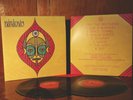
JEAN SCHWARZ "Anticycle II" LP NM/NM Gatefold France Musique Concrète Electronic
$
63


Favourite Auctions
To save auctions to your favourites, please login
If you don't have an account, please register
Description
Jean Schwarz was born in 1939 in Lille into a family of music-lovers. During his childhood he initiated himself into the music of the romantic German composers thanks to his father. He studied the rudiments of music, harmony and percussion at the Versailles Conservatory and played percussion in different professional jazz groups.
In 1961 he listened to an EP record of works by Iannis Xenakis and Pierre Schaeffer; interested in this music, he discovered the existence of the Studio in the Rue de l’Université and joined the Groupe de Recherches Musicales (GRM). He worked as a research instrumentalist before becoming a permanent member of the GRM until 1981. There he made the acquaintance of Bernard Parmegiani’s assistant, Philippe Beetz, with whom he began to compose music for advertising films. This was instrumental music with very little electroacoustics. Thanks to such bread-and-butter work he was able to buy his first Revox and could start on his first manipulations before being able, later, to set up his own studio in the basement of his house in Viroflay.
Erda (1972), composed at the GRM, is an illustration of his earliest research undertaken in a professional composition studio. With the exception of a few guitar notes, all the sounds are of purely electronic origin. He chose, for this work, to compose several short sequences, each being the expression of research based on a clearly defined manipulation and sound colour. Each sequence is also a kind of particular study of rhythm on different materials.
His prime instrument became the tape recorder. His approach has been to record material then work on the sound and the form, using from a few millimetres of tape to much longer sections. He also makes macro sound recordings with elements to be produced, certain sequences of which he develops in the attempt to find a theme. In this way he gathers sound fragments from nature (Year of the horse, 1978), from an urban environment (Surroundings, 1980), or uses synthetic sources as in Il était une fois (1974). This work reveals very extensive technical knowledge in the domain of electroacoustics as well as a deeply theatrical feel for its deployment. It illustrates some of the possibilities of the studio, by confronting moments when the sounds are in a position of conflict or on the contrary harmonise with each other, as compared with other moments when the mechanism of the machine seems to gain the ascendency over playing and body techniques.
Schwarz’s involvement in the electroacoustic domain resulted in 1978 in the creation of the electroacoustic class at the Gennevilliers Conservatory, at the instigation of its director Jean Leber. Jean Schwarz was its teacher from 1979 to 1997. In order to propagate his electroacoustic music, he created his own publishing company, Célia Records, of which he is producer, artistic director and sole composer.
In addition to the pieces for solo tape (Symphonie pour bande, commissioned by the GRM, 1975; Windmills, 1980; Quatre-vingts, 1988; Suite symphonique, 1989; Vent d’est, 1990), Jean Schwarz has composed mixed works such as Klavierband (1978) for piano and tape, Gamma Plus (1979) for synthesiser played live and tape, Olé (1992) for guitar and tape. He has written incidental music as well as ballets, notably for the choreographers Carolyn Carlson (Wheels, 1979; Writings in the wall, 1979; Undici onde, 1981; Still waters, 1986; Dall’Interno, 1998), Françoise and Dominique Dupuy (Comodulation, 1974; Eclats, 1975 ; Danses en liberté, 1978 ; De profundis, 1980 ; L'estran, 2005 ; Le regard par dessus le col, 2007), Larrio Ekson (Roundaboutnow, 1979), Quentin Rouiller (Dune, 1980).
He has also composed very many electroacoustic music sequences for films, notably Providence of Alain Resnais, for which he received the Décibel d’Or in 1977. Also worthy of mention are Ici et ailleurs of Jean-Luc Godard (1976), L’enfance d’hier of Antoine Léotaud (1977), La justice of Serge Moati (1977), Eaux profondes of Michel Deville (1981).
Jean Schwarz attraction to jazz led him quite naturally to write for jazz improvisers, whom he confronts with musical elements pre-recorded on tape. For example, in Surroundings (1979), two jazz musicians are in dialogue with the noises of engines and of crowds previously recorded in the USA. This American chronicle combines electroacoustic sounds with those of spoken voices, uncontrolled sirens and above all a drum set with jazz rhythms, a piano used in the extreme low register and a saxophone superposed on the other elements. For jazz soloists and tape he composed Roundtrip (1977), Blue Chicken (1979), And Around (1981) – a work chosen for the Prix Italia, Medley body music (1988). Finally, in Suite N, a work for solo tape, its material generated or treated by computer, Schwarz includes a truncated quotation from Charlie Parker’s Scrapple from the apple.
An engineer, researcher at the CNRS, attached to the department of ethnology in the Musée de l’Homme in Paris, Schwarz is interested in extra-European music and this also influences his compositions. In Anticycle (1972), for example, for tape and percussionist, the tape was produced in a studio from prerecorded elements of percussion, the work comprising a series of movements ranging from orchestral keyboards to jazz drum sets, via drums, bells and African balafons, the ‘prehistoric’ lithophone and the forty gongs of the ethnomusicology department of the Musée de l’Homme as well as sets of cymbals and kettle-drums. Makinak (1994) features rhythms of various origins, treated on several machines while renewing the writing and using the sampler and the GRM-Tools software. Schwarz shows particular care for rhythm and the percussion. He is interested in the Baschet instruments held in the studios of the GRM and presents, in Sonances (1973), a journey into the world of sheet metal, from the dull hammering that recalls that of the heart to the light metallic clashing that evokes the sea breaking on rocks.
Like a painter, Schwarz composes with a infinite knowledge of colour, he projects sound, controls it, manipulates it with the aim of obtaining maximum purity. He is close to the pictorial art and composed Fotoband (1975) from graphic data of the painter Ekkehart Rautenstrauch. For the composition of this work, Schwarz chose 14 musical signs corresponding to the 14 graphic signs and the 14 colours of the pictorial composition.
A sophisticated colourist, he used in his Symphonie (1975) five families of sounds: flute-like sounds of electronic origin, brass-like sounds of electronic origin, brass and tutti of orchestral origin, concrete sounds, and strings, some of them modified.
Literature has also been a source of inspiration for several works: Bran (1982) for tape, composed to texts by Chateaubriand and Barzaz Breiz; Déclarations (2001) to poems of André Velter; L’odyssée de Kazantzaki (2004) to the poetic work of Nikos Kazantzaki in 33 333 lines of 17 syllables.
His latest large-scale works, collaborations on shows of Bartabas, reveal his interest in the equestrian world: Les juments de la nuit (2008), Darshan (2009), Le centaure et l’animal (2010).
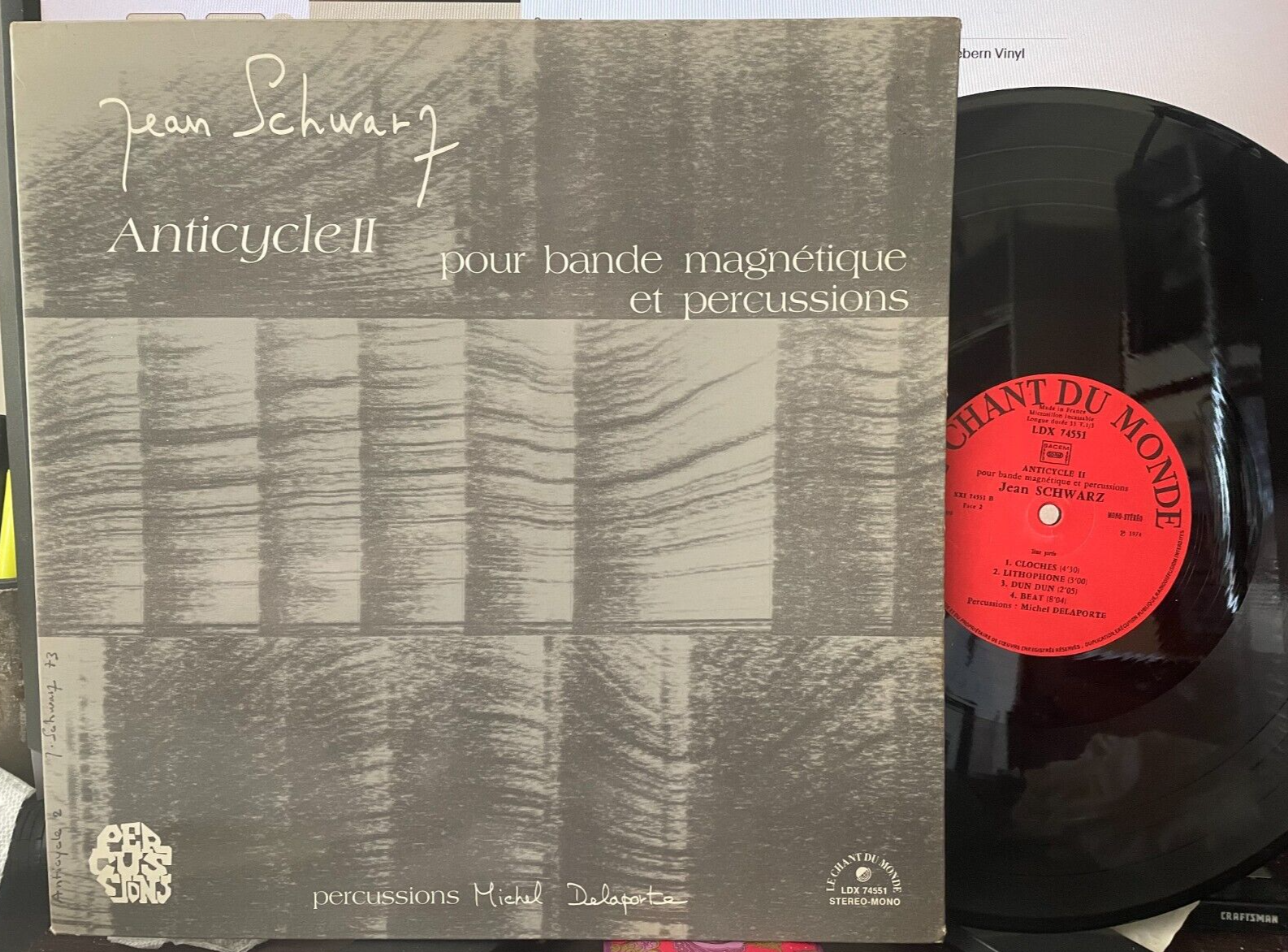
Jean Schwarz – Anticycle II
Jean Schwarz - Anticycle II album cover
More images
Label: Le Chant Du Monde – LDX 74551
Series: Percussions
Format:
Vinyl, LP, Album
Country: France
Released: 1974
Genre: Electronic, Classical
Style: Musique Concrète, Contemporary, Experimental
A1 Xylorimba, Xylafricain
Cymbal, Bongos, Drums, Wood Block [Wood Blocks], Tom Tom [Tom] – Michel Delaporte
7:20
A2 Gongs
Tam-tam [Tam Tam] – Michel Delaporte
4:10
A3 Cymbales
Percussion [Brushes] – Michel Delaporte
4:00
A4 Djimbé
Bongos, Drum [Armpit Drum], Drums – Michel Delaporte
2:55
B1 Cloches
Tabla – Michel Delaporte
4:30
B2 Lithophone
Goblet Drum [Zarb] – Michel Delaporte
3:00
B3 Dun Dun
Drum [Armpit Drum] – Michel Delaporte
2:05
B4 Beat
Snare [Snare Drum], Bongos, Congas [Tumbas], Timbales – Michel Delaporte
8:04
Printed By – Est-Typo-Offset, Vincennes
Composed By, Tape – Jean Schwarz
Layout, Design – Anne-Marie Rechner
Percussion – Michel Delaporte
Tape part realized at the Groupe de recherches musicales de l'O.R.T.F. The original version has 14 movements. Gatefold sleeve.
Matrix / Runout (Label side A): XXI 74551 A
Matrix / Runout (Label side B): XXI 74551 B
Matrix / Runout (Runout side A, Etched): XXI 74 551 A
Matrix / Runout (Runout side B, Etched): XXI 74 551 B
Price Code: Ⓑ
Rights Society: SACEM SACD SDRM SGDL
Other (Label, side A & B): 09
Michel Redolfi - Immersion / Pacific Tubular Waves
Immersion / Pacific Tubular Waves
Redolfi
Released
1980 — France
Vinyl —
LP
Bernard Parmegiani - De Natura Sonorum
De Natura Sonorum
Bernard Parmegiani
Released
1974 — France
Vinyl —
LP, Album
GOLDMINE GRADING
MINT ---- It should appear to be perfect. No scuffs or scratches, blotches or stains, labels or writing, tears or splits. Mint means perfect.
NEAR MINT ---- Otherwise mint but has one or two tiny inconsequential flaws that do not affect play. Covers should be close to perfect with minor signs of wear or age just becoming evident: slight ring-wear, minor denting to a corner, or writing on the cover should all be noted properly.
VERY GOOD PLUS ---- The record has been handled and played infrequently or very carefully. Not too far from perfect. On a disc, there may be light paper scuffs from sliding in and out of a sleeve or the vinyl or some of the original luster may be lost. A slight scratch that did not affect play would be acceptably VG+ for most collectors.
VERY GOOD ---- Record displays visible signs of handling and playing, such as loss of vinyl luster, light surface scratches, groove wear and spindle trails. Some audible surface noise, but should not overwhelm the musical experience. Usually a cover is VG when one or two of these problems are evident: ring wear, seam splits, bent corners, loss of gloss, stains, etc.
GOOD ---- Well played with little luster and significant surface noise. Despite defects, record should still play all the way through without skipping. Several cover flaws will be apparent, but should not obliterate the artwork.
POOR ---- Any record or cover that does not qualify for the above "Good" grading should be seen as Poor. Several cover flaws.
price rating