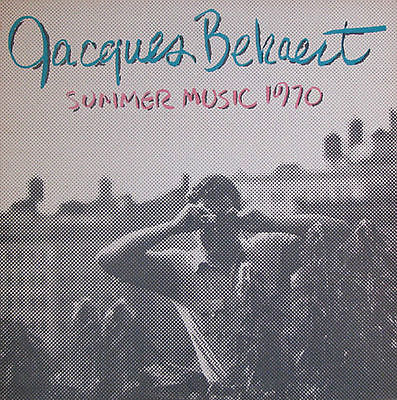
JACQUES BEKAERT Summer Music 1970 LOVELY MUSIC RECORDS Sealed Vinyl LP
$
24


$ 24
Sold For
Jul 1, 2015
Sold Date
Jul 7, 2013
Start Date
1
Number Of Bids
USA
Country Of Seller
eBay
Sold at
Favourite Auctions
To save auctions to your favourites, please login
If you don't have an account, please register
Description
WDCD RADIO * PLEASE CHECK OUR STORE FOR MORE GREAT RECORDS! * WDCDradio
JACQUES BEKAERT
SUMMER MUSIC 1970
Belgian journalist and composer Jacques Bekaert was born May 11, 1940.
Around 1965, Bekaert studied with Henri Pousseur and, in 1968,
worked at Pousseur’s Studio for Electronic Music in Brussels
He settled in New York City in 1968,
earning his life writing articles on US politics for a Belgian newspaper.
His scores combine instructions and poetic imagery
toward interactive and spontaneous creation.
MUSICIANS
E. Jedidiah Denman, bass
Phil Harmonic, piano, accordion and harmonica
Anne Klingensmith, cello
George Lewis, trombone and bowed trombone
Frankie Mann, electric bass and flute
Maggi Payne, flute and psalter
David Rosenboom, violin and viola
Joel Ryan, stereo rotation
John Sackett, clarinets
Mimi Shevitz, voice
Tony Truhang, piano
"Blue" Gene Tyranny, piano
TRACK TITLES
11 for Shirley Johnson
Each person has an instrument.
Sing one sound for as long as possible, then play one sound on your instrument.
Try to have the instrumental sound resemble the sung sound as much as possible.
Do this again and again, little by little coming into unison.
9 for Jean and Virgie Toche
One performer or one singer plays or sings a single sound,
repeating it through the entire performance.
The others play or sing the shortest possible sounds at any time during the performance.
Do not play a melody, just very short sounds.
7 for Sari Dienes
Play or sing one sound as long as you can.
If there is more than one performer, it is not necessary to start together.
Try to lay or sing a beautiful sound.
You may repeat the sound, changing one aspect of it.
6 for Hilde Wood
For one singer and chorus and/or instruments.
The soloist sings one sound as long as possible.
Then the chorus and/or the instruments sing or play one sound as long as possible.
During that time the soloist is free to sing or do whatever he or she wants
(use instruments, machines, walk or dance, etc. ...).
Decide how many times you will repeat it through chance operations.
19 for Alvin & Mary Lucier
Ask Alvin Lucier for one or more tapes of his voice
(Alvin Lucier reading a text about new music, for instance).
Play the tape using a tape recorder and headphones.
The public should not hear the sound of the tape.
The performers try to play the sound of Alvin’s voice.
Eventually several performers can listen to the same tape or loops or different parts of it.
10 for Jean Dupuy
Each performer throws two dice one time.
The number that comes up tells him how many sounds he has to play.
Timing, dynamics, etc., are up to the performers.
The piece is over when everybody has played all his sounds.
The sounds can be produced by any means.
2 for Ariel Ginsbourg
Listen to the clouds in the sky and dream the music,
or play it, considering the form of the clouds.
You can also use photos or pictures of clouds.
(For several live performances we have used sky postcards by Geoff Hendricks as a score.)
17 for George Cacioppo
Copy short fragments of Cassiopeia by George Cacioppo on a transparent plastic sheet.
(Use chance operations to decide how many fragments you will use.)
Put the plastic music score on blank music paper — and play!
20 for Gordon Mumma
Cigar Music
The conductor chooses a cigar (Havanas are the best) and starts to smoke it.
He gives some kind of musical stimulus
(a word, a tune, a few notes, an indication for a musical action, etc. ...).
There are four performers (or groups of performers).
Performer 1 tries to imitate and develop the initial stimulus.
Performer 2 imitates performer 1 but always pp and as slowly as possible.
Performer 3 imitates performer 1 but as fast as possible and mf-ff.
Performer 4 tries to play the contrary of performer 1 (at least in spirit).
From time to time the smoker can feed the musical machine again.
As soon as he starts to do something, performer 1 stops playing.
Then he plays (or sings or dances) according to the new stimulus.
Performers 2, 3, and 4 follow performer 1.
The piece is over when the cigar is smoked.
23 for David Tudor
Card game piece
Take a pack of cards and give several cards to each player
(decide how many cards you give through chance operations.)
Each card represents a certain musical action:
The numbers tell you how many sounds you have to play
(Jack = 11, Queen = 12 and King = 13 sounds).
One ace means one single sound, repeated if necessary
to fill the determined length of time.
The colors indicated the pitch:
a black card = high sounds, more or less
a red card = low sounds, more or less
diamonds = pp
hearts = mf
clubs = ff
spades = mp
If you receive the Joker, you are free to play whatever you want
(in the given length of time).
The King tells you to play in a rather classical style,
the Queen in a romantic fashion, and the Jack indicates a burlesque style.
24 A & B for Jasper Johns
Flag piece
Get one or several recordings of Stars and Stripes Forever by John Philip Sousa.
If necessary, play and record the march yourself.
a) Make a lot of loops using fragments of the taped Stars and Stripes.
Use one channel for each loop.
The original sound can be transformed by any means
(filters, ring modulators, echo chambers, etc.).
b) The sound of the loops is sent directly into headphones.
The performer plays what he hears (or sings it).
The audience does not hear the sound of the loops.
LOVELY MUSIC-VITAL RECORDS 1071
Vinyl Record
STILL SEALED
WDCD RADIO * PLEASE CHECK OUR STORE FOR MORE GREAT RECORDS! * WDCDradio Shipping & Handling: (US) LP's
Priority mail + Delivery Confirmation = $10.00
or: Media mail + Delivery Confirmation = $4.00
International orders will be advised of postage
Payment: We prefer PayPal
price rating