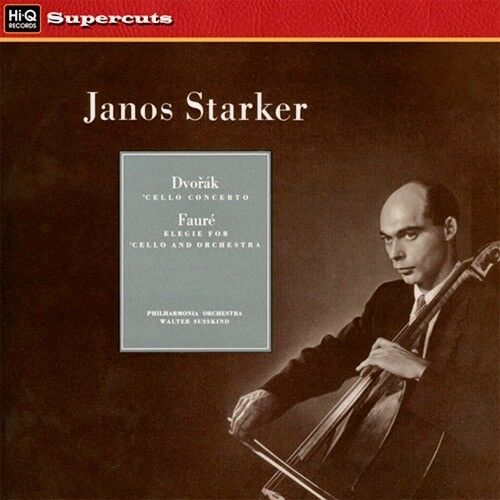
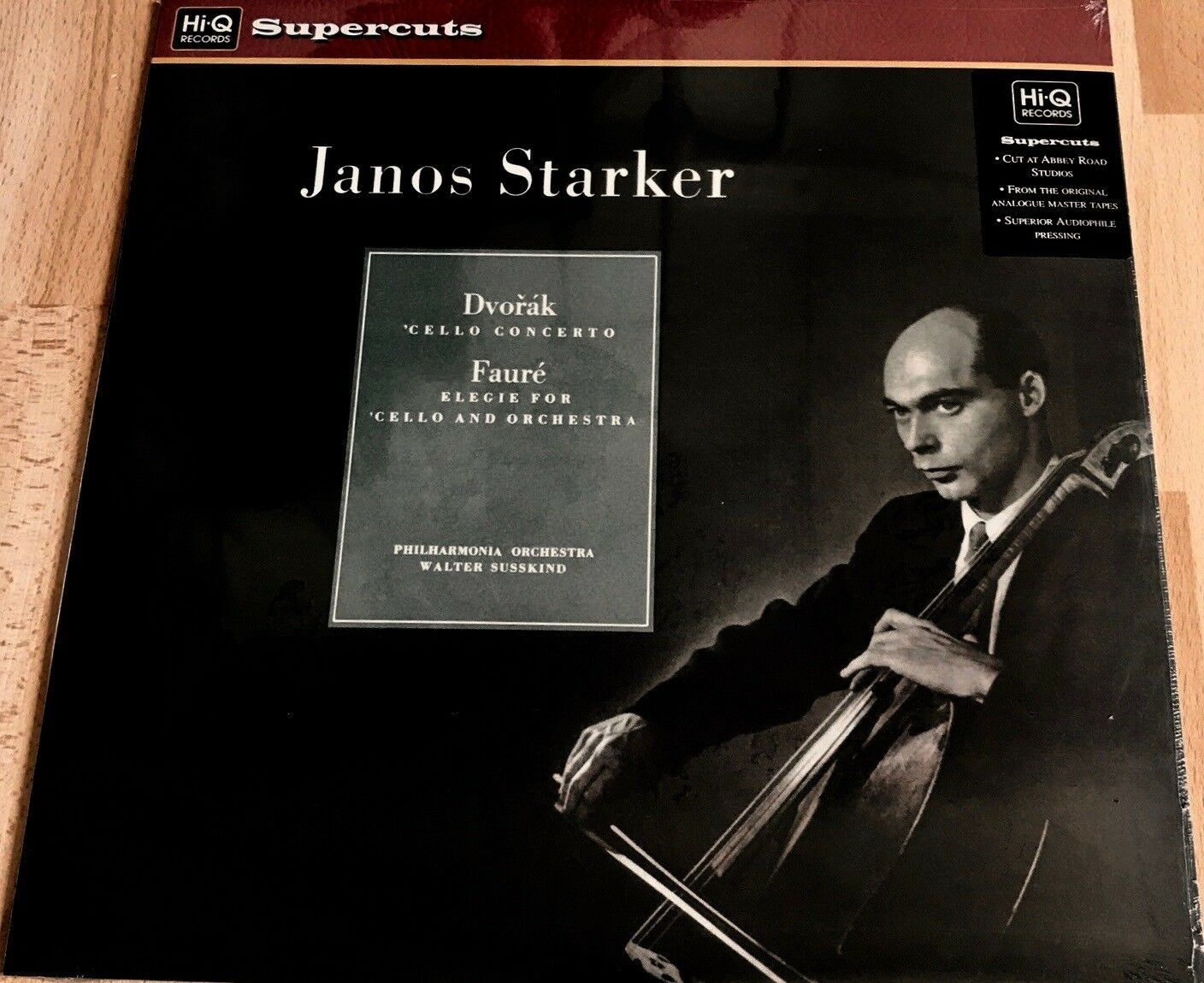
Hi-Q LP-045: JANOS STARKER - Dvorak Cello Concerto, Faure Elegie, UK 2015 SEALED
C$
40
$
28


C$ 40
Sold For
Jun 16, 2020
Sold Date
Jun 5, 2018
Start Date
1
Number Of Bids
Canada
Country Of Seller
eBay
Sold at
Favourite Auctions
To save auctions to your favourites, please login
If you don't have an account, please register
Description
****Welcome to our listing, thanks very much for looking!
****See our own website! We have lots of out of print LPs and CDs! Find us on the web at -
hearthedifference.net
****Shipping cost is only an estimate - it depends on the actual weight and size of the package as well as the service required. We do not profit from shipping costs, so if we overcharge, we will refund the difference back to you. It's always best to wait for our invoice before paying for your item. We will combine shipping for multiple items purchased.
****Please see our other listings - new items added daily!
****To access our eBay store click on the little red door at the top right section of any of our eBay listings or, click on -
http://stores.ebay.com/Hear-The-Difference
Background -
János Starker (July 5, 1924 – April 28, 2013) was a Hungarian-American cellist. From 1958 until his death, he taught at the Indiana University Jacobs School of Music, where he held the title of Distinguished Professor.Cellist Janos Starker was born in Hungary to music-loving Russian parents. His two brothers were violinists, and he was given a cello before he was six. He made public appearances at ages six and seven. Soon he entered the Franz Liszt Academy of Music in Budapest, making his debut there at 11. He had begun teaching other children at eight, and by the time he was 12 he had five pupils. Starker regarded the experience as important to his artistic development. He found himself having to articulate phenomena that students his age rarely grasp, let alone impart to others. Starker was especially influenced by Leo Weiner, a composer who taught chamber music. He said that for more than 50 years Weiner taught every prominent Hungarian musician to learn and understand music as a language.
At 14 Starker made his professional debut playing the Dvorák concerto. He left the conservatory in 1939. After the war, when musical activities resumed, Starker became principal cellist of the Budapest Opera and the Budapest Philharmonic orchestras. Soviet Red Army forces had occupied the country, and the Communist Party was gaining dominance. Starker left the country in 1946 when relatively free travel was still possible.
He gave a successful concert in Vienna, then remained there to prepare for the Geneva Cello Competition, held in October 1946. He won only a bronze medal. "I played like a blind man," he said. "What happens to the bird who sings and doesn't know how it sings? That's what happens to child prodigies." Starker set out to rebuild his technique. He analyzed all aspects of playing, from breathing to the physics of applying muscular force to the bow and the instrument, to phrasing, bowing, and fingering. By October of the following year he had regained his confidence. He decided to stay in the West due to the deteriorating political situation in Hungary, and headed for the United States, where Hungarian musicians had important positions.
Antal Dorati, music director of the Dallas Symphony, made Starker the orchestra's principal cellist. A year later Starker accepted Fritz Reiner's invitation to become principal cellist of the Metropolitan Opera Orchestra. In 1953 Reiner began a brilliant period as music director of the Chicago Symphony, and brought Starker with him to lead the cello section. Starker remained in Chicago until 1958, becoming a U.S. citizen in 1954 and bringing his family to the country. In 1958 he resigned his Chicago position in order to pursue his solo career. In the meantime, he had already begun making important recordings, including an early set of Bach suites. Easing the transition was an offer from Indiana University School of Music to join the faculty on a two-year trial basis. Starker quickly found Bloomington a congenial base, and attracted exceptionally talented students.
Starker's stage demeanor and public persona were rather restrained and undemonstrative. The unwary draw the same mistaken conclusion that also plagued Jascha Heifetz, charging Starker with coldness and lack of emotion. Discerning critics, however, have always tended to speak of the warmth and expressiveness of his playing. Another similarity to Heifetz lies in Starker's very focused tone, with a light, narrow, and quick vibrato. He proclaimed himself happier if, after a concert, people say "What beautiful music Schubert wrote" rather than "How well Starker plays." Similarly, he considered it at least as important to turn out the next generation of fine cello teachers as the next generation of star players. - Joseph Stevenson
Reissue of EMI / COLUMBIA SAX 2263
As the Telegraph obituary put it: 'Starker possessed a phenomenal technique. His bow attacked the strings with both a ravishing intensity and a deep, biting edge. He was equally startling to watch, his piercing black eyes glaring out from beneath deep black eyebrows.' But he wasn't all scary – many a recital programme involved him performing in short sleeves, puffing on a cigarette (he smoked 60 a day) and sipping scotch, interspersed with sharing his low opinions on conductors.
In the original October 1957 mono review in GRAMOPHONE: Lionel Salter somewhat grudgingly conceded that Starker's Dvo?ák was "undeniably a great performance..." but by the time the stereo version was reviewed in January 1959, he seemed more enthusiastic: "Starker's playing is of great virtuosity and often of great poetry..." and concluded the LP was "certainly among the leading recorded performances of this wonderful concerto."
By the mid 1950s, the Hungarian cellist Janos Starker was already a legend and principal cellist for the Chicago Symphony Orchestra under the leadership of Fritz Reiner.
EMI producer Walter Legge arranged for Starker to record all the essential works in his repertoire. This stereo recording of the Dvorak concerto, made at London's Kingsway Hall in 1956, has become a highly collectable LP, here freshly minted from the original stereo masters.
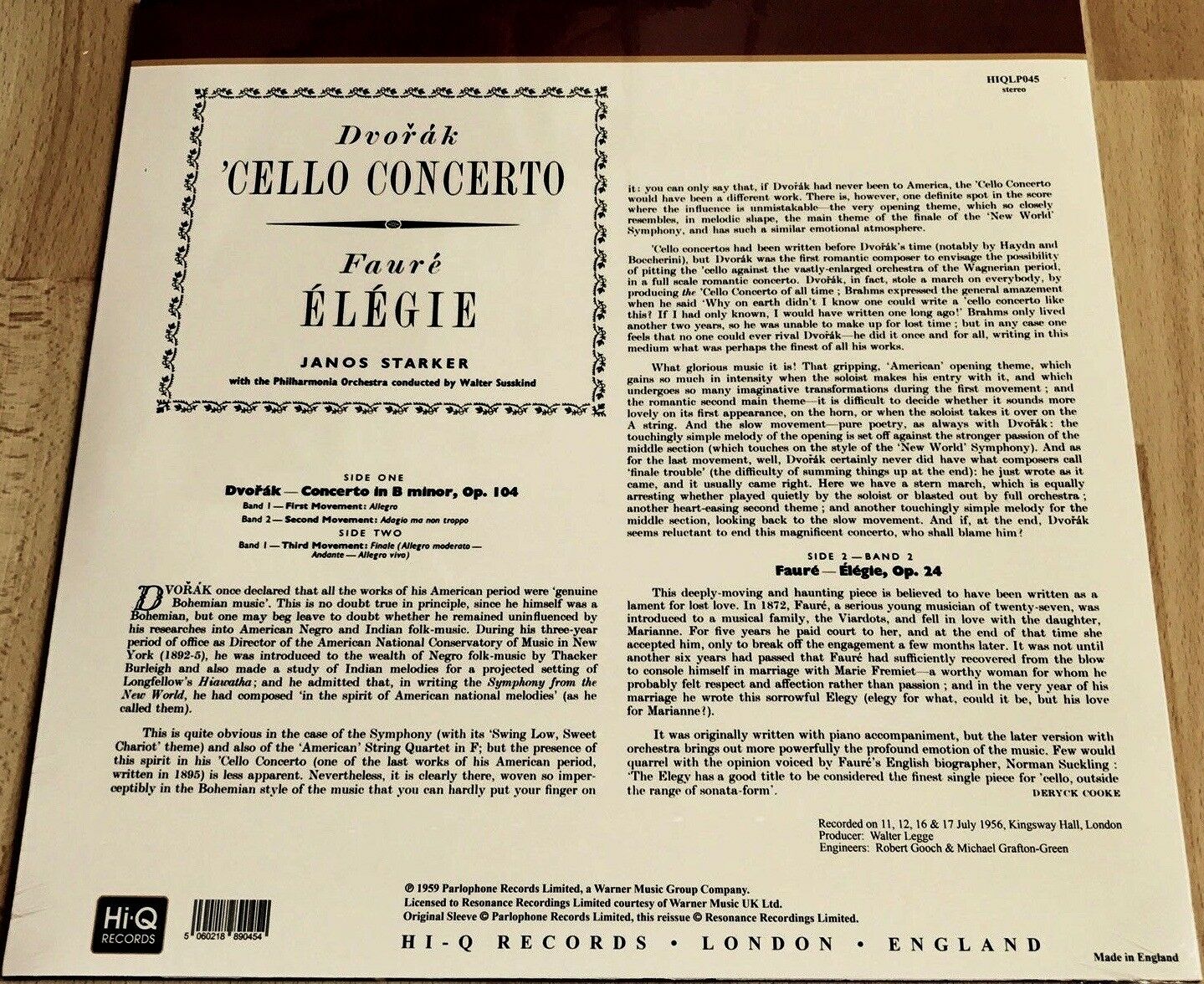
Recorded in stereo on July 11, 12, 16 & 17, 1956 at Kingsway Hall in London, the recording was produced by the legendary Walter Legge and engineered by Robert Gooch & Michael Grafton-Green.
Cut at Abbey Road Studios from the original stereo analogue master tapes with the Neumann VMS82 lathe fed an analogue pre-cut signal from a specially adapted Studer A80 tape deck with additional ‘advance’ playback head, making the cut a totally analogue process.
Pressed on 180g vinyl to audiophile standards using the original EMI presses by The Vinyl Factory in Hayes, England.
-
Hi-Q Records "Supercuts" LP item - FACTORY SEALED
-
Records Made in the UK / England / Great Britain
-
Pressing is in STEREO - recordings are from 1959 - originally issued on the EMI label
-
Limited Edition
-
Record Speed: 33 rpm
-
Record Made issued in: 2015
-
Record Catalog Number: HIQLP045
Featured on this item:
Dvorak / Faure / Janos Starker / Walter Susskind
Title / Music on this Audiophile LP -
Dvorak Cello Concerto / Faure Elegie
Track Listings -
Side A:Anton Dvorak (1841-1904)
Concerto in B minor, Op. 104
1. First Movement: Allegro
2. Second Movement: Adagio ma non troppo
Side B:
Anton Dvorak
Concerto in B minor, Op. 104
3. Third Movement: Finale: Allegro moderato - Andante - Allegro vivo
Gabriel Faure (1845-1924)
4. Elegie, Op. 24
Performed By / Credits on this LP include -
Janos Starker, cello
The Philharmonia Orchestra
Walter Susskind, conductor
Other Information -
• Hi-Q Records Supercuts 180g Vinyl
• Cut at Abbey Road Studios from the original EMI stereo analogue master tapes
• Superior Audiophile Pressing
• Features original album artwork
• Made in England Recorded July 11, 12, 16 & 17, 1956 at Kingsway Hall, London.
CONDITION Details:
LP Jacket:-
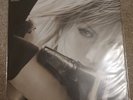
The jacket is in MINT condition - no seam splits or corner dings - FACTORY SEALED!
-
The jacket has NO splits of any kind - it is completely solid and intact, and shows only some very minimal shelf wear.
-
It has NO drill holes or saw marks of any kind.
-
There is NO writing on the front or back of the jacket.
-
The cover has clean and sharp colors - see picture with this listing for more detail.
-
The LP is assumed to be in MINT condition - FACTORY SEALED!
-
This is the mint copy you want for your collection - any super picky audiophile would be happy with this one!
-
As for any record, even brand new, sealed ones, we always recommend a proper record cleaning before playing!
A Short Note About LP GRADING -
- Mint = Only used for sealed items.
- Near Mint = Virtually flawless in every way.
- Near Mint Minus = Item has some minor imperfections, some audible.
- Excellent = Item obviously played and enjoyed with some noise.
- Very Good Plus = Many more imperfections which are noticeable and obtrusive.
price rating



![PETER GABRIEL- Birdy [LP] (Vinyl, Classic Records) 200 Gram Super Vinyl New](https://www.popsike.info/php/thumbnail.php?url=https://www.popsike.pics/pix/20220723/304573164314.jpg)