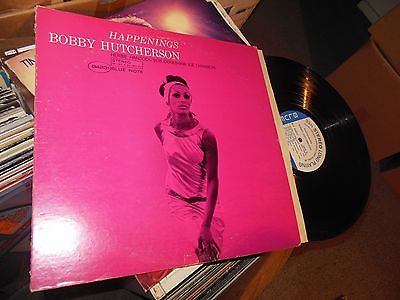
Happenings - Bobby Hutcherson LP STEREO Blue Note Herbie Hancock Joe Chambers
$
33


Favourite Auctions
To save auctions to your favourites, please login
If you don't have an account, please register
Description
LP NM-
Jacket VG+
Artist Biography by Steve Huey
Easily one of jazz's greatest vibraphonists, Bobby Hutcherson epitomized his instrument in relation to the era in which he came of age the way Lionel Hampton did with swing or Milt Jackson with bop. He isn't as well-known as those two forebears, perhaps because he started out in less-accessible territory when he emerged in the '60s playing cerebral, challenging modern jazz that often bordered on avant-garde. Along with Gary Burton, the other seminal vibraphone talent of the '60s, Hutcherson helped modernize his instrument by redefining what could be done with it -- sonically, technically, melodically, and emotionally. In the process, he became one of the defining (if underappreciated) voices in the so-called "new thing" portion of Blue Note's glorious '60s roster. Hutcherson gradually moved into a more mainstream, modal post-bop style that, if not as adventurous as his early work, still maintained his reputation as one of the most advanced masters of his instrument.
Bobby Hutcherson was born January 27, 1941, in Los Angeles. He studied piano with his aunt as a child, but didn't enjoy the formality of the training; still, he tinkered with it on his own, especially since his family was already connected to jazz: His brother was a high school friend of Dexter Gordon and his sister was a singer who later dated Eric Dolphy. Everything clicked for Hutcherson during his teen years when he heard a Milt Jackson record; he worked until he saved up enough money to buy his own set of vibes. He began studying with Dave Pike and playing local dances in a group led by his friend, bassist Herbie Lewis. After high school, Hutcherson parlayed his growing local reputation into gigs with Curtis Amy and Charles Lloyd and in 1960, he joined an ensemble co-led by Al Grey and Billy Mitchell. In 1961, the group was booked at New York's legendary Birdland club and Hutcherson wound up staying on the East Coast after word about his inventive four-mallet playing started to spread. Hutcherson was invited to jam with some of the best up-and-coming musicians in New York: hard boppers like Grant Green, Hank Mobley, and Herbie Hancock, but most importantly, forward-thinking experimentalists like Jackie McLean, Grachan Moncur III, Archie Shepp, Andrew Hill, and Eric Dolphy. Through those contacts, Hutcherson became an in-demand sideman at recording sessions, chiefly for Blue Note.
Hutcherson had a coming-out party of sorts on McLean's seminal "new thing" classic One Step Beyond (1963), providing an unorthodox harmonic foundation in the piano-less quintet. His subsequent work with Dolphy was even more groundbreaking and his free-ringing, open chords and harmonically advanced solos were an important part of Dolphy's 1964 masterwork Out to Lunch. That year, he won the DownBeat readers' poll as Most Deserving of Wider Recognition on his instrument. Hutcherson's first shot as a leader came with 1965's Dialogue, a classic of modernist post-bop with a sextet featuring some of the hottest young talent on the scene -- most notably Freddie Hubbard, Sam Rivers, and Andrew Hill, although drummer Joe Chambers would go on to become a fixture on Hutcherson's '60s records (and often contributed some of the freest pieces he recorded). A series of generally excellent sessions followed over the next few years, highlighted by 1965's classic Components (which showcased both the free and straight-ahead sides of Hutcherson's playing) and 1966's Stick-Up! In 1967, he returned to Los Angeles and started a quintet co-led by tenor saxophonist Harold Land, which made its recording debut the following year on Total Eclipse. Several more sessions followed (Spiral, Medina, Now) that positioned the quintet about halfway in between free bop and mainstream hard bop -- advanced territory, but not entirely fashionable at the time. Thus, the group didn't really receive its due and dissolved in 1971. By that point, Hutcherson was beginning a brief flirtation with mainstream fusion, which produced 1970s funky but still sophisticated San Francisco (named after his new base of operations). By 1973, however, he'd abandoned that direction, returning to modal bop and forming a new quintet with trumpeter Woody Shaw that played at that summer's Montreux Jazz Festival (documented on Live at Montreux). In 1974, he re-teamed with Land and over the next few years, he continued to record cerebral bop dates for Blue Note despite being out of step with the label's more commercial direction. He finally departed in 1977 and signed with Columbia, where he recorded three albums from 1978-1979 (highlighted by Un Poco Loco). Adding the marimba to his repertoire, Hutcherson remained active throughout the '80s as both a sideman and leader, recording most often for Landmark in a modern-mainstream bop mode. He spent much of the '90s touring rather than leading sessions; in 1993, he teamed with McCoy Tyner for the duet album Manhattan Moods. Toward the end of the decade, Hutcherson signed on with Verve, for whom he debuted in 1999 with the well-received Skyline.
All Lps are sight graded
Note: I Do Not Grade inner sleeves, If these are Important to you then you may e-mail me)
RECORD GRADING Based On Goldmine Grading Standards:
Near Mint (NM): A nearly perfect record. There may be one or two small inaudible defects. The record should show no obvious signs of wear. A 45 RPM or EP sleeve should have no more than the most minor defects, such as almost invisible ring wear or other sights of slight handling. An LP jacket should have no creases, folds, seam splits or any other noticeable similar defect. No cut-out holes, either.
Near Mint Minus (NM-): A record that should play mint but has a few slight visible marks. The album will have as much luster as an NM, there just may be some superficial scuffs from the sleeve or very light hairlines that shouldn't be audible. An NM- album cover subjectively fits somewhere in between VG+ and NM.
Very Good Plus (VG+): A Very Good Plus record will show some signs that it was played and otherwise handled by a previous owner who took good care of it. Record surfaces may show some slight signs of wear and may have slight scuffs or very light scratches that don t significantly affect play. Slight warps that do not affect the sound are OK. The label may have some ring wear or discoloration, but it should be barely noticeable. The center hole will not have been misshapen by repeated play. 45 Picture sleeves will have some slight wear, lightly turned-up corners, or a slight seam-split. An LP jacket may have slight signs of wear also and may be marred by a cut-out hole, indentation or corner indicating it was taken out of print and sold at a discount.
Very Good (VG): Many of the defects found in a VG+ record will be more pronounced in a VG disc. Surface noise will be evident upon playing, especially in soft passages and during a song s intro and fade, but will not overpower the music otherwise. Groove wear will start to be noticeable, as will light scratches (deep enough to feel with a fingernail) that will affect the sound. Labels may be marred by writing, or have tape or stickers (or their residue) attached. The same will be true of picture sleeves or LP covers. However, it will not have all of these problems at the same time, just two or three of them.
Good (G), Good Plus (G+): Good does not mean Bad! A record in Good or Good Plus condition can be put onto a turntable and will play though without skipping. But it will have significant surface noise and scratches and visible groove wear. A jacket or sleeve will have seam splits, especially at the bottom or on the spine. Tape, writing, ring wear or other defects will start to overwhelm the subject.
Poor (P), Fair (F): Below good. imperfections will be described.
Please check out my other items for sale. (I offer shipping discounts) I'll Be adding More Daily except for Friday and Saturday.
ALLSHIPPING PRICES ARE FINAL
additional items are 1.50 per item up to 6 within USA (if you are bidding on multiple items lots I have in one listing. you pay each shipping total added together)
Priorty shipping is available e-mail for total
Please Do A One Time payment for combined shipping on all all items won. Request a Final invoice if I have not already combined them for you
NOTE: Gatefold Lps Count as 2 Lps when shipping out of the country
SHIPPING TO CANADA Multiple LP Shipping Rates In USD
1 LP 11.50
2. Lps 13.00
3 Lps 15.00
4 Lps 17.00
5 Lps 26.00
6 Lps 29.00
Multiple Shipping Rates SHIPPING TO Rest Of The World Outside USA in USD
Note: Gatefold Lps Count as 2 Lps
1 LP 17.25
2 LP 20.00
3. Lps 26.50
4 Lps 30.00
5 Lps 48.00 (price jump becuse weight usually takes it to priority mail rate)
6 Lps 51.00
7 Lps 54.00
8 LPs 58.00
9 Lps 61.00
10 Lps 64.00
11 Lps 67.00
12 Lps 70.00
The MAN has to get his cut so Texas residents must add 8.25 % Sales Tax
If you are unsure about shipping costs please do not hesitate to e-mail me.
QUESTIONS:? Please ask. That is what I am here for. (I may not get to them if you wait close to an item's ending.)
MORE PICTURES? Just ask and I'll send them to you
MEDIA MAIL: is not recommended for rare items. Priority mail is faster and safer.
I leave feedback after item arrives and it is left for me. (It's easier to keep up with that way) Please limit your feedback comments to things within the realm of my responsibility.
Thank you for reading all of this :-)
price rating