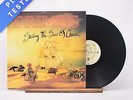
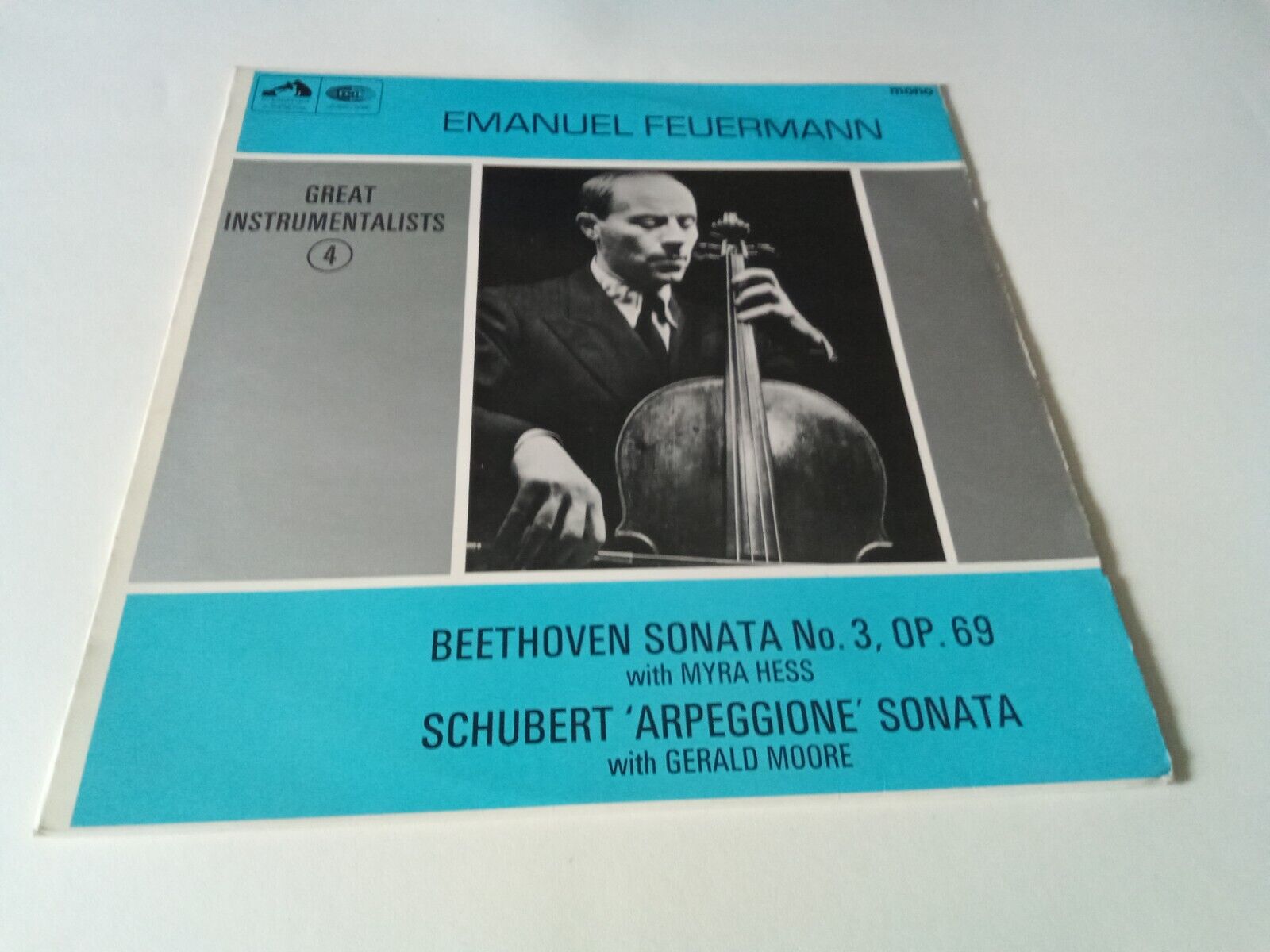
HQM 1079 FEUERMANN BEETHOVEN SCHUBERT CELLO SONATAS HMV LP Vintage Rare EMI
£
125
$
166

Favourite Auctions
To save auctions to your favourites, please login
If you don't have an account, please register
Description
Please see my other items for sale and if you have any questions feel free to ask.
CLANCAL
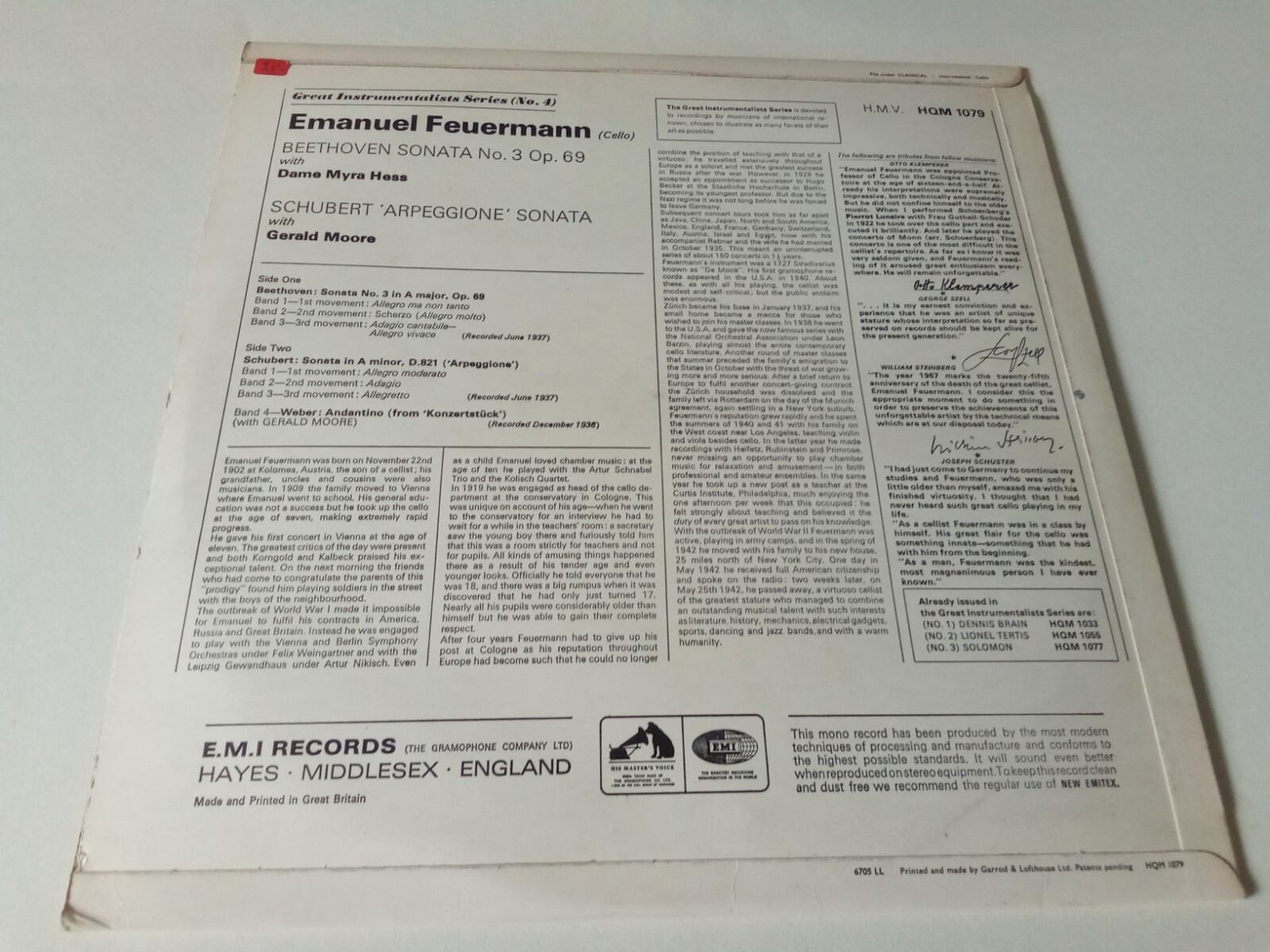
Great Instrumentalists Series (No. 4)
Emanuel Feuermann (Cello)
BEETHOVEN SONATA No. 3 Op. 69 with Dame Myra Hess
SCHUBERT 'ARPEGGIONE' SONΑΤΑ with Gerald Moore
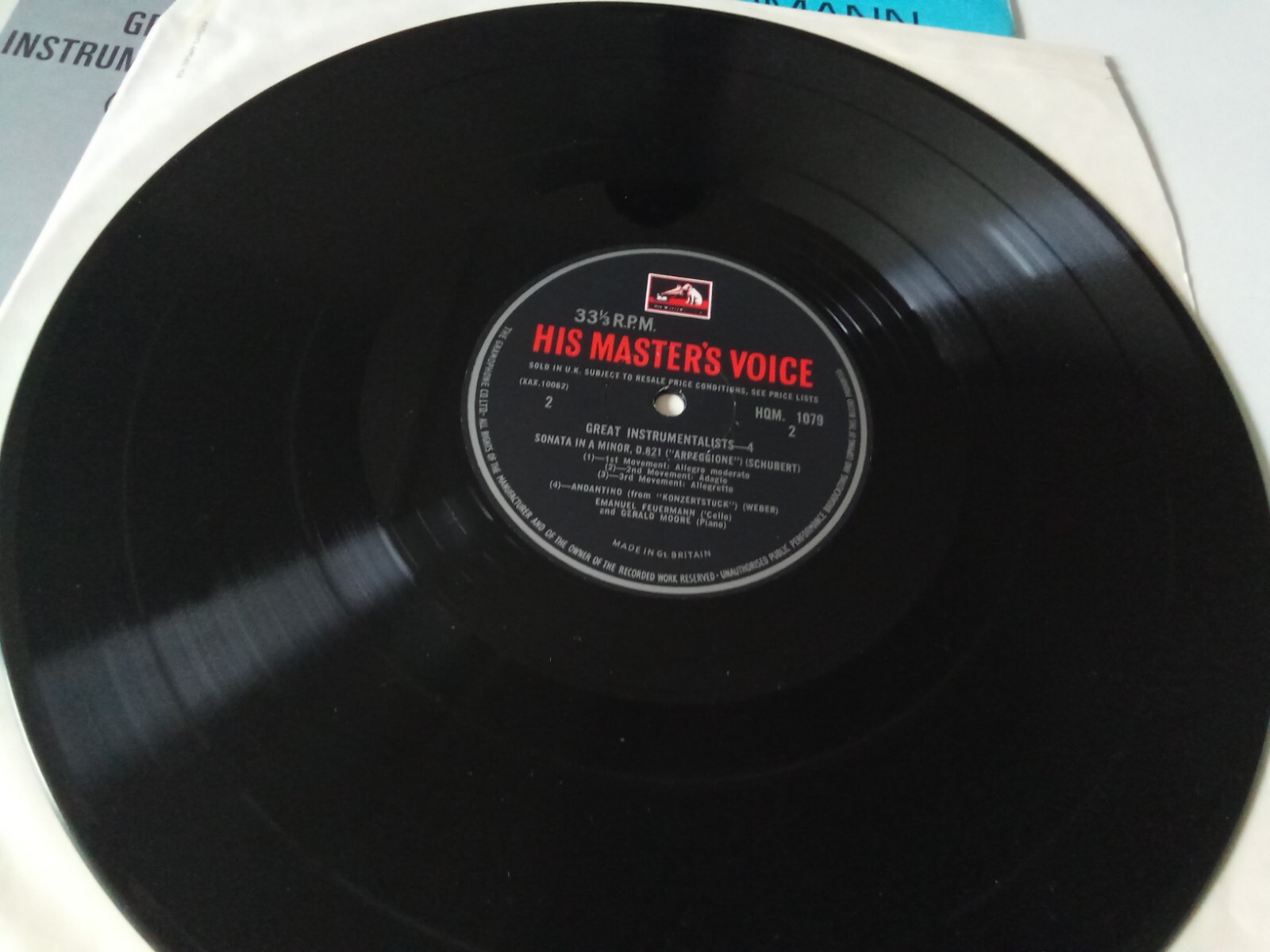
Side Two
(Recorded June 1937) Band 3-3rd movement: Adagio cantabile- Allegro vivace
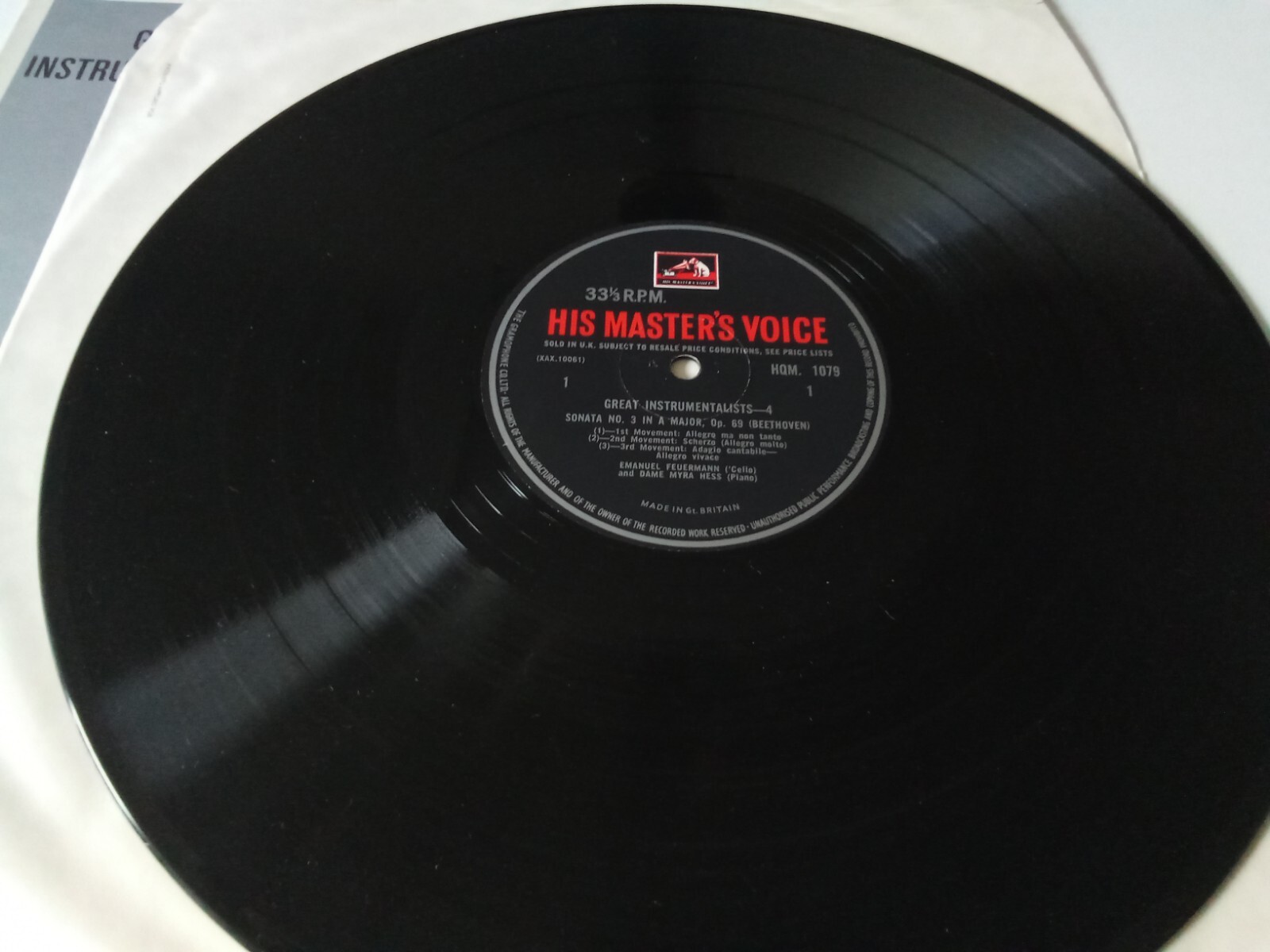
Side One
Beethoven: Sonata No. 3 in A major, Op. 69
Band 1-1st movement: Allegro ma non tanto Band 2-2nd movement: Scherzo (Allegro molto)
Schubert: Sonata in A minor, D.821 ('Arpeggione') Band 1-1st movement: Allegro moderato
Band 2-2nd movement: Adagio Band 3-3rd movement: Allegretto
Band 4-Weber: Andantino (from 'Konzertstück') (with GERALD MOORE) (Recorded December 1936)
Emanuel Feuermarin was born on November 22nd 1902 at Kolomes, Austria, the son of a cellist; his grandfather, uncles and cousins were also musicians. In 1909 the family moved to Vienna where Emanuel went to school, His general edu- cation was not a success but he took up the cello at the age of seven, making extremely rapid
progress. He gave his first concert in Vienna at the age of eleven. The greatest critics of the day were present and both Korngold and Kalbeck praised his ex- ceptional talent. On the next morning the friends who had come to congratulate the parents of this "prodigy" found him playing soldiers in the street with the boys of the neighbourhood. The outbreak of World War I made it impossible for Emanuel to fulfil his contracts in America, Russia and Great Britain. Instead he was engaged to play with the Vienna and Berlin Symphony Orchestras under Felix Weingartner and with the Leipzig Gewandhaus under Artur Nikisch. Even
(Recorded June 1937)
as a child Emanuel loved chamber music: at the age of ten he played with the Artur Schnabel Trio and the Kolisch Quartet.
The Great Instrumentalists Series is devoted to recordings by musicians of international nown, chosen to illustrate as many facets of their art as possible
combine that of a position of teaching irtuoso he travelled extensively throughout soloist and met the greatest success was forced Euro in Russia after the war. However, in 1929 sccepted an appointment as successor to Hugo Becker at the Staatliche Hochschule in Berlin, becoming its youngest professor. But due to the Nazi regime it was not long before to leave Germany. Subsequent concert tours took him as far apart as Java, China, Japan, North and South America, Mexico, England, France, Germany, Switzerland. Italy, Austria, Israel and Egypt, any, Switzerland. accompanist Rebner Egypt, now w with his and the wife he had married In October October or 1935. 1935 This meant an uninterrupted series of about 150 concerts in 15 years Feuermann's instrument was a 1727 Stradivarius known as "De Monk. His
first gramophone te- cords appeared in the USA. in 1940. About these, as with all his playing. the cellist was modest and critical, but the public acclaim wes enormous. self Zürich became his base in January 1937, and his small home became meccs for those who
In 1919 he was engaged as head of the cello de partment at the conservatory in Cologne. This was unique on account of his age-when he went to the conservatory for an interview he had to wait for a while in the teachers' room: a secretary
saw the young boy there and furiously told him that this was a room strictly for teachers and not for pupils. All kinds of amusing things happened there as a result of his tender age and even younger looks. Officially he told everyone that he was 18, and there was a big rumpus when it was discovered that he had only just turned 17. Nearly all his pupils were considerably older than himself but he was able to gain their complete.
respect. After four years Feuermann had to give up his post at Cologne as his reputation throughout Europe had become such that he could no longer
H.M.V. HOM 1079
The following are tribules from fellow mus OTTO KLEMPERERw musiciens
"Emanuel Feuermann was app fessor of Cello in the Colog sixteen-and- toire appointed Pro d-a-half. Al- were supremely at the age of ready his interpretations were impressive, both technically But he did not conf confine himself tomusically. usic. W did not confine himself to the older music. Wh When I performed Schoenberg's Pierrot Lunaire with Frau Gutheil-Schoder in 1922 he took over the cello part and exe cuted it brilliantly. And later he played the concerto of Monn (arr. Schoenberg). This
wished to join his master classes. In 1938 he went to the U.S.A. and gave the now famous series with the National Orchestral Association under Leon Barzin, playing almost the entire contemporary cello literature. Another round of master classes that summer preceded the family's emigration to the States in October with the threat of war grov ing more and more serious. After a brief return to Europe to fulfil another concert-giving contract the Zürich household was dissolved and the family left vis Rotterdam on the day of the Munich
concerto is one of the most difficult in the cellist's repertoirs. As far as I know it wes very seldom given, and Feuermann's read- ing of it aroused grest enthusiasm every where. He will remain unforgettable
Otto Klemperer
GEORGE SZELL
"... stature whose interpretation so far as pre- served on records should be kept alive for the present generation." it is my earnest conviction and perience that he was an artist of unique
WILLIAM STRINBERG "The year 1967 marks the twenty-fifth anniversary of the death of the great cellist. Emanuel Feuermann. I consider this the
appropriate moment to do something in order to preserve the achievements of this unforgettable artist by the technical means which are at our disposal today"
hichin Stricon.
JOSEPH SCHUSTER come to Germany "I had just to continus my
studies and Feuermann, who was only a little older than myself, amazed me with his finished virtuosity. I thought that I had never heard such great cello playing in my
life agreement, again settling in a New York suburb.
Feuermann's reputation grew rapidly and he spent the summers of 1940 and 41 with his family on the West coast near Los Angeles, teaching violin and viola besides cello, in the latter year he made recordings with Heifetz, Rubinstein and Primrose. never missing an opportunity to play chamber music for relaxation and amusement-in both professional and amateur ensembles. In the same year he took up a new post as a teacher at the Curtis Institute, Philadelphia, much enjoying the one afternoon per week that this occupied he felt strongly about teaching and believed it the duty of every great artist to pass on his knowledge. With the outbreak of World War II Feuermann was active, playing in army camps, and in the spring of
1942 he moved with his family to his new house. 25 miles north of New York City. One day in May 1942 he received full American citizenship and spoke on the radio: two weeks later, on May 25th 1942, he passed away, a virtuoso cellist of the greatest stature who managed to combine an outstanding musical talent with such interests as literature, history, mechanics, electrical gadgets, sports, dancing and jazz bands, and with a warm humanity.
"As a cellist Feuermann was in a class by himself. His great flair for the cello was
something innate something that he had with him from the beginning. "As a man, Feuermann was the kindest, most magnanimous person I have ever known."
Already issued in
HOM 1033 HQM 1055 HQM 1077
the Great Instrumentalists Series are: (NO. 1) DENNIS BRAIN (NO. 2) LIONEL TERTIS (NO. 3) SOLOMON
E.M.I RECORDS (THE GRAMOPHONE COMPANY LTD) HAYES MIDDLESEX ENGLAND
Made and Printed in Great Britain
EMI HIS MASTER'S VOICE
This mono record has been produced by the most modern techniques of processing and manufacture and conforms to the highest possible standards. It will sound even better when reproduced on stereo equipment. To keep this record clean and dust free we recommend the regular use of NEW EMITEX.
6705 LL Printed and made by Garrod & Lofthouse Ltd. Patents paniding HQM 1079
price rating