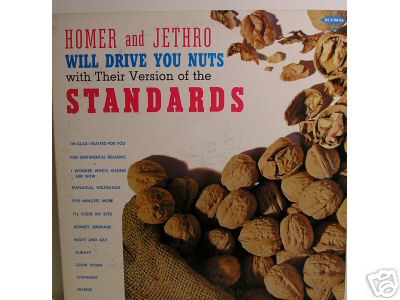
HOMER & JETHRO -Drive You Nuts rare King 639 LP Mint-
$
61


Favourite Auctions
To save auctions to your favourites, please login
If you don't have an account, please register
Description
SCARCE 1959 ALBUM ON THE KING LABEL
Homer & Jethro - "Their Versions of the Standards (Will Drive You Nuts)", mono, on King 639.Record Grade: Mint-
Cover Grade: VG+, minor to average wear, 4" bottom seam split at the opening
Labels: Black and silver crownless, 3" King letters
Song Titles
- Five Minutes More
- Always
- Donkey Serenade
- Glow Worm
- I'm Glad I Waited for You
- For Sentimental Reasons
- Night and Day
- Symphony
- I Wonder Who's Kissing Her Now
- Margie
- I'll Close My Eyes
- Managua, Managua
About the Artist: by Cub Koda
Known as "the thinking man's hillbillies," Homer Haynes and Jethro Burns got a lot of mileage out of an act that shouldn't have lasted or gone as far as it did, at least on the surface of things. Certainly there were other, far more established duos mining similar turf on the country music circuit, with Lonzo & Oscar leading the way. But Homer & Jethro were far more than just two hayseeds doing cornball send-ups of pop tunes. Underneath the cornpone facade were two top-flight musicians with a decidedly perverse sense of humor and a keen sense of satire. Homer D. Haynes was the older of the two men, born in Knoxville, TN, on July 27, 1918. Jethro was born with the decidedly non-show biz moniker of Kenneth D. Burns also in Knoxville on March 10, 1923. The duo met in their early teens and started playing music together almost immediately, with Haynes on guitar and Burns alternating between mandolin and banjo. In the mid-'30s they began working on local radio station WNOX as part of a larger group, the String Dusters. One night, the boys heard a radio broadcast of a pop singer doing a broad — and fairly denigrating — takeoff of a hillbilly singer singing a country tune. Using exaggerated vowel and consonant stressing (trademarks of bluegrass singing) and deliberately going off-key as much as possible, the singer's performance irked the duo to no end. They decided right then and there that payback was the only logical solution to this kind of insult. From here on out, they would take current popular songs and send them up as hillbilly renditions, performed in deadpan earnest by Haynes and Burns, who now took the stage name of Jethro. They started working in the act while the rest of the group took a break during the broadcast. The new duo's "intermission" turn proved to be immensely popular and within four years' time, their characters and their timing were fully honed to a razor edge. By 1938, they had broken off from the String Dusters and moved up to the more prestigious Renfro Valley Barn Dance, later broadcasting on the Chicago-based Plantation Party. World War II split the duo up, with Homer serving in Europe and Jethro serving in the Pacific theater. Getting back together after their respective discharges, they started up their radio appearances again, this time working on the Cincinnati-based Midwestern Hayride. Their recording careers also began during this time period, signing with King Records out of Cincinnati, issuing several 78s between 1946 and 1948. By the end of the year, country producer legend Steve Sholes had signed them to RCA Victor, where they would spend the rest of their recording careers, cutting records — especially in the '60s — as if nothing could contain them. The duo joined up briefly with Spike Jones & His City Slickers, appearing in the stage show for a while, recording at least one session with him in 1950 ("Pal-Yat-Chee"), and letting Jones' agency handle all their bookings. It was in the late '40s into the 1950s, basing themselves out of the Windy City, that the duo hit their true stride. Their first big hit was a takeoff on "Baby, It's Cold Outside" with a quite young June Carter contributing on vocals. The success of this single brought them to the attention of powerful radio station WLS, thus securing Homer & Jethro a regular spot on the National Barn Dance. Joining in 1949, the duo would stay faithful to the original version of the Grand Ole Opry, staying with the show until 1958. The national hookup did wonders for their career, which got an added boost when they started working double duty as regulars on Don McNeil's Breakfast Club, one of the top-rated morning-radio chat shows of its time, also based out of Chicago. The 1950s found them scoring big with numerous guest shots on television. The beauty of Homer & Jethro (as opposed to another country novelty act) was that they could work anywhere and be understood. They could be on the bill with Roy Rogers or trading cornball putdowns with Jimmy Dean or slickly one-upping Johnny Carson, and they always held their own. As time went on, their act became more deadpan and, if anything, even more polished, as if to distance themselves from everything else that had existed before them in their little corner of the country world. State-fair work was replaced with the glitzier surroundings of Las Vegas and the like. RCA Victor Living Stereo album covers aside, Homer & Jethro never had to dress up in bib overalls and play hicks to get their act over. If anything, the straighter they dressed and the straighter they acted, the funnier they were. They were still singing with broad accents, but the satires were getting more acerbic with each release, giving rise to their lasting sobriquet as "the thinking man's hillbillies." Their satire of Patti Page's "How Much Is That Doggie in the Window?" (Homer & Jethro'd into "How Much Is That Hound Dog in the Winder?") became their first crossover hit in 1953. In 1959, the duo won their first — and only — Grammy award for "The Battle of Kookamonga," their hilarious spoof of Johnny Horton's "The Battle of New Orleans," a country crossover record that cut a wide swath on the charts that year. When Southern country humor became a small phenomenon of the 1960s with the success of television shows like The Beverly Hillbillies, Petticoat Junction, and Green Acres, Homer & Jethro's career went into overdrive. They (and RCA Victor) released an avalanche of records like there was no tomorrow, issuing eight albums of new material between 1966 and 1967 alone. Their studio efforts were produced by Chet Atkins with the cream of Nashville sidemen, and one album, Playing It Straight, found them in an all-instrumental setting, showing there were chops aplenty behind the cornball vocals and broad satires. The duo also participated in a wildly successful advertising campaign in the mid-'60s for Kellogg's Corn Flakes, even issuing an album based on the ad's catch phrase, Ooh, That's Corny!, to brisk sales. The duo continued until Homer's death in 1971. Jethro went into semiretirement for a few years, being coaxed back into show business by folksinger Steve Goodman, who brought him out on tour, spotlighting him to much recognition as a fine jazz-influenced mandolinist. Homer & Jethro were inducted into the Country Music Hall of Fame in 2001.
MY GRADING SYSTEMS: I’ve been told that I grade conservatively. My NM (near mint) is my highest grade for opened records (which would also include unplayed records). It’s a 9 or 10 on a 1-10 scale. M- would be equivalent to an 8; VG++ to a 7; VG+ to a 6; VG to a 5; VG- to a 4; G to a 3; F to a 2 and P to a 1. The same scale applies when I grade covers (jackets). Significant defects are specifically noted and taken into consideration in the grade.
GRADING DESCRIPTIONS
RECORDS:- GRADING Grading is based on the following criteria
- Sealed = store stock new
- Near Mint = like new or near new with only one or two small insignificant defects, a 9 or better on a 1-10 scale
- Mint- = extremely nice. Would be Near Mint, except for a couple of light hairlines or scuffs, which do not affect play
- VG++ = still a very nice record with all or nearly all of its original gloss but may have a few more light, surface marks, hairlines, needle tracks or the like which should not materially effect play
- VG+ = a nice, but used record that may have a series of light scuffs or scratches. It probably plays with a few pops, but has no serious problems.
- VG = a well-used record that still should sound OK when played, but may have moderate surface noise, pops, etc.
- VG- = a very well-worn record that plays through without skipping, but will do until a better copy comes along.
- Good = not actually good at all but probably will play through but with much in the way of surface noise, pops, crackles, etc. Still, will have no cracks, chips or the like
- Fair = you’re getting this record just to own but not to play
- Poor = the sky’s the limit, generally I will discard a record this bad (and sell the cover, jacket or sleeve alone) unless the label holds some particular interest
VISUAL GRADING: All records are visually graded only unless I state that they are play-graded. Some labels such as RCA, Capitol, Colpix, Atlantic, MGM were pressed on better quality vinyl and will sound better than a record which visually appears the same on labels such as Crown, Score or Design. Recording techniques also varied. The sound on live albums may be far inferior to studio recordings. There may also be defects in the pressing which are invisible. The point is that an album on RCA graded VG+ may sound far better than an album on Crown graded Near Mint. I have no problem issuing a refund if you are dissatisfied with the sound on a record as long as it’s requested as per my stated return policy below. But please don’t be shocked if a record visually graded Near Mint doesn’t sound state of the art. If I base my grade on a PLAY GRADE, I will state this specifically in my grading section.
COVERS: There are really too many possible defects regarding covers to be as specific in my definitions as I had been with my record grades. But please keep in mind these general grading guidelines:
- I will give greater weight to the condition of the front cover than back cover when assigning an overall grade
- No cover with a cut out hole or saw mark will be graded Near Mint even if it is still in factory shrink and there is no other wear
- I will not reduce the grade of a cover for stickers which are glued to the jacket by the record company (eg. Contains the hit song Tennessee Stud); but will reduce the grade for stickers glued on the cover by stores, previous owners, etc.
- If I write that a cover has a bb hole, I’m talking about a small cut out hole
- A saw mark is a narrow cut in the perimeter of the cover, could be anywhere and vary in length from 1/2” to 2” at the most.
- The overall grade takes into consideration any stated defects. For example, if I grade a cover VG+ and then state it has 6” top and bottom seam splits - I’ve already reduced the grade because of the seam splits. If the seams weren’t split, the cover would be graded higher such as VG++ or Mint-.
Shipping Costs:
The buyer pays for shipping. For one or two albums, the cost for priority mail in the United States is $6.50. For media rate postage within the U.S. the cost will be $3.50 for one or two albums.The cost for shipping a 7” record via 1st class is $2.50 and the cost for shipping a compact disc via 1st class is $3.20.
Save money when I mail 2 or more records in the same package.
Insurance is optional but highly recommended for “high ticket” purchases. Insurance is available only on purchases of over $50.00. The cost for insurance is $2.20 for up to $100; $3.20 for up to $200 and $1.00 additional for each additional $100 of insurance. Rates are quoted in my winning bid notices. The shipping charges for box sets, multi-record sets and other items of non-standard size and weight will be quoted.
International Shipments: Overseas customers are welcome to bid. Postage to the U.K., western Europe and Latin America is $12.00 for airmail and $6.50 for surface for one album. Canada is $6.00 airmail (no surface option). To all other countries, postage is $15.00 airmail and $7.00 surface. 7“ records are $5.50 airmail anywhere in the world. Save on shipping cost per record when I mail two or more records in one package.
Please check out my other eBay auctions
. I’ve been listing all types of records - mostly LP’s - including 50’s and 60’s rock ‘n’ roll, country, folk jazz, blues, personalities, new wave and punk, surf, psych, spoken word, comedy, etc., etc....... I try to list unusual, unique or obscure records, not the ones that you see all the time. While a majority of my listings are albums, you’ll often find a nice selection of 45’s, EP’s or picture sleeves...and an occasional 78 or two.My return policy: I don’t get many returns but customers are important to me so I like to offer a relatively hassle-free return policy. However, in order to return the record or other item, you must notify me by e-mail of your intent shortly after your receipt of the record or other item and within a reasonable time after the auction’s close. Also, the item must be returned in its original condition , i.e. the way it was shipped when it left my hands. While a very high percentage of my records arrive safe and sound (I use professional mailers and a filler or two, more for 78’s), they occasionally are damaged in transit. If that happens, I won’t accept the return of the record or other item - that’s why you have the option of obtaining insurance.
My Feedback Policy: Because I've been burnt on a few occasions, I've decided I'm only going to respond to feedback once it is left for me (and I'll try to do so on a weekly basis if not more often). Most recently, a fellow from Belgium e-mailed me after a couple of weeks and said he never received his Reparata & the Delrons album which he won for $7.50. I told him it was mailed about two weeks before and he should be a bit patient. A couple of weeks later, he e-mails me again and said it didn't arrive. I offered to mail him a copy of my postal receipt if that would make him feel better. Next thing I know, I get negative feedback. When I attempted to leave him an appropriate response, I discovered I had already left him positive feedback. This is about the 4th time this has happened over the years, getting unfavorable feedback thru no fault of my own. Unwarranted negative feedback can end up costing me $. Unfortunately a few bad apples ruin it for the large percentage of honest and reasonable folks.
Any other questions? About anything? Please e-mail me at ibuyvinyl@nc.rr.com .