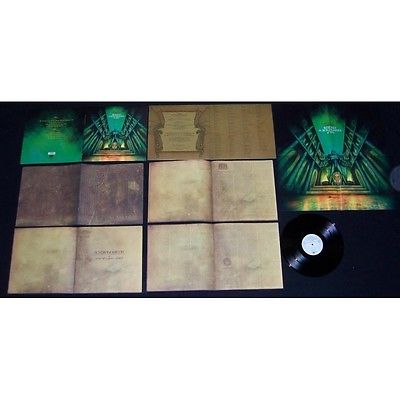
HELLWELL BEYOND THE BOUNDARIES OF SIN NEW LP VINYL BOOKLET MANILLA ROAD
$
26


Favourite Auctions
To save auctions to your favourites, please login
If you don't have an account, please register
Description
NEW. 20 PAGE BOOKLET, CONTAINS ACHERONOMICON STORY BOOK. BLACK VINYL.
SHIP DAILY, INTERNATIONAL WELCOME, PAYPAL ONLY. PAYMENT WITHIN 5 DAYS.I WILL ONLY SHIP TO ADDRESS ON PAYPAL ACCOUNT, AS PART OF MY SELLER PROTECTION PROGRAM.
IF YOU LIKE THIS ITEM CLICK HERE FOR MORE LIKE IT: http://stores.ebay.com/MUSICFRENZY76INTERNATIONAL BUYERS MUST READ AND AGREE TO TERMS BELOW.
SHIPPING & HANDLING.
INTERNATIONAL & THE REST OF THE WORLD.
BOX SETS ARE MORE DEPENDING ON COUNTRY AND ORDER SIZE.
ALSO NOTE WITH CUSTOMS THERE MAY BE A SLIGHT DELAY IN YOU RECEIVING PACKAGE.
FIRST CLASS MAIL INTERNATIONAL IS $20 FOR 1ST ITEM AND $5 EACH ADDITIONAL ITEM.
CANADA IS $15 1ST ITEM AND $5 EACH ADDITIONAL ITEM.
Registered Mail Required on any order over $100 INTERNATIONALLY.
$35 for the first item and $5 for each extra item. $30 For Canada and $5 each extra item.
PACKAGE COMES WITH TRACKING NUMBER.
Any fees of customs and duties are buyers.
THANK YOU.
supHellwell - Beyond the Boundaries of Sin (Article / Feature)
Born out of a decades-long association built upon mutual interest, Manilla Road’s Mark Shelton and long-time friend E.C. Hellwell recently came together to form a new band that merges their shared fondness for heavy metal with their love of the weird and macabre. Converging at last as a songwriting tandem, Shelton and Hellwell co-wrote all of the music for the new project, with the exception of “Deadly Nightshade”, which was originally intended to be a Manilla Road song on Playground of the Damned. Instead, it found new life right in the middle Hellwell’s debut album, Beyond the Boundaries of Sin.
It is of little surprise, of course, that much of the music on Beyond the Boundaries of Sin is reminiscent of Shelton’s primary band, Manilla Road. After all, he has for over three decades worked to forge the unique style of writing that has made Manilla Road such a cult icon within the underground heavy metal scene. A good deal of that distinctive style pervades Hellwell’s music as well, but it is augmented with a heavy employment of keys and synthesizers, which work to establish the foreboding aura best befitting the subject matter common in the band’s lyrics.
To claim that the synthesizer work on the album is not its most immediate and viscerally distinctive feature would be a tough sell indeed, as it introduces its prominence at the very beginning of the album with the intro of “The Strange Case of Dr. Henry Howard Holmes”. E.C. Hellwell is the orchestrator of the keys in this project, utilizing them in order to underscore the riffs, often simply duplicating them in the background to create a deeper and more expansive sound.
Although this technique can at times have the adverse effect of taking a bit of the punch out of some of the more biting riffs on the album (such as the chorus riff on “Eaters of the Dead”, for example), there are an equal number of examples within the album that highlight the poignancy with which the keys are employed. Indeed, one need look no further than the second half of the aforementioned song to find one of the highlights of the entire recording, in no small part due to the solemn keys. The introductory passage of the following song, “Keepers of the Devil’s Inn”, would serve as another fine example of the way in which the keys are used tastefully as a lead, rather than complementary, tool.
Despite the prominence and distinctiveness of the usage of keys on the album, however, there is no question that the core foundation of Beyond the Boundaries of Sin is the songwriting and guitar work of Mark Shelton. In point of fact, a good deal of the riff work on the album sounds more inspired and energetic than on Playground of the Damned, Manilla Road’s latest album from 2011 prior to the release of Mysterium. In particular, the main theme of “Deadly Nightshade” (which, again, was in fact left off of the aforementioned Manilla Road album) is a real highlight of sharp, cutting riff-craft. While other particular passages from “Eaters of the Dead” or “The Heart of Ahriman” could also be cited, the former does appear to have quickly become a favorite amongst fans and the band alike, and not for undue reason.
What Shelton’s writing does not perhaps get credit often enough for, however, is that many of the passages that he writes belie a traditional metal background with his usage of disharmony and technicality. The former has become more commonplace in the post-reunion material, namely from Voyager onward, but technical songwriting, both in structure and technique, has long been a staple of Manilla Road, and the trend has continued in Hellwell.
While his projects may never, mercifully, be mistaken for a ‘technical’ metal band, the subtly unconventional paths that he takes on the way to his musical goals provide a sense of freshness to an all too often stale contemporary traditional metal front. Although Shelton’s writing for this project can perhaps be said to place a greater emphasis on creating halting, staccato riffs than is common in Manilla Road, perhaps due to E.C. Hellwell’s influence—he is, after all, listed as co-author of all of the songs on the album sans “Deadly Nightshade”—the unmistakable riffing style of the Shark is very much intact on Beyond the Boundaries of Sin.
Special note must be made for Mark Shelton’s ability to surround himself with technically proficient, yet structurally conscious drummers. From Rick Fisher to Randy “Thrasher” Foxe, Scott Peters to Cory Christner, and in the case of Hellwell, Johnny Benson, Shelton has always seemed to be blessed with excellent and interesting drumming to support his musical ideas.
Of course, it is best when all of these elements are able to work in synchronicity with one another, particularly with respect to the way that the musical aspect anticipates and complements its lyrical and narrative counterpart. The epic closing track—and concluding chapter of the Acheronomicon triptych, but more on that later—is as fine an example as any.
The 13-minute “End of Days”, while a perfectly strong song on its own merits, should be appreciated in its full context, as its momentum is built off of the two preceding songs, of which it is of course the culminating piece of the tale. It is an apocalyptic treatment of the rise of an ancient race and the subsequent destruction of the planet and enslavement of humanity as a result, thus accounting for the fatalistic and decadent tenor of the song. The faux Eastern scales that introduce the piece serve as a transition, both musically and conceptually, from the previous track, “The Heart of Ahriman”, the events of which set in motion the reality introduced in “End of Days”.
The introductory passage both serves as a token of the journey undertaken by the narrator amongst the “Stygian sands” to retrieve the self-same object of the previous song as well as declares the apocalyptic tone that is the cornerstone of the epic album closer. The song maintains a deliberately oppressive atmosphere in tone and pace, reflecting the harsh and inescapable nature of the world displayed in the lyrics. It is a slow burn, which gradually builds up to one of Shelton’s typically grand and expressive solos, only to dissipate once again into the Eastern theme that introduced the song—a fittingly nihilistic crescendo that acknowledges the hopelessness of the world’s fate.
The time is come
Acheron
Raised from the dust
Acheron
The serpents rise
Acheron
Mankind's demise
Gleaming spires touch the sky
Vampire flights every night
Serpents eyes none can hide
Mortal cries from the fires
In truth, it is the lyrical component above all other features that is perhaps the most creative and unusual aspect of Hellwell. That is because E.C. Hellwell himself is an amateur writer of weird fiction in the vein of H.P. Lovecraft, Robert E. Howard, and Edgar Allan Poe—three authors, obviously, that have had a profound influence on Manilla Road’s own works over the years. Half of the music—the last three songs on the album—is inspired directly from one of Hellwell’s own tales, a previously unpublished piece by the title ofAcheronomicon. While a limited slipcase version of Beyond the Boundaries of Sin included an unabridged publication of the tale in a separate 60-page booklet, it is wholly unnecessary to have read it to appreciate Mark Shelton’s lyrical adaptation of its story.
The narrative of the tale, as on the album, is broken into three distinct segments, entitled “Tomb of the Unnamed One”, “The Heart of Ahriman”, and “End of Days”. It retells the story of Dr. Ashton Clark (an obvious homage to Clark Ashton Smith, a contemporary writer and friend of Lovecraft’s, of whom he himself once paid homage with the figure of the wizard Klarkash-Ton). Clark had been taken under wing by Dr. Phillip Campbell of Miskatonic University, who had let the younger Clark in on his own private studies into the fall of the Acheron Empire and its principle city, Python. Acheron was an alleged pre-cataclysmic civilization of serpent-like men, the evidence for the existence of which has either gone unnoticed or been deliberately buried from the global consciousness.
Were it not obvious by some of the above, much of the weird writing after Howard and Lovecraft is highly self-referential, continually drawing upon its original innovators for creative fodder. Even Lovecraft and his peers actively promoted the idea of a collective mythology and encouraged other writers to use their devices, such as Cthulhu and the Necronomicon, in their own works. This is no different, of course, from any other artistic niche, including heavy metal, so it is no surprise that Hellwell’sAcheronomicon contains all of these references, subtle or otherwise, to its literary touchstones just as the band’s music echoes its own influences and inspirations, even outside of Manilla Road.
In the first section of the tale, and, likewise, the first in the trinity of songs that constitute the Acheronomicon cycle, Campbell leads Clark and a few select others on a clandestine expedition to the ruins of the city of Python. As they tunnel deeper into the ruins, the path opens into a wide chamber, as depicted in the artwork of Beyond the Boundaries of Sin. Within the chamber, the expedition awakens the spirit of the last of the Acheron race, who slaughters the entire entourage, short of Clark, whom the creature enlists as his slave.
It is essentially at this point of the story that the first song, “Tomb of the Unnamed One”, picks up. The verses in the lyrics make up a conversation between Clark and the creature, wherein the core plot point of the narrative is established. Clark is enslaved by the creature, who controls him by reading his thoughts and sending waves of pain through him when his thoughts stray from his objective. That objective is to retrieve the Heart of Ahriman, a magic jewel that will raise the Old Ones and resurrect the fallen city of Python.
“The Heart of Ahriman”—part two of the tale—recounts this years-long search for the gem and Clark’s struggles and failure to shield his thoughts and elude the creature’s control before ultimately submitting to the unnamed one’s will and returning the heart to the ruins of Python, sealing the fate of human civilization in turn.
I found the tomb
Where hid the gem of doom
I feel my master call to me
Into his hands
I gave the fate of man
And now I fear the earth shall bleed
The lengthy, final chapter of the tale, “End of Days”, is a simple account of the rise of the Acheron Empire and the slow dissolution and destruction of the world of mankind. Over a period of years, the serpent creatures war with humanity and overthrow civilization, enslaving their prey when not feasting on their flesh as a delicacy.
While Shelton’s lyrics do not recount the fate of Ashton Clark, Hellwell’s tale explains that the Acheronomicon is Clark’s own writing. The unnamed one ‘granted’ him what he soon realizes is eternal life after he takes a gun to his head with no lasting ill effects. It is only after a period of hundreds of years that Clark recounts his story in writing, hoping that in some way it may serve a purpose in the future. Reflecting that he has tried and failed countless times to stifle the flame of his guilt-ridden existence, he reasoned that he may yet live to see the Acheron Empire fall once again. As he stares out into the distance from the window of his room in one of Python’s many spiraled towers, however, the hope of such a future seems futile at best.
Inside the temple of the Old Ones
The Heart of Ahriman still beats
Bringing the plague of decimation
The likes the world has never seen
The age of man is gone forever
The sons of demons rule the earth
Born out of fire a new world order
Posted by Dodens Grav in Latest News on Mar 07, 2013
reme
price rating