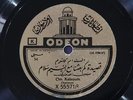
Greek JEWISH SEPHARDIC STELLA CHASKIL Haskil Kalfopoulos Perpiniadis Takis Bini
$
40


Favourite Auctions
To save auctions to your favourites, please login
If you don't have an account, please register
Description
A series of great early Opera performances: From 1902 G&Ts to 40s wartime German records:
her parents in 1911, in Thessaloniki, where her odyssey begins. He marries Haim Gaegos in 1911 and brings to the world 5 girls:
the Rakhil (1912 - 17 December 1998),Great recordings of Greek Rebetiko from Greek Odeon and Parlophone Masters recorded in Athens or Saloniki
Soúla Kalfopoúlou - Stellákis Perpiniádis - Tákis Bínis
Xanagyrnó Sto Ftochikó
Written-By – A. Márkou, Sp. Kalfópoulos
And the great Jewish Sephardic Greek Singer Stella Chaskil before her untimely death in 1954
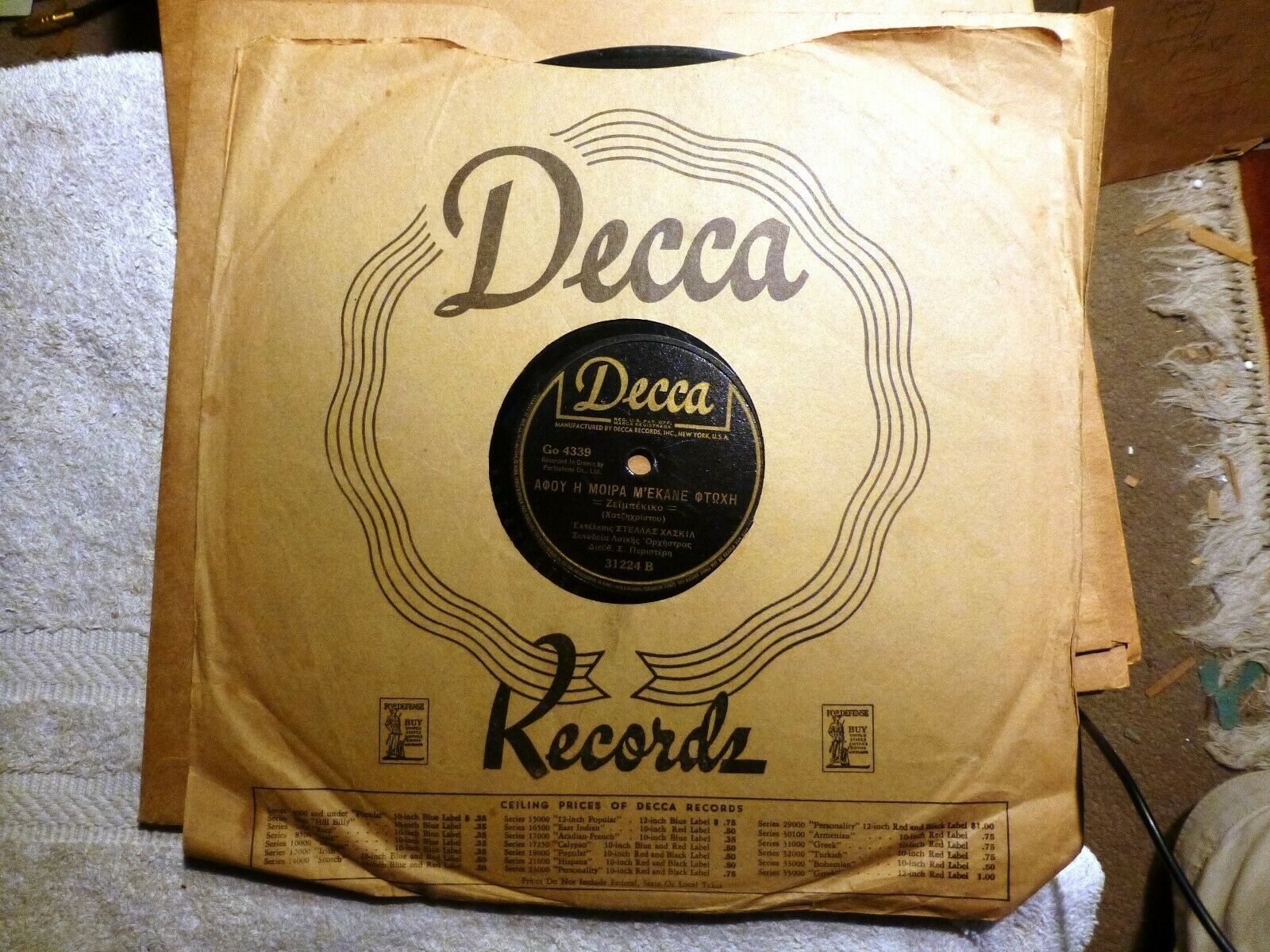
Stélla Chaskíl Afoú I Moíra M' Ékane Ftochí
Conductor [Orchestra] – S. Peristéris*
Written By – E. Chatzichrístos
Notes
? Made in Greece
? Synod. Laïkís Orchístras
? ''Zeïb.'' stands for Zeïmpékiko [Zeimbekiko], a Greek dance style.
10" 78 rpm record
Condition:
VERY GOOD, some wear, deep scratch on Kalfopoúlou, rim chip on Haskil 4 mm into grooves, causes rare clicks at start. Plays quiet w some crackly swish
Stella Haskil (real name: Stella Yehaskel, Thessaloniki, 1918 - Athens, February 27, 1954) was a leading Greek performer of rebetiko.
Biography
Her father's surname is Gage. Her father, Haim Gaegos, is one of the few who have become known to him through narratives of relatives, saying that he had a great age difference from his wife and mother Stella Haskil, as the exact date of birth remains unknown.
It is only assumed that he was between 1870 and 1875. Born in Thessaloniki, very wealthy, apparently due to his profession, the iron trade. From his daughters nothing was missing, he took care of their dowry, still all at a very young age. Unfortunately, however, with the German invasion of Thessaloniki, everything became ashes and he died around 1941 - 42.
Her mother, Perla Kamchi, born in Skopje in 1890, of Balkan origin, arrives with
Assyria (1914 - 1934 or 1936),
Stella (1918 - 1954),
Elli (Lili) (1920 - 1982) and
the Gifts (1925 -).
About 1927 - 28, we find her reunited with Andrea Dapollas. With him, on December 25, 1929, she acquires her last daughter, Marika. Perla leaves life around 1961.
A premier feature of the rebetiko song, in her short life, she managed to record her wonderful voice in 102 amazing performances first voice and 30 more second voice.
In 1945, she married Jacob Jehaskell, and in her professional life she used the artistic nickname Haskil.
He first appeared in Thessaloniki before the war and later went down to Athens where he began collaborating with all the great composers of the time: Vassilis Tsitsani, Apostolos Hatzichristo, Markos Vamvakaris, Manolis Chiotis, Apostolos Kalodas.
The first song he recorded with the adjective Haskil on the disc was George Lavka's "Sevilleans" in 1947. In 1934 he had recorded two records with Gage's father pre-war, 2 of which were amane. In the 7 years left, she was lucky enough to record some of Tsitsani's best-known songs ("Seaside Sunset", "Arab Flower", "Gul Bahar", "Some Mom Sighs", "Poverty the Rags"), by Kalda ("Night Without a Moon"), by Vamvakaris ("In the Butcher Market"), Chiotis ("I Want a Man to Love") and many other artists.
Stella Haskil's voice had the rigor of classical rebetiko, as well as the flexibility of the great voices of elementary and folk.
He died at the age of 36 in Athens on February 28, 1954.
On December 21, 2005, at the age of 82, the great folk singer, composer and bass player Takis Binis passed away. He was born in Thessaloniki in 1923 and in 1950 made his first recordings, released on 78-gram discs by Odeon - Parlophone.
Stelios Perpiniadis (May 14, 1899 - September 4, 1977), also known as Stellakis, was a Greek folk singer and instrumentalist and is also a composer, mainly of rebetiko song.
Biography
Born in 1899 in Tinos, he grew up in Constantinople and in 1923 moved to Piraeus, where he came into contact with Asia Minor rebetes. He has collaborated with almost all major composers from time to time, such as Panos Tountas, Yovan Chau, Costas Skarvelis, Costas Karipis, Vangelis Papazoglou, Vassilis Tsitsanis, Stelios Chrysinis, Baatein Saiipanis, Bayanis Saiipanis, Baianis and Markos Vamvakaris and later with George Mitsakis, Manolis Chiotis and others. He is considered to be the biggest star of the song from 1930 to 1950 and has done several duets with well-known performers and performers of the time, such as Ioanna Georgakopoulou, Stratos Paioumtzis, Marika Ninou and Dimitrios Perdikou Perdikou Perdikopoulos. It is worth noting about the ethos of artists of the genre and era that Stellakis did not hesitate to make a second voice and even very discreetly to artists whose names were in front of his own. One day in 1938 he was found passing by Odeon while Markos Vamvakaris was recording his "Delicious Black". Stellakis did not hesitate to sit down to make a second voice. The result was a masterpiece from the one that would come out of Mark Solo, but Stellakis didn't get a drachma and his name was not written on the record because he was at that time bound by an exclusive contract with Columbia.
His son was also the well-known folk singer Vangelis Perpiniadis.
Stelios Perpiniadis died on September 4, 1977 in Athens.
price rating