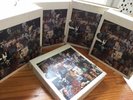
Gilberto Gil LP 1969 1st Press SOM Brazil Import Lyric Sheet MPB, Psych
$
245


Favourite Auctions
To save auctions to your favourites, please login
If you don't have an account, please register
Description
Gilberto Gil LP 1969 1st Press SOM Brazil Import Lyric Sheet MPB, Psych Lyric Sheet Archival Sleeve The coolest of the Cool .... Essential
Gilberto Gil (Cérebro Eletrônico) to differentiate it from Gil's other self-titled releases is the third solo album by Gilberto Gil, originally released in 1969. The album was arranged by Rogério Duprat, and has a strong element of psychedelic rock to it, being considered by some to be his most experimental album. Since Gil was not allowed by the Brazilian military dictatorship to leave Salvador, Bahia, before being exiled to London, he recorded vocals and acoustic guitar in Salvador, and Rogério Duprat recorded the other instruments in Rio de Janeiro and São Paulo.
The album has one of Gilberto Gil's most famous songs, "Aquele Abraço" ( "That Hug") is a song in the samba genre. Written during a period of military dictatorship and cultural censorship in Brazil, the lyrics invoke neighborhoods, landmarks, samba schools and popular culture figures of Rio de Janeiro. It was released as the third track, with an expanded version as track 11, on Gil's third album Gilberto Gil, issued by Universal in 1969. On the tracks, he introduces the song as being "for Dorival Caymmi, João Gilberto and Caetano Veloso," all major Brazilian singer-songwriters.
Gil was inspired to write the song on Ash Wednesday of 1969, his last day before leaving Rio, shortly after he had been released from detention in a military prison in the neighborhood of Realengo, referenced in the song lyrics. Upon his return to his home town of Salvador, he was placed under house arrest, where he developed the melody and instrumentation and made the recordings. Although Gil was exiled to Europe by the summer of 1969, the song became a major hit in Brazil, with an extended stay at the top of the charts, and in August 1970 it was awarded the Golden Dolphin (Golphino d'Ouro) prize from the Sound and Image Museum (Museu da Imagem e do Som) in Rio. However, Gil refused to accept the prize, writing an angry response in the counter-cultural Brazilian journal O Pasquim titled "Rejeito + aceito = rejeito" [reject + accept = reject].
Among the cultural references in the lyrics are the fans of the Flamengo football team, the popular television personality Chacrinha, young girls of the favelas, the samba school Portela, and the Carnaval street parade Banda de Ipanema. In an interview in O Pasquimshortly after his exile, he explained that the song was his way of capturing the joy and happiness he had seen on the streets, which he had not felt for some time--"my intention was really, very simply, to give an embrace to the people of Rio...It was a song of encountering, not leaving." In that same interview, Gil also addressed the controversy of whether he had taken the title phrase "Aquele Abraço" from the popular Rio television personality Lilico. Gil asserted that he had never seen Lilico's show and that the phrase had existed in the Brazilian imagination for a long time, used in the same nostalgic sense that he had invoked in his song. The song has since achieved an iconic status in Brazilian popular culture and was performed by MPB artists Marisa Monte and Seu Jorge at the closing ceremony of the 2012 Summer Olympics in London, as part of the preview of the 2016 Summer Olympics in Rio de Janeiro.
Gilberto Passos Gil Moreira (born 26 June 1942), is a Brazilian singer-songwriter and politician, known for both his musical innovation and political activism. From 2003 to 2008, he served as Brazil's Minister of Culture in the administration of President Luiz Inácio Lula da Silva. Gil's musical style incorporates an eclectic range of influences, including rock, Brazilian genres including samba, African music, and reggae.
Gil started to play music as a child and was a teenager when he joined his first band. He began his career as a bossa nova musician and grew to write songs that reflected a focus on political awareness and social activism. He was a key figure in the música popular brasileira and tropicália movements of the 1960s, alongside artists such as longtime collaborator Caetano Veloso. The Brazilian military regime that took power in 1964 saw both Gil and Veloso as a threat, and the two were held for nine months in 1969 before they were told to leave the country. Gil moved to London, but returned to Bahia in 1972 and continued his musical career, while also working as a politician and environmental advocate. Known internationally, the album Quanta Live at the 41st Annual Grammy Awards, it won the award for Best World Album and album Eletracústico won Grammy Award—Best Contemporary World Music Album.
price rating



![Roky Erickson - Gremlins Have Pictures 180gm Vinyl [Vinyl New]](https://www.popsike.info/php/thumbnail.php?url=https://www.popsike.pics/pix/20151222/141858995469.jpg)