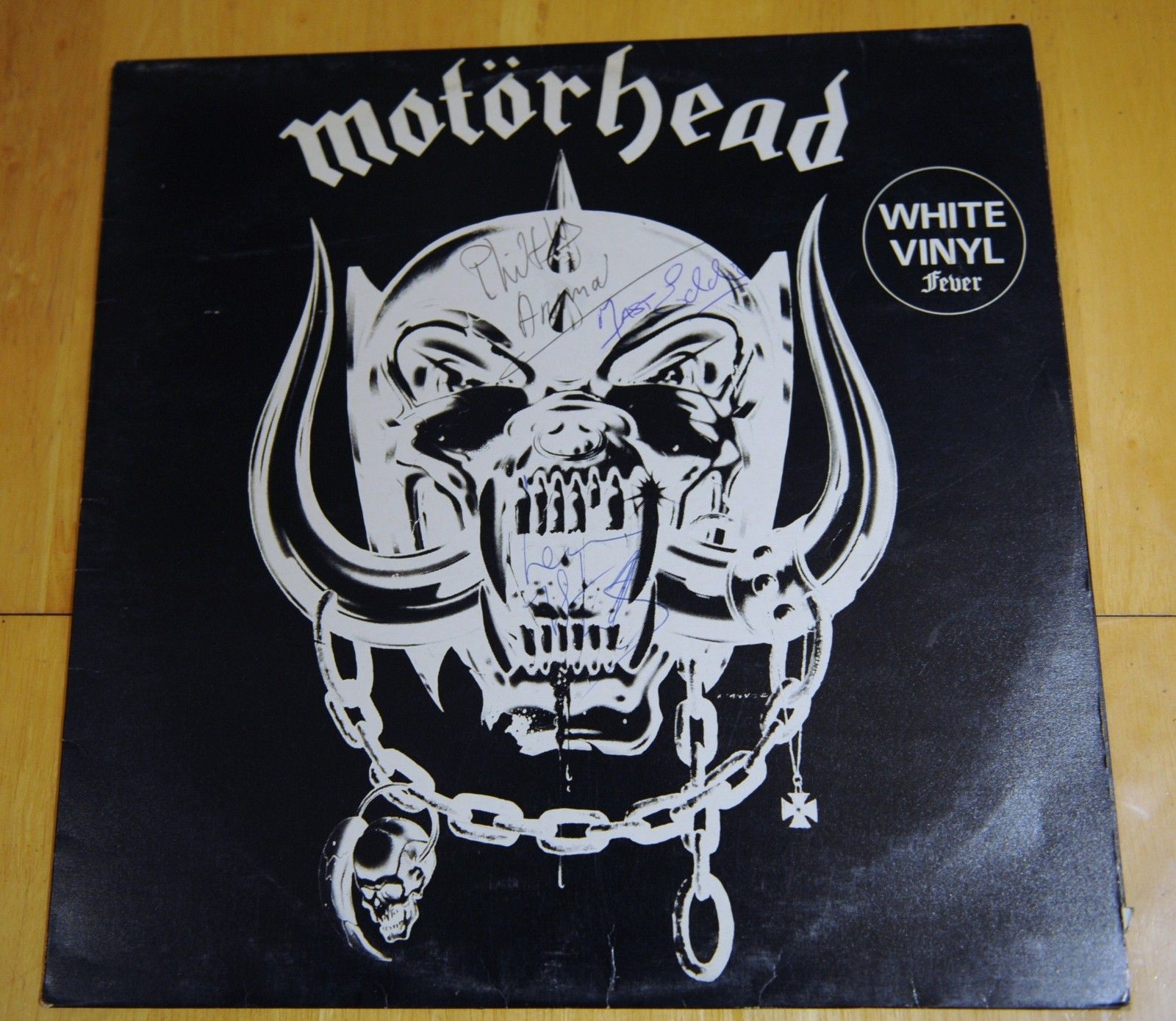
FULLY SIGNED MOTORHEAD WHITE VINYL LP 1978 Chiswick Records CWK 3008
£
221
$
293


Favourite Auctions
To save auctions to your favourites, please login
If you don't have an account, please register
Description
BETTER PICS COMING SOON
MOTORHEAD - MOTORHEAD
LTD EDITION WHITE VINYL LP - FULLY SIGNED SLEEVE BY THE BAND Chiswick Records CWK 3008
UK White Vinyl LP NOV 1978
VERY GOOD CONDITION
ORIGINAL WHITE VINYL CLASSIC LP
FULLY AUTOGRAPHED BY LEMMY, FAST EDDIE AND PHILTHY
AWESOME!!!
FULLY SIGNED COVER BY LEMMY & FAST EDDIE IN BLUE BIRO PHILTHY ANIMAL HAS SIGNED IN BLACK BIRO
OBTAINED BY ME SOMETIME IN 1980 AT HMV RECORDS IN BIRMINGHAM WHERE THEY WERE SIGNING RECORDS
SADLY TWO OF THE ABOVE HAVE PASSED ON TO THE GREAT GIG IN THE SKY
SO THIS IS A RARE AND DESIRABLE, FULLY AUTOGRAPHED RECORD BY THE CLASSIC LINE-UP
IN VERY GOOD CONDITION - IT HAS BEEN IN A PLASTIC SLEEVE ALL OF IT'S LIFE JUST A SMALL AMOUNT OF WEAR
WHITE VINYL RECORD ALSO IN VERY CONDITION 'CHOP AND SNIFF' / ' WHITE VINYL FEVER' ETCHED ON RUNOUTS
BLACK INNER SLEEVE
LTD EDITION ONLY 10,000 WERE PRESSED
AND I BET NOT MANY ARE FULLY SIGNED BY THE BAND
FREE POSTAGE TO UK
38 YEARS OLD AND STILL A FAB ITEM!!! SEE PICS
Check out my other items!
Motörhead – Motörhead
FULLY SIGNED MOTORHEAD WHITE VINYL LP 1978
Chiswick Records CWK 3008
UK White Vinyl LP NOV 1978
Tracklist
Motörhead Vibrator Lost Johnny Iron Horse / Born To Lose
White Line Fever Keep Us On The Road The Watcher The Train Kept A-Rollin
Credits Artwork [Logo] – Joe Petagno Engineer – John Burns Executive-Producer – John Burns, Motörhead Photography By – Lensy, Motorcycle Irene Producer – Speedy Keen Notes 1977 Chiswick Records Recorded at Escape Studios' Kent Remix at Olympic Studios, London
Printed in England Manufactured and distributed by EMI Records, Ltd.
White vinyl version
Barcode and Other Identifiers Matrix / Runout (Run-out A-Side): WHITE VINYL FEVER ¦ CWK+3008+B Matrix / Runout (Run-out B-Side): CHOP AND SNIFF ¦ CWK+3008+A Matrix / Runout (A-Side): CWK 3008-A Matrix / Runout (B-Side): CWK 3008-B
Motörhead is the self-titled debut album by English rock band Motörhead, released in August 1977.
Background
In May 1975, bassist Ian "Lemmy" Kilmister was fired from Hawkwind after he was arrested at the Canadian/US border in Windsor, Ontario on drug possession charges. Lemmy also explained to Classic Albums that he had been at odds with the band because he "did the wrong drugs, you know, I didn't do the designer drugs...I did the street stuff, so I was massively unpopular for that". From there, he went on to form a new band called Bastard with guitarist Larry Wallis (former member of the Pink Fairies, Steve Took's Shagrat and UFO) and drummer Lucas Fox. In 1976, after changing the band's name to Motörhead, the group signed with United Artists and recorded songs for an album at Rockfield Studios in Wales, but the record company, which doubted its commercial viability, refused to release it. On 1 April 1977, disheartened by their experience with UA and their lack of success in general, the band – which now consisted of drummer Phil "Philthy Animal" Taylor and guitarist "Fast" Eddie Clarke, decided to disband after playing one final show at the Marquee Club in London. As Clarke recalls in the documentary The Guts and the Glory, "It was going to be our farewell gig. I said, 'Let's get a mobile down at least to record the fuckin' year and a half we've been together', and put something on the fuckin' tape, you know?" The band asked Chiswick label owner Ted Carroll to record the show but, according to Clarke, "the problem with the Marquee was they wanted 500 quid for doing a recording at the Marquee. Well, that was out of the question in those days". Carroll then offered the band two days at Escape Studios in Kent to record a single with producer John "Speedy" Keen. As Clarke explained to John Robinson of Uncut in 2015, the band finished the gig at the Marquee and drove straight to the studio in Kent: "That was Friday night, so we had all Saturday and Sunday. We'd been playing these songs for a year, so we thought fuck it, we can do an album. In a few hours we had all the backing tracks down. Put the vocals down. Bit more speed, put some more guitars on. Few more beers – we were fucking steaming. Come Saturday night, we'd nearly finished it". As biographer Joel McIver recalls in his book Overkill: The Untold Story of Motörhead, "As the story goes, by the time Carroll came back to the studio to hear the results, the band had recorded no fewer than 11 tracks. Impressed, he paid for more studio time to allow them to complete an album. The album did well enough to ensure the band would remain together, but it would be their next album, 1979's Overkill, that proved to be their true breakthrough".
Recording
For their eponymous album, the band chose to re-record the United Artists album in almost its entirety; only Fools and Leaving Here weren't re-recorded at these sessions. In addition, two new self-penned compositions, White Line Fever and Keep Us on the Road, were added, as well as a cover of Train Kept A-Rollin. Three tracks on the album were written by Lemmy when he was with Hawkwind, including "Motorhead", "Lost Johnny," and "The Watcher," the latter a psychedelic acoustic piece. Like the band name itself, the song "Motorhead" (About this sound sample (help·info)) is a reference to speed – Lemmy's drug of choice at the time – and was coupled with the non-album track City Kids for release as 7" and 12" singles. In his autobiography White Line Fever, Lemmy recalls that producer Speedy Keen and engineer John Burns "were speeding out of their heads because they couldn't afford to go to sleep – they didn't have time, and they wanted to make an album as much as we did. They mixed twenty-four versions of Motörhead alone!" In the Classic Albums documentary on the making of Ace of Spades, Eddie Clarke states that Lemmy's bass style, which featured maximum treble, was unique at this time: "Motörhead wasn't a straight forward outfit to play with because, with Lemmy's bass playing being the way it was, it made it slightly different than all the other bands you'd hear at the time because there was no real bass guitar – it was like a bass rhythm".
Four remaining tracks from the session were shelved until 1980, when they were released on the Beer Drinkers and Hell Raisers EP. In his memoir Lemmy noted, "Once again it was cash-in time – for the record labels, at least. I've never recorded more than we need since! But having said that, I don't begrudge Ted Carroll that – he saved my band" The B-side and the EP were later added as bonus tracks to the CD release.[1] The band members were less than pleased with the album's muddled sound, however, with Joel McIver quoting Clarke in 2011: "That first album was pretty dreadful, the songs were good but the sound was shocking...It wasn't good enough, really. I wouldn't shell out four pounds for it".
The sleeve artwork featured War-Pig, or Snaggletooth, the fanged face that would become an icon of the band, created by artist Joe Petagno, who had worked with Storm Thorgerson of Hipgnosis and had designed the Swan Song logo for Led Zeppelin. The inner sleeve featured old and new photographs of the band and friends, plus letters of thanks from Lemmy, Eddie and Phil. Advertisements for the album, single, and tour bore the words "Achtung! This Band Takes No Prisoners".
Alex Ogg of AllMusic writes, "Though only a minor chart success, Motörhead patented the group's style: Lemmy's rasping vocal over a speeding juggernaut of guitar, bass, and drums...no wonder the punks liked them". Many critics have noted that the album is not as polished as later works like Bomber and Ace of Spades; assessing the album and its debut single in 2011, biographer Joel McIver states, "...with the benefit of hindsight it's glaringly obvious that neither comes close to capturing the group's mesmerizing live sound".
Producer – Speedy Keen Engineer – John Burns Recorded – Escape Studios, Kent Remix – Olympic Studios, London Mastering - Adam Skeaping Executive Producers – Motörhead/John Burns Logo – Joe Petagno Photographs – Lensy, Motorcycle Irene
Release history
21/Aug/1977 – UK vinyl – Chiswick, WIK2 – First 1000 printed black on silver foil sleeve. With inner sleeve. 10/Nov/1979 – UK vinyl – Chiswick/EMI, CWK3008 – The first 10,000 copies pressed on white vinyl, with "White vinyl fever" written on cover. Later versions had a gold stamped promo sleeve. 1981 – UK vinyl – Big Beat, WIK 2 – Red "Motörhead" lettering and "Includes inner sleeve with rare pix" written on cover. With inner sleeve. Black, clear and red (16,000 copies) vinyl editions. Big Beat have also issued a Direct Metal Mastered LP edition. One-sided test pressings (used in the trade; not mis-presses) escaped the pressing plant and are on the market. 1988 – UK CD – Big Beat, CDWIK 2 – Red "Motörhead" lettering and "Plus 5 more headbanging tracks!!!" written on cover. With Bonus tracks. 2/Apr/2001 – UK CD – Big Beat CDWIKM2 – Red "Motörhead" lettering. With bonus tracks. 16/Jul/2007 – UK vinyl – Devils Jukebox, DJB006LP – 180g vinyl replica of original silver foil vinyl edition limited to 666 copies. First 100 with one sided 12" silver vinyl featuring the 5 bonus tracks, and poster. 8/Oct/2007 – UK CD – Big Beat, CDHP021 – CD replica of original silver foil vinyl edition limited to 3000 copies. ========================


![The Eight-Legged Groove Machine - The Wonder Stuff[1988 promo vinyl LP, Polydor]](https://www.popsike.info/php/thumbnail.php?url=https://www.popsike.pics/pix/20210301/224368931289.jpg)