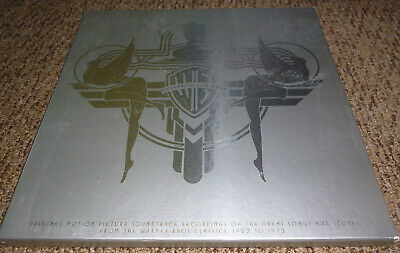
FIFTY 50 YEARS OF WARNER BROTHERS FILM MUSIC 3 LP Vinyl Record Album BOX SET
$
30


Favourite Auctions
To save auctions to your favourites, please login
If you don't have an account, please register
Description
You are bidding on a
======================================
WARNERS BROTHERS
50 Years of Film Music
======================================
TRIPLE ALBUM BOX SET
UNSEALED BUT UNPLAYED
Warner Bros. - Fifty Years of Film Music
1923 – 1973
3 LPS WITH A 26 PAGE PHOTO/INFO-BOOKLET
RECORD ONE - SIDE ONE
Music by Erich Wolfgang Korngold
1. The Sea Hawk (1940) (6:59)
THE SEA HAWK ranks as one of Errol Flynn’s best all around films, and remains a beautiful picture to watch and to hear. It deals with the exploits of a fictional character suggested by Sir Francis Drake (Flynn) who, along with other privateers, commanded marauding expedition against the Spanish, taking rich booty from treasure ships and Spanish possessions in the Americas for the treasury of Queen Elizabeth (Flora Robson).
ERICH WOLFGANG KORNGOLD’S exuberant score splendidly captures the sweep and roll of 16th-century ships and the court pomp and intrigue.
In addition to the full-blooded Main Title music, included here is the score to accompany a love scene between Flynn and Brenda Marshall, and the sequence following the escape from the galley, when Flynn and his men – free of the oppressive shackles – break into a spirited song as they set sail for Dover and home on the captured Spanish galleon.
2. Kings Row (1942) (4:52)
Kings Row, a fictional small mid-Western town in 1890, was dissected in an elaborately mounted psychological melodrama. William Cameron Menzies’ ingenious production design, James Wong Howe’s striking black and white photography and Sam Wood’s first-rate direction fused to produce a potent film.
The final touch was ERICH WOLFGANG KORNGOLD’S surging and passionate music, which emphasized the intricate relationships inherent in the original novel by Henry Bellamann and retained in Casey Robinson’s fine adaptation.
Beginning the short suite is an unexpected interpolation: ERICH KORNGOLD had a most distinctive manner of playing the piano. During a party given for Korngold in 1951 by Ray Heindorf, the head of Warner’s music department, the composer played selections from his work at the piano. Heindorf recorded him on tape, and the suite begins with Korngold’s piano rendition of the main theme from KINGS ROW, and then segues to the actual opening music with full orchestra from the original sound track. There is a short scherzo depicting the children at play in the ice house, and a full, rich statement of the lovely melody associated with Randy (Ann Sheridan) and Drake (Ronald Reagan).
3. THE ADVENTURES OF ROBIN HOOD (1938) (15:16)
One of the most extraordinary blends of dramatic music and visual imagery to come out of Hollywood, THE ADVENTURES OF ROBIN HOOD is truly an endearing and enduring masterpiece of the screen.
ERICH WOLFGANG KORNGOLD’S operatic-like score is descriptive music of the highest order and exceptionally appropriate to the subject and its treatment. Korngold composed over a dozen themes for the principal characters and situations – many of which are included in this suite.
The opening title music starts with the March of the Merry Men – Robin’s band of outlaws. This rollicking motif melts into a noble and dual theme depicting Robin’s love for Lady Marian (Olivia de Havilland) and his loyalty to King Richard the Lion-Hearted (Ian Hunter). The title music ends with a brief fanfare used to denote Prince John (Claude Rains) and the villainous Norman knights. A short, “old English” interlude to set the scene of a banquet in Nottingham Castle is interrupted by Robin Hood’s entrance – with a deer over his shoulders – into the Main Hall.
A major sequence in the film occurs when Robin and his band drop from the trees onto Sir Guy of Gisbourne (Basil Rathbone) and his entourage on horseback in order to save the ransom money for King Richard, who is a prisoner in Austria. A light-hearted feast in Robin’s Sherwood Forest lair follows.
The festive and heraldic Archery Tournament fanfares lead up to the scene in which Robin, in disguise, splits his opponent’s arrow with one of his own, thereby winning the tournament.
A beautifully developed music structure follows to support a love scene between Robin and Lady Marian at her balcony window on the evening following Robin’s escape from the hangman’s noose.
The last selection is the finale to the film Richard has returned to rule, Prince John and his followers are suppressed, and Robin and Marian will presumably live happily ever after.
RECORD ONE - SIDE TWO
Warner Bros. Presents
1. ALL THIS, AND HEAVEN TOO (1940) (1:40)
The important and commanding Warner Bros. fanfare – composed by MAX STEINER in 1937 – opens side two of 50 Years of Warner Bros. Film Music. This Trade Mark theme, used behind hundreds of Warner films, leads into the Main Title for one of Bette Davis’ more opulent period productions.
As governess to a nobleman’s children in 19th century France, Henriette’s (Davis) romance with the duke (Charles Boyer) eventually leads to murder, suicide, and scandal.
Steiner’s theme for Henriette is a lovely waltz, introduced in the Main Title and reprised in several moods during the film.
2. THE TREASURE OF THE SIERRA MADRE (1948) (4:35)
Once the characters portrayed by Humphrey Bogart, Walter Huston and Tim Holt begin their trek into the mountainous Sierra Madre in Mexico, MAX STEINER introduces his memorable and haunting theme to underline the journey and its participants.
The composer’s skill is evident in the way this particular music lends itself to the variety of changes it undergoes as the three men react to the stress, hardship, and psychological tests of the search for and the finding of promised riches.
Reflected in the score is Bogart’s increasing paranoiac behavior, which eventually leads to the sardonic ending of this justly famous film.
3. NOW, VOYAGER (1942 (1:24)
Bette Davis admirers vary in what they consider to be their favorite Davis film but usually a listing of the top three vehicles includes NOW, VOYAGER.
Despite its unabashed soap opera plot and characters, there is a perennial appeal to the story of the repressed an mother-dominated ugly duckling (Davis) who changes into a lovely lady and finds the perfect man (Paul Henreid) – charming, sensitive, romantic, European, and apparently pretty well off. But he’s married and can never divorce his wife. The picture ends with a final scene of unfulfilled love.
MAX STEINER’S extremely popular theme for the frustrated lovers underscores an idyllic interlude in South America during a voyage, when the two first discover their love and their plight. The score won for Steiner the second of three Academy Awards.
4. ADVENTURES OF DON JUAN (1948) (5:55)
MAX STEINER composed one of his major scores for another fine Flynn swashbuckling epic.
Variations on primary themes are heard in the selections on this recording. The Don Juan motif, featured initially in the Main Title, is sometimes exuberant, sometimes stately, dashing, sad or reflective, and works beautifully for any mood. It contrasts suitably with a serenade, used throughout the film to accompany the legendary character’s balcony climbings and lighter romantic escapades.
5. THE NUN’S STORY (1959) (3:04)
THE NUN’S STORY is a rare and totally successful attempt to make a serious film of the religious life. The masterful Fred Zinnemann directed the story of a young, independent and self-willed Belgian girl (Audrey Hepburn) who mistook a desire to nurse the sick for a religious vocation and joined a nursing order of nuns.
Through perseverance she finishes her training and eventually goes to the Congo where her work is to assist a surgeon (Peter Finch). Sister Luke is continually plagued by her inner conflict, and after seventeen years is officially released from her vows.
Filmed in Rome, the Congo, and Brussels, THE NUN’S STORY is still a superlative film which benefits enormously from FRANZ WAXMAN’S intelligent and moving score. The Main Title music, featured here, sets the scene for the drama to come.
6. SAYONARA (1957) (2:24)
SAYONARA is the MADAME BUTTERFLY of the Korean War. Based on James Michener’s novel and photographed to a large extent on location in Japan, the film is beautifully complemented by FRANZ WAXMAN’S sensitive and tasteful score.
Waxman weaves IRVING BERLIN’S title song (written for an aborted Broadway musical on the subject) with a secondary theme of his own for the character played by Miyoshi Umeki, who, in desperation, commits suicide when she becomes pregnant and cannot go the America with her Army husband (Red Buttons).
Marlon Brando portrays an American air ace who overcomes his prejudices and falls in love with and later marries a beautiful Japanese actress-dancer (Miiko Taka).
7. A STREETCAR NAMED DESIRE (1951) (1:42)
One of the few genuinely timeless films, Elia Kazan’s production of Tennessee Williams’ A STREETCAR NAMED DESIRE has mood, intricate and intriguing character involvement, and the omnispresent conflict between illusion and reality.
ALEX NORTH’S music is a landmark in the history of Hollywood film music: it was the first major jazz oriented score, and its impact was instantaneous.
The hot, humid New Orleans milieu and the undercurrent of sensuality are captured by plaintive saxophones, insinuating brass, nervous pizzicatos, rolling piano figures, and languid blues.
When coarse, compassionless Stanley (Marlon Brando) and complex, delicate Blanche (Vivien Leigh) confront one another at various times throughout the film, the musical counterpoint hints at the inevitable - the final disintegration of Blanche after Stanley attacks her.
North’s object was to simulate jazz in a classical structure, and the result was flawless.
8. WHO’S AFRAID OF VIRGINIA WOOLFE? (1966) (2:15)
The gifted ALEX NORTH’S contribution to Mike Nichols’ screen version of Edward Albee’s play WHO’S AFRAID OF VIRGINIA WOOLF? is a major and subtle one. For this extraordinarily difficult subject, North’s solution, after a good deal of pondering, was to play against the film with his own rather romantic concept of the man-woman relationship. This was expressed with a quasi-baroque score.
“I wanted to get to the soul of these people (played by Richard Burton and Elizabeth Taylor) and suggest they were really meant for each other,” says North. Fortunately, the composer discarded the possibility of frenetic underscoring , jazz, or a twelve-tone approach.
9. LAND OF THE PHARAOHS (1955) (1:30)
DIMITRI TIOMKIN’S impressive score for augmented orchestra and chorus composed for LAND OF THE PHARAOHS gave a necessary added dimension to the saga of the 100,000 slaves who were put to work quarrying and transporting huge blocks of stone on the decree of a Pharaoh who wanted The Great Pyramid of Cheops as a monument to himself and as a hiding place for the treasures he wished to carry with him to his second life.
The haunting establishment of the primary theme from the Main Title immediately recreates the exotic atmosphere of ancient Egypt.
10. THE HIGH AND THE MIGHTY (1954) (2:20)
Ernest K. Gann’s novel about a disabled airliner in flight from Honolulu to San Francisco and the stirring multi-drama of its passengers forced to face the prospect of sudden death was made into a gripping film by director William Wellman.
John Wayne played the co-pilot, and one remembers the lonely, haunting tune whistled throughout the film. The wistfully romantic melody melody was often taken up by the orchestra, and is here presented in an evocative statement.
DIMITRI TIOMKIN’S memorable score was certainly a major factor in the success of this Grand Hotel of the air.
Produced by Leslies Harsten
Associate Producer: Jeff Pennig
Engineer: Bob Hata
Music Consultant and Notes: Rudy Behlmer
RECORD TWO - SIDE THREE
We’re In The Money
1. WE’RE IN THE MONEY (from THE GOLD DIGGER OF 1933) (3:07)
Remember Ginger Rogers, dressed in a skimpy outfit consisting entirely of silver coins, leading a group of similarly attired chorus girls in a spirited optimistic HARRY WARREN and AL DUBIN song called “We’re in the Money”? This was in 1933 – the bottom of the Depression – and we were certainly not in the money. But Ginger and the girls made us temporarily forget that unpleasant trifle.
2. ABOUT A QUARTER TO NINE
(from GO INTO YOUR DANCE – 1935) (1:49)
Al Jolson – co-starring for the first and only time with his wife, Ruby Keeler, in GO INTO YOUR DANCE - sang one of his biggest hits: WARREN AND DUBIN’S “About A Quarter to Nine.”
3. THE GIRL FRIEND OF THE WHIRLING DERVISH
(from GARDEN OF THE MOON – 1938) (4:35)
The Garden of the Moon is the fictitious name of a nightclub where the orchestra does a novelty number, “The Girl Friend of the Whirling Dervish,” by WARREN AND DUBIN. Among those participating are Jerry Colonna, Johnny “Scat” Davis, Joe Venuti, and Ray Mayer. That’s John Payne, who plays the leader of the band, singing the first chorus.
4. I ONLY HAVE EYES FOR YOU (from DAMES – 1934) (3:00)
Dick Powell and Ruby Keeler were together for the first time in 42nd STREET – and then together again and again – in THE GOLD DIGGERS OF 1933, FOOTLIGHT PARADE, FLIRTATION WALK, DAMES, and SHIPMATES FOREVER. Dick sang WARREN AND DURBIN’S “I Only Have Eyes For You” to Ruby for the first time on the Staten Island ferry boat in DAMES. It was reprised later in the film as a mammoth Busby Berkeley production number involving what appeared to be innumerable Ruby Keelers.
5. SHE’S A LATIN FROM MANHATTAN
(from GO INTO YOUR DANCE – 1935) (3:14)
Another WARREN AND DUBIN hit from GO INTO YOUR DANCE was Al Jolson’s rendition of “A Latin from Manhattan” (“She’s a forty-second streeter”). Both “A Quarter to Nine” (band two) and “A Latin from Manhattan” were later reprised in THE JOLSON STORY (1946).
6. I’LL STRING ALONG WITH YOU
(from TWENTY MILLION SWEETHEARTS – 1934) (2:03)
Dick Powell temporarily deserted Ruby Keeler to sing a duet with Ginger Rogers called “I’ll String Along With You” by WARREN AND DUBIN.
7. I’M LIKE A FISH OUT OF WATER
(from HOLLYWOOD HOTEL – 1937) (2:54)
Dick Powell and Rosemary Lane (remember the Lane Sisters – Priscilla, Lola, and Rosemary?) sang “I’m Like a Fish Out of Water” by RICHARD WHITING and JOHNNY MERCER in HOLLYWOOD HOTEL, as they went wading – fully attired of course – in a small fountain. Note the reference such as “Like J.P. Morgan swingin’ it on the organ,” “Like Man O’War as an also ran,” “Like Sally Rand if she lost her fan.”
8. BY A WATERFALL (from FOOTLIGHT PARADE – 1933) (4:54)
Dick and Ruby were together again singing SAMMY FAIN and IRVING KAHAL’S “By a Waterfall,” which appropriately enough took place by a waterfall and pond. Halfway through the number the pond suddenly transformed into the world’s largest swimming pool. The introduction by James Cagney in the role of the director – “If this doesn’t get ‘em, nothin’ will!” – gives you a modest hint of the elaborate production number involving scores of aquatic chorines photographed from overhead, underwater, and all conceivable (and a few conceivable) angles.
RECORD TWO - SIDE FOUR
The Lullaby Of Broadway
In 1933 the Hollywood musical staged an astonishing comeback by the same studio’s GOLD DIGGERS OF 1933. Then for the next several years Warners produced steady stream of musical divertissements starring various combinations of Dick Powell, Ruby Keeler, Al Jolson, Ginger Rogers, Joan Blondell and, even on occasion, James Cagney.
Although various composers contributed songs, the team of HARRY WARREN AND AL DUBIN stands out and epitomizes the Warner musicals from 1933 to 1939. All of the numbers on this side (and most of the numbers on the reverse side) were composed by WARREN and DUBIN and directed by Busby Berkeley. Berkeley is famous for his geometric patterns, masses of people playing neon violins, swimming in gigantic pools, singing and dancing on top of taxi cabs, along Flirtation Walk, in Caliente, Shanghai, the Garden of the moon, drive-in restaurants, at the Wonder Bar, and on simulated Broadway stages that seemed to defy the laws of time, space and gravity.
1. THE LULLABY OF BROADWAY
(from THE GOLD DIGGERS OF 1935) (2:07)
“The Lullaby of Broadway” was one of the longest (15 minutes) and most spectacular of the Busby Berkeley production numbers. The singing was handled by Wini Shaw and the chorus with a bit of Dick Powell for good measure.
2. 42nd Street (from (42nd STREET – 1933) (2:45)
The title song from 42nd STREET is rendered first by Ruby Keeler, who then does her famous tap dance on top of a taxi cab. Dick Powell picks up the vocal, and finally the large chorus wraps it up. This is a “dramatic” number that takes place on a simulated 42nd Street set as part of the stage musical show-within-a-show that harassed director Warner Baxter somehow manages to whip into shape with a last minute replacement for the ailing star. Naturally, little miss nobody (Ruby Keeler) becomes an overnight smash!
3. SHUFFLE OFF TO BUFFALO (from 42ND STREET – 1933) (2:52)
“Shuffle Off TO Buffalo” features Ruby Keeler, Ginger Rogers, Una Merkel, and Clarence Nordstrom on the sleeper train to Buffalo. All aboard for the Niagara Limited!
4. THE LULLABY OF BROADWAY
(from THE GOLD DIGGERS OF 1935) (1:20)
Every dancer in Hollywood tap danced away on a night club set roughly the size of Grand Central Station.
5. DAMES (from DAMES – 1934) (3:22)
Dick Powell insisted that it’s not the story, cast or publicity that makes the show but – dames (“Knees in action – that’s the attraction”). After making the point to his cohorts, the stage opens up and Busby Berkeley brings on his infinite variety of dames to further illustrate.
6. THE GIRL AT THE IRONING BOARD (from DAMES – 1934) (4:09)
Joan Blondell, the wise-cracking blonde with the heart of gold, was always in there pitching at Warners during the 30s. she played opposite just about every male star on the lot and occasionally appeared in a musical. “The Girl At The Ironing Board” (Bring back, bring back, oh bring back your laundry to me) was her featured number in DAMES. The scene is a backyard and the laundry on the clothesline, consisting entirely of men’s garments, comes to life dancing and cavorting.
7. THE LULLABY OF BROADWAY
(from THE GOLD DIGGERS OF 1935) (1:24)
The tap dance goes on (and on)!
8. SEPTEMBER IN THE RAIN (from MELODY FOR TWO – 1937) (2:15)
Following the success of ONE NIGHT OF LOVE with Grace Moore in 1934, several opera stars (Lily Pons, Gladys Swarthout, Lawrence Tibbit, etc.) temporarily were given the star treatment in Hollywood. Among them was concert artist James Melton, who introduced one of WARREN and DUBIN’S finest songs, “September In The Rain,” in MELODY FOR TWO. Later Melton was the leading tenor of the Metropolitan Opera.
9. THE LULLABY OF BROADWAY
(from THE GOLD DIGGERS OF 1935) (2:47)
Since most of the Busby Berkeley production numbers were of marathon length, and one song usually was repeated - and repeated – and repeated, it seems only fitting to close this tribute to the music of HARY WARREN and AL DUBIN with yet another chorus (or two or three or more) of what is probably their most popular number. The ending is unusual: during a frenetic night on the town, the girl played by Wini Shaw accidentally falls off a skyscraper balcony to her death.
Produced by Leslies Harsten
Associate Producer: Jeff Penning
Engineer: Bob Hata
Music Consultant and Notes: Rudy Behlmer
Special thanks to Harry Warren for his guidance and humor.
RECORD THREE - SIDE FIVE
As Time Goes By
1. AS TIME GOES BY (from CASABLANCA – 1943) (3:04)
If there is one film that personifies the image, the style, and the evocative spirit of Warne Bros. it is probably the 1943 CASABLANCA – a romantic melodrama delivered with Warners’ customary pace, sentiment, and cynicism. It is the quintessence of the Bogart mystique and Ingrid Bergman’s continental loveliness.
CASABLANCA’S timeless ingredients are irresistible: The large and typical supporting cast (Claude Rains, Paul Henreid, Conrad Veidt, Sydney Greenstreet, Peter Lorre, S.Z. Sakall, etc.), the exotic milieu, Michael Curtiz’ expert direction, MAX STEINER’S lush underscoring, and certainly Dooley Wilson’s rendition of the song associated with the romance of Bogart and Bergman – “AS TIME GOES BY.”
Originally written by HERMAN HUPFELD and introduced in an obscure Warner film in 1931. “As Time Goes By” was resurrected for CASABLANCA and created a sensation.
Here is Sam playing “As Time Goes By” on the old upright piano for Ilsa and Rick at “Rick’s Café Americain” in Casablanca following the fall of France.
2. THE MAN THAT GOT AWAY (from A STAR IS BORN – 1954) (5:06)
Judy Garland made only one film for Warner Bros., but it just happened to be one of her most outstanding vehicles – A STAR IS BORN, a drama-with-music remake of the 1937 Janet Gaynor-Fredric March hit.
HAROLD ARLEN and IRA GERSHWIN composed many admirable tunes for the film. “The Man That Got Away,” and unconventionally structured blues, is a true classic and here is exceptionally well performed.
3. JEEPERS CREEPERS (from GOING PLACES – 1938) (2:04)
In GOING PLACES, a Warner film probably few people remember, Louis Armstrong introduced a novelty song by HARRY WARREN and JOHNNY MERCER called “Jeepers Creepers.” In fine form, the irresistible Satchmo sang and played the tune to a race horse, whose name, incidentally, was Jeepers Creepers.
4. HE NEEDS ME and SUGAR
(from PETE KELLY’S BLUES – 1955) (3:19)
Peggy Lee was discovered working with a vocal group in Chicago, 1941, by Mrs. Benny Goodman. She sang with Goodman’s orchestra for two years and then went on to become one of the most jazz-oriented singers in the popular field, with many vocal qualities strongly reminiscent of Billie Holiday. ARTHUR HAMILTON’S “He Needs Me” is an effective example of her distinctive style.
Following immediately - as it does in PETE KELLY’S BLUES – is MACEO PINKARD and SIDNEY D. MITCHELL’S jazz standard, “Sugar.”
5. JUST ONE OF THOSE THINGS
(from THE YOUNG AT HEART – 1954) (2:03)
In 1953 Frank Sinatra staged a remarkable comeback, after a few years in the doldrums, with FROM HERE TO ETERNITY. A new recording contract, renewed confidence, and a rejuvenated, matured voice allowed him to dominate once again the popular singing field.
A sterling example of his superb singing style is evident on COLE PORTER’S “Just One Of Those Things,” sung in Warners’ THE YOUNG AT HEART (a remake of FOUR DAUGHTERS), in which he co-starred with Doris Day.
6. SECRET LOVE (from CALAMITY JANE – 1953) (3:42)
Doris Day has been a major star for a good number of years, but many people forget that she started out as a singer with the Bob Crosby and Les Brown bands. In addition to making successful records on her own, she sang with Frank Sinatra on the YOUR HIT PARADE radio show in the late 40s.
“Secret Love” is an exceptionally durable gem written by SAMMY FAIN and PAUL FRANCIS WEBSTER for the original screen musical, CALAMITY JANE.
7. WITH A SONG IN MY HEART
(from YOUNG MAN WITH A HORN – 1950) (3:22)
Doris Day teams with trumpet star Harry James for RICHARD RODGERS and LORENZ HART’S “With A Song In My Heart” from YOUNG MAN WITH A HORN, a drama with music in which Kirk Douglas plays a role vaguely suggested by the legendary jazz cornet player, Bix Beiderbecke. At the end of the rendition the character portrayed by Douglas tries valiantly for an always elusive high note (James doubled for Douglas on the sound track), but in a dramatic moment breaks down completely.
8. PUT ‘EM IN A BOX, TIE ‘EM WITH A RIBBON
(from ROMANCE ON THE HIGH SEAS – 1948) (3:28)
Doris Day’s first film, ROMANCE ON THE HIGH SEAS, made her a Warner Bros. start. “Put ‘Em In A Box,” by JULE STYNE and SAMMY CAHN, presents a bouncing, swinging Doris accompanied by The Page Cavanaugh Trio.
Faultless phrasing and timing and an infectious lilt have all contributed to make the numbers edited from her early Warner films for this album a musical delight that will surprise quite a few who may think of Miss Day primarily as a charming actress who alternates between light comedy and drama.
RECORD THREE - SIDE SIX
Broadway To Hollywood
1. HOORAY FOR HOLLYWOOD
(from HOLLYWOOD HOTEL – 1937) (2:09)
RICHARD WHITING and JOHNNY MERCER’S “Hooray For Hollywood” is the opening number in Warners’ HOLLYWOOD HOTEL. After the familiar Warner signature fanfare and the opening titles, Benny Goodman and his band, Frances Langford, and Johnny “Scat” Davis are all discovered en route to the St. Louis airport to see the character played by Dick Powell off on his trip to Hollywood. That’s drummer Gene Krupa singing a few bars during the last half of the song.
2. SWANEE (from RHAPSODY IN BLUE – 1945) (1:55)
No highlights of the music of Warner Bros. would be definitive without the inclusion of Al Jolson. One of the really outstanding entertainers of the first half of the 20th century, Jolson starred in Warners’ pioneering sound picture THE JAZZ SINGER (1927) and continued to appear in a series of musical films for Warner Bros. well into the 1930s.
When the studio did RHAPSODY IN BLUE in 1945, based on the life and music of GEORGE GERSHWIN, Jolson was recalled to “Swanee,” a Gershwin song he popularized years before.
3. HOW TO HANDLE A WOMAN (from CAMELOT – 1967) (4:16)
CAMELOT, Warners’ film version of the FREDERICK LOEW – ALLAN JAY LERNER stage success of 1960, contains some of the finest music and lyrics ever created for one show. Here Richard Harris as the mythical King Arthur ponders a traditional dilemma: “How to Handle a Woman.” Harris, in a highly individual but simple rendition, concludes with a reasonable answer: “How to handle a woman, is to lover her, simply lover her, merely love her.”
4. MY HEART BELONGS TO DADDY
(from NIGHT AND DAY – 1946) (2:50)
In 1937 a young lady from Texas made her Broadway debut and introduced a new COLE PORTER tune in LEAVE IT TO ME! The young lady was Mary Martin and the tune was “My Heart Belongs To Daddy.” In Warners’ musical success, NIGHT AND DAY, she reprised the song and it became one of the major highlights of the film.
5. TROUBLE (from THE MUSIC MAN – 1962) (4:18)
Harold Hill, the fast-talking love ‘em and leave ‘em, vintage 1912 con man who specializes in selling band instruments and uniforms in small towns, gives us a taste of his overwhelming style in “Trouble,” a revivial-styled pitch which was one of the many featured spots in Warners’ film version of MEREDITH WILLSON’S extraordinarily entertaining THE MUSIC MAN.
Robert Preston is, of course, the indefatigable traveling salesman – the role he created in the original Broadway musical. His masterful rendition of “Trouble” is a dazzling tour de force.
6. BOSOM BUDDIES (from MAME – 1974) (4:08)
The newest inclusion in this panoramic collection of Warner film music is a number from MAME, based on the 1966 Broadway musical hit, which in turn was taken from Patrick Dennis’ novel, AUNTIE MAME, and the stage play and Warner Bros. film of the same name.
MAME stars Lucille Ball in the title role. A highlight from the film is the unique Miss Ball and Bea Arthur (from the original Broadway company) singing JERRY HERMAN’S delightful “Bosom Buddies.”
7. YANKEE DOOLE DANDY MEDLEY:
“Yankee Doodle Boy” “Harrigan” “Give My Regards To Broadway”
(from YANKEE DOODLE DANDY – 1942) (6:56)
Easily one of the most popular films produced by Warner Bros., YANKEE DOODLE DANDY featured James Cagney and a full quota of the numbers written and made famous by that song-and-dance man GEORGE M. COHAN.
Cagney has done only a handful of musicals – being mostly associated with dramatic roles – but he is truly inspired and electric in this gem.
The medley made up for this recording from the original soundtrack consists of three of the best remembered songs. “Give My Regards To Broadway” and “Yankee Doodle Boy” were presented originally in a patriotic and sentimental Broadway show, written and performed by Cohan in 1904, called LITTLE JOHNNY JONES. The plot took Johnny Jones (Cohan) to England as an American jockey riding his horse Yankee Doodle in the Derby. “Harrigan,” performed here by Cagney and Joan Leslie, was first heard in a Cohan show, FIFTY MILES FROM BOSTON of 1908.
Cagney, in his Academy Award performance, not only captures many of Cohan’s mannerisms and stylized techniques, but he brought his own particular kind of zest and distinctive dancing ability to the role.
Produced by Leslie Harsten
Associate Producer: Jeff Penning
Engineer: Bob Hata
Music Consultation and Notes: Rudy Behlmer
Please email me with any other questions
NY State residents add 8.625% sales tax
THANKS FOR LOOKING!
INTERNATIONAL BUYERS:
PLEASE SEE URGENT NOTE BELOW
I am a 35 year veteran of music industry and I’m selling off goodies and rarities acquired during decades of collecting. Many of these items are very hard to find or were not available to the general public. All items have been carefully stored in a smoke free climate controlled environment.
All items are legitimate releases. NO BOOTLEGS OR BURNED COPIES! If it’s autographed, I guarantee it because it was signed right in front of me or given to me by a member of the music industry who had access to the artist(s). I’m clearing out lots of rare items so, if you are interested in stuff like this, you may want to add me as a favorite seller.
I have 100% Positive Feedback on eBay
Bid & Buy with Confidence
**********************************************
>>> PLEASE READ: SHIPPING & PAYMENT TERMS <<<
All items are carefully packaged to ensure safe delivery. Free shipping (if applicable) is within the continental United States ONLY via USPS or UPS Ground. Shipping to Hawaii, Alaska and Puerto Rico is usually extra. Items ship within 1-2 business days following payment. Your speedy payment ensures speedy shipping.
>>> URGENT <<<
IF YOUR COUNTRY DOES NOT PARTICIPATE WITH EBAY'S GLOBAL SHIPPING PROGRAM, THEN INTERNATIONAL SHIPPING MUST BE USPS PRIORITY MAIL EXPRESS INTERNATIONAL. IT IS THE ONLY SERVICE THAT OFFERS TRACKING FROM THE U.S. THROUGH YOUR COUNTRY’S CUSTOMS AND CONTINUES TRACKING ALL THE WAY TO YOUR ADDRESS. IT IS EXPENSIVE, BUT IT IS WORTH IT. THE COST IS $150.
As always, shipping costs do not include duty taxes unless you use eBay's Global Shipping Program, then you will see and pay the duty taxes in advance. If not, you might be charged an additional duty fee based on your country’s import laws. You will need to check with your Customs Authorities.
WE DO NOT SHIP TO APO/FPO
WE DO NOT SHIP TO P.O. BOXES
All payments must be PayPal and must be
made immediately after auction ends.
>>> RETURN POLICY <<<
Returns are not accepted on all items.
Please check Shipping and Payment tab above (by Description tab).
If return is accepted, it is ONLY accepted if item was damaged during shipping.
YOU MUST KEEP ALL ORIGINAL PACKING MATERIALS FOR INSPECTION BY SHIPPER
OTHERWISE THE RETURN POLICY IS VOID.
***********************************************
PLEASE CHECK OUT MY eBay STORE
RRRCollectables
price rating