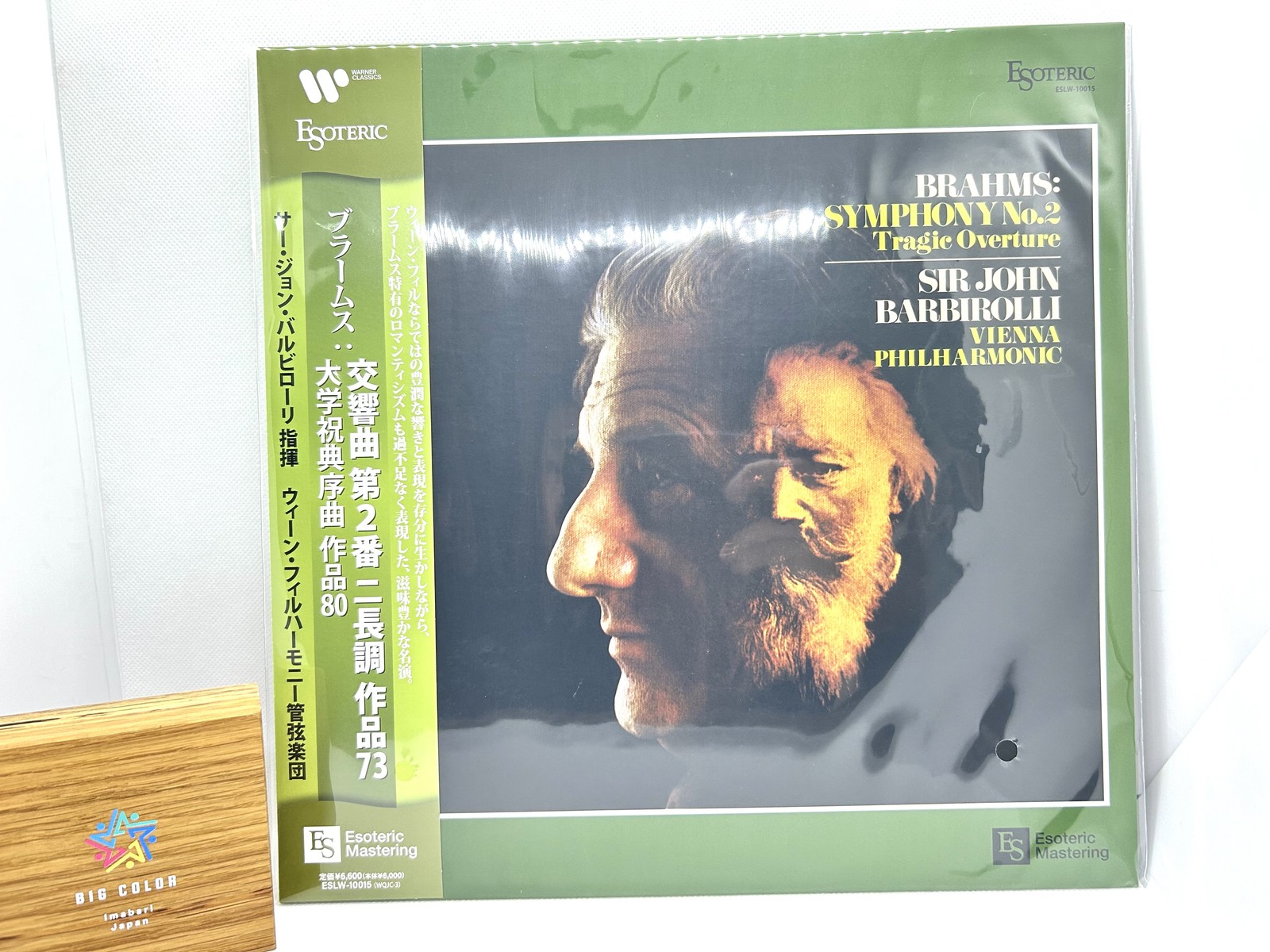
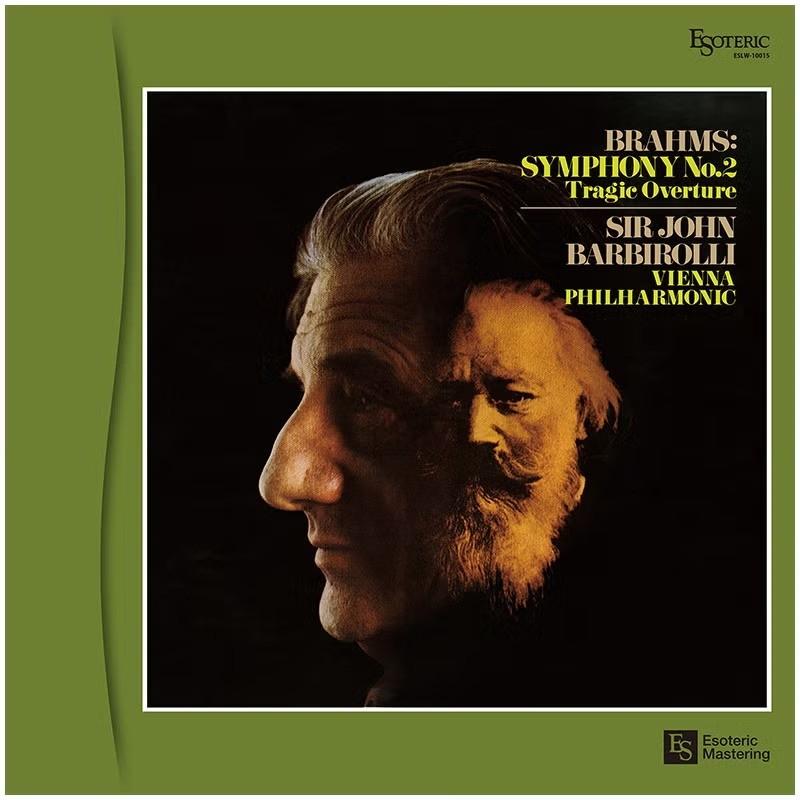
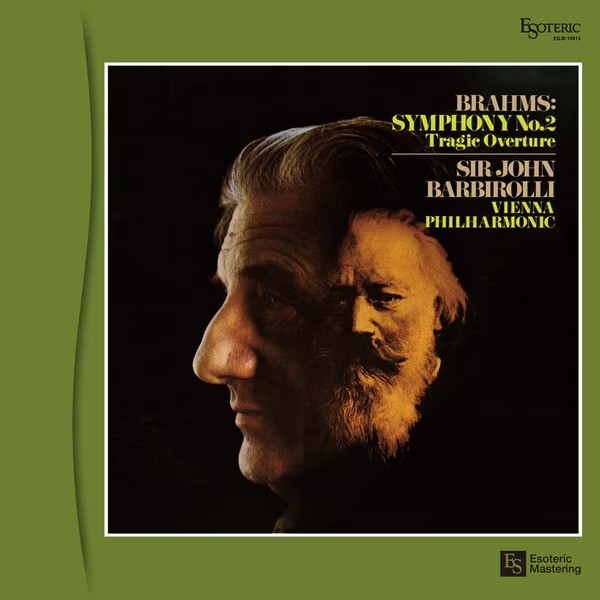
ESOTERIC BRAHMS Symphony No2, Academic Festival Overture BARBIROLLI Vinyl
$
81

Favourite Auctions
To save auctions to your favourites, please login
If you don't have an account, please register
Description
Click here to see all products in our store!
* International Buyers - Please Note:
Import Duties & Taxes Policy
United States
All shipments to the U.S. are sent DDP (Delivered Duty Paid). Import duty, taxes and brokerage are prepaid — no extra payment at delivery.
Other Countries
Unless duties/taxes are already collected by eBay at checkout, shipments are sent DDU (Delivered Duty Unpaid) and the buyer is responsible for import VAT/GST, duty, and carrier fees on delivery.
* Description
The golden sound of the Vienna Philharmonic echoes through the Musikverein.
Experience Barbirolli’s most beautiful performance of Brahms on LP
Who knew its true brilliance was this profound!
Sir John Barbirolli (1899–1970) was a renowned British conductor who, after World War II, served as music director of the Hallé Orchestra and ushered in its golden age. His performances, with their almost decadent emotional depth, continue to captivate the hearts of many music lovers to this day.
An Italian-British musician whose grandfather and father were active as violinists at La Scala in Milan, he moved to London in the 1890s and began his career as a conductor in 1924.
He was active in recording from the SP era onward, leaving behind numerous recordings throughout his life. In the postwar stereo era, his recordings of symphonies and orchestral works by Sibelius, Mahler, Elgar, and Vaughan Williams are known as classic masterpieces; he can truly be called a star conductor of the LP era.
Alongside Mahler’s Symphony No. 9, recorded with the Berlin Philharmonic in 1964, the complete set of Brahms’s symphonies—recorded between 1966 and 1967 and his only recording with the Vienna Philharmonic—shines with exceptional brilliance within Barbirolli’s discography.
Among them, Symphony No. 2 was a work he held particularly dear, having recorded it far more times than any of his other symphonies.
This album, a collaboration with the Vienna Philharmonic, captures Symphony No. 2 and the Academic Festival Overture, bringing out their aesthetic beauty to the fullest.
The first movement alone is packed with highlights: the mesmerizing beauty of the interplay between the lower strings, horns, and woodwinds at the opening; the emotionally charged cellos introducing the second theme; the majestic three-dimensionality of the development section; and the sound of the setting sun sinking into the horizon in the coda.
The Vienna Philharmonic has released acclaimed recordings of Symphony No. 2 at various intervals under conductors such as Schuricht, Kubelik, Kertész, Böhm, Bernstein, and Giulini, but among them, this Barbirolli recording stands out as the performance with the richest emotional depth and nuance.
[Track List]
Johannes Brahms:
Symphony No. 2 in D Major, Op. 73
Side 1
Movement 1: Allegro non troppo
Movement 2: Adagio non troppo - L'istesso tempo, ma grazioso
Side 2
Movement 3: Allegretto grazioso (Quasi andantino) - Presto ma non assai - Tempo I
Movement 4: Allegro con spirito
Academic Festival Overture, Op. 80
[Performers] Vienna Philharmonic Orchestra
[Conductor] Sir John Barbirolli
[Original Recording]
[Recorded] December 7–9, 1966 (Symphony No. 2), December 6–8, 1967 (Academic Festival Overture),
Great Hall of the Musikverein, Vienna
Compared to Symphony No. 1, which took decades to complete, Symphony No. 2 was written in a single burst of inspiration over just four months in 1877.
It is said that Symphony No. 2 reveals another side of Brahms, with bright, refreshing, and beautiful melodies flowing seamlessly.
The period from 1877 to 1879 was his most prolific.
Composed while he spent the summer in Perchach, a scenic resort on the shores of Lake Wörth in southern Austria, this work evokes the local landscape. As he wrote in a letter to the Viennese critic Hanslick during its composition, “It has a very bright and pleasant sound.” In contrast to the dramatic and weighty Symphony No. 1, which took 15 years to complete, this work overflows with bright and rich emotion, and because its melodies are so accessible, it has been called “Brahms’s Pastoral.”
Although all movements are written in major keys, the work possesses a rich depth of shadow and light. It is a masterpiece tightly constructed around the three notes—D–C♯–D—introduced by the cellos and double basses at the beginning, which serve as the basic motif, lending a sense of unity to the entire piece.
The Academic Festival Overture was composed in the summer of 1880 at the resort town of Bad Ischl in the Salzkammergut, between his Second and Third Symphonies (1883).
As Brahms himself described this bright and lively overture as a “cheerful Suppé-style potpourri,” he skillfully inserted adaptations of the German student songs “We Have Built a Fine Schoolhouse,” “Father of the Fatherland,” and “The Fox’s Song” into a free sonata form, concluding the piece with the widely beloved “Gaudeamus” (Song of Joy).
Vienna’s famous Musikverein is known for its rich acoustics and is considered a challenging venue for unadmitted session recordings; however, this recording of Brahms by Barbirolli, with EMI’s characteristic concert-like balance, captures the magnificent music resonating throughout the hall fully and appropriately.
The way the lustrous string section, charming woodwinds, and rich Viennese horns and brass blend together beautifully while retaining their clarity is a testament to the exquisite mixing skills of engineer Ernst Roese.
The recording was produced by the veteran Ronald Kinlock Anderson (1911–1984).
He was a leading figure at EMI in the mid-1960s, and most of Barbirolli’s recordings were produced by him.
Even after Barbirolli’s death, he worked alongside his widow to promote music preservation initiatives and dedicated himself to preserving Barbirolli’s legacy, including the establishment of the Barbirolli Room at the Royal Academy of Music.
* Shipping
We ship using FedEx, DHL and UPS or Japan Post.
* Payment
We usually ship within 3〜7 business days of receiving cleared payment.
price rating