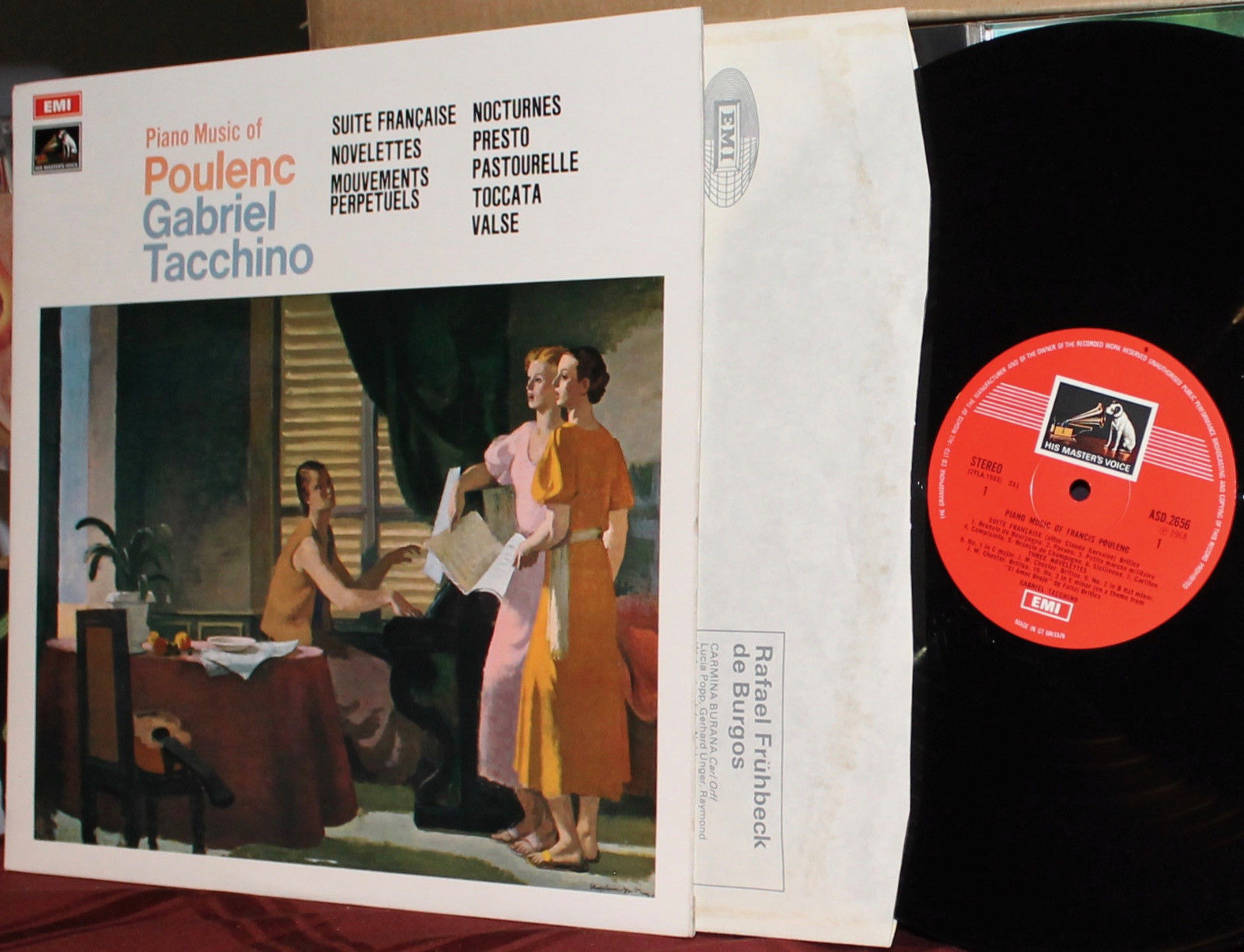
EMI LP ASD 2656: POULENC Piano Music, various pieces, Gabriel TACCHINO - 1968 UK
C$
50
$
36


C$ 50
Sold For
Mar 14, 2018
Sold Date
Jan 26, 2018
Start Date
1
Number Of Bids
Canada
Country Of Seller
eBay
Sold at
Favourite Auctions
To save auctions to your favourites, please login
If you don't have an account, please register
Description
****Welcome to our listing, thanks very much for looking!
****See our own website! We have lots of out of print LPs and CDs! You can find us on the world wide web at -
hearthedifference.net
****Shipping cost is only an estimate - it depends on the actual weight and size of the package as well as the service required. We do not profit from shipping costs, so if we overcharge, we will refund the difference back to you. It's always best to wait for our invoice before paying for your item. We will combine shipping for multiple items purchased.
****Please see our other listings for more great LPs and CDs - new items added daily!
****To access our eBay store either click on the little red door at the top right section of any of our eBay listings or, click on -
http://stores.ebay.com/Hear-The-Difference
Background -
Gabriel Tacchino is one of the premier post-war French classical pianists; he also teaches piano.Tacchino was born in Cannes on April 4, 1934. He studied at the Paris Conservatoire from 1947 to 1953, where his teachers included Jacques Février and Marguerite Long. He also studied with Francis Poulenc, the only pianist ever to do so; consequently, his interpretation of Poulenc's piano music reveals a special insight into the composer's intentions.
His early prizes included the Viotti Competition (1st prize, 1953); the Busoni Competition (1954, 2nd prize); Casella International Competition (1954; 1st prize); the Geneva Competition (1955; joint 2nd prize with Malcolm Frager); and the Marguerite Long-Jacques Thibaud Competition (1957, 4th prize).
Herbert von Karajan was instrumental in Tacchino getting his break, by engaging him to play with various orchestras including the Berlin Philharmonic. His United States debut was in 1962, with Erich Leinsdorf and the Boston Symphony Orchestra. He has since performed under conductors such as Pierre Monteux, André Cluytens, Jascha Horenstein, Riccardo Muti, Kent Nagano, and many others. Other orchestras with which he has played include the London Symphony Orchestra, Philharmonia Orchestra, Orchestre de la Suisse Romande, English Chamber Orchestra, Orchestre de Paris, Orchestre National de France, Montreal Symphony Orchestra and many others. He is also a regular solo performer on the concert platform and also holds master classes.
He has also played chamber music with notables such as Isaac Stern, Jean-Pierre Rampal, Pierre Amoyal, Maxence Larrieu, and others.
His recordings include the complete music for piano by Poulenc, which was reissued by EMI on five CDs in 2005; the complete piano concertos (five each) by Saint-Saëns and Prokofiev for Vox; and works by J. S. Bach, Mozart, Chopin, Franck, Grieg, Debussy, Satie, Ravel, Gershwin, Addinsell, and others for recording labels such as Erato and Pierre Verany.
Having taught at his alma mater the Paris Conservatoire 1975-1994, he now teaches at the University of Fine Arts and Music (Geidai) in Tokyo, the Mozarteum University in Salzburg, and at the Schola Cantorum in Paris.
David Dubal writes of Tacchino: "A splendid pianist. His playing is buoyant and well planned."
Gabriel Tacchino was propelled to international stardom after winning a string of competition prizes in the mid-'50s. By the early '60s he was regularly touring the globe and appearing with major conductors, like Karajan, Monteux, Leinsdorf, Horenstein, Cluytens, Fruhbeck de Burgos, Armin Jordan, and countless others. He became a major recording artist in the 1960s, and while he has been less active in that role from about the 1990s, many of his numerous recordings are still available on EMI, Erato, Vox, and Brilliant Classics. Not surprisingly, Tacchino first became identified with French repertory, particularly with the music of Francis Poulenc, with whom he studied. But Tacchino had always possessed a broad repertory and quickly became recognized for his eclectic sensibilities, drawing high praise for his interpretations of J.S. Bach, Mozart, Schubert, Prokofiev, de Falla, Gershwin, and a spate of others. Tacchino was also a prominent teacher, serving on the faculty at the Paris Conservatory for 20 years (1975-1994).
Gabriel Tacchino was born in Cannes, France, on August 4, 1934. He began piano lessons at six; he studied music at the Paris Conservatory, where his teachers included Jean Batalla, Jacquer Févier, and Marguerite Long. Tacchino won two major competitions -- the Viotti in Vercelli (1953) and the Casella in Naples (1954) -- and won prizes at several others: the Busoni in Bolzano (1954), the Geneva (1955), and the Long-Thibaud in Paris (1957). He debuted in the U.S. in 1962, with Erich Leinsdorf and the Boston Symphony Orchestra.
Tacchino began recording the complete piano works of Francis Poulenc for Vox in the 1960s. His next major project for Vox was the cycle of five concertos by Prokofiev, which he recorded from 1972-1977 with conductor Louis de Froment and the Luxembourg RSO. Tacchino began teaching at the Paris Conservatory in 1975 and was already active in the realm of chamber music, regularly collaborating with major artists like Isaac Stern, Jean-Pierre Rampal, and Bruno Rigutto.
Tacchino also became active in promoting music festivals: in 1975 he founded and has since served as director of the Nuits Musicales du Suquet in Cannes, and he has regularly appeared at the Montreux, Lausanne, Prague, Amsterdam Concertgebouw Summer Festival, Richter Moscow Festival, and many others. Following his 1994 retirement from teaching, Tacchino remained active on the concert scene and has devoted a portion of time to conducting master classes in Switzerland, Canada, Korea, and, from 2006, at Tokyo's University of Fine Arts and Music. - Robert Cummings
No composer can move from carefree high spirits to a sense of poignancy and loss with greater success and effortless facility than Poulenc. The three Novelettes, Mouvements perpetuels, the Nocturnes and Suite francaise were first issued on LP. The ear soon adjusts but I had forgotten that the sound was on the dry and shallow side; some of the later recordings, also made in Salle Wagram in the 1970s and 1980s, including the Improvisations and the Villageoises, are not significantly better. As LS put it in reviewing a previous reissue of this material, ‘Tacchino understands this music as well as anyone,’ though he did notice ‘a reluctance to come down to a real piano.’ His articulation is splendidly crisp and (to paraphrase LS again) he plays with ‘a zest comparable to the composer’s own at the keyboard [and] shows us Poulenc in all his mercurial moods and all his magpie-nest of styles.’ - RL
Gabriel Tacchino's fastidious recordings of Francis Poulenc's piano music date from 1968. This EMI LP includes the most popular of the pieces, such as the droll Trois mouvements perpétuels, the sentimental Trois Novellettes, the deceptively simple Suite française (d'apres Claude Gervais). Completists will find this LP worth having for these rare recordings. However, as a representative compilation of Poulenc's fanciful and fun piano music, this disc should satisfy newcomers. - Blair Sanderson
-
LPs made by EMI (His Master's Voice) Records, in the UK / England / Great Britain
-
LPs released in 1968
-
LPs are recorded in STEREO
-
Record Catalog Number: ASD 2656
-
Record Labels are primarily RED with BLACK & WHITE lettering, and has the postage stamp sized, coloured "Nipper" logo on the record labels.
Francis Poulenc // Gabriel Tacchino
Piano Music of Poulenc
Track Listing -
Suite FrançaiseA1 Bransle De Bourgogne
A2 Pavanne
A3 Petite Marche Militaire
A4 Complainte
A5 Bransle De Champagne
A6 Sicilienne
A7 Carillon
Three Novelettes
A8 No. 1 In C Major
A9 No. 2 In B Flat Minor
A10 No.3 In E Minor
Mouvements Perpetuels
B1a Assez Modéré
B1b Très Modéré
B1c Alerte
Three Nocturnes
B2 In C Major
B3 In A Major ("Bal De Jeunes Filles")
B4 In C Minor
B5 Presto (B Flat Major)
B6 Pastourelle
B7 Toccata
B8 Valse In C Major
Performers / Credits -
• Composed By – Francis Poulenc
• Piano – Gabriel Tacchino
• Sleeve Notes – Marcel Schneider
Other Information -
?1968 - release date taken from printing date on bottom seam 7101
• Matrix / Runout (Side A Label): 2YLA.1553
• Matrix / Runout (Side B Label): 2YLA.1554
• Matrix / Runout (Side A Runout): 2YLA 1553-2G, W, 1
• Matrix / Runout (Side B Runout): 2YLA 1554-2G, A, 1
• Phonographic Copyright (p) – The Gramophone Co. Ltd.
• Printed By – Garrod & Lofthouse Ltd.
• Made By – Garrod & Lofthouse Ltd.
Sleeve - Laminated front, not back with flipped over “clam-shell” seams at the top, bottom and spine. (On labels:) COLOURED postage stamp nipper logo
(On labels:) ? 1968
(On labels:) The Gramophone Co. Ltd.
(On labels:) Made in Gt. Britain Comes with the original inner sleeve
CONDITION Details:
The LP Jacket is in near mint minus condition! The jacket has NO seam splits or crushed corners! The corners and seams are solid with just some light shelf wear evident. The front of the jacket is laminated (not the back). The jacket has the flipped over or "clam shell" seams at the top, bottom and spine. The colors on the jacket are sharp and clean (see pictures with this listing as they are of the actual item).
The LP is in near mint minus condition! We found that the vinyl looked superb on this vintage LP. There are no significant marks and the LP retains much of the original gloss and sheen - obviously well taken care of! There may be a bit of dust and perhaps a finger print or two on the vinyl m so they should be cleaned before playing. There are NO serious spindle marks on the record labels either. Just beautifully made vinyl! That said, acquiring a vintage LP like this is for the performance and rarity of the LP, not necessarily for the sound quality. A Short Note About LP GRADING -- Mint = Only used for sealed items.
- Near Mint = Virtually flawless in every way.
- Near Mint Minus = Item has some minor imperfections, some audible.
- Excellent = Item obviously played and enjoyed with some noise.
- Very Good Plus = Many more imperfections which are noticeable and obtrusive.
For best results, always properly clean your LPs before playing them.
The LP is an audiophile quality pressing (any collector of fine MFSL, half speeds, direct to discs, Japanese/UK pressings etc., can attest to the difference a quality pressing can make to an audio system).
Don't let this rarity slip by!!!
price rating