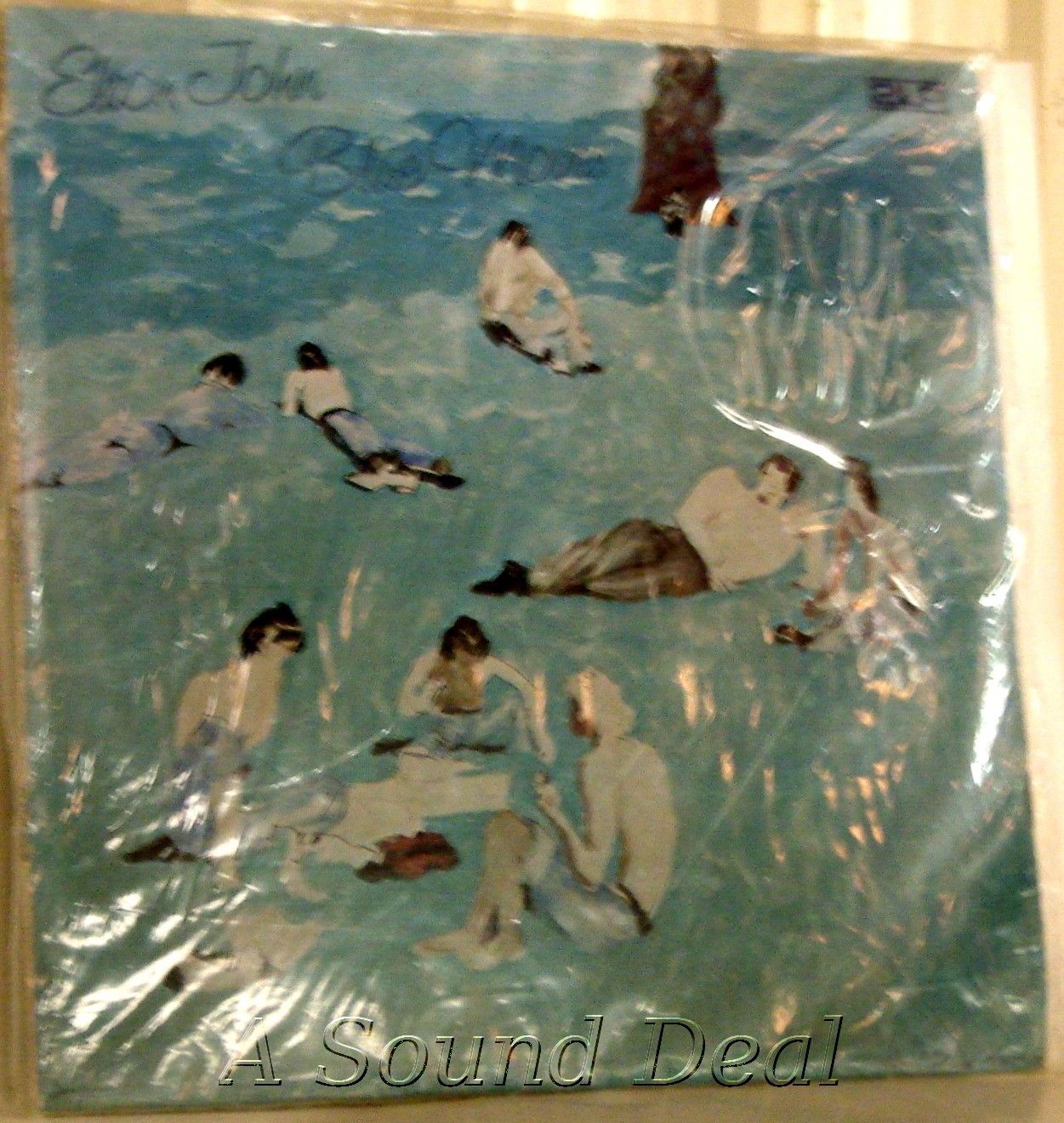
ELTON JOHN Blue Moves LP 1976 SEALED South Africa original gf hear Mint RARE
$
30


Favourite Auctions
To save auctions to your favourites, please login
If you don't have an account, please register
Description
Record: Mint (M) Still Sealed! Cover: Excellent (EX) Labels: Clean! Elton John Blue Moves 1976 South Africa Rocket Record Company 12" Stereo Double LP eltonjohnlpbluemosaf
Elton John
Blue Moves
Extremely limited quality South Africa press double LP in gatefold sleeve still sealed in loose baggy sleeve
Condition
Vinyl: Mint (M) Still Sealed!
Sleeve: Excellent (EX)
See Item Specifics section above for additional details
(clickable images enlarge)
Tracks:
Elton John ?– Blue Moves Label: The Rocket Record Company – DAR 221 Format: 2 × Vinyl, LP, Gatefold Country: South Africa Released: 1976 Genre: Rock Style: Pop Rock Tracklist? A1 Your Starter For... 1:25 A2 Tonight 8:02 A3 One Horse Town 5:47 A4 Chameleon 5:27 B1 Boogie Pilgrim 6:03 B2 Cage The Songbird 3:28 B3 Crazy Water 5:42 B4 Shoulder Holster 4:20 C1 Sorry Seems To Be The Hardest Word 3:43 C2 Out Of The Blue 6:10 C3 Between Seventeen And Twenty 5:10 C4 The Wide-eyed And Laughing 3:20 C5 Someone's Final Song 4:00 D1 Where's The Shoorah? 4:30 D2 If There's A God In Heaven (What's He Waiting For?) 4:20 D3 Idol 4:10 D4 Theme From A Non-existent TV Series 1:20 D5 Bite Your Lip (Get Up And Dance!) 6:37 Companies etc? Printed By – Artone Press Credits? Backing Vocals – Cindy Bullens (tracks: A4, B3, C3), David Crosby (tracks: B2, C4), Graham Nash (tracks: B2, C4) Producer – Gus Dudgeon Strings – Martyn Ford Orchestra, The (tracks: A3, B3, D2)
ELTON JOHN Blue Moves LP 1976 SEALED South Africa original gf hear Mint RARE! Sir Elton Hercules John, CBE (born Reginald Kenneth Dwight on 25 March 1947) is an English rock singer-songwriter, composer, pianist and occasional actor. He has worked with lyricist Bernie Taupin as his songwriter partner since 1967; they have collaborated on more than 30 albums to date. In his four-decade career John has sold more than 250 million records, making him one of the most successful artists of all time.[1] His single "Candle in the Wind 1997" has sold over 33 million copies worldwide, and is the best selling single in the history of the UK Singles Chart and the US Billboard Hot 100.[2][3] He has more than 50 Top 40 hits, including seven consecutive No. 1 US albums, 56 Top 40 singles, 16 Top 10, four No. 2 hits, and nine No. 1 hits. He has won six Grammy Awards, four Brit Awards, an Academy Award, a Golden Globe Award and a Tony Award. In 2004, Rolling Stone ranked him Number 49 on its list of the 100 greatest artists of all time.[4] John was inducted into the Rock and Roll Hall of Fame in 1994.[5] Having been named a Commander of the Order of the British Empire in 1996, John received a knighthood from Queen Elizabeth II for "services to music and charitable services" in 1998.[6] John has performed at a number of royal events, such as the funeral of Princess Diana at Westminster Abbey in 1997, and the Queen's Diamond Jubilee Concert outside Buckingham Palace in 2012.[7][8] He has been heavily involved in the fight against AIDS since the late 1980s.[9] In 1992, he established the Elton John AIDS Foundation and a year later began hosting the annual Academy Award Party, which has since become one of the highest-profile Oscar parties in the Hollywood film industry. Since its inception, the foundation has raised over $200 million.[10] John entered into a civil partnership with David Furnish on 21 December 2005 and continues to be a champion for LGBT social movements. In 2008, Billboard magazine ranked him as the most successful male solo artist on "The Billboard Hot 100 Top All-Time Artists" (third overall, behind only The Beatles and Madonna).[11]Debut album to Goodbye Yellow Brick Road (1969–1973) When John transitioned to solo performance, he started wearing increasingly flamboyant clothing onstage, including this hat and domino mask On the advice of music publisher Steve Brown, John and Taupin started writing more complex songs for John to record for DJM. The first was the single "I've Been Loving You" (1968), produced by Caleb Quaye, former Bluesology guitarist. In 1969, with Quaye, drummer Roger Pope, and bassist Tony Murray, John recorded another single, "Lady Samantha", and an album, Empty Sky. For their follow-up album, Elton John, John and Taupin enlisted Gus Dudgeon as producer and Paul Buckmaster as musical arranger. Elton John was released in April 1970 on DJM Records/Pye Records in the UK and Uni Records in the USA, and established the formula for subsequent albums; gospel-chorded rockers and poignant ballads. The first single from the album, "Border Song", made into the US Top 100, peaking at Number 92. The second single "Your Song" made the US Top Ten, peaking at number eight and becoming John's first hit single as a singer. The album soon became his first hit album, reaching number four on the Billboard 200 album chart.[34] Backed by ex-Spencer Davis Group drummer Nigel Olsson and bassist Dee Murray, John's first American concert took place at The Troubadour in Los Angeles in August 1970, and was a success.[35] The concept album Tumbleweed Connection was released in October 1970, and reached the Top Ten on the Billboard 200. The live album 17-11-70 (11–17–70 in the US) was recorded at a live show aired from A&R Studios on WABC-FM in New York City. Sales of the live album were heavily hit in the US when an east coast bootlegger released the performance several weeks before the official album, including all 60 minutes of the aircast, not just the 40 minutes selected by Dick James Music.[36] Elton John at the Musikhalle, Hamburg in March 1972 John and Taupin then wrote the soundtrack to the obscure film Friends and then the album Madman Across the Water, the latter reaching the Top Ten and producing the hit "Levon", while the soundtrack album produced the hit "Friends". In 1972, Davey Johnstone joined the Elton John Band on guitar and backing vocals. The band released Honky Chateau, which became John's first American number 1 album, spending five weeks at the top of the charts and spawning the hit singles "Rocket Man (I Think It's Going To Be A Long, Long Time)" (which is often compared to David Bowie's "Space Oddity") and "Honky Cat".[37] both of which songs ironically were recorded at Trident Studios. The pop album Don't Shoot Me I'm Only the Piano Player came out at the start of 1973, and produced the hits "Crocodile Rock" and "Daniel"; the former became his first US Billboard Hot 100 number one hit.[38] Both the album and "Crocodile Rock" were the first album and single, respectively on the consolidated MCA Records label in the USA, replacing MCA's other labels including Uni. Goodbye Yellow Brick Road gained instant critical acclaim and topped the chart on both sides of the Atlantic, remaining at Number 1 for two months.[39] It also temporarily established John as a glam rock star. It contained the number 1 hit "Bennie and the Jets", along with the popular and praised "Goodbye Yellow Brick Road", "Candle in the Wind", "Saturday Night's Alright for Fighting", "Funeral for a Friend/Love Lies Bleeding" and "Grey Seal" (originally recorded and released in 1970 as the B-side to the UK-only single "Rock and Roll Madonna"). There is also a VHS and DVD as part of the Classic Albums series, discussing the making, recording, and popularity of Goodbye Yellow Brick Road through concert and home video footage including interviews.Rocket Records to 21 at 33 (1974–1979) Elton John performing live in 1975 John formed his own MCA-distributed label Rocket Records and signed acts to it – notably Neil Sedaka ("Bad Blood", on which he sang background vocals) and Kiki Dee – in which he took a personal interest. Instead of releasing his own records on Rocket, he opted for $8 million offered by MCA. When the contract was signed in 1974, MCA reportedly took out a $25 million insurance policy on John's life.[40] In 1974 a collaboration with John Lennon took place, resulting in Lennon appearing on John's single cover of The Beatles' "Lucy in the Sky with Diamonds", the b-side of which was Lennon's "One Day at a Time. In return John was featured on "Whatever Gets You thru the Night" on Lennon's "Walls and Bridges" album. Later that year, on Thanksgiving Day, in what would be Lennon's last live performance, the pair performed these two number 1 hits along with the Beatles classic "I Saw Her Standing There" at Madison Square Garden in New York. Lennon made the rare stage appearance with John and his band to keep the promise he made that he would appear on stage with John if "Whatever Gets You Thru The Night" became a number 1 single.[41] Caribou was released in 1974 and, although it reached number 1, it was widely considered[42] a lesser quality album. Reportedly recorded in a scant two weeks between live appearances, it featured "The Bitch Is Back"[42] and the lushly orchestrated "Don't Let the Sun Go Down on Me".[42] John performing, 1975. Pete Townshend of The Who asked John to play a character called the "Local Lad" in the film of the rock opera Tommy, and to perform the song "Pinball Wizard". Drawing on power chords, John's version was recorded and used for the movie release in 1975 and the single came out in 1976 (1975 in the US). The song charted at number 7 in England. Bally subsequently released a "Captain Fantastic" pinball machine featuring an illustration of John in his movie guise. On the 1975 autobiographical album Captain Fantastic and the Brown Dirt Cowboy, John revealed his previously ambiguous personality, with Taupin's lyrics describing their early days as struggling songwriters and musicians in London. The lyrics and accompanying photo booklet are infused with a specific sense of place and time that is otherwise rare in John's music. "Someone Saved My Life Tonight" was the hit single from this album and captured an early turning point in John's life. The album's release signalled the end of the Elton John Band, as an unhappy and overworked John dismissed Olsson and Murray, two people who had contributed much of the band's signature sound and who had helped build his live following since the beginning. According to Circus Magazine[43] a spokesman for John Reid said the decision was reached mutually via phone while John was in Australia promoting Tommy. She said there was no way Reid could have fired them "because the band are not employed by John Reid, they're employed by Elton John."[43] She went on to say Nigel would be going back to his solo work and Dee would do session work "and possibly cut a solo album".[43] Davey Johnstone and Ray Cooper were retained, Quaye and Roger Pope returned, and the new bassist was Kenny Passarelli; this rhythm section provided a heavier-sounding backbeat. James Newton-Howard joined to arrange in the studio and to play keyboards. John introduced the line-up before a crowd of 75,000 in London's Wembley Stadium. John in 1975. The rock-oriented Rock of the Westies entered the US albums chart at number 1 like Captain Fantastic, a previously unattained feat. Elton John's stage wardrobe now included ostrich feathers, $5,000 spectacles that spelled his name in lights, and dressing up like the Statue of Liberty, Donald Duck, or Mozart, among others, at his concerts.[44][45] To celebrate five years since he first appeared at the venue, in 1975 John played a two-night, four-show stand at The Troubadour. With seating limited to under 500 per show, the chance to purchase tickets was determined by a postcard lottery, with each winner allowed two tickets. Everyone who attended the performances received a hardbound "yearbook" of the band's history. That year he also played piano on Kevin Ayers' Sweet Deceiver, and was among the first and few white artists to appear on the black music series Soul Train on American television.[39] On 9 August 1975, John was named the outstanding rock personality of the year at the first annual Rock Music Awards at ceremonies held in Santa Monica, California.[46] In 1976, the live album Here and There was released in May, followed by the Blue Moves album in October, which contained the single "Sorry Seems to Be the Hardest Word". His biggest success in 1976 was "Don't Go Breaking My Heart", a duet with Kiki Dee that topped both the American and British charts. Finally, in an interview with Rolling Stone that year entitled "Elton's Frank Talk", John stated that he was bisexual.[47] John playing in Mannheim, Germany in 1979. Besides being the most commercially successful period, 1970–1976 is also held in the most regard critically. Within only a three-year span, between 1972 and 1975 John saw seven consecutive albums reach number one in the US, which had not been accomplished before.[39] Of the six Elton John albums to make Rolling Stone's list of "The 500 Greatest Albums of All Time" in 2003, all are from this period, with Goodbye Yellow Brick Road ranked highest at number 91; similarly, the three Elton John albums given five stars by Allmusic (Tumbleweed Connection, Honky Château, and Captain Fantastic) are all from this period. During the same period, John made a guest appearance on the popular Morecambe and Wise Show on the BBC. The two comics spent the episode pointing him in the direction of everywhere except the stage in order to prevent him singing.[48] In November 1977 John announced he was retiring from performing; Taupin began collaborating with others. Now only producing one album a year, John issued A Single Man in 1978, employing a new lyricist, Gary Osborne; the album produced no singles that made the Top 20 in the US but the two singles from the album released in the UK, Part-Time Love and Song for Guy, both made the Top 20 in the UK with the latter reaching the Top 5. In 1979, accompanied by Ray Cooper, John became one of the first Western solo artists to tour the Soviet Union (as well as one of the first in Israel), then mounted a two-man comeback tour of the US in small halls. John returned to the singles chart with "Mama Can't Buy You Love" (number 9, 1979), a song originally rejected in 1977 by MCA before being released, recorded in 1977 with Philadelphia soul producer Thom Bell.[49] Elton reported that Thom Bell was the first person to give him voice lessons; Bell encouraged John to sing in a lower register. A disco-influenced album, Victim of Love, was poorly received. In 1979, John and Taupin reunited, though they did not collaborate on a full album until 1983's Too Low For Zero. 21 at 33, released the following year, was a significant career boost, aided by his biggest hit in four years, "Little Jeannie" (number 3 US), although the lyrics were written by Gary Osborne. Rock British Invasion,Rock 'n' Roll,Britpop Import,Still Sealed 33 RPM Elton John Blue Moves 1976 South Africa Rocket Record Company 12" Double LP Cover: Excellent (EX) Record: Mint (M) Still Sealed! Labels: Clean! eltonjohnlpbluemosaf
This exquisite slice of retro music history is a vinyl sound recording (not a CD). Please reference Item Specifics above for additional detail. Strict Goldmine grading -- Over 17 years on Ebay! Combine Items to Save $$$!
©A Sound Deal
price rating