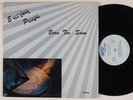
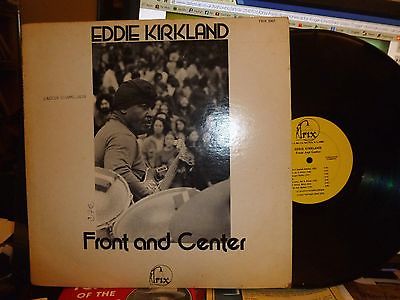
EDDIE KIRKLAND "Front and Center" LP, 1973, NM / VG, TRIX 3301
$
20


Favourite Auctions
To save auctions to your favourites, please login
If you don't have an account, please register
Description
Condition:
AMG Artist Biography by Bill Dahl How many Jamaican-born bluesmen recorded with John Lee Hooker and toured with Otis Redding? It's a safe bet there was only one: Eddie Kirkland, who engaged in some astonishing on-stage acrobatics over the decades (like standing on his head while playing guitar on TV's Don Kirshner's Rock Concert). But you would never find any ersatz reggae grooves cluttering Kirkland's work. He was brought up around Dothan, Alabama before heading north to Detroit in 1943. There he hooked up with Hooker five years later, recording with him for several labels as well as under his own name for RPM in 1952, King in 1953, and Fortune in 1959. Tru-Sound Records, a Prestige subsidiary, invited Kirkland to Englewood Cliffs, New Jersey in 1961-1962 to wax his first album, It's the Blues Man! The polished R&B band of saxophonist King Curtis intersected with Kirkland's intense vocals, raucous guitar, and harmonica throughout the exciting set. Exiting the Motor City for Macon, Georgia in 1962, Kirkland signed on with Otis Redding as a sideman and show opener not long thereafter. Redding introduced Kirkland to Stax/Volt co-owner Jim Stewart, who flipped over Eddie's primal dance workout "The Hawg." It was issued on Volt in 1963, billed to Eddie Kirk. By the dawn of the '70s, Kirkland was recording for Pete Lowry's Trix label; he also waxed several CDs for Deluge in the '90s. Kirkland remained active into the 21st century, and was in Florida to perform at a show in the Gulf Coast community of Dunedin when he died from injuries sustained when the automobile he was driving collided with a Greyhound bus in Crystal River on February 27, 2011. Eddie Kirkland was 87 years old.
Eddie Kirkland ?– Front And Center
Label: Trix ?– 3301 Format: Vinyl, LP, AlbumCountry: US Released: 1973 Genre: Blues Style:
Tracklist
A1 When I First Started Hoboing A2 I Tried To Be A Friend A3 Eddie's Boogie Chillen A4 Nora A5 I Need A Lover, Not Just A Friend A6 I Walked Twelve Miles A7 I've Got An Evil Woman B1 Goin' Back To Mississippi B2 Lonesome Talking Blues B3 Detroit Rock Island B4 Jerdine B5 Have You Seen That Lonesome Train B6 Goint To The River, See Can I Look AcrossCredits
- Guitar – Fred Robinson* (tracks: B5)
- Guitar, Harmonica, Vocals, Producer, Arranged By, Written-By – Eddie Kirkland
- Mastered By – Ray Hagerty
- Percussion – Brian Bristol (2) (tracks: B5)
- Producer, Engineer, Liner Notes – Pete Lowry
Notes
Recorded in Macon, Georgia.Tracks A7, B1, B5 recorded Dec. 28, 1970.
Tracks A1 to A3, A5, B2, B3, B6 recorded July 20/21, 1971.
Tracks A6, B4 recorded Sept. 29, 1972.
Yellow label with black print.
See our other EBAY auctions by using search by seller and using “recordcollectormichigan”
Ferndale, Michigan 48220
Phone: 248-548-9888
Hours: Monday thru Saturday NOON to 6:00 PM (Eastern)
GOLDMINE GRADING
MINT ---- It should appear to be perfect. No scuffs or scratches, blotches or stains, labels or writing, tears or splits. Mint means perfect.
NEAR MINT ---- Otherwise mint but has one or two tiny inconsequential flaws that do not affect play. Covers should be close to perfect with minor signs of wear or age just becoming evident: slight ring-wear, minor denting to a corner, or writing on the cover should all be noted properly.
VERY GOOD PLUS ---- The record has been handled and played infrequently or very carefully. Not too far from perfect. On a disc, there may be light paper scuffs from sliding in and out of a sleeve or the vinyl or some of the original luster may be lost. A slight scratch that did not affect play would be acceptably VG+ for most collectors.
VERY GOOD ---- Record displays visible signs of handling and playing, such as loss of vinyl luster, light surface scratches, groove wear and spindle trails. Some audible surface noise, but should not overwhelm the musical experience. Usually a cover is VG when one or two of these problems are evident: ring wear, seam splits, bent corners, loss of gloss, stains, etc.
GOOD ---- Well played with little luster and significant surface noise. Despite defects, record should still play all the way through without skipping. Several cover flaws will be apparent, but should not obliterate the artwork.
POOR ---- Any record or cover that does not qualify for the above "Good" grading should be seen as Poor. Several cover flaws.
price rating