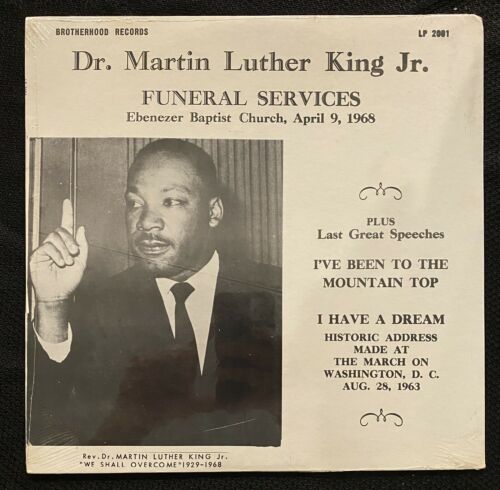
Dr. Martin Luther King, Jr. Funeral Services LP APRIL 9 1968 I HAVE A DREAM
$
38


Favourite Auctions
To save auctions to your favourites, please login
If you don't have an account, please register
Description
Dr. Martin Luther King, Jr. ~Funeral Services~ LP~APRIL 9, 1968~I HAVE A DREAM.
Strength to Love. New York: Harper & Row Publishers, 1963. This is a collection of Dr. King’s most requested sermons.
Stride Toward Freedom: The Montgomery Story. New York: Harper & Row Publishers, 1958. Dr. King’s first book; the story of the Montgomery Bus Boycott and the beginning of the Nonviolent Civil Rights Movement.
The Trumpet of Conscience. New York: Harper & Row Publishers, 1968. (Foreword by Coretta Scott King.) This book is taken from the 1967 Massey Lectures which King gave through the Canadian Broadcasting Corporation. King addresses issues including the Vietnam War, youth and civil disobedience and concludes with the “Christmas Sermon for Peace.”
Where Do We Go From Here: Chaos or Community? New York: Harper & Row Publishers, 1967. An assessment of America’s priorities and a warning that they need to be re-ordered.
Why We Can’t Wait. New York: Harper & Row Publishers, 1963. The essential writings of Martin Luther King, Jr. , James M. Washington, ed.
Farris, Christine King. Martin Luther King, Jr.: His Life and Dream. Lexington: Silver, Burdettee and Ginn, Inc., 1986. Teaching guide for grades K-12.
King, Rev. Bernice A. Hard Questions, Heart Answers: Three Rivers Press
King, Coretta Scott. My Life with Martin Luther King, Jr. New York: Holt, Rinehart & Winston, Inc., 1969. Mrs. King writes of her experiences as the wife of Martin Luther King, Jr.
King, Dexter Scott. Growing Up King: An Intimate Memoir: Grand Central Publishing
King, Rev. Martin Luther, Sr. Daddy King: An Autobiography. New York: William Morrow & Co. Inc., 1980. Rev. Martin Luther King, Sr. tells the poignant aspects of his life.
King, Yolanda Denise; Elodia Tate. Open My Eyes, Open My Soul : Celebrating Our Common Humanity
Watkins, Angela Farris. My Uncle Martin’s Big Heart: Abrams Books for Young Readers
Carson, Clayborne and Shepard, Kris (editors). A Call to Conscience: The Landmark Speeches of Dr. Martin Luther King, Jr. New York: Warner Books, 2001. This collection includes the text of Dr. King’s best-known oration, “I Have a Dream, ” his acceptance speech for the Nobel Peace Prize, and “Beyond Vietnam,” a compelling argument for ending the ongoing conflict. Each speech has an insightful introduction on the current relevance of Dr. King’s words by such renowned defenders of civil rights as Rosa Parks, the Dalai Lama, and Ambassador Andrew Young, among others.
A Testament of Hope. San Francisco: Harper & Row Publishers, 1986. A collection of quotations by Dr. King selected by Mrs. Coretta Scott King focusing on seven areas of concern; The Community of Man, Racism, Civil Rights, Justice and Freedom, Faith and Religion, Nonviolence and Peace.
The Words of Martin Luther King, Jr. New York: Newmarket Press, 1983 Carson, Clayborne and Holloran, Peter (editors).
A Knock At Midnight: Inspiration from the Great Sermons of Reverend Martin Luther King, Jr., New York: IPM in Association with Warner Books, 1998.
This is the definitive collection of eleven of Dr. King’s most powerful sermons, from his earliest known audio recording to his last sermon, delivered days before his assassination. With introductions by renowned theologians and ministers including Reverend Billy Graham and Archbishop Desmond Tutu, filled with moving personal reflections and firsthand accounts of the events surrounding each sermon, A KNOCK AT MIDNIGHT is Dr. King’s living voice today – an irresistible call that resonates and inspires greatness in us all.
Carson, Clayborne (editor). The Autobiography of Martin Luther King, Jr. New York: IPM in Association with Warner Books, 1998.
This history-making autobiography is Martin Luther King in his own words: the mild-mannered, inquisitive child and student who chafed under and eventually rebelled against segregation; the dedicated young minister who continually questioned the depths of his faith and the limits of his wisdom; the loving husband and father who sought to balance his family’s needs with those of a growing, nationwide movement; and the reflective, world-famous leader who was fired by a vision of equality for people everywhere.
Bates, Daisy. The Long Shadow of Little Rock. Fayetteville: University of Arkansas, 1987. A memoir by Daisy Bates giving her account of “The Battle of Little Rock” of September 3, 1957.
Bennett, Lerone Jr. Before the Mayflower: A History of Black America. New York: Viking Penguin, 1984. This black history classic emphasizes the role of African-Americans in American history and culture. It is based on the trials and triumphs of black Americans.
Carson, Clayborne. In Struggle: SNCC and the Black Awakening of the 1960s. Massachusetts: Harvard University, 1981. A history of SNCC’s evolving radicalism.
Clark, Septima. Ready From Within: Septima Clark and the Civil Rights Movement. California: Wild Tree Press, 1986. A first-person narrative book on Septima Clark of her participation in the movement.
Fager, Charles E. Selma 1965: The March that Changed the South. Boston: Beacon Press, 1985.
Fairclough, Adam. To Redeem the Soul of America: The SCLC and Martin Luther King, Jr. Athens: University of Georgia, 1987. A history of the SCLC and its role in bringing about a second reconstruction of the South.
Farmer, James. Lay Bare the Heart. New York: Arbor House, 1985. Autobiographical history of the Civil Rights Movement as seen through the eyes of James Farmer, founder of CORE.
Gilliard, Deric A. Unsung: Living in the Shadows of a Legend: Unsung Heroes and Sheroes Who Marched With Dr. Martin Luther King, Jr. Gilliard Communications. 2002
Leventhal, Willy S. The Children Coming On: A Retrospective of the Montgomery Bus Boycott. Black Belt Press. 1998
Lewis, John. Walking with the Wind: A Memoir of the Movement. Mariner Books. 1999
Morris, Aldon. The Origins of The Civil Rights Movement. New York: Free Press, 1984. This book covers a decade of the Civil Rights Movement, 1953-1963, focusing on the unsung black Americans and their little known community organizations which were a vital force in the Movement.
Pickering, George W., and Alan B. Anderson. Confronting the Color Line: Broken Promise of the Civil Rights Movement in Chicago. Athens: University of Georgia, 1986.
Raines, Howell. My Soul Is Rested. New York: Viking Penguin, 1977. Personal recollections from leaders and followers of the Civil Rights Movement, as well as voices from the resistance and supporters of the “Old South.” This book presents the reader with human and compelling documentation.
Robinson, JoAnn. The Montgomery Bus Boycott and the Women Who Started It: The Memoir of JoAnn Gibson Robinson. Knoxville: University of Tennessee Press, 1987. David J.Garrow, ed.
Williams, Juan. Eyes on the Prize: America’s Civil Rights Years, 1954-1965. New York: Viking, 1987. A history of the Civil Rights Movement from 1955-1965 as seen by participants in the movement, then and now.
Woods, Barbara, Jacqueline Anne Rouse, and Vicki L. Crawford. Women in the Civil Rights Movement: Trailblazers and Torchbearers, 1941-1965. New York: Carlson Publishing, 1990. A history of the significant roles African-American women have played in the struggle for freedom and equality.
Young, Andrew. An Easy Burden: The Civil Rights Movement and the Transformation of America. Baylor Press. 2008.
Young, Andrew. A Way Out of No Way; The Spiritual Memoirs of Andrew Young. Thomas Nelson, Inc. 1996
Martin Luther King Jr. was a prominent African-American clergyman, a leader in the civil rights movement and a Nobel Peace Prize laureate. King himself observed, "In the quiet recesses of my heart, I am fundamentally a clergyman, a Baptist preacher."[2]
Speechwriter and orator
The famous "I Have a Dream" address was delivered in August 1963 from the steps of the Lincoln Memorial in Washington, D.C. Less well-remembered are the early sermons of that young, 25-year-old pastor who first began preaching at the Dexter Avenue Baptist Church in Montgomery, Alabama, in 1954.[3] As a political leader in the Civil Rights Movement and as a modest preacher in a Baptist church, King evolved and matured across the span of a life cut short. The range of his rhetoric was anticipated and encompassed within "The Three Dimensions of a Complete Life," which he preached as his trial sermon at Dexter Avenue Baptist Church in 1954 and every year thereafter for the rest of his life.[4]
Sermons Edit
1953 – "The Three Dimensions of a Complete Life"[5]
1954 – "Rediscovering Lost Values", Sunday February 28, Detroit, Michigan.[6]
1955 - "The Impassable Gulf (The Parable of Dives and Lazarus)", Sunday October 2, Dexter Avenue Baptist Church, Montgomery, Alabama.[7]
1956 - "The Death of Evil Upon the Seashore", Wednesday May 17, Cathedral of St. John the Divine, New York City[8]
1956 - "Living Under the Tensions of Modern Life", Sunday September (exact date unknown), Dexter Avenue Baptist Church, Montgomery, Alabama.[9]
1956 – "Paul's Letter to American Christians", Sunday November 4, Dexter Avenue Baptist Church, Montgomery, Alabama.[10]
1957 – "The Birth of a New Nation", Sunday April 7, Dexter Avenue Baptist Church, Montgomery, Alabama.[11]
1957 – "Garden of Gethsemane", Sunday April 14, Dexter Avenue Baptist Church, Montgomery, Alabama.[12]
1957 – "Loving Your Enemies", Sunday November 17, Dexter Avenue Baptist Church, Montgomery, Alabama.[13]
1960 – "Why Jesus Called A Man A Fool", Sunday May 15, Ebenezer Baptist Church, Atlanta[14]
Possibly the first time King delivered a variation of this sermon, see 27 August 1967 below
1963 – "Eulogy for the Martyred Children" (victims of 16th Street Baptist Church bombing), Wednesday September 18, Birmingham, Alabama[15]
1966 – "Guidelines for a Constructive Church", Sunday June 5, Ebenezer Baptist Church, Atlanta[16]
1967 – "The Three Dimensions Of A Complete Life", Sunday April 9, New Covenant Baptist Church, Chicago.[17]
1967 - "Three Evils of Society" Address Delivered to the First Annual National Conference for New Politics[18]
1967 - "The Casualties of the War in Vietnam" Address delivered at the Nation Institute[19]
1967 – "Why Jesus Called A Man A Fool", Sunday August 27, Mt. Pisgah Missionary Baptist Church, Chicago[20]
Possibly the last time King delivered a variation of this sermon, which started at least as early as May 15 1960 (see above)[21]
1967 – "A Knock at Midnight", Delivered on several occasions, including the Installation Service of Ralph Abernathy at Atlanta's West Hunter Baptist Church February 11, 1962.[22]
1968 – "The Drum Major Instinct", Sunday February 4, Ebenezer Baptist Church, Atlanta.[23]
1968 – "Remaining Awake Through a Great Revolution", Sunday March 31, National Cathedral, Washington, D.C.[24]
King's last Sunday sermon.
1968 – "I've Been to the Mountaintop", Wednesday April 3, Mason Temple, Memphis, Tennessee.[25]
1968 – "Why America May Go to Hell",[26] planned to be delivered on Sunday April 7, but never delivered due to his assassination.[27]
price rating