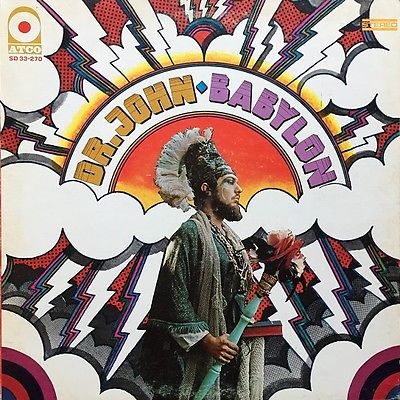
Dr. John: Babylon-1968 Atco Yellow Label 1st Edition 33RPM Stereo 12" Record
$
19


Favourite Auctions
To save auctions to your favourites, please login
If you don't have an account, please register
Description
Used 1968 Atco Yellow Label Gatefold Stereo Release of Bandleader/Composer/Kayboardist/Pioneering Blues and R & B Vocalist Mac Rebennack AKA Dr. John Entitled Babylon, Arranged and Produced by Harold Battiste, Jr., a Sonny & Cher Production, Recording Engineer Is "Soulful Pete", Recorded at Gold Star Recording Studios in Hollywood - "Although he didn't become widely known until the 1970s, Dr. John had been active in the music industry since the late '50s, when the teenager was still known as Mac Rebennack. A formidable boogie and blues pianist with a lovable growl of a voice, his most enduring achievements fused with New Orleans R&B, rock, and Mardi Gras craziness to come up with his own brand of "voodoo" music. He's also quite accomplished and enjoyable when sticking to purely traditional forms of blues and R&B. On record, he veers between the two approaches, making for an inconsistent and frequently frustrating legacy that often makes the listener feel as if "the Night Tripper" (as he's nicknamed himself) has been underachieving. In the late '50s, Rebennack gained prominence in the New Orleans R&B scene as a session keyboardist and guitarist, contributing to records by Professor Longhair, Frankie Ford, and Joe Tex. He also recorded some overlooked singles of his own, and by the '60s had expanded into production and arranging. After a gun accident damaged his hand in the early '60s, he gave up the guitar to concentrate exclusively on keyboards. Skirting trouble with the law and drugs, he left the increasingly unwelcome environs of New Orleans in the mid-'60s for Los Angeles, where he found session work with the help of fellow New Orleans expatriate Harold Battiste. Rebennack renamed himself Dr. John, The Night Tripper when he recorded his first album, Gris-Gris. According to legend, this was hurriedly cut with leftover studio time from a Sonny & Cher session, but it never sounded hastily conceived. In fact, its mix of New Orleans R&B with voodoo sounds and a tinge of psychedelia was downright enthralling, and may have resulted in his greatest album. He began building an underground following with both his music and his eccentric stage presence, which found him conducting ceremonial-type events in full Mardi Gras costume. Dr. John was nothing if not eclectic, and his next few albums were granted mixed critical receptions because of their unevenness and occasional excess. They certainly had their share of admirable moments, though, and Eric Clapton and Mick Jagger helped out on The Sun, Moon & Herbs in 1971. The following year's Gumbo, produced by Jerry Wexler, proved Dr. John was a master of traditional New Orleans R&B styles, in the mold of one of his heroes, Professor Longhair. In 1973, he got his sole big hit, "In the Right Place," which was produced by Allen Toussaint, with backing by the Meters. In the same year, he also recorded with Mike Bloomfield and John Hammond, Jr. for the Triumvirate album. The rest of the decade, unfortunately, was pretty much a waste musically. Dr. John could always count on returning to traditional styles for a good critical reception, and he did so constantly in the '80s. There were solo piano albums, sessions with Chris Barber and Jimmy Witherspoon, and In a Sentimental Mood (1989), a record of pop standards. These didn't sell all that well, though. A more important problem was that he was capable of much more than recastings of old styles and material. In fact, by this time he was usually bringing in the bacon not through his own music, but via vocals for numerous commercial jingles. It continued pretty much in the same vein throughout the '90s: New Orleans super sessions for the Bluesiana albums, another outing with Chris Barber, an album of New Orleans standards, and another album of pop standards. In 1994, Television did at least offer some original material. At this point he began to rely more upon cover versions for the bulk of his recorded work, though his interpretive skills will always ensure that these are more interesting than most such efforts. His autobiography, Under a Hoodoo Moon, was published by St. Martin's Press in 1994, and in 1998 he resurfaced with Anutha Zone, which featured collaborations with latter-day performers including Spiritualized, Paul Weller, Supergrass, and Ocean Colour Scene. Duke Elegant followed in early 2000. Additional albums for Blue Note followed in 2001 (Creole Moon) and 2004 (N'Awlinz: Dis Dat or d'Udda). Sippiana Hericane, a four-song EP celebrating his beloved hometown of New Orleans in the wake of Hurricane Katrina, arrived in November of 2005. Mercernary, an album of covers of songs made famous by Johnny Mercer, appeared on Blue Note in 2006. City That Care Forgot followed in 2008. The Night Tripper persona was revived for 2010's Tribal, which featured guest spots from Derek Trucks, Allen Toussaint, Donald Harrison, and the late Bobby Charles. Dr. John also contributed to French electronic artist Féloche's international hit single "Gris Gris John" the same year. He teamed up with the Black Keys' Dan Auerbach to produce and record Locked Down. It was issued in the spring of 2012. Two years later, he released the third album in his tribute series, a collection of songs by and associated with Louis Armstrong entitled Ske-Dat-De-Dat: Spirit of Satch. It featured guest appearances from Bonnie Raitt, Ledisi, the McCrary Sisters, and Blind Boys of Alabama, and appeared in August of 2014. Earlier that year, Don Was assembled an all-star tribute to Dr. John and that May 2014 concert was released by Concord in October 2016 as The Musical Mojo of Dr. John: Celebrating Mac & His Music." - "Dr. John's ambition remained undiminished on his second solo album, Babylon, released shortly after the groundbreaking voodoo-psychedelia-New Orleans R&B fusion of his debut, Gris-Gris. The results, however, were not nearly as consistent or impressive. Coolly received by critics, the album nonetheless is deserving of attention, though it pales a bit in comparison with Gris-Gris. The production is sparser and more reliant on female backup vocals than his debut. Dr. John remains intent on fusing voodoo and R&B, but the mood is oddly bleak and despairing, in comparison with the wild Mardi Gras-gone-amok tone of his first LP. The hushed, damned atmosphere and after-hours R&B sound a bit like Van Morrison on a bummer trip at times, as peculiar as that might seem. "The Patriotic Flag-Waiver" (sic), in keeping with the mood of the late '60s, damns social ills and hypocrisy of all sorts. An FM underground radio favorite at the time, its ambitious structure remains admirable, though its musical imperfections haven't worn well. To a degree, you could say the same about the album as a whole. But it has enough of an eerie fascination to merit investigation." - Living Legend Dr. John Plays the Keyboards and Sings on These Seven Original Compositions! - Selections on Side One Are Original Compositions Babylon, Glowin', Black Widow Spider & the Dr. John Harold Battiste Jr. Penned Barefoot Lady - Tracks for Side Two Consist of Twilight Zone, the Patriotic Flag Waiver and the Lonesome Guitar Strangler - Used Copy, Cover Very Good++, Record Has a Few Light Marks & Scuffs - Gatefold Sleeve, Stereo Recording, Product Code SD 33-270 - California Residents Add 9.75% Sales Tax - International S & H Extra -
price rating




![This Is Our Vice [LP] by Cub Sport.](https://www.popsike.info/php/thumbnail.php?url=https://www.popsike.pics/pix/20160618/182175649090.jpg)