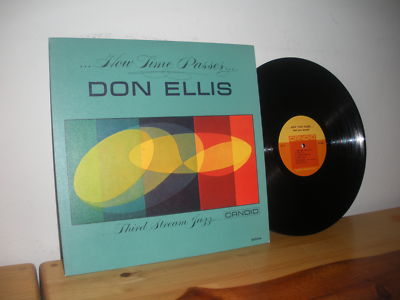
Don Ellis "How Time Passes"; Jaki Byard; Ron Carter; Persip; OG Candid LP; NM/NM
$
60


Favourite Auctions
To save auctions to your favourites, please login
If you don't have an account, please register
Description
Don Ellis / "How Time Passes (Third Stream Jazz)" / Candid Records 8004 / Mono LP / Yellow-Orange Label / Original Pressing
Vinyl Grade: Audibly Checked: NM
Album Cover: NM
Musicians:
Date(s) Recorded
October 4, 1960 – October 5, 1960
Tracks
1. …How Time Passes… (Ellis) - 6:23
2. Sallie (Ellis) - 4:33
3. A Simplex One (Ellis) - 4:10
4. Waste (Byard) - 8:03
5. Improvisational Suite # 1 (Ellis) - 22:07
Credits
Jaki Byard - Piano, Also Sax
Ron Carter - Bass
Don Ellis - Trumpet
Charlie Persip - Drums
Liner Notes
Gunther Schuller
Original Release
Candid (1960)
Review:
"In 1960, Ellis displayed his growing creativity and innovative experimentation on his first solo album, How Time Passes. Featured on the recording was Ellis's roommate and friend from Boston, Jaki Byard, a noteworthy modern jazz musician who was closely-associated with Ellis from 1959-62.
How Time Passes feature devices that marked Ellis as an emerging jazz modernist. He experimented with the use of a tone row as the basis of jazz composition in "Improvisational Suite #1." According to Gunther Schuller's liner notes on this piece:
"The SUITE uses twelve-tone rows only as a point of departure. It does not develop the row material along orthodox methods. Formally, the SUITE consists of a series of loosely strung together sections, alternating between free cadenzas and strict time improvisations. Don's own statement of intent: 'to create an extended piece which would be almost totally improvised, which would sound new and fresh each time, and which would present a variety of moods and levels of density and intensity, but which would be highly unified structurally."
The first Ellis recordings reflect an early and somewhat primitive fascination with tempo and rhythm, such as expanding and reducing the musical timeline. This effect was achieved through accelerandos and ritardandos in the title track of How Time Passes."
price rating