Don CHERRY * Symphony For Improvisers * Blue Note * LP
€
25
$
29


Favourite Auctions
To save auctions to your favourites, please login
If you don't have an account, please register
Description
Ein Wort zuvor: Gerne können Sie die LP auch abholen. Sofern Sie aber den Versand bevorzugen, kommen zum Höchstgebot noch Euro 4 für den Versand per Hermes in einem stabilen Plattenpäckchen hinzu.
Bieten Sie bitte nicht, wenn Sie damit nicht einverstanden sind. Danke!
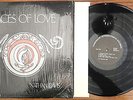
DON CHERRY: Symphony For Imrovisers
on Blue Note Liberty BST 84247/ BLP 4247, VAN GELDER in deadwax
Cover/Vinyl: vg++ [comment on rear cover, soc]/vg++
Das sagt Allmusic.com:
For his second album, Symphony for Improvisers, Don Cherry expanded his Complete Communion quartet -- tenor saxophonist Gato Barbieri, bassist Henry Grimes, and drummer Ed Blackwell -- to a septet, adding vibraphonist Karl Berger, bassist Jean François Jenny-Clark, and tenor saxophonist Pharoah Sanders (who frequently plays piccolo here). The lineup has a real international flavor, since Barbieri was from Argentina, Berger from Germany, and Jenny-Clark from France; Cherry had gigged regularly with all three during his 1964-1965 sojourn in Europe, and brought them to New York to record. With all the added firepower, it's remarkable that Symphony for Improvisers has the same sense of shared space and controlled intelligence as its predecessor, even when things are at their most heated. Once again, Cherry sets up the album as two continuous medleys that fuse four compositions apiece, which allows the group's improvisational energy and momentum to carry straight through the entire program. The "Symphony for Improvisers" suite is the most raucous part of Cherry's Blue Note repertoire, and the "Manhattan Cry" suite pulls off the widest mood shifts Cherry had yet attempted in that format. Even though the album is full of passionate fireworks, there's also a great deal of subtlety -- the flavors added to the ensemble by Berger's vibes and Sanders' piccolo, for example, or the way other instrumental voices often support and complement a solo statement. Feverish but well-channeled, this larger-group session is probably Cherry's most gratifying for Blue Note.
Biograhpy
The second track from Tomorrow Is the Question -- Ornette Coleman's 1959 wake-up call to the fusty hard bop movement -- is a medium tempo blues, "Tears Inside." After the statement of the tune's two-beat, countrified-bebop theme, trumpeter Don Cherry plays a solo that -- for all its frail beauty and general adherence to modern jazz's harmonic conventions -- sounds as if it might have been played by Miles Davis or Chet Baker. Coleman and Cherry were vanguardists, to be sure, and they were received as such by critics, musicians, and audiences alike. Even so, today, in listening to these early free jazz sides, one wonders what all the fuss was about, for it's clear that both musicians -- especially Cherry -- played in a style derived from the mainstream of jazz's development.
Naturally, the passing of four decades provides us a perspective denied listeners at the time; changes that seem slight to us today were magnified then. Coleman and Cherry's elastic relationship to pitch and swing-time were certainly a liberation from the tyranny of equal temperament and literal pulse. Despite the music's revolutionary characteristics, however, no one would now deny that the work of these men is an extension or interpretation of the jazz tradition. This is particularly obvious in Cherry's case; abstracted from his contexts, Don Cherry's style was in a real sense grounded in bebop. He wasn't an especially strong bebop player by classic standards -- his range and facility were somewhat limited, for one thing -- but externally, his style bore the marks of modern jazz in terms of melody, harmony, rhythm, and phrasing.
Evaluating Cherry in classic terms is a mistake, for like Miles Davis -- and Coleman, for that matter -- concepts of Western musical objectivity were nearly irrelevant to his work. Cherry was not gifted with extraordinary chops, but those are classicist concerns, and his was a wholly romantic art. Cherry's greatest strength was less easily quantified, less tangible: an ability to convey emotional depth via a subtle manipulation of musical elements. An improvised Don Cherry line might bear all the typical contours of bebop, but Cherry micro-managed every aspect of his playing, rhythmically, harmonically, melodically, timbrally, and dynamically. Like Coleman, Cherry's sound came as close to the expressive qualities of the human voice as was instrumentally possible. And his playing was utterly spontaneous; Cherry was among the most unpredictable of improvisers. His frequent stutters in mid-solo may have stemmed from a limited vocabulary of canned phrases, but his resultant recoveries were the stuff of which great jazz is made.
Cherry first attained prominence with Coleman, with whom he began playing around 1957. At that time Cherry's instrument of choice was a pocket trumpet (or cornet) -- a miniature version of the full-sized model. The smaller instrument -- in Cherry's hands, at least -- got a smaller, slightly more nasal sound than is typical of the larger horn. Though he would play a regular cornet off and on throughout his career, Cherry remained most closely identified with the pocket instrument. Cherry stayed with Coleman through the early '60s, playing on the first seven (and most influential) of the saxophonist's albums. In 1960, he recorded The Avant-Garde with John Coltrane. After leaving Coleman's band, Cherry played with Steve Lacy, Sonny Rollins, Archie Shepp, and Albert Ayler. In 1963-4, Cherry co-led the New York Contemporary Five with Shepp and John Tchicai. With Gato Barbieri, Cherry led a band in Europe from 1964-6, recording two of his most highly regarded albums, Complete Communion and Symphony for Improvisers. Cherry taught at Dartmouth College in 1970, and recorded with the Jazz Composer's Orchestra in 1973. He lived in Sweden for four years; he used the country as a base for his travels around Europe and the Middle East. Cherry became increasingly interested in other, mostly non-Western styles of music. In the late '70s and early '80s, he performed and recorded with Codona, a cooperative group with percussionist Nana Vasconcelos and multi-instrumentalist Collin Walcott. Codona's music was a pastiche of African, Asian, and other indigenous musics. Concurrently, Cherry joined with ex-Coleman associates Charlie Haden, Ed Blackwell, and Dewey Redman to form Old and New Dreams, a band dedicated to playing the compositions of their former employer. After the dissolution of Codona, Cherry formed Nu with Vasconcelos and saxophonist Carlos Ward. In 1988, he made Art Deco, a more traditional album of acoustic jazz, with Haden, Billy Higgins, and saxophonist James Clay. Until his death in 1995, Cherry would continue to combine disparate musical genres; his interest in world music never abated. Cherry learned to play and compose for wood flutes, tambura, gamelan, and various other non-Western instruments. Elements of these musics inevitably found their way into his later compositions and performances, as on 1990's Multi Kulti, a characteristic celebration of musical diversity. As a live performer, Cherry was notoriously uneven. It was not unheard of for him to arrive very late for gigs, and his technique -- never great to begin with -- showed on occasion a considerable, perhaps inexcusable decline. In his last years, especially, Cherry seemed less self-possessed as a musician. Yet, his musical legacy is one of such influence that his personal failings fade in relative significance.
Non-EU bidders could pay with Paypal.
Deutschland und EU: Ueberweisung möglich.
Shipping fee:
EU = 4 EURO
World = 6 Euro
Viele weitere LP's, CD's, Bücher usw. in meinen anderen Auktionen! Jazz, Avantgarde, Garage, Freakbeat, Rock, Voodoo Rhythm, Fuzz, Yé Yé, Punk, Wergo, Elektra Nonesuch, Blue Note usw.
Schönen Dank für Ihr Interesse und viel Vergnügen beim Bieten!
Das hier ist ein Privatverkauf. Mit der Abgabe eines Gebotes erklären Sie sich ausdrücklich damit einverstanden, auf die ihnen gesetzlich zustehende Garantie/Gewährleistung bei Gebrauchtwaren zu verzichten. Keine Rücknahme des Artikels. Bieten Sie bitte nicht, wenn Sie mit dieser Regel nicht einverstanden sind.
price rating