Derek and the Dominos ? Layla & Other Assorted Love Songs ? RSO Dbl Vinyl LP
$
24


Favourite Auctions
To save auctions to your favourites, please login
If you don't have an account, please register
Description
Welcome to Classic Cadillac Records! My goal is to provide each and every customer with the best possible buying experience, no matter the size of the order. Unlike most sellers, I advertise all my items clearly and in as much detail as possible, without shouting at you in all caps. I take multiple high quality pictures and never use stock photos, so you know exactly what you?re buying. I take great pride in my work and go the extra mile, which can clearly be seen in my listings compared to other sellers that put minimal effort into theirs. I visually grade all my records as accurately as possible and will never grade anything above Near Mint unless it?s still sealed. Please note that a visual grade can differ from a play grade, and am happy to spot check a record upon request. All orders are shipped within 1 business day (usually sooner) and packed with extra care to ensure fast, safe arrival. I combine shipping on multiple orders to save you money and gladly ship worldwide. Please look closely at all pictures, read all relevant details and ask any questions you may have before buying. I offer a full 30-day return policy on everything I sell, so buy with confidence! And most importantly, thanks for looking!
Layla and Other Assorted Love Songs Studio album by Derek and the Dominos Released 9 November 1970 Recorded 26 August–10 September, 1–2 October 1970 Studio Criteria Studios, Miami, Florida Genre Blues rock Length 76:44 Label Polydor, Atco Producer Tom Dowd (exec), Derek and the Dominos Derek and the Dominos chronology Layla and Other Assorted Love Songs
(1970) In Concert
(1973) Eric Clapton chronology Eric Clapton
(1970) Layla and Other Assorted Love Songs
(1970) The History of Eric Clapton
(1972) Singles from Layla and Other Assorted Love Songs
- "Bell Bottom Blues"
Released: January 1971 - "Layla"
Released: March 1971
Layla and Other Assorted Love Songs is a double album by the English–American blues rock band Derek and the Dominos. Released in November 1970, it is best known for its title track, "Layla", and is often regarded as Eric Clapton's greatest musical achievement. The other band members were Bobby Whitlock on keyboards and vocals, Jim Gordon on drums, Carl Radle on bass. Duane Allman played lead and slide guitar on 11 of the 14 songs.
Layla and Other Assorted Love Songs is Derek and the Dominos first release, and only studio album. Initially regarded as a critical and commercial disappointment, it failed to chart in Britain and peaked at number 16 on the Billboard Top LPs chart in the United States. It returned to the US albums chart again in 1972, 1974 and 1977, and has since been certified Platinum by the RIAA. The album finally debuted on the UK Albums Chart in 2011, peaking at number 68.
In 2000, the album was inducted into the Grammy Hall of Fame. In 2003, television network VH1 named Layla and Other Assorted Love Songs the 89th-greatest album of all time, and Rolling Stone ranked it number 117 on its list of "The 500 Greatest Albums of All Time". In 2012, the Super Deluxe Edition of the record won a Grammy Award for Best Surround Sound Album.
Background
Derek and the Dominos grew out of Eric Clapton's frustration with the hype associated with his previous bands, the supergroups Cream and Blind Faith. Following the latter's dissolution, he joined Delaney & Bonnie and Friends, whom he had come to know while they were the opening act on Blind Faith's US tour in the summer of 1969. After that band also split up, a Friends alumnus, Bobby Whitlock, joined up with Clapton in Surrey, England. From April 1970, the two spent weeks writing a number of songs "just to have something to play", as Whitlock put it. These songs would later make up the bulk of the material on Layla and Other Assorted Love Songs.
Having toured with Joe Cocker straight after leaving Delaney & Bonnie, Carl Radle and Jim Gordon reunited with Clapton and Whitlock in England. Clapton attempted to avoid the limelight under cover of the anonymous "Derek and the Dominos", with whom he played a tour of small clubs in Britain during the first three weeks of August. The group's name had reportedly resulted from a gaffe made by the announcer at their first concert, who mispronounced the band's provisional name, "Eric & The Dynamos". In fact, Clapton chose "Derek and the Dominos" because he did not want his name and celebrity to get in the way of maintaining a "band" image. When the tour was over, they headed for Criteria Studios in Miami to record an album.
The source of the album's eventual centrepiece, "Layla", was rooted in Clapton's infatuation with Pattie Boyd, the wife of his friend and Beatle lead guitarist George Harrison, who had joined Clapton as a guitarist on Delaney & Bonnie's European tour in December 1969. Dave Marsh, in The Rolling Stone Illustrated History of Rock and Roll, wrote that "there are few moments in the repertoire of recorded rock where a singer or writer has reached so deeply into himself that the effect of hearing them is akin to witnessing a murder, or a suicide … to me, 'Layla' is the greatest of them."
Duane Allman's arrival
Veteran producer Tom Dowd was working on the Allman Brothers second album, Idlewild South, when the studio received a phone call that Clapton was bringing the Dominos to Miami to record. Upon hearing this, guitarist Duane Allman indicated that he would love to drop by and watch, if Clapton approved.
Allman later called Dowd to let him know that his band was in town to perform a benefit concert on 26 August. When Clapton learned of this he insisted on going to see their show, saying, "You mean that guy who plays on the back of (Wilson Pickett's) 'Hey Jude'? … I want to see him play … let's go." Stage hands seated Clapton and company in front of the barricade separating the audience from the stage. When they sat down, Allman was playing a solo. As he turned around and opened his eyes and saw Clapton, he froze. Dickey Betts, the Allmans' other lead guitarist, picked up where Allman left off, but when he followed Allman's eyes to Clapton, he had to turn his back to keep from freezing, himself.
After the show, Allman asked Clapton if he could come by the studio to watch some recording sessions, but Eric invited him there directly, saying: "Bring your guitar; you got to play!" Jamming together overnight, the two bonded; Dowd reported that they "were trading licks, they were swapping guitars, they were talking shop and information and having a ball – no holds barred, just admiration for each other's technique and facility." Clapton wrote later in his autobiography that he and Allman were inseparable during the sessions in Florida; he talked about Allman as the "musical brother I'd never had but wished I did".
Recording
The majority of the songs on Layla and Other Assorted Love Songs were products of Clapton and Whitlock's collaboration, which produced six of the nine originals on the recording; five covers fleshed out the balance. Clapton used a diminutive 5-watt tweed Fender Champ during the sessions, which has grown to legend since.
Original songs
Clapton and Whitlock co-wrote "I Looked Away", "Keep on Growing", "Anyday", "Bell Bottom Blues", "Tell the Truth" and "Why Does Love Got to Be So Sad?" Whitlock also contributed "Thorn Tree in the Garden", while Clapton brought "I Am Yours" (from a poem by Nizami) and "Layla" (with a coda credited to Jim Gordon).
"Tell the Truth" had been initially recorded with an upbeat tempo in June 1970 with Harrison's famed Wall of Sound producer, Phil Spector. It was issued as a single, with "Roll It Over" on the B-side. However, as Whitlock recalls, Spector's Wall of Sound approach did not fit the band's style, and they had the single withdrawn. On 28 August, with Allman contributing slide, the song was recorded as a long and slow instrumental jam. The version with vocals released on Layla captures the jam's slower pace. Both vocal versions were later included on the 1972 compilation The History of Eric Clapton.
The last track on the album, "Thorn Tree in the Garden", was recorded with Whitlock, Clapton, Allman, Radle and Gordon sitting in a circle around a single microphone. The result, according to Dowd, was "the perfect stereo recording".
Covers
The album's five covers included the blues standards "Nobody Knows You When You're Down and Out" (Jimmy Cox), "Key to the Highway" (Charles Segar, Willie Broonzy), and "Have You Ever Loved a Woman" (Billy Myles), a slowed-down version of Jimi Hendrix's "Little Wing", and an up-tempo take on Chuck Willis's doo-wop ballad "It's Too Late".
According to Dowd, the recording of "Key to the Highway" was unplanned, triggered by the band hearing Sam Samudio performing the song for his album Hard and Heavy in another room at the studio. When the Dominos spontaneously started playing it Dowd told the engineers to roll tape, resulting in the tune's telltale fade-in.
Artwork
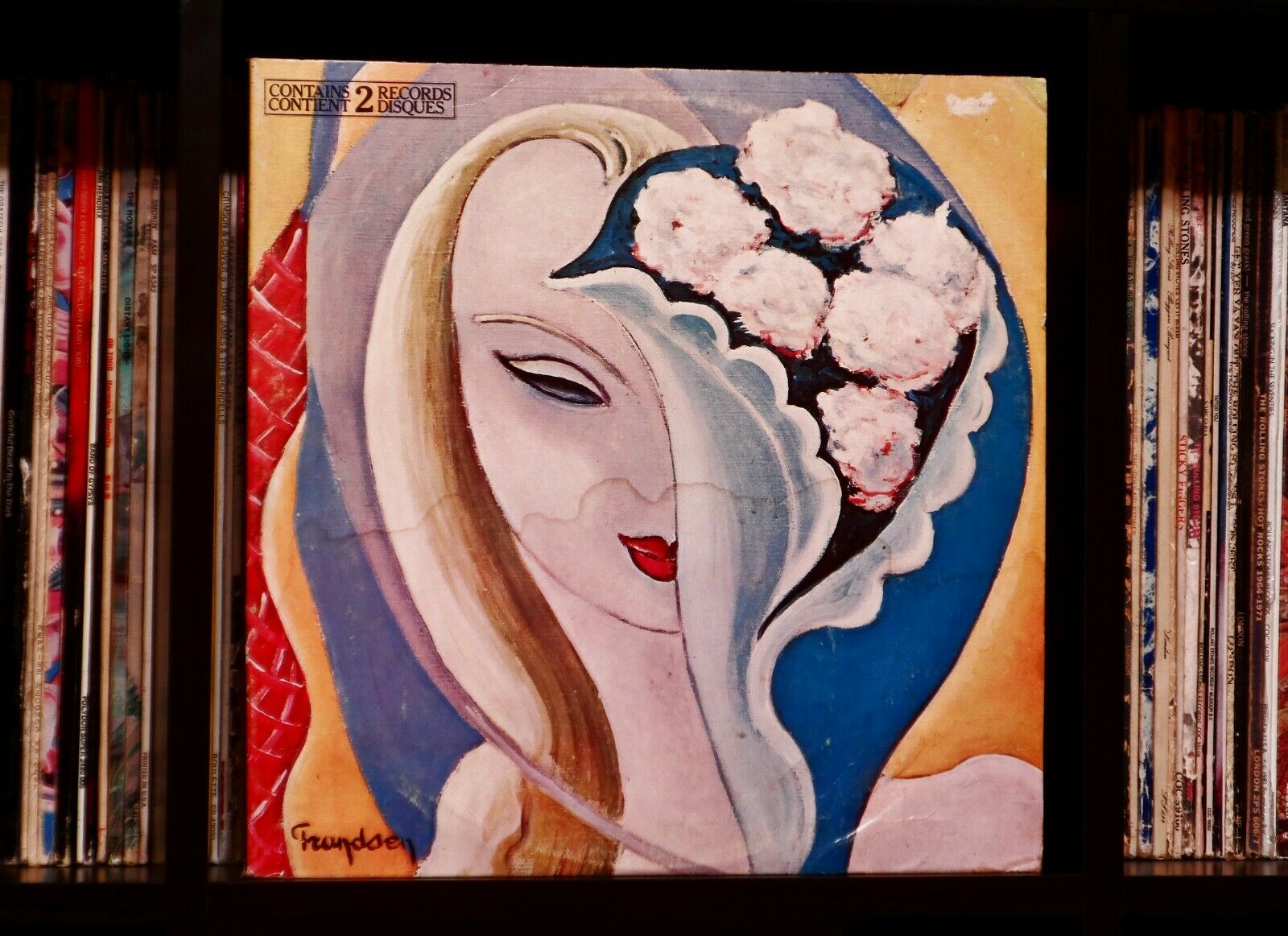
The album's front cover is credited as "Cover painting by Frandsen-De Schomberg with thanks to his son, Emile, for the abuse of his house." Bobby revealed in an interview in August 1970 they started an egg-throwing fight at Frandsen's house in France which his son Emile covered for them. Then he took them to his father's studio where they saw the painting that would become their album cover. Called "La Fille au Bouquet", Eric immediately spotted a likeness between the blonde-haired woman it depicted and Pattie Boyd. Clapton also insisted that Frandsen de Schomberg's image be unadorned on the ''Layla'' sleeve, with no text added to give either the band's name or the title of the album.
Release and reception
Atco Records issued Layla and Other Assorted Love Songs in November 1970 in the United States, with a UK release following in December, on Polydor. The album failed to chart in the United Kingdom, while in the US, it peaked at number 16 on the BillboardTop LPs chart. Despite this achievement, Layla was viewed as a commercial failure, according to authors Harry Shapiro and Jan Reid. Dowd later rued the difficulty of getting airplay for the songs on US radio, while Shapiro attributes its lack of success in Britain to minimal promotion by Polydor and what he terms "the unrelenting and monotonous Press litany of a post-Cream withdrawal syndrome". Concerned that the press and the public were unaware of Clapton's involvement, Atco and Polydor distributed badges reading "Derek is Eric".
Layla also flopped critically, according to Shapiro: "As with Eric's first solo album, the reviewers liked the guitars-on-fire-stuff … but regarded the [love songs] as little more than fluff." Writing in Melody Maker, Roy Hollingworth opined that the songs ranged "from the magnificent to a few lengths of complete boredom", and specified: "We have Hendrix's 'Little Wing' played with such spreading beauty that Jimi would surely have clapped till his hands bled, and then we have 'I Am Yours' … a bossa that novas in pitiful directions." While he identified portions of "pretty atrocious vocal work", Hollingworth considered Layla to be "far more musical" than Eric Clapton, and praised Clapton and Allman for "giv[ing] about every superb essay possible on the playing of the electric guitar". Writing in Saturday Review magazine, Ellen Sander described it as "pointless and boring" and "a basket case of an album", and said that Clapton had "all but blown his musical credibility". Grouping the Dominos album with recent releases by Bob Dylan, the Beatles and Stephen Stills, Sander added, "It's [Clapton's] instincts, not his talents, that are out of synch, and he is certainly not alone, nor by any means the worst offender, in depositing garbage into the vault of a guaranteed personal audience." In a more favourable review for Rolling Stone, Ed Leimbacher noted the album's "filler" material but added that "what remains is what you hoped for from the conjunction of Eric's developing style, the Delaney and Bonnie styled rhythm section, and the strengths of 'Skydog' Allman's session abilities." Leimbacher found Clapton's singing "always at least adequate, and sometimes quite good" and concluded, "forget any indulgences and filler – it's still one hell of an album."
In his consumer guide for The Village Voice, critic Robert Christgau gave the album an A rating (in later years upgraded to A+). He complimented the contrast of "the high-keyed precision of [Clapton's] guitar" with "the relaxed rocking of Allman/Whitlock/Radle/Gordon" and added, "even though this one has the look of a greedy, lazy, slapdash studio session, I think it may be Eric Clapton's most consistent recording [...] one of those rare instances when musicians join together for profit and a lark and come up with a mature and original sound." In a review for the album's 1972 reissue, Ed Naha of Circus called Layla an "amazing collection of Clapton tumblers" and stated, "Clapton shines once again as the high priest of rock guitar."
Legacy
Professional ratings Retrospective reviews Review scores Source Rating AllMusic Chicago Tribune Christgau's Record Guide A+ Down Beat Encyclopedia of Popular Music MusicHound Rock 5/5 Q Rolling Stone Sputnikmusic 5/5 Uncut Classic RockSince its initial reception, Layla has been acclaimed by critics and regarded as Clapton's greatest overall work. In Christgau's Record Guide: Rock Albums of the Seventies (1981), Christgau dubbed it "Clapton's most carefully conceived recording", while admiring the album's "relaxed shuffle and simple rock and roll" and Clapton's "generally warm" singing. Christgau wrote in conclusion: "his meaning is realized at those searing peaks when a pained sense of limits – why does love have to be so sad, I got the bell-bottom blues, Lay-la – is posed against the good times in an explosive compression of form." Anthony DeCurtis of Rolling Stone called the album "a masterpiece" and praised its raw nature, writing that "the playing on the album, too, teeters on the edge of chaos but never tips."
AllMusic editor Stephen Thomas Erlewine praised Allman's slide guitar work for "push[ing] Clapton to new heights" and stated, "what really makes Layla such a powerful record is that Clapton, ignoring the traditions that occasionally painted him into a corner, simply tears through these songs with burning, intense emotion." Andy Gill of The Independent complimented the album's "blues standards and sensitive originals" and noted Clapton's fiery affinity with Allman, whom Gill writes "would ensure the epochal status" of the album. Yahoo! Music's Dave DiMartino also noted Allman's "stinging guitar work" and described Layla as "Clapton's masterwork, and one of the finest rock 'n' roll albums of the '70s", commenting that "this best-selling double LP established Clapton's post-Cream superstardom." Jim DeRogatis of the Chicago Sun-Times called it "the strongest recording of Eric Clapton’s career, and arguably the greatest blues-rock album ever made", while Chicago Tribune critic Greg Kot hailed it as Clapton's "blues-rock guitar masterpiece".
Live performances
Derek and the Dominos went on tour to support Layla and performances from the October–December 1970 US tour were released in January 1973 on In Concert. Allman never toured with Derek and the Dominos, but made two guest appearances with them: on 1 December 1970 at the Curtis Hixon Hall in Tampa (Soulmates LP), and the following day at Onondaga County War Memorial in Syracuse, New York.
The band appeared on the The Johnny Cash Show, which became their only television appearance. Filmed at the Ryman Auditorium in Nashville, Tennessee, and broadcast on 6 January 1971, the band performed "It's Too Late" and then joined Cash and Carl Perkins for the Perkins' classic, "Matchbox".
Clapton continued to play the song "Layla" live, as at Live Aid (in Philadelphia) in 1985.[43] In 2006, Clapton and J.J. Cale recorded The Road to Escondido, on which Allman Brothers guitarist Derek Trucks played guitar. Following this, Clapton went on tour with Trucks as part of his band. Clapton explained later that playing with Trucks made him feel like he in Derek and the Dominos again. As the tour progressed the set changed, with the first half of the show consisting entirely of songs from Layla and Other Assorted Love Songs and culminating in "Layla".
Track listing
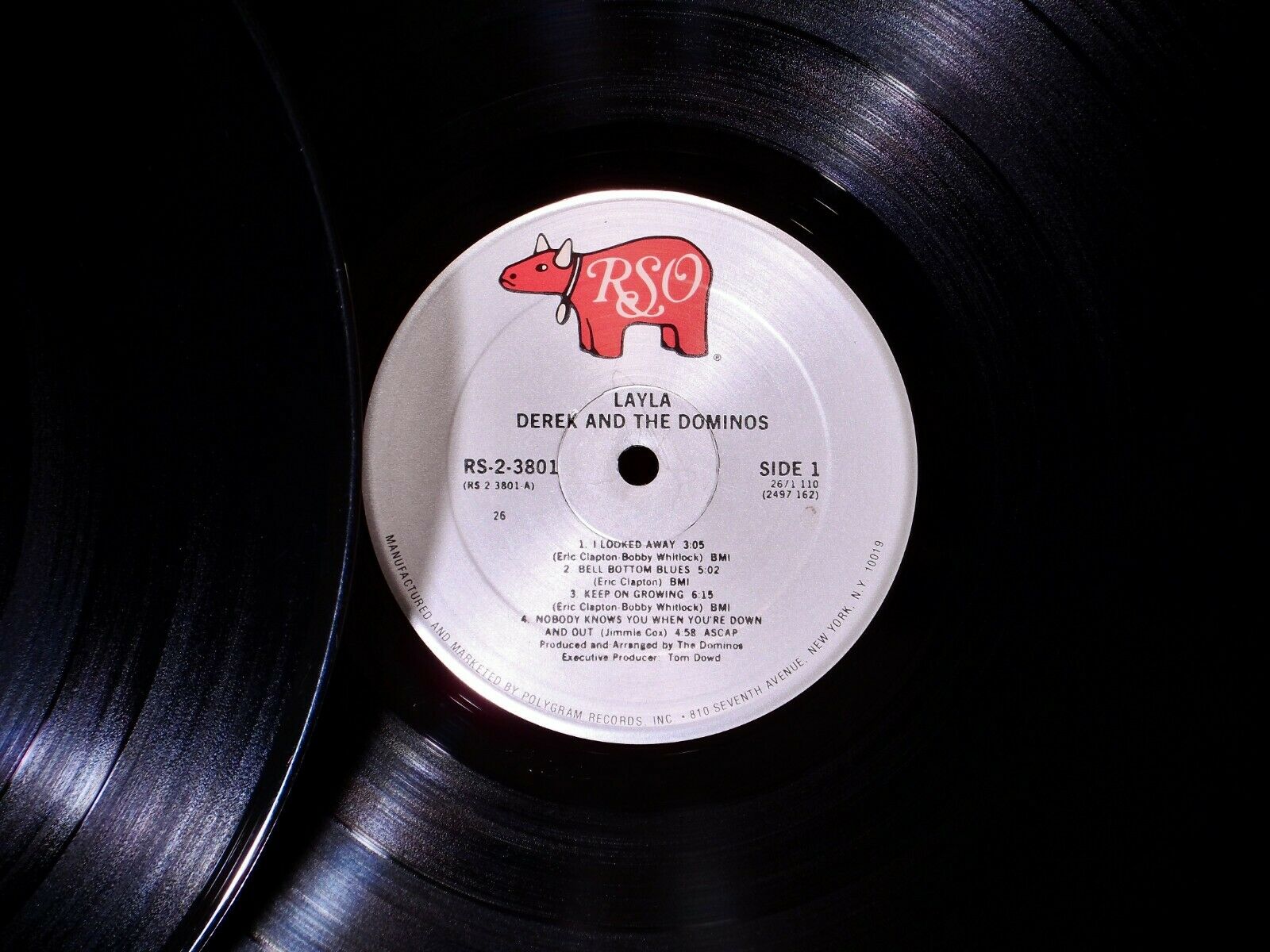
Side one No. Title Writer(s) Length 1. "I Looked Away" Eric Clapton, Bobby Whitlock 3:05 2. "Bell Bottom Blues" Clapton, Whitlock 5:02 3. "Keep on Growing" Clapton, Whitlock 6:21 4. "Nobody Knows You When You're Down and Out" Jimmy Cox 4:57 Side two No. Title Writer(s) Length 1. "I Am Yours" Clapton, Nizami 3:34 2. "Anyday" Clapton, Whitlock 6:35 3. "Key to the Highway" Charles Segar, Willie Broonzy 9:40 Side three No. Title Writer(s) Length 1. "Tell the Truth" Clapton, Whitlock 6:39 2. "Why Does Love Got to Be So Sad?" Clapton, Whitlock 4:41 3. "Have You Ever Loved a Woman" Billy Myles 6:52 Side four No. Title Writer(s) Length 1. "Little Wing" Jimi Hendrix 5:33 2. "It's Too Late" Chuck Willis 3:47 3. "Layla" Clapton, Jim Gordon 7:05 4. "Thorn Tree in the Garden" Whitlock 2:53price rating