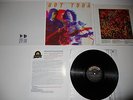
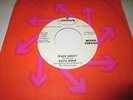
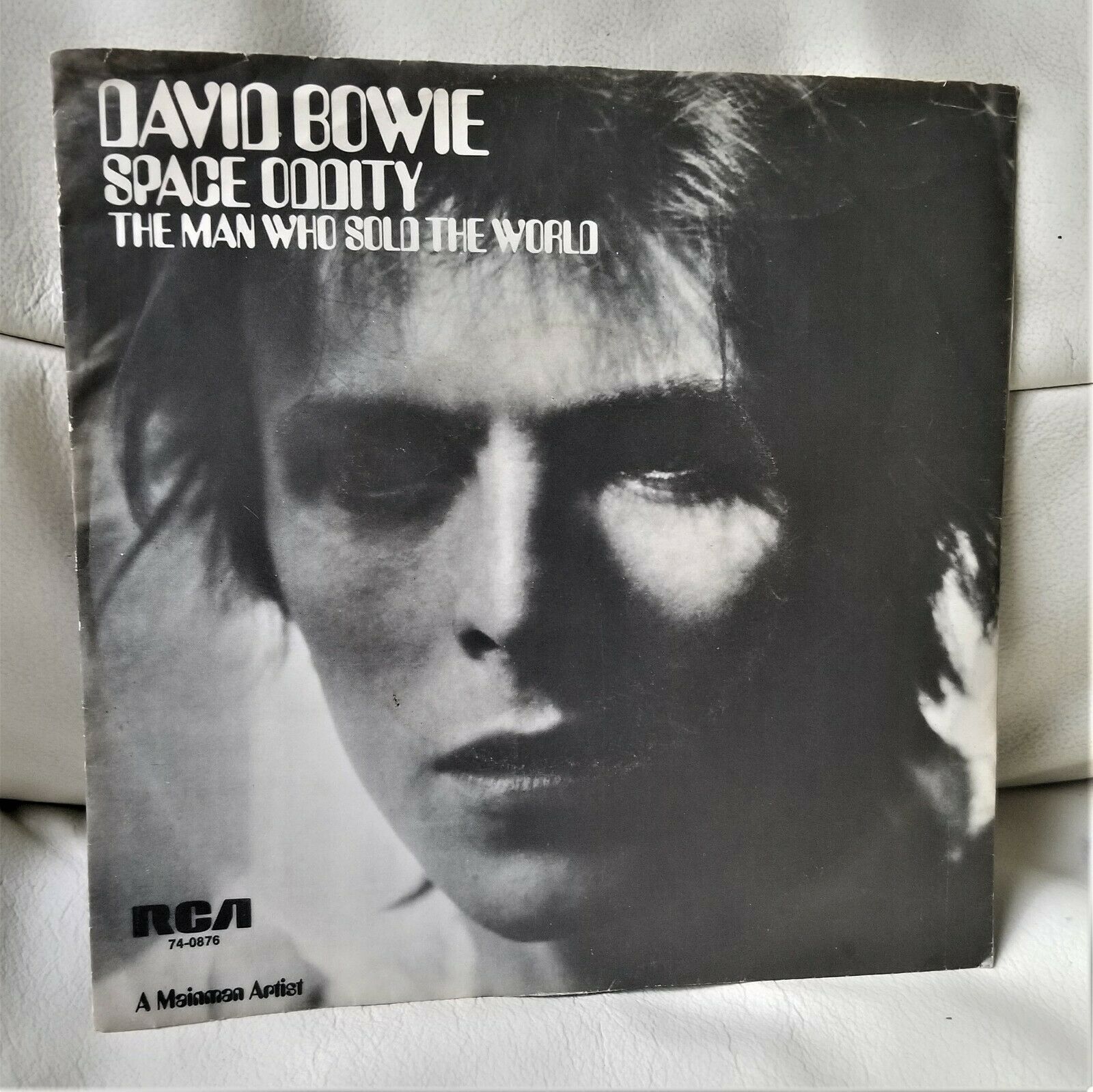
David Bowie - Space Oddity / Man Who Sold The World / 1973 RCA Vinyl 45 rpm PS
$
23


Favourite Auctions
To save auctions to your favourites, please login
If you don't have an account, please register
Description
Rare - 1973 Original Vinyl Pressing Classic Rock 45 RPM Record
David Bowie Space Oddity b/w The Man Who Sold The World
1973 RCA Records 45 RPM Vinyl with Picture Sleeve
Vinyl: NM Condition Jacket: VG+ to NM Condition
This will be a great addition to your vintage vinyl collection.
Good luck and good bidding!
USA Shipping: via USPS Media Mail
International Shipping: Buyers please contact me first before bidding to get Int'l Postage quote.
David Bowie The cliché about David Bowie is that he was a musical chameleon, adapting himself according to fashion and trends. While such a criticism is too glib, there's no denying that Bowie demonstrated a remarkable skill for perceiving musical movements at his peak in the '70s. After spending several years in the late '60s as a mod and an all-around music-hall entertainer, Bowie reinvented himself as a hippie singer/songwriter. Prior to his breakthrough in 1972, he recorded a proto-metal record and a pop/rock album, eventually redefining glam rock with his ambiguously sexy Ziggy Stardust persona. Ziggy made Bowie an international star, but he wasn't content to continue to churn out glitter rock. By the mid-'70s, he'd developed an effete, sophisticated version of Philly soul that he dubbed "plastic soul," which eventually morphed into the eerie avant-pop of 1976's Station to Station. Shortly afterward, he relocated to Berlin, where he recorded three experimental electronic albums with Brian Eno. At the dawn of the '80s, Bowie was still at the height of his powers, yet following his blockbuster dance-pop album Let's Dance in 1983, he slowly sank into mediocrity before salvaging his career in the early '90s. Even when he was out of fashion in the '80s and '90s, it was clear that Bowie was one of the most influential musicians in rock, for better and for worse. Each one of his phases in the '70s sparked a number of subgenres, including punk, new wave, goth rock, the new romantics, and electronica. Few rockers have ever had such lasting impact.
Scary Monsters was Bowie's last album for RCA, and it wrapped up his most innovative, productive period. Later in 1980, he performed the title role in the stage production of The Elephant Man, including several shows on Broadway. Over the next two years, he took an extended break from recording, appearing in Christiane F (1981) and the vampire movie The Hunger (1982), returning to the studio only for his 1981 collaboration with Queen, "Under Pressure," and the theme for Paul Schrader's remake of Cat People. In 1983, he signed an expensive contract with EMI Records and released Let's Dance. Bowie had recruited Chic guitarist Nile Rodgers to produce the album, giving the record a sleek, funky foundation, and hired the unknown Stevie Ray Vaughan as lead guitarist. Let's Dance became his most successful record, thanks to its stylish, innovative videos for "Let's Dance" and "China Girl," which turned both songs into Top Ten hits. Bowie supported the record with the sold-out arena tour Serious Moonlight.
Greeted with massive success for the first time, Bowie wasn't quite sure how to react, and he eventually decided to replicate Let's Dance with 1984's Tonight. While the album sold well, producing the Top Ten hit "Blue Jean," it received poor reviews and was ultimately a commercial disappointment. He stalled in 1985, recording a duet of Martha & the Vandellas' "Dancing in the Street" with Mick Jagger for Live Aid. He also spent more time jet-setting, appearing at celebrity events across the globe, and appeared in several movies -- Into the Night (1985), Absolute Beginners (1986), Labyrinth (1986) -- that turned out to be bombs. Bowie returned to recording in 1987 with the widely panned Never Let Me Down, supporting the album with the Glass Spider tour, which also received poor reviews. In 1989, he remastered his RCA catalog with Rykodisc for CD release, kicking off the series with the three-disc box Sound + Vision. Bowie supported the discs with an accompanying tour of the same name, claiming that he was retiring all of his older characters from performance following the tour. Sound + Vision was successful, and Ziggy Stardust re-charted amidst the hoopla. Sound + Vision may have been a success, but Bowie's next project was perhaps his most unsuccessful. Picking up on the abrasive, dissonant rock of Sonic Youth and the Pixies, Bowie formed his own guitar rock combo, Tin Machine, with guitarist Reeves Gabrels, bassist Hunt Sales, and Hunt's brother, drummer Tony, who had previously worked on Iggy Pop's Lust for Life with Bowie. Tin Machine released an eponymous album to poor reviews that summer and supported it with a club tour, which was only moderately successful. Despite the poor reviews, Tin Machine released a second album, the appropriately titled Tin Machine II, in 1991, and it was completely ignored. Bowie returned to a solo career in 1993 with the sophisticated, soulful Black Tie White Noise, recording the album with Nile Rodgers and his by-then-permanent collaborator, Reeves Gabrels. The album was released on Savage, a subsidiary of RCA, and received positive reviews, but his new label went bankrupt shortly after its release, and the album disappeared. Black Tie White Noise was the first indication that Bowie was trying hard to resuscitate his career, as was the largely instrumental 1994 soundtrack The Buddha of Suburbia. In 1995, he reunited with Brian Eno for the industrial rock-tinged 1. Outside. Several critics hailed the album as a comeback, and Bowie supported it with a co-headlining tour with Nine Inch Nails in order to snag a younger, alternative audience, but his gambit failed; audiences left before Bowie's performance and 1. Outside disappeared. He quickly returned to the studio in 1996, recording Earthling, an album heavily influenced by techno and drum'n'bass. Upon its early 1997 release, Earthling received generally positive reviews, yet the album failed to gain an audience, and many techno purists criticized Bowie for allegedly exploiting their subculture. hours... followed in 1999. In 2002, Bowie reunited with producer Toni Visconti and released Heathen to very positive reviews. He continued on with Visconti for Reality in 2003, which was once again warmly received. Bowie supported Reality with a lengthy tour but it came to a halt in the summer of 2004 when he received an emergency angioplasty while in Hamburg, Germany. Following this health scare, Bowie quietly retreated from the public eye. Over the next few years, he popped up at the occasional charity concert or gala event and he sometimes sang in the studio for other artists (notably, he appeared on Scarlett Johansson's Tom Waits tribute Anywhere I Lay My Head in 2008). Archival releases appeared but no new recordings did until he suddenly ended his unofficial retirement on his 66th birthday on January 8, 2013, releasing a new single called "Where Are We Now?" and announcing the arrival of a new album. Entitled The Next Day and once again produced by Visconti, the album was released in March of 2013. Greeted with generally positive reviews, The Next Day debuted at either number one or two throughout the world, earning gold certifications in many countries. The following year, Bowie released a new compilation called Nothing Has Changed, which featured the new song "Sue (Or in a Season of Crime)." This song turned out to be the cornerstone of Bowie's next project, Blackstar. Arriving on January 8, 2016, the album found Bowie re-teaming with Tony Visconti and exploring adventurous territory, as signaled by its lead single, "Blackstar." Just two days after its release, it was announced that David Bowie had died from liver cancer. In a Facebook post, Tony Visconti revealed that Bowie knew of his illness for at least 18 months and created Blackstar as "his parting gift." It topped several national charts -- including the Billboard 200, which made it his first number one album in the U.S. By the autumn of 2016, posthumous projects began to surface, including Who Can I Be Now? -- a collection of his mid-'70s albums that functioned as a sequel to the previous year's box set Five Years -- and the release of the cast recording to Lazarus, the Broadway musical he completed in his final years. On January 8, 2017 -- the year anniversary of the release of Blackstar -- the No Plan EP, containing Bowie's versions of songs heard in the Lazarus musical, was released. A New Career in a New Town -- the third volume of retrospective box sets, this installment focusing on his recordings of the late '70s -- appeared in September 2017. The following year, the fourth retrospective box -- Loving the Alien -- was released, featuring albums issued between the years 1983 and 1988. Included was Bowie's biggest-selling '80s album, Let's Dance -- alongside a selection of live releases -- as well as a 2018 production of his 1987 album Never Let Me Down, featuring string arrangements by Nico Muhly and production from Mario McNulty. Over the course of 2019, Parlophone released a series of limited-edition vinyl sets spotlighting demos Bowie recorded in 1969. At the end of the year, these recordings were collected alongside a new mix of David Bowie (Space Oddity) in the box set Conversation Piece.CLOSE
price rating