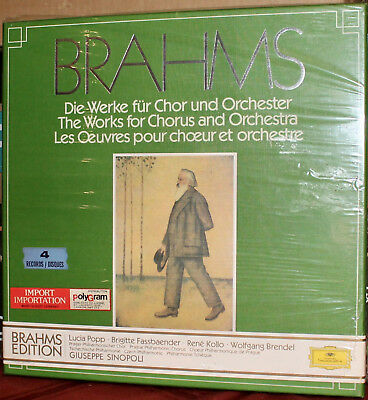
DGG 4-LPs 2741-019: BRAHMS - Works for Chorus & Orchestra - SINOPOLI 1983 DEU SS
C$
100
$
72


Favourite Auctions
To save auctions to your favourites, please login
If you don't have an account, please register
Description
****Welcome to our listing, thanks very much for looking!
****See our own website! We have lots of out of print LPs and CDs! Find us on the web at -
hearthedifference.net
****Please see our other listings - new items added daily!
****Shipping cost is only an estimate - it depends on the actual weight and size of the package as well as the service required. We do not profit from shipping costs, so if we overcharge, we will refund the difference back to you. It's always best to wait for our invoice before paying for your item. We will combine shipping for multiple items purchased.
Background -
FACTORY SEALED item from 1983.Giuseppe Sinopoli (2 November 1946 – 20 April 2001) was an Italian conductor and composer.
Sinopoli was born in Venice, Italy, and later studied at the Benedetto Marcello Conservatory in Venice under Ernesto Rubin de Cervin and at Darmstadt, including being mentored in composition with Karlheinz Stockhausen. He also obtained a degree in medicine from the University of Padua, and completed a dissertation on criminal anthropology.
Sinopoli began to make a name for himself as a composer of serial works, becoming professor of contemporary and electronic music at the Venice Conservatoire Benedetto Marcello in 1972, and a major proponent of the new movement in Venice for contemporary music. He studied conducting at the Vienna Academy of Music under Hans Swarowsky; and in Venice, founded the Bruno Maderna Ensemble in the 1970s. His single most famous composition is perhaps his opera Lou Salomé, which received its first production in Munich in 1981, with Karan Armstrong in the title role.
Sinopoli was appointed principal conductor of the Philharmonia in 1984, and served in this position until 1994, making a number of recordings with them, including music by Elgar and the complete symphonies of Mahler. Sinopoli was supposed to take over the position of chief conductor at Deutsche Oper Berlin in 1990. However, even before the start of his term he receded from his contract. He became principal conductor of the Staatskapelle Dresden in 1992. He also joined the Bayreuth Festival's roster of conductors. He is best known for his intense and sometimes controversial interpretations of opera, especially works by Italian composers and Richard Strauss. Sinopoli specialized in late-nineteenth century and early-twentieth century music, from Wagner and Verdi to Strauss, Mahler and the Second Viennese School. His conducting was the object of much controversy, especially in the symphonic genre, with some berating the "eccentricity" of his interpretations, while others praised the insightfulness of his often intellectual approach to works.
On 20 April 2001, Sinopoli died of a heart attack at the age of 54 while conducting Giuseppe Verdi's Aida at the Deutsche Oper in Berlin. The performance was supposed to serve as a reconciliatory appearance and dedicated to the memory of the company's late chief director, Götz Friedrich. Two nights later, Marcello Viotti stepped in to direct Aida, and dedicated his performance to Sinopoli's memory. The funeral in Rome on 23 April was attended by the Italian President and Prime Minister, as well as a large contingent from La Scala. He was survived by his wife Silvia and two sons.
His books include Masterpieces of Greek Ceramics from the Sinopoli Collection. He died two days before receiving his Laurea in Archeology at Università La Sapienza in Rome.
Sinopoli's last recordings included Richard Strauss's Ariadne auf Naxos and Friedenstag, as well as Dvo?ák's Stabat Mater.
Conductor Giuseppe Sinopoli was one of the world's great conducting stars. He gave powerful, psychologically penetrating, even expressionist, performances that were often highly controversial. At the age of 12, Sinopoli studied harmony and organ at Messina, then harmony and counterpoint at the Venice Conservatory (1965-1967). At the insistence of his father he simultaneously studied medicine. From 1969 to 1973, he attended the Accademia Musicale Chigiana in Siena, studying under Franco Donatoni. He graduated with his doctorate of medicine in psychiatry and a PhD in anthropology from the University of Padua in 1972. His psychiatry dissertation was on the physiology of the areas of the brain concerned with creating the sensations of sound.
After a period as Donatoni's assistant, Sinopoli was appointed to the faculty of the Venice Conservatory as professor for contemporary and electronic music. In that year he also took up conducting studies with Hans Swarowsky in Vienna. In 1975 he founded the Bruno Maderna Ensemble, an avant-garde music group, while continuing to teach and compose.
He began to make a reputation as a composer. His work, typically, was intense and followed the trend toward serial music that prevailed at the time. He received several major commissions. His largest work was an opera named Lou Salomé, based on the life of a 19th century literary figure. It was premiered at the Bavarian State Opera in Munich in 1981.
Meanwhile, his work leading the Bruno Maderna Ensemble had been noticed. He began receiving requests to conduct. In 1976 and 1977, respectively, he led highly acclaimed performances of the Verdi operas Aïda and Macbeth in Venice, then the same composer's Macbeth at the Deutsche Oper Berlin and Attila at the Vienna State Opera. Sinopoli's London operatic debut was Puccini's Manon Lescaut at Covent Garden (1983) and his New York debut was at the Metropolitan with Puccini's Tosca (1985). As an operatic conductor, he performed frequently at the Bayreuth Festival, La Scala, and other major opera houses. He is particularly known for his electrifying performances of the Richard Strauss operas Salome and Elektra.
In addition to Bayreuth, Sinopoli was also a frequent guest at the Salzburg, Lucerne, and Schlewsig-Holstein Music Festivals. From 1990 until his death, Sinopoli was director of the Taormina Arte Festival in Sicily. He was appointed principal conductor of the Orchestra dell'Accademia di Santa Cecilia in Rome (serving there through 1987) and in 1984 became the principal conductor of the Philharmonia Orchestra in London, remaining through 1994. In 1987, his position was upgraded to that of music director of the Philharmonia, which he held until 1994. From 1992 to 2001 Sinopoli was principal conductor of the Staatskapelle Dresden.
Giuseppe Sinopoli recorded exclusively for Deutsche Grammophon. His set of Maderna works won the Grand Prix International du Disque and Premio della Critica Discografia Italiana in 1981. His Manon Lescaut recording won both those prizes in addition to the International Record Critics Award in 1985. Further prizes were a Gramophone Award in 1987 for La forza del destino, the Tokyo Record Academy Prize and Stella d'Oro for Madama Butterfly, three prizes for Tannhäuser, and three for Tosca. Sinopoli's most honored recording was Strauss' Salome, which won the Orphee d'Or, the Stella d'Argento, the Grand Prix de la Nouvelle Academie du Disque, and the Edison Award. In 1994, the Italian government awarded Sinopoli its highest award, the Gran Croce al Merito, for his contribution to arts and music. Giuseppe Sinopoli died at the Deutsche Oper Berlin of a heart attack while conducting the third act of Aïda. - Joseph Stevenson
Brahms was always a fervent patriot. He revelled in the fall of Paris in 1871, rejoiced in Bismark's appointment to the chancellorship, and wrote a choral song of triumph, the Triumphlied, to mark both the Prussian victory and the declaration of the King of Prussia as the first German Emperor. ''it is not difficult music,'' Brahms once laconically remarked, ''merely loud''. It is Brahms out of Handel and the triumphalist Beethoven and as such suits the extrovert side of Sinopoli rather well. It is also robustly sung by the Prague Philharmonic Choir who elsewhere on the set join with the DG engineers to turn in a largely unrecommendable recording of the German Requiem. It is a pity because Sinopoli and his forces turn in reliable, often imaginative performances of various dramatic and choral fragments from the 1860s, 1870s and 1880s, where we find Brahms, ever the ambiguous figure, appearing as Hellenist, hedonist, and Stoic. Of especial interest is Sinopoli's performance, with Rene Kollo, of Rinaldo, Brahms's setting for tenor, chorus and orchestra of Goethe's lyric distillation of the Tasso epic in which the gallant Rinaldo is drawn into wasteful dalliance by the alluring Armida. I have little doubt that Brahms identified with Rinaldo: first, as a composer tempted by that contemporary Jezebel, Wagnerian music-drama; secondly as a man stirred by the idea of forbidden passion. Explicit sensuality is rare in Brahms but in Rinaldo, under the stimulus of both memory and desire, he is almost indecently frank. - Richard Osborne
Alto Rhapsody, Nänie
"Turning to the Sinopoli performance, in the Rhapsody...Fassbaender sings with feeling and Sinopoli conducts with intensity. His conviction and competence result in the best Nänie I've ever heard…” -- James Miller, Fanfare [7/1984]
Song of Triumph, Song of Destiny, Rinaldo
"Earlier recordings of Nänie and Song of the Fates by Haitink (Orfeo) and Swarowsky (Opus) are easily surpassed here. This is the only recorded edition of the Song of Triumph which I have heard. The performance is thoroughly satisfying for this rather rousing work. ...In the Song of Destiny Sinopoli's polished forces easily equal my old standby by Beecham (Angel) and Walter (CBS). Rinaldo, a real masterpiece that has been unjustly neglected, is equal to the much loved old Abbado on London that featured James King's ringing tenor in the solo role. — John Bauman, Fanfare [11/1987]
Johannes Brahms (1833-1897) was the greatest composer of the mid-19th Century!
What's amazing is that there are otherwise sane people who would dispute that judgment. Now, it's true that Brahms never wrote an opera. Given the prevalent musical manner of operas during his lifetime, perhaps we should be thankful. It's also true that he was not especially prolific, composing only four symphonies, a handful of string quartets / quintets / sextets, four concerti, and only one truly monumental work for chorus and orchestra, his German Requiem. But then he also wrote a plethora of Lieder, part songs, and smaller scale choral works, many of which are all too seldom performed and all too often amateurishly recorded. Honestly, Brahms would be a candidate for "the most poorly recorded great composer of all time", were it not that Bach has that trophy in the bag.
I recently wrote a harsh review of an older Brahms performance, conducted by Helmut Rilling, which included the same Alt-Rhapsodie op.53 as this 1983 recording by the Czech Philharmonic, Giuseppe Sinopoli conducting. The Rilling performance featured alto Lioba Braun, whose singing was so awful that I decided I needed to hear another interpretation as soon as possible, to cleanse my ears. I'm very happy to report that alto Brigitte Fassbänder sings this sardonic text by Goethe with gorgeous technique and affect. The Rilling performance also offered a blunt stab at the unfinished oratorio Rinaldo. This re-release of Sinopoli includes different but comparable triumphal music - the three Songs of Triumph, on texts from the Revelations of John - sung by baritone Wolfgang Brendel, plus a setting of Freidrich Hölderlin's dour, dire poem Schiksalslied (Song of Destiny). Brendel has all the voice and about 85% of the technique of a grand romantic-era era, but the musical thrills of these works come chiefly from the orchestra. The recording is filled out with one of Brahms's indisputable masterworks, the choral setting of Friedrich von Schiller's elegy for Beauty titled "Nänie". The voices of the Prague Philharmonic Chorus are well tuned, well balance, well disciplined by Sinopoli, and the result is a suave and consolatory an interpretation of Nänie as any I've ever heard. Of course, the sound recording of any large chorus was challenging in 1983, and is still challenging today. But I confess, I didn't expect this recording to be as good as it is. - Gio
-
LPs made by DGG - Deutsche Grammophon Gesellschaft Records, in GERMANY
-
LPs released in 1983
-
LPs are recorded in STEREO
-
Record Catalog Number: 2741 019
Brahms // Giuseppe Sinopoli
The Works for Chorus and Orchestra
Track Listing -
1. German Requiem, Op. 45 by Johannes BrahmsPerformer: Lucia Popp (Soprano), Wolfgang Brendel (Baritone)
Conductor: Giuseppe Sinopoli
Orchestra/Ensemble: Czech Philharmonic Orchestra, Prague Philharmonic Chorus
Period: Romantic
Written: 1854-1868; Austria
Date of Recording: 1982
Venue: Rudolphinium, Prague
Language: German
2. Rinaldo, Op. 50 by Johannes Brahms
Performer: René Kollo (Tenor)
Conductor: Giuseppe Sinopoli
Orchestra/Ensemble: Prague Philharmonic Chorus, Czech Philharmonic Orchestra
Period: Romantic
Written: 1863-1868; Austria
Date of Recording: 1982
Venue: Rudolphinium, Prague
Length: 39 Minutes 13 Secs.
Language: German
3. Song of Destiny, Op. 54 by Johannes Brahms
Conductor: Giuseppe Sinopoli
Orchestra/Ensemble: Czech Philharmonic Orchestra, Prague Philharmonic Chorus
Period: Romantic
Written: 1868-1871; Austria
Date of Recording: 1982
Venue: Rudolphinium, Prague
Length: 16 Minutes 37 Secs.
Language: German
4. Triumphlied, Op. 55 by Johannes Brahms
Performer: Wolfgang Brendel (Baritone)
Conductor: Giuseppe Sinopoli
Orchestra/Ensemble: Czech Philharmonic Orchestra, Prague Philharmonic Chorus
Period: Romantic
Written: 1870-1871; Austria
Date of Recording: 1982
Venue: Rudolphinium, Prague
Length: 23 Minutes 46 Secs.
Language: German
5. Alto Rhapsody, Op. 53 by Johannes Brahms
Performer: Brigitte Fassbaender (Mezzo Soprano)
Conductor: Giuseppe Sinopoli
Orchestra/Ensemble: Czech Philharmonic Orchestra, Prague Philharmonic Chorus
Period: Romantic
Written: 1869; Austria
Date of Recording: 1982
Venue: Rudolphinium, Prague
Length: 14 Minutes 24 Secs.
Language: German
6. Gesang der Parzen, Op. 89 by Johannes Brahms
Conductor: Giuseppe Sinopoli
Orchestra/Ensemble: Czech Philharmonic Orchestra, Prague Philharmonic Chorus
Period: Romantic
Written: 1882; Austria
Date of Recording: 1982
Venue: Rudolphinium, Prague
Length: 8 Minutes 43 Secs.
Language: German
7. Nänie, Op. 82 by Johannes Brahms
Conductor: Giuseppe Sinopoli
Orchestra/Ensemble: Czech Philharmonic Orchestra, Prague Philharmonic Chorus
Period: Romantic
Written: 1880-1881; Austria
Date of Recording: 1982
Venue: Rudolphinium, Prague
Length: 14 Minutes 12 Secs.
Language: German
Ein Deutsches Requiem - 75:40
A1. Selig Sind, Die Da Leid Tragen - 12:13
A2. Denn Alles Fleisch Es Ist Wie Gras - 15:35
B1. Herr, Lehre Doch Mich - 10:22
B2. Wie Lieblich Sind Seine Wohnungen, Herr Zebaoth - 7:24
B3. Ihr Habt Nun Traurigkeit - 6:49
C1. Denn Wir Haben Hier Keine Bleibende Statt - 10:45
C2. Selig Sind Die Toten - 12:32
Triumphlied - 23:32
D1. Lebhaft Und Feierlich - 7:31
D2. Mässig Belebt - 9:21
D1. Lebhaft - 7:40
Rinaldo - 38:50
E1. Kantate Für Tenor Solo, Männerchor Und Orchester Auf Worte Von Johann Wolfgang Goethe Op. 50 - 22:37
F1. Beendigung - 16:13
Rhapsodie - 14:21
G1. Für Eine Altstimme, Männerchor Und Orchester Auf Worte Von Johann Wolfgang Goethe Op. 53 - 14:21
Nänie - 14:12
G2. Für Gemischten Chor Und Orchester Auf Worte Von Friedrich Schiller Op. 82 - 14:12
Schicksalslied - 16:35
H1. Für Gemischten Chor Und Orchester Auf Worte Von Friedrich Hölderlin Op. 54 - 16:35
Gesang Der Parzen - 8:43
H2. Für Sechsstimmigen Gemischten Chor Und Orchester Auf Worte Von Johann Wolfgang Goethe Op. 89 - 8:43
Performers / Credits -
• Alto Vocals – Brigitte Fassbaender (tracks: G1)
• Baritone Vocals – Wolfgang Brendel (tracks: B1, C1, D1, D2, D3)
• Choir – Prager Philharmonischer Chor
• Chorus Master – Lubomír Mátl
• Composed By – Johannes Brahms
• Conductor – Giuseppe Sinopoli
• Engineer – Karl-August Naegler
• Orchestra – Tschechische Philharmonie
• Producer – Hans Hirsch
• Recording Supervisor – Milan Slavický, Wolfgang Stengel
• Soprano Vocals – Lucia Popp (tracks: B3)
• Tenor Vocals – René Kollo (tracks: E1, F1)
Other Information -
Digital Recording
Contains 44-page LP size booklet
recorded 25 - 27 March, 1982 (side 7 & 8) and from 25 August - 3 September (side 1 - 6) at Prager Haus der Künstler
Co-Production w. Supraphon, Prague
(P) (C) 1983
Made in Germany
CONDITION Details:
The 4-LP box is in mint condition! The box has NO splits or crushed corners and does have a tiny drill hole at the spine of the box, at the bottom, near the catalog number which is barely noticeable - just gorgeous! The corners and seams are solid with no shelf wear. The outer plastic cellophane wrap has a bit of tearing, nothing serious! The colors on the box are sharp and clean (see pictures with this listing as they are of the actual item).
The set comes complete with a paper insert/libretto.
The 4-LPs are assumed to be in mint condition as this vintage 1983 item is still FACTORY SEALED! A Short Note About LP GRADING -- Mint = Only used for sealed items.
- Near Mint = Virtually flawless in every way.
- Near Mint Minus = Item has some minor imperfections, some audible.
- Excellent = Item obviously played and enjoyed with some noise.
- Very Good Plus = Many more imperfections which are noticeable and obtrusive.
For best results, always properly clean your LPs before playing them, even for brand new, sealed items.
The LP is an audiophile quality pressing (any collector of fine MFSL, half speeds, direct to discs, Japanese/UK pressings etc., can attest to the difference a quality pressing can make to an audio system).
Do not let this rarity slip by!
price rating