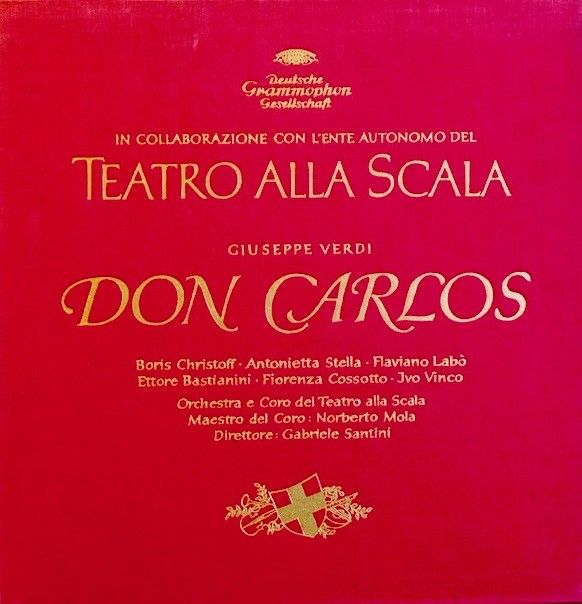
DGG 4-LP Box 138-760/63: VERDI - Don Carlos - Christoff, SANTINI, 1966 TULIP DEU
C$
60
$
43


Favourite Auctions
To save auctions to your favourites, please login
If you don't have an account, please register
Description
****Welcome to our listing, thanks very much for looking!
****See our own website! We have lots of out of print LPs and CDs! Find us on the web at -
hearthedifference.net
****Shipping cost is only an estimate - it depends on the actual weight and size of the package as well as the service required. We do not profit from shipping costs, so if we overcharge, we will refund the difference back to you. It's always best to wait for our invoice before paying for your item. We will combine shipping for multiple items purchased.****Please see our other listings for more great LPs and CDs - new items added daily.
****To access our eBay store click on the little red door at the top right section of any of our eBay listings or, click on -
http://stores.ebay.com/Hear-The-Difference
Background -
Gabriele Santini was a major conductor of opera in the early and mid-twentieth century, but his name gradually faded in the decades following his death. Reissues of his recordings in recent years, however, have revived interest in his career. Santini worked with some of the greatest singers of the day, including Maria Callas, Jussi Björling, Franco Corelli, Beniamino Gigli, Toti Dal Monte, Tito Gobbi, and numerous others. Santini's repertory was rich in Verdi and Puccini fare, as well as other staples of the Italian stage, but it also included works outside the Italian sphere, like Carmen, Der Freischütz, and Ravel's L'heure espagnole. He often introduced new works as well, among them Giordano's Il re (1930). His recordings are available on many labels, including EMI, Naxos, Pantheon, and Warner Fonit.Gabriele Santini was born in Perugia, Italy, on January 20, 1886. He studied with several teachers locally, but his advanced training came at the Bologna Conservatory. He was a mere 20 when he gave his conducting debut. After a brief stint at the Teatro Costanzi in Rome, Santini left Italy and settled in Buenos Aires, where he worked for eight seasons at the Teatro Colón.
He held posts thereafter in Rio de Janeiro and Chicago, and then returned to Italy. Perhaps his most important activity came in the crucial years ahead (1925-1929), when he worked with the influential Toscanini at La Scala. Here Santini led acclaimed performances of Madama Butterfly, Tosca, Aida, Carmen, and other staples of the repertory. From 1929-1933 he worked at the Rome Opera, and in the prewar and wartime eras -- a period when, for obvious reasons, opera performances were scaled back -- he managed to lead many important productions at La Scala. In 1944 he was appointed artistic director at the Rome Opera. He served in that capacity until 1947, when he assumed duties there as music director.
From this time until 1962 -- the year he stepped down -- Santini led some of his most memorable performances, and with many of the opera world's superstar singers. Almost all of his recordings date to the period of 1952-1964. Among the most memorable of them is a La Traviata featuring Callas. Santini continued introducing new works during this period as well, including Milhaud's Christoph Colomb (1954). The busy Santini collapsed during a recording session of Tosca in 1964 and died a short while later. - Robert Cummings
Don Carlos is a five-act grand opera composed by Giuseppe Verdi to a French-language libretto by Joseph Méry and Camille du Locle, based on the dramatic play Don Carlos, Infant von Spanien (Don Carlos, Infante of Spain) by Friedrich Schiller. In addition, it has been noted by David Kimball that the Fontainebleau scene and auto da fé "were the most substantial of several incidents borrowed from a contemporary play on Philip II by Eugène Cormon". The opera is most often performed in Italian translation, usually under the title Don Carlo.
The opera's story is based on conflicts in the life of Carlos, Prince of Asturias (1545–1568). Though he was betrothed to Elisabeth of Valois, part of the peace treaty ending the Italian War of 1551–59 between the Houses of Habsburg and Valois demanded that she be married instead to his father Philip II of Spain. It was commissioned and produced by the Théâtre Impérial de l'Opéra (Paris Opera) and given its premiere at the Salle Le Peletier on 11 March 1867.
The first Italian version given in Italy was in Bologna in March 1867. Revised again by Verdi, it was given in Naples in November/December 1872. Finally, two other versions were prepared: the first was seen in Milan in January 1884 (in which the four acts were based on some original French text which was then translated). That is now known as the "Milan version", while the second—also sanctioned by the composer—became the "Modena version" and was presented in that city in December 1886. It restored the "Fontainebleau" first act to the Milan four-act version.
Over the following twenty years, cuts and additions were made to the opera, resulting in a number of versions being available to directors and conductors. No other Verdi opera exists in so many versions. At its full length (including the ballet and the cuts made before the first performance), it contains close to four hours of music and is Verdi's longest opera.
This, performance, or at least the highlights from it, was seminal in my operatic education and tastes. I returned home from college to find that a new LP of highlights from the recording was the family pride and joy. I knew Traviata and Rigoletto from the family LPs, the latter on the Cetra issue with Taddei and Tagliavini as the jester and Duke respectively. But I recognised the music of Don Carlo as being of a different breed to the composer’s middle period duo, and it haunted me. The impact was most pronounced in listening to Boris Christoff’s heart-rending singing of Philip’s great lonely soliloquy Ella giammai m’amo and the portrayal of Rodrigo by Tito Gobbi, whose account of the noble, selfless soldier’s death has never been equalled on record. As to the duet between the two, even in my then complete operatic naivety, I recognised it as being a truly great performance of great music.
The premiere of the original five-act form of Don Carlos at the Paris Opéra on 11 March 1867 was only modestly received. The Italian translation, as Don Carlo, premiered at Bologna in September 1867 and in Rome and the remainder if the Italian peninsula. So far as critical reception was concerned it fared little better. Both the Italian public and theatre managements found the opera overlong and were slow to take it to their hearts. It was not long before the act three ballet and then the Fontainebleau act were dropped in performances. The arrival in Italy of the shorter and grander Aida, in 1871, added to the difficulty of the opera’s length. After a failure in Naples in the same year Verdi made his first alterations to the score for a revival under his own supervision. Still the fortunes of the opera disappointed the composer; as early as 1875 he began seriously to consider shortening the work himself. With other demands he did not begin serious work on this until 1882 concluding his revision as a four act opera the following year with the premiere having to wait until 1884. The new shorter four-act revision involved much reworking to explain the sequence of events and maintain narrative coherence. Verdi’s revision also involved the removal of the Fontainebleau act, the ballet and the Inquisitor’s chorus in act five as well as other detailed changes. The premiere of the new four act Don Carlo, which has become known as the 1884 version, was a great success at La Scala and featured the tenor Tamagno who created Otello three years later.
At the time of this first studio recording in 1954 it was common practice to perform the 1884 four-act version. This situation began to change after the Covent Garden performances under Giulini in 1958 with a tendency to include the original Act 1 music. Performance practice now often goes further with the inclusion of music that Verdi reluctantly cut before the Paris premiere when it became obvious that the length of what he had written would cause Parisians to miss the last trains home if it was given in full! What is evident in the original, and even more so in this 1884 version, is Verdi’s more complex chromaticism compared to his great middle period operas. Accommodation of this increased orchestral complexity requires a sure and steady hand at the rostrum. In the period since this recordings first appearance Gabriele Santini’s conducting has received criticism from some quarters for its lack of drama and dynamism. I first owned the complete recording when it made its CD debut in the late eighties. With the rather boxed and occluded sound I did not then appreciate the conductor’s dramatic virtues and pacing of the work. Mark Obert-Thorn’s remastering brings the whole sound-stage, and particularly the voices, into a more forward focus and aural balance causing me to radically change my view. I now find Santini sympathetic to both Verdi’s complex lines and to the unfolding drama.
Of the other soloists, Antoinetta Stella benefits from the added clarity of the recording. She is not a spinto more a strong lyric soprano. There are moments of strain but her Tu che la vanita is far superior to that of Montserrat Caballé on the extensively eulogised Giulini studio recording of 1971. - Robert J Farr
Originally recorded in June of '62 in stereo. I was surprised to see that this 50 plus year old performance is still available. It is the five act version, so it includes the Fontainebleau scenes, which I believe helps establish the love connection between Carlo and Elisabetta much better than the four act version. Fontainebleau is so important to making the drama work. If the Italian version of Don Carlo is one of your favorite Verdi operas, I recommend this recording. - Brian Lowery
This is an OPENED, in NEAR MINT condition 4-LP box set issued by "DGG - Deutsche Grammophon Gesellschaft" in 1963 - a super RARE title that is long out of print!
The 4-LP boxed set made by DGG Records is a highly collectible title from their catalog - a superb CLASSICAL title featuring the music of -
Verdi // Gabriele Santini
Title and tracks -
Don Carlos (complete opera)
Performers - Credits -• Baritone Vocals – Ettore Bastianini
• Bass Vocals – Alessandro Maddalena, Boris Christoff, Ivo Vinco
• Choir – Coro Del Teatro Alla Scala
• Chorus Master – Norberto Mola
• Conductor – Gabriele Santini
• Mezzo-soprano Vocals – Fiorenza Cossotto
• Orchestra – Orchestra Del Teatro Alla Scala
• Soprano Vocals – Antonietta Stella, Aurora Cattelani, Giuliana Matteini
• Tenor Vocals – Flaviano Labò, Franco Piva, Piero De Palma
Track Listing -
Performer: Boris Christoff (Bass), Flaviano Labò (Tenor), Fiorenza Cossotto (Mezzo Soprano),
Ettore Bastianini (Baritone), Antonietta Stella (Soprano)
Conductor: Gabriele Santini
Orchestra/Ensemble: Milan Teatro alla Scala Orchestra, Milan Teatro alla Scala Chorus
Period: Romantic
Written: 1867/1886
Language: Italian
Notes: Composition written: Paris, France (03/11/1867).
Composition revised: Naples, Italy (1872).
Composition revised: La Scala Opera House, Milan, Italy (01/10/1884).
A. Atto Primo
B1. Atto Secondo - Parte Prima
B2. Atto Secondo - Parte Seconda (1)
C. Atto Secondo - Parte Seconda (2)
D1. Atto Secondo - Parte Seconda (3)
D2. Atto Terzo - Parte Prima (1)
E1. Atto Terzo - Parte Prima (2)
E2. Atto Terzo - Parte Seconda
F. Atto Quarto - Parte Prima (1)
G1. Atto Quarto - Parte Prima (2)
G2. Atto Quarto - Parte Seconda
H. Atto Quinto
The title is from the rare DGG series of vintage LPs.
- DGG - Deutsche Grammophon Gesellschaft RECORDS
- LPs made in Germany
- Pressings are in STEREO, they have the TULIP label vintage (indicates earliest pressings)
- With 60-page booklet, printed in Germany 3/66.
- Comes in a luxurious linen covered boxed set
- Record vintage = made in 1966 (out of print)
- LP catalog # SLPM 138-760/63
CONDITION Details:
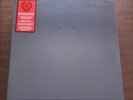
The 4-LP linen-like covered outer box is in near mint condition! The box has NO splits or crushed corners, but does show some light shelf wear, along the seams and corners. The box does have a tiny drill hole at the lower part of the spine which is barely noticeable. The colors on the box are sharp and clean (see pictures with this listing for more detail).
The set comes complete with a large format, 60 page paper insert/libretto.
The 4-LPs are in near mint minus condition! We found that the vinyl looked superb on this vintage LP set. There are no significant marks and the LPs retain much of the original gloss and sheen - obviously well taken care of! They do have a bit of dust and perhaps a finger print or two on them so they should be cleaned before playing. There are NO serious spindle marks on the record labels either. Just beautifully made vinyl! That said, acquiring a vintage LP like this is for the performance and rarity of the LP, not necessarily for the sound quality. A Short Note About LP GRADING -- Mint = Only used for sealed items.
- Near Mint = Virtually flawless in every way.
- Near Mint Minus = Item has some minor imperfections, some audible.
- Excellent = Item obviously played and enjoyed with some noise.
- Very Good Plus = Many more imperfections which are noticeable and obtrusive.
For best results, always properly clean your LPs before playing them.
The LP is an audiophile quality pressing (any collector of fine MFSL, half speeds, direct to discs, Japanese/UK pressings etc., can attest to the difference a quality pressing can make to an audio system).
Don't let this rarity slip by!!!
price rating