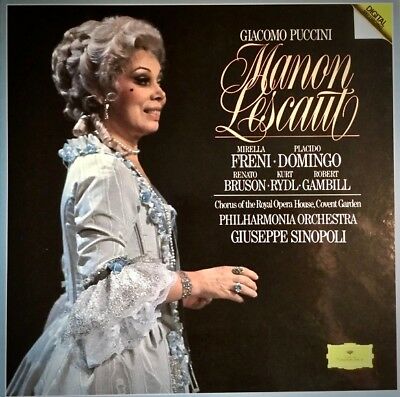
DGG 3-LP Box 413-893-1: Puccini - Manon Lescaut - SINOPOLI - 1984 GERMANY SEALED
C$
70
$
51


Favourite Auctions
To save auctions to your favourites, please login
If you don't have an account, please register
Description
****Welcome to our listing, thanks very much for looking!
****See our own website! We have lots of out of print LPs and CDs! Find us on the web at -
hearthedifference.net
****Please see our other listings - new items added daily!
****Shipping cost is only an estimate - it depends on the actual weight and size of the package as well as the service required. We do not profit from shipping costs, so if we overcharge, we will refund the difference back to you. It's always best to wait for our invoice before paying for your item. We will combine shipping for multiple items purchased.
Background -
Factory SEALED since 1984.Manon Lescaut was premiered at the Teatro Regio, in Turin, Italy, on February 1, 1893. It was a sensation, immediately elevating Puccini to the front rank of Italian composers and making his name well-known throughout Europe. While he would have many other successes in his career -- Madama Butterfly (in its revised version) and Tosca -- he would never again experience this kind of overwhelming triumph.
The libretto, based on Antoine François Prévost's novel, is quite effective despite the participation of five hands in it, though not all in collaboration: Leoncavallo (who fashioned the first version), Marco Praga, Domenico Oliva, Luigi Illica, and Giuseppe Giacosa.
The story is set in late eighteenth century Paris, where the nobleman Des Grieux espies the beautiful Manon Lescaut, accompanied by her brother (Lescaut) and the treasurer-general, Geronte di Ravoir, who fancies himself her suitor. Des Grieux is captivated by her and learns from her she plans to join the convent. He convinces her to run off with him, but Geronte forges other plans and she eventually becomes his mistress, but not before living with and then leaving Des Grieux. Some time later, at Geronte's Paris residence, Manon confides in her brother that she is bored with Geronte and wishes to have Des Grieux back. Lescaut fetches the latter, and when Des Grieux and Manon attempt to run off, Geronte has her arrested as a thief and woman of loose morals. Authorities plan to deport her to a Louisiana prison. Des Grieux cannot bear to be without her, and following a failed attempt to free her, boards the ship bound for Louisiana. Later in America, Des Grieux flees with her after a duel with the nephew of the colony's governor. On the run with Des Grieux, Manon becomes seriously ill and bids him a sad and dramatic farewell. He falls unconscious over her body.
Puccini's score is lushly orchestrated and features the usual quota of memorable tunes and imaginative vocal writing. Of the many popular numbers in the opera, the Act One "Cortese damigella" is among the more memorable, not least because of its soaring melody and deft writing for both Manon and Des Grieux. The ensuing "Donna non vidi Mai", in which Des Grieux declares his feelings for Manon, is one of Puccini's most beguiling arias, full of passion and yearning, instantly appealing even to the ear unaccustomed to operatic singing.
The Act Two aria, "In quelle trini morbide", sung by Manon who is now disenchanted by Geronte, is another gem. Later on in that act, when Des Grieux attempts to free Manon from Geronte, there is a passionate and intense love scene between the two lovers ("Tu, tu, amore? Tu?!"). "Sola perduta, abbandonata" is another attractive aria for Manon, that comes near the end of the opera. Here, she sings of her past life and her encumbering beauty. In sum, this is one of Puccini's finest operas. - Robert Cummings
Conductor Giuseppe Sinopoli was one of the world's great conducting stars. He gave powerful, psychologically penetrating, even expressionist, performances that were often highly controversial. At the age of 12, Sinopoli studied harmony and organ at Messina, then harmony and counterpoint at the Venice Conservatory (1965-1967). At the insistence of his father he simultaneously studied medicine. From 1969 to 1973, he attended the Accademia Musicale Chigiana in Siena, studying under Franco Donatoni. He graduated with his doctorate of medicine in psychiatry and a PhD in anthropology from the University of Padua in 1972. His psychiatry dissertation was on the physiology of the areas of the brain concerned with creating the sensations of sound.
After a period as Donatoni's assistant, Sinopoli was appointed to the faculty of the Venice Conservatory as professor for contemporary and electronic music. In that year he also took up conducting studies with Hans Swarowsky in Vienna. In 1975 he founded the Bruno Maderna Ensemble, an avant-garde music group, while continuing to teach and compose.
He began to make a reputation as a composer. His work, typically, was intense and followed the trend toward serial music that prevailed at the time. He received several major commissions. His largest work was an opera named Lou Salomé, based on the life of a 19th century literary figure. It was premiered at the Bavarian State Opera in Munich in 1981.
Meanwhile, his work leading the Bruno Maderna Ensemble had been noticed. He began receiving requests to conduct. In 1976 and 1977, respectively, he led highly acclaimed performances of the Verdi operas Aïda and Macbeth in Venice, then the same composer's Macbeth at the Deutsche Oper Berlin and Attila at the Vienna State Opera. Sinopoli's London operatic debut was Puccini's Manon Lescaut at Covent Garden (1983) and his New York debut was at the Metropolitan with Puccini's Tosca (1985). As an operatic conductor, he performed frequently at the Bayreuth Festival, La Scala, and other major opera houses. He is particularly known for his electrifying performances of the Richard Strauss operas Salome and Elektra.
In addition to Bayreuth, Sinopoli was also a frequent guest at the Salzburg, Lucerne, and Schlewsig-Holstein Music Festivals. From 1990 until his death, Sinopoli was director of the Taormina Arte Festival in Sicily. He was appointed principal conductor of the Orchestra dell'Accademia di Santa Cecilia in Rome (serving there through 1987) and in 1984 became the principal conductor of the Philharmonia Orchestra in London, remaining through 1994. In 1987, his position was upgraded to that of music director of the Philharmonia, which he held until 1994. From 1992 to 2001 Sinopoli was principal conductor of the Staatskapelle Dresden.
Giuseppe Sinopoli recorded exclusively for Deutsche Grammophon. His set of Maderna works won the Grand Prix International du Disque and Premio della Critica Discografia Italiana in 1981. His Manon Lescaut recording won both those prizes in addition to the International Record Critics Award in 1985. Further prizes were a Gramophone Award in 1987 for La forza del destino, the Tokyo Record Academy Prize and Stella d'Oro for Madama Butterfly, three prizes for Tannhäuser, and three for Tosca. Sinopoli's most honored recording was Strauss' Salome, which won the Orphee d'Or, the Stella d'Argento, the Grand Prix de la Nouvelle Academie du Disque, and the Edison Award. In 1994, the Italian government awarded Sinopoli its highest award, the Gran Croce al Merito, for his contribution to arts and music. Giuseppe Sinopoli died at the Deutsche Oper Berlin of a heart attack while conducting the third act of Aïda. - Joseph Stevenson
-
LPs made by DGG (Deutsche Grammophon) Records, in GERMANY
-
LPs released in 1984
-
LPs are recorded in STEREO (Digital Recording)
-
Record Catalog Number: 413 893-1
Giacomo Puccini // Giuseppe Sinopoli & Philharmonia Orchestra
Puccini: Manon Lescaut
Track Listing -
Puccini - Manon Lescaut 1. Atto Primo (1) 2. Atto Primo (2)3. Atto Secondo (1)
4. Atto Secondo (2)
5. Intermezzo
6. Atto Terzo
7. Atto Quarto
Performers / Credits / Other Information -
• Choir [Madrigale] – Elizabeth Sikora, Elizabeth Stanford, Iris Saunders, Jean Tredaway
• Chorus Master – Nina Walker
• Composed By – Giacomo Puccini
• Conductor – Giuseppe Sinopoli
• Engineer [Recording] – Klaus Hiemann
• Libretto By – Domencio Oliva, Giulio Ricordi, Giuseppe Giacosa, Luigi Illica, Marco Praga
• Producer – Günther Breest
• Recording Supervisor – Wolfgang Stengel
• Vocals [Edmondo, Studente] – Robert Gambill
• Vocals [Geronte Di Ravoir, Tesoriere Generale] – Kurt Rydl
• Vocals [Il Cavaliere Renato Des Grieux, Studente] – Placido Domingo
• Vocals [Il Maestro Di Ballo] – John Fryatt
• Vocals [L'Oste] – George Macpherson
• Vocals [Lescaut, Sergente Delle Guardie Del Re] – Renato Bruson
• Vocals [Manon Lescaut] – Mirella Freni
• Vocals [Sergente Degli Arcieri] – Handel Thomas
• Vocals [Un Comandante Di Marina] – John Tomlinson
• Vocals [Un Lampionaio] – Mark Curtis
• Vocals [Un Musico (Voce Sola)] – Brigitte Fassbaender
• Vocals [Un Sergente] – Paschal Allen
• Barcode (Scanned): 028941389312
CONDITION Details:
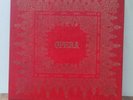
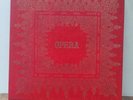
The 3-LP box is in near mint condition as this item is FACTORY SEALED! The box has NO splits or crushed corners and has NO cut out marks! The corners and seams are solid. The colors on the box are sharp and clean (see pictures with this listing as they are of the actual item).
The 3-LPs are assumed to be in mint condition as this item is factory SEALED!
A Short Note About LP GRADING -- Mint = Only used for sealed items.
- Near Mint = Virtually flawless in every way.
- Near Mint Minus = Item has some minor imperfections, some audible.
- Excellent = Item obviously played and enjoyed with some noise.
- Very Good Plus = Many more imperfections which are noticeable and obtrusive.
For best results, always properly clean your LPs before playing them.
The LP is an audiophile quality pressing (any collector of fine MFSL, half speeds, direct to discs, Japanese/UK pressings etc., can attest to the difference a quality pressing can make to an audio system).
Do not let this rarity slip by!
price rating