DECCA 4-LP BOX SET 288-91: JS BACH - St. Matthew's Passion - MUNCHINGER, 1965 UK
$
100

Favourite Auctions
To save auctions to your favourites, please login
If you don't have an account, please register
Description
****Welcome to our listing, thanks very much for looking!
****See our own website! We have lots of out of print LPs and CDs! Find us on the web at -
hearthedifference.net
****Please see our other listings - new items added daily!
****Shipping cost is only an estimate - it depends on the actual weight and size of the package as well as the service required. We do not profit from shipping costs, so if we overcharge, we will refund the difference back to you. It's always best to wait for our invoice before paying for your item. We will combine shipping for multiple items purchased.
Background -
There are records and then there are "RECORDS". This one belongs in the latter category. Decca is one of the most highly collectible labels produced. The LPs the company issued in the "golden age" of LP recordings are the most sought after by audiophiles across the globe.Karl Münchinger (29 May 1915 – 13 March 1990) was a German conductor of European classical music. He helped to revive the now-ubiquitous Canon in D by Johann Pachelbel, through recording it with his Stuttgart Chamber Orchestra in 1960. (Jean-François Paillard made a rival, and also very popular, recording of the same piece at around the same time.) Münchinger is also noted for restoring baroque traditions to the interpretation of Bach's oeuvre, his greatest musical love: moderate-sized forces, judicious ornamentation, and rhythmic sprightliness, though not on "period instruments".
Born in Stuttgart, Münchinger studied at the Hochschule für Musik in his home city. At first, he guest-conducted often, supporting himself also with other duties as an organist and church choir director. In 1941, he became principal conductor of the Hanover Symphony, a post he held for the next two years. He held no other conducting position until the end of World War II.
The year that the war ended, he founded the Stuttgart Chamber Orchestra, which he built into an impressive touring ensemble; it made its Paris debut in 1949 and its American debut in San Francisco in 1953. Under his leadership the orchestra issued (for the Decca label) numerous recordings, mostly during the 1950s and 1960s, and mostly of Bach's output; these included the Brandenburg Concertos (three times), the orchestral suites, the St. Matthew Passion, the St. John Passion, the Musical Offering, and the Christmas Oratorio. Of his and the ensemble's non-Bach releases, probably the best – and certainly the most famous, other than the Pachelbel performance mentioned earlier – is that of Haydn's The Creation.
In 1977, the Stuttgart Chamber Orchestra became the first German ensemble to visit the People's Republic of China. Münchinger retired in 1988, two years before his death.
Stylistically Münchinger's approach with his orchestra was rather similar to those of his somewhat younger contemporaries Raymond Leppard, Sir Neville Marriner, Claudio Scimone, and the above-mentioned Paillard, though displaying an extra element of tonal solidity (not to mention a fierce rigor during rehearsals as well as performances) which might be thought of as Teutonic. With the increased fashionability of 18th-century instruments, from the 1970s onwards, Münchinger's interpretations fell dramatically from critical favor and were often dismissed as "passé", though he always showed himself to be a fine, tough, disciplined, and sensitive musician. There have been more profoundly imaginative German conductors than Münchinger, but there have been very few who matched his consistently high standards.
Karl Münchinger was one of those rare conductors whose careers are largely tied to their native city, in his case, Stuttgart. He was also closely identified with Bach, having conducted and recorded many of the Baroque master's compositions, generally with high critical praise. Münchinger also conducted much music from the Classical and Romantic periods and, to a lesser extent, from the twentieth century. The majority of his numerous recordings were made for the Decca label. Münchinger showed musical talent as a child and later began studies at the Hochschule für Musik in Stuttgart. He then studied conducting at the Leipzig Conservatory under Hermann Abendroth. After graduation, he returned to Stuttgart and freelanced as a conductor while primarily supporting himself as an organist and choir director. In 1941, he accepted the post of conductor of the Hanover Symphony Orchestra. This would be the only major appointment in his career outside of his native Stuttgart. He held no post from 1943 until the end of the war. In summer 1945, he founded the Stuttgart Chamber Orchestra, the ensemble he became identified with in much the way Karajan would be with the Berlin Philharmonic Orchestra. He quickly built the orchestra up from modest resources in the postwar era, so that by the late-'40s, they were making their first important tours abroad. Münchinger and the SCO debuted in Paris in 1949, representing the first German ensemble to appear there since the prewar era. That same year, they made successful tours of England and Spain. In 1952, they toured Central and South America. The conductor himself made his American debut in 1953 (San Francisco) and took the SCO back to the U.S. the following year for a successful concert tour there. He would return with his ensemble in 1977, once more receiving generally favorable response from both critics and the public. By the mid-'50s, Münchinger had established a reputation as one of the finest Bach interpreters in Europe. His admirers will assert that he was instrumental in restoring Baroque traditions to Bach interpretation, filtering out errant Romantic elements that had crept in over the years. Also by this time, Münchinger and the SCO were receiving invitations from throughout Europe, Russia, and Japan, and appeared in these various locales over the next couple of decades, scoring particular triumphs at the yearly festivals in Edinburgh, Salzburg, Prague (Prague Spring), and Colmar. In the recording studio, Münchinger was scoring triumphs a well: in 1964, he led the SCO in a recording of Bach's St. Matthew Passion with soloists Peter Pears, Hermann Prey, and Elly Ameling for the Decca label, that was awarded a Grand Prix du Disque. He made numerous other notable recordings of choral works by Bach, as well as the Brandenburg Concertos; symphonies by Beethoven and Mozart; and even music by twentieth century Swiss composer Frank Martin. Münchinger founded the Klassiches Philharmonie Stuttgart in 1966, an offshoot ensemble of the SCO, expanding the membership to 45 musicians in order to accommodate performing larger compositions. Münchinger and the SCO continued a fairly heavy performance and recording schedule in the 1970s and '80s, with many tours abroad. In 1977, they became the first German ensemble to visit the People's Republic of China. Münchinger retired in 1988 and died two years later. - Robert Cummings
The St Matthew Passion (German: Matthäus-Passion), BWV 244, is a Passion, a sacred oratorio written by Johann Sebastian Bach in 1727 for solo voices, double choir and double orchestra, with libretto by Picander (Christian Friedrich Henrici). It sets chapters 26 and 27 of the Gospel of Matthew (in the German translation of Martin Luther) to music, with interspersed chorales and arias. It is widely regarded as one of the masterpieces of classical sacred music. The original Latin title Passio Domini nostri J.C. secundum Evangelistam Matthæum translates to "The Passion of our Lord J[esus] C[hrist] according to the Evangelist Matthew”.
Münchinger recorded the St. Matthew Passion in 1964 at the Ludwigsburg Church of Schloss in Stuttgart using the Stuttgarter Hymnus-Chor. Of the major roles the part of the Evangelist is taken by tenor Peter Pears and bass Hermann Prey takes the part of Christ. I especially enjoyed the performance of the contralto arias Buß und Reu with the advantage of its lovely flute accompaniment and Erbarme dich, mein Gott with violin obbligato. Both arias are movingly sung by contralto Marga Höffgen who demonstrates a splendid technique with a richly coloured timbre. Sung with considerable feeling for the text by the bright and expressive voice of Elly Ameling the hauntingly moving soprano arias Blute nur, du liebes Herz! and Aus Liebe will mein Heiland sterben stay in the memory. Equally strong is the bass aria Gerne will ich mich bequemen sung with feeling and beautifully paced by Tom Krause. Tenor Fritz Wunderlich is smooth-toned and deeply reverential in his briskly taken aria Ich will bei meinem Jesu wachen. -- Michael Cookson, MusicWeb International
Bach’s obituary from 1750 claimed that he had written five passions. Only the St. John Passion (1724) and the St. Matthew Passion (1727) have survived in their entirety.
The St. Matthew Passion, BWV 244 was completed in 1727 and was given its first performance by Bach two years later at the St. Thomas Church in Leipzig. The texts by Picander are settings taken from chapters 26 and 27 of the St. Matthew Gospel.
Münchinger recorded the St. Matthew Passion in 1964 at the Ludwigsburg Church of Schloss in Stuttgart using the Stuttgarter Hymnus-Chor. Of the major roles the part of the Evangelist is taken by tenor Peter Pears and bass Hermann Prey takes the part of Christ.
I especially enjoyed the performance of the contralto arias Buß und Reu with the advantage of its lovely flute accompaniment and Erbarme dich, mein Gott with violin obbligato. Both arias are movingly sung by contralto Marga Höffgen who demonstrates a splendid technique with a richly coloured timbre. Sung with considerable feeling for the text by the bright and expressive voice of Elly Ameling the hauntingly moving soprano arias Blute nur, du liebes Herz! and Aus Liebe will mein Heiland sterben stay in the memory. Equally strong is the bass aria Gerne will ich mich bequemen sung with feeling and beautifully paced by Tom Krause. Tenor Fritz Wunderlich is smooth-toned and deeply reverential in his briskly taken ariaIch will bei meinem Jesu wachen. - Michael Cookson
"In the Netherlands, the St Matthew Passion is an annual Good Friday tradition in nearly all towns where there is a choir and an orchestra. I grew up with this, and have heard some fine ones; but this is still the absolute best. Pears as the Evangelist is nothing short of miraculous; Ameling was always at her best in Bach; Wunderlich is a fine tenor, Krause a magnificent bass, and Prey a deeply moving Jesus, esp. at the Last Supper. Only Hoffgen the alto is not quite up to the others. But the choral parts are rich and intimate, and the orchestra does a fine job. One complaint: the English translations of the non-NT texts are pretty awful. But then, German is a great language worth learning . . .” - Roger K.
-
LPs made by DECCA Records, in the UK / England / Great Britain
-
LPs released in 1965
-
LPs are recorded in STEREO
-
Record Catalog Number: SET 288-91
-
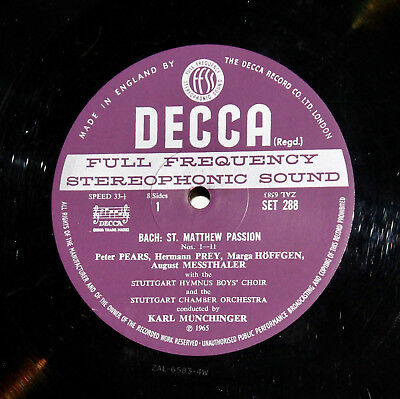
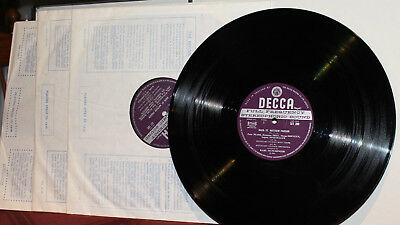
Record Labels are primarily VIOLET (PURPLE) & SILVER with inverse SILVER and VIOLET lettering, featuring the earliest Decca Records logo on the record labels, with "Made in England" at the 11 o'clock position.
- Violet (Purple) / Silver labels.
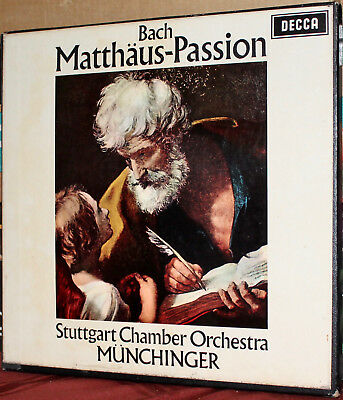
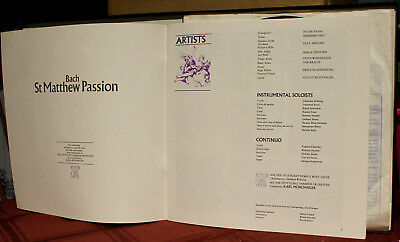
Includes a large book with credits and libretto.
This recording is issued to coincide with the 20th anniversary of the foundation of THE STUTTGART CHAMBER ORCHESTRA by its conductor, KARL MÜNCHINGER
• Printed By – MacNeill Press Ltd.
• Copyright (c) – The Decca Record Company Limited
• Recorded At – Schlosskirche, Ludwigsburg
• Manufactured By – The Decca Record Company Limited
• Matrix / Runout (Label 1-8): ZAL.6583 - ZAL.6590
• Matrix / Runout (Runout A-H): ZAL-6583-4W
• Matrix / Runout: ZAL-6584-3W
• Matrix / Runout: ZAL-6585-5W
• Matrix / Runout: ZAL-6586-4W
• Matrix / Runout: ZAL-6587-5W
• Matrix / Runout: ZAL-6588-5W
• Matrix / Runout: ZAL-6589-4W
• Matrix / Runout: ZAL-6590-4W
J.S. Bach // Karl Munchinger
4-LP Boxed Set Title -Bach - Matthaus-Passion (St. Matthew's Passion)
1. Saint Matthew Passion, BWV 244 by Johann Sebastian Bach
Performer: Hermann Prey (Baritone), Elly Ameling (Soprano), Marga Höffgen (Alto),
Heinz Wunderlich (Tenor), Tom Krause (Bass), Peter Pears (Tenor)
Conductor: Karl Münchinger
Orchestra/Ensemble: Stuttgart Hymnus Boys Choir, Stuttgart Chamber Orchestra
Period: Baroque
Written: Circa 1727; Leipzig, Germany
Date of Recording: 07/1964
Venue: Ludwigsburg Castle, Germany
Length: 196 Minutes 43 Secs.
Language: German
Part One
A1 No.1 Kommt, Ihr Töchter, Helft Mir Klagen
A2 No.2 Da Jesus Die Rede Vollendet Hatte
A3 No.3 Herzliebster Jesu, Was Hast Du Verbrochen
A4 No.4 Da Versammleten Sich Die Hohenpriester
A5 No.5 Ja Nicht Auf Das Fest
A6 No.6 Da Nun Jesus War Zu Bethanien
A7 No.7 Wozu Dienet Dieser Unrat
A8 No.8 Da Das Jesus Merkete, Sprach Er Zu Ihnen
A9 No.9 Du Lieber Heiland Du
A10 No.10 Buss' Und Reu'
A11 No.11 Da Ging Hin Der Zwölfen Einer
B1 No.12 Blute Nur, Du Liebes Herz
B2 No.13 Aber Am Ersten Tage
B3 No.14 Wo Willst Du, Dass Wir Dir Bereiten
B4 No.15 Er Sprach: Gehet Hin In Die Stadt / Herr, Bin Ich's
B5 No.16 Ich Bin's, Ich Sollte Büssen
B6 No.17 Er Antwortete Und Sprach
B7 No.18 Wiewohl Mein Herz In Tränen Schwimmt
B8 No.19 Ich Will Dir Mein Herze Schenken
B9 No.20 Und Da Sie Den Lobgesang Gesprochen Hatten
B10 No.21 Erkenne Mich, Mein Hüter
B11 No.22 Petrus Aber Antwortete Und Sprach
B12 No.23 Ich Will Hier Bei Dir Stehen
B13 No.24 Da Kam Jesus Mit Ihnen Zu Einem Hofe
C1 No.25 O Schmerz, Hier Zittert Das Gequälte Herz
C2 No.26 Ich Will Bei Meinem Jesus Wachen
C3 No.27 Und Ging Hin Ein Wenig
C4 No.28 Der Heiland Fällt Vor Seinem Vater Nieder
C5 No.29 Gerne Will Ich Mich Bequemen
C6 No.30 Und Er Kam Zu Seinen Jüngern
C7 No.31 Was Mein Gott Will
C8 No.32 Und Er Kam Und Fand Sie Aber Schlafend
C9 No.33 So Ist Mein Jesus Nun Gefangen
D1 No.34 Und Siehe, Einer Aus Denen, Die Mit Jesu Waren
D2 No.35 O Mensch, Bewein' Dein' Sünde Gross
Part Two
D3 No.36 Ach, Nun Ist Mein Jesus Hin
D4 No.37 Die Aber Jesum Gegriffen Hatten
D5 No.38 Mir Hat Die Welt Trüglich Gericht't
D6 No.39 Und Wiewohl Viel Falsche Zeugen
D7 No.40 Mein Jesus Schweigt
D8 No.41 Geduld, Wenn Mich Falsche Zungen Stechen
E1 No.42 Und Der Hohepriester Antwortete / Er Ist Des Totes Schuldig
E2 No.43 Da Speieten Sie Aus / Weissage Uns, Christe
E3 No.44 Wer Hat Dich So Geschlagen
E4 No.45 Petrus Aber Sass Draussen / Wahrlich, Du Bist Auch Einer Von Denen
E5 No.46 Da Hub Er An, Sich Zu Verfluchen
E6 No.47 Erbarme Dich, Mein Gott
E7 No.48 Bin Ich Gleich Von Dir Gewichen
E8 No.49 Des Morgens Aber Hielten Alle Hohenpriester / Was Gehet Uns Das An
E9 No.50 Und Er Warf Die Silberlinge
E10 No.51 Gebt Mir Meinen Jesum Wieder
E11 No.52 Sie Hielten Aber Einen Rat
E12 No.53 Befiehl Du Deine Wege
F1 No.54 Auf Das Fest Aber Hatte Der Landpfleger / Barrabam! / Pilatus Sprach Zu Ihnen / Lass Ihn Kreuzigen
F2 No.55 Wie Wunderbarlich Ist Doch Diese Strafe!
F3 No.56 Der Landpfleger Sagte
F4 No.57 Er Hat Uns Allen Wohlgetan
F5 No.58 Aus Liebe Will Mein Heiland Sterben
F6 No.59 Sie Schrieen Aber Noch Mehr / Lass Ihn Kreuzigen! / Da Aber Pilatus Sahe / Sein Blut Komme Über Uns / Da Gab Er Ihnen Barrabam Los
F7 No.60 Erbarm Es Gott! Hier Steht Der Heiland
F8 No.61 Können Tränen Meiner Wangen
F9 No.62 Da Nahmen Die Kriegsknechte / Gegrüsset Seist Du, Judenkönig / Und Speieten Ihn An
F10 No.63 O Haupt Voll Blut Und Wunden
G1 No.64 Und Da Sie Ihn Verspottet Hatten
G2 No.65 Ja Freilich Will In Uns Das Fleisch
G3 No.66 Komm, Süsses Kreuz
G4 No.67 Und Da Sie An Die Stätte Kamen / Der Du Den Tempel Gottes Zerbrichst / Desgleichen Auch Die Hohenpriester Spotteten Sein / Anderen Hat Er Geholfen
G5 No.68 Desgleichen Schmäheten Ihn
G6 No.69 Ach Golgatha, Unsel'ges Golgatha
G7 No.70 Sehet, Jesus Hat Die Hand
G8 No.71 Und Von Der Sechsten Stunde An / Der Rufet Den Elias / Und Bald Lief Einer Unter Ihnen / Halt, Lass Sehen
G9 No.72 Wenn Ich Einmal Soll Scheiden
G10 No.73 Und Siehe Da, Der Vorhang / Wahrlich, Dieser Ist Gottes Sohn Gewesen
H1 No.73 (Continued) Und Es Waren Viel Weiber Da
H2 No.74 Am Abend, Wenn Es Kühle War
H3 No.75 Mache Dich, Mein Herze, Rein
H4 No.76 Und Josef Nahm Den Leib / Herr, Wir Haben Gedacht / Pilatus Sprach Zu Ihnen
H5 No.77 Nun Ist Der Herr Zur Ruh' Gebracht
H6 No.78 Wir Setzen Uns Mit Tränen Nieder
Performers / Credits on this disc include -
• Alto Vocals [Arias, 2nd Maid] – Marga Höffgen
• Bass Vocals – Tom Krause
• Bassoon – Herbert Anton
• Cello – Siegfried Barchet
• Choir – Stuttgart Hymnus Boys' Choir
• Chorus Master [Choir Master] – Gerhard WIlhelm
• Composed By – Bach
• Conductor – Karl Münchinger
• Double Bass – Wilhelm Nossek
• Engineer – Martin Fouqué
• Engineer [Assistant] – Werner Paschke
• Flute – Klaus Schochow, Robert Dohn
• Illustration [Boxfront] – Guido Reni
• Lyrics By – Picander
• Oboe Da Caccia – Helmut Renz
• Oboe, Oboe d'Amore – Helmut Winschermann
• Oboe, Oboe Da Caccia – Hanspeter Weber
• Orchestra – The Stuttgart Chamber Orchestra
• Organ – Eva Hölderlin, Helmut Rothweiler
• Producer, Liner Notes – Ray Minshull
• Recorder – Gerhard Braun, Hartmut Strebel
• Soprano Vocals [Arias, 1st Maid, Pilate's Wife] – Elly Ameling
• Tenor Vocals [Arias] – Fritz Wunderlich
• Viola da Gamba – Johannes Koch
• Violin – Johannes Brüning
• Vocals [Evangelist] – Peter Pears
• Vocals [Jesus] – Hermann Prey
• Vocals [Judas] – August Messthaler
• Vocals [Peter, High Priest, Pontius Pilate] – Heinz Blankenburg
CONDITION Details:
The LP box is in excellent plus condition. The box is tight and clean, with NO splits or crushed corners. It has a bit of the gold lettering of the title rubbed off on the spine. The corners are solid. The colors on the box are sharp with NO discoloration on the front or back. The corners and seams show a bit of shelf wear due to the age (see pictures with this listing for more detail as they are of the actual item).
The LPs are in near mint minus condition! There are no serious marks on the vinyl. There may be some very light spider marks on the LPs which are caused by sliding the LP in and out of the inner sleeve. Most of the time, these types of marks are not audible, but it really depends on the sensitivity of your audio gear. This is not a new audiophile LP....some extraneous sound is inevitable and should be expected for a vintage LP. A record from the 1960s is rarely perfect. The LP retains much of the original gloss and sheen! There are NO serious spindle marks on the record labels either. That said, acquiring a vintage LP like this is for the performance and rarity of the LP, not necessarily just for the sound quality.A Short Note About LP GRADING -
- Mint = Only used for sealed items.
- Near Mint = Virtually flawless in every way.
- Near Mint Minus = Item has some minor imperfections, some audible.
- Excellent = Item obviously played and enjoyed with some noise.
- Very Good Plus = Many more imperfections which are noticeable and obtrusive.
For best results, always thoroughly clean your LPs before playing them.
LPs can be audiophile quality pressings (any collector of fine MFSL, half speeds, direct to discs, Japanese/UK pressings etc., can attest to the difference a quality pressing can make to an audio system).
Do not let this rarity slip by!price rating