Circa 1947-48 NICK's JAZZ CLUB Greenwich Village, Miff Mole, Jack Teagarden etc
£
139
$
185


Favourite Auctions
To save auctions to your favourites, please login
If you don't have an account, please register
Description
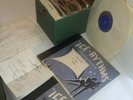
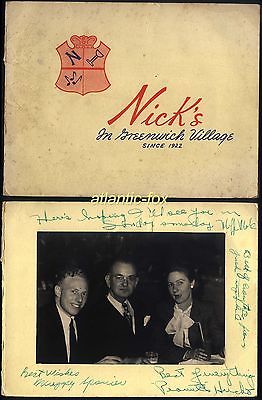
ORIGINAL Photo folder from Nick's - In Greenwich Village - Since 1922, containing a photograph of Miff Mole famous Jazz trombonist, sitting with guests Raymond Victor Dickeson and his Wife to be Denise Finnes, sometime pre July 1948.
Raymond Victor Dickeson was an Englishman, in WWII RAF 156 Pathfinder Squadron, three Tours of Operations, his Wife to be was also English but lived in New York. The Couple had these photographs taken while visiting this famous Jazz club, the photograph is Autographed by Miff Mole (trombone), Jack Teagarden (Considered the Father of trombone & Vocals & who played with Glen Miller), Peanuts Hucko (Band leader & Clarinet player who also played with Glen Miller), and Muggsy Spanier (Jazz Trumpet).
Mole, Miff (Irving Milfred) Miff Mole was one of the first to bring the tailgate style of Kid Ory and other New Orleans trombonists to his hometown of New York, and he made some of the first jazz recordings. In doing so, he added his own, more soloistic approach to the instrument, which was characterized by wide leaps in pitch and clear, rhythmic articulation. This virtuosity prompted Tommy Dorsey to call him "the Babe Ruth of the trombone." Miff Mole As a member of The Original Memphis Five, Mole played on some of the first jazz recordings, and went on to record with some of the other top musicians of early hot jazz, including cornetist Bix Beiderbecke, saxophonist Frank Trumbauer and Jimmy Dorsey. His legacy as a trombonist stretches beyond jazz, as he performed under Arturo Toscanini with the NBC Radio Orchestra and was a successful teacher. Born on March 11, 1898, in Roosevelt, New York, Mole began his musical studies on the violin at age 11. His father, also a violinist, augmented Mole's training by having him sit in with his own dance band. Two years later, Mole purchased a used alto horn, which he learned to play in addition to the violin. After seeing a trombone playing in a local parade, he decided to teach himself yet another instrument at age 14. Already self-taught on the piano, he learned the trombone slide positions by playing pitches on the keyboard and finding them on the slide. During high school, he devoted himself entirely to his trombone study under the tutelage of classical trombonist Prof. Charles Randall in New York. While classically trained, Mole found himself in the midst of New York's burgeoning hot jazz scene when, at age sixteen, he got a job with a small band at the College Arms in Brooklyn. That was when the sounds of early jazz began to find their way into Mole's ears, starting with the music of Hank O'Hara. Mole began to study the first jazz records and became one of the early masters of the new trombone style. His proficiency led him to land the trombone chair with the Original Memphis Five. The group began performing at the Harvard Inn on Coney Island, at the time run by gangster Al Capone. The group then embarked on a nationwide tour which included performances in Los Angeles, where Mole remained when the rest of the ensemble returned to New York. Mole returned to New York in 1919 to play a five-month engagement at the Roseland Theater with the Sam Lanin Orchestra, and continued working with them until 1924. He also recorded with other groups during this time, including again with the Original Memphis Five in 1922. He left Lanin to play with Ray Miller in Atlantic City along with saxophonist Frank Trumbauer. Mole shaped the role of the trombone in these ensembles as a combination of tailgate-style counterpoint and occasional melody, perhaps informed by his early training as a violinist. While playing with Miller, Trumbauer and Mole first heard cornetist Bix Beiderbecke, and the three came to be close friends. Mole also became friends with another groundbreaking cornetist and trumpeter, Red Nichols. The two began co-leading their own recording sessions in 1925 under a number of group names including Hottentot, the Red Heads, Arkansas Travelers, Red and Miff's Stompers, the Five Pennies and Miff's Molers. Other important collaborators on these records included Jimmy Dorsey, Eddie Lang, Adrian Rollini and Joe Venuti. "Buddy's Habits," recorded with the Five Pennies in 1926, is one example of this ensemble's work. Mole was often featured as a soloist with this group, a role that was unusual for trombonists at the time. Two sides that feature Mole's solo work include "Delerium," recorded with Red and Miff's Stompers in 1927, and "Riverboat Shuffle," recorded the same year with the Five Pennies. Mole's early innovations on the trombone are especially apparent in the Five Pennies' recording of "The Original Dixieland One-Step," starting with the first solo break. In the version popularized by the Original Dixieland Jazz Band and widely copied, the trombone break features a long, brassy glissando. Mole, however, plays a fast, pointillistic figure that more closely resembles clarinet phrasing than the traditional trombone passage. Throughout the rest of the song, however, he blends into the mix in a more "tailgate" style but with a clear, articulate sound and good control across a wide range of pitches, particulalry in the lower register. Mole also recorded regularly with Bix Beiderbecke in the late 1920s, and can be heard on Beiderbecke's famous recording of "Singin' the Blues." No stranger to Beiderbecke's heavy drinking and partying, Mole, along with Beiderbecke and Jimmy Dorsey, once missed a recording session after a long bender, and the musicians performed what Mole later described as their best set together on top of a double-decker bus leaving the studio. In 1929, Mole was offered a chair in the NBC orchestra and played with them throughout most of the 1930s. He also led his own group, Miff's Molers, until 1930, and did other occasional studio work. In 1934, he played the famous trombone solo from Ravel's Bolero, beating out a number of outside classical soloists who auditioned for the part. Mole briefly played second trombone in the group under Arturo Toscanini, but left in 1938 to join Paul Whiteman. Ironically, it was his desire to play more jazz that led him to join Whiteman's group, the same reason he cited when leaving two years later. While with Whiteman, Mole played briefly alongside fellow jazz trombone pioneer Jack Teagarden. Teagarden left the group at the end of 1938, two weeks after Mole's arrival, but enough time for the two to record together in Whiteman's December 1938 Carnegie Hall Concert, billed as "An Experiment In Modern Music" and featuring the work of a number of budding composers including Duke Ellington. "Blue Belles of Harlem" was Ellington's contribution to the concert. Mole left Whiteman in 1940 to refine his own trombone skills and to open a teaching studio in New York, where he fostered over 50 young trombonists, including Eddie Bert. Mole left teaching in 1942 to join the Benny Goodman band, but decided to leave to form a small Dixieland ensemble a year later. He continued to play with small groups in both New York and Chicago for the rest of the 1940s, working with Muggsy Spanier, Dave Tough, Bobby Hackett, Eddie Condon, Pee Wee Russell and many others. Although he was thoroughly in the Dixieland-revival camp and derided as one of the "moldy figs" by some of his peers in the bebop community, Mole maintained a healthy respect for bop. He even appeared with his friend and fellow trombonist Jack Teagarden at Dizzy Gillespie's debut at the Blue Note, praising the performance in a 1948 Down Beat interview. Mole began to develop serious health issues in 1945 that limited his ability to perform regularly, starting with hip surgery in 1945 that produced numerous complications. His last gig came with Pee Wee Russell in 1960, a year before his death on April 29, 1961 in New York City. He had been scheduled to play at the 1961 Newport Jazz Festival, only to arrive and find out that riots at the festival that year had caused his performance to be cancelled. Miff's friends in the jazz world, led by fellow trombonist Charlie Galbraith, had planned a "Miff Mole Day" in New York to celebrate the trombonist's career on June 21, 1961, but Mole did not survive to see it. Proceeds from the concert went to help his widow and family pay off the debts that he had incurred from his lengthy medical treatments. After his death, even his prized trombone had been seized by the Welfare Committee of New York, from whom he had been drawing support in his later years. Despite the tragedy of his late life, Mole left a legacy as one of the first models of the jazz trombone style. Many of the music's subsequent trombone virtuosi learned how to play by transcribing his solos with the Original Memphis Five and the Five Pennies. This enduring influence led one of his earliest admirers, Tommy Dorsey, to aptly describe him as "the trombone player's trombone player."
Teagarden, Jack (Weldon Leo) Trombonist and singer Jack Teagarden may have been at ease in the tailgate style of his generation, but he was the first to step out of that role and stand on his own as a melodic improviser. Where his trombone playing was highly decorative and technical, his singing was understated, a subtle baritone coated with very light vibrato. But both, while different in timbre, achieved the same goal: they convey a deep melancholic sadness rooted in the blues. Teagarden's style as a soloist was closer the clarinetists of his time than to other trombonists; he achieved this by cultivating licks in the upper register, supported by his comfort over three octaves on the instrument and ability to use the special mechanics of the slide to help carry his phrases. As he matured musically, he also developed a very sophisticated double-time rhythmic feel that complimented this style of melodic phrasing. Weldon Leo "Jack" Teagarden was born on August 29, 1905 in Vernon, Texas. His mother, Helen Giengar, taught piano lessons in their home and his father, Charles Woodbury "Woodie," was an enthusiastic although not particularly talented amateur trumpet player and community band organizer. Teagarden always claimed that the abundance of music in his childhood home led him to develop perfect pitch. Teagarden's three siblings Charlie, Norma and Clois also became professional musicians. Starting at age five, he began taking piano lessons with his mother. At age seven, he began to play the tenor horn, a brass instrument still used today in British-style brass bands and Mexican banda music, motivated by his distaste for piano lessons. Three years later, he switched to trombone and began playing duets with his mother at the local movie theater to accompany silent films. In 1918, Teagarden's father died and the family moved to Chappell, Nebraska, where he continued to work in theaters with his mother. A year later, the family moved to Oklahoma City. By age sixteen, he was working professional career with Cotton Bailey's Dance and Jazz Band in San Antonio, Texas, then joined Peck Kelley's Bad Boys. Based in Houston, the Bad Boys were known as one of Texas's premier territory bands, and toured all over the Southwest, including tours to New Orleans and the northern states of Mexico. It was Peck Kelley who gave Teagarden the nickname "Jack." By this time, Teagarden had developed a hobby as an amateur mechanic, and was responsible for keeping the band's Stanley Steamer in working order. He also made mechanical innovations to his trombone, including new mouthpieces and what is believed to be the first trombone "spit valve." He became well-known for playing trombone solos with the trombone bell removed, such as on the 1928 recording of Makin' Friends. During this period he me and married his first wife, Ora Binyon, with whom he had two sons. The success of the Bad Boys caught the attention of visiting bandleader Paul Whiteman, who offered Teagarden a position in his New York band. Teagarden chose to continue playing locally, however, and didn't travel to New York until 1926 on an eastern tour with Doc Ross' Jazz Bandits. He finally went to New York on his own in 1927 with the intention of joining Paul Whiteman's orchestra. However, upon arriving in New York he heard the Ben Pollack group and set his sights on playing with them. After two months with the Tommy Gott orchestra, Teagarden was able to replace Glenn Miller as Pollack's first trombonist. He made his first recording with an offshoot of the Pollack band, the Kentucky Grasshoppers. "She's a Great, Great Girl", recorded in March of 1928, provides a good example of Teagarden's playing at this point: he is already using a wide range of pitches and using lip trills, shakes and "against the grain" playing, scalar patterns played by moving the slide outwards towards the alternate positions in the mid-to-upper register, and fluid improvisation. During the next few years, Teagarden performed with many notable early jazz pioneers including Pollack, Louis Armstrong, Benny Goodman, Bix Beiderbecke, Red Nichols, Jimmy McPartland, Eddie Condon, Joe Venuti and Eddie Lang. One such example is his recording with Ben Pollack and brother Charlie Teagarden of "Cryin' For the Carolines" in 1930. Teagarden also began recording vocal numbers during this period. His laid-back, husky baritone was most commonly featured on blues numbers. Working with Glenn Miller, he co-wrote new lyrics to "Basin Street Blues," which became one of the staples of his repertoire for the rest of his career. Like many of the early jazz pioneers, Teagarden had by this point developed a serious pattern of alochol abuse which would darken much of the rest of his life. In early 1933, Teagarden relocated to Chicago where he played with Wingy Manone, only to return to New York later in the fall, when he cut a number of sides with clarinetist Bennie Goodman, including Billie Holiday's recording debut "Riffin' the Scotch" and his own vocal rendition of "I Gotta Right to Sing the Blues." On "I Gotta Right to Sing the Blues," Teagarden is featured as the group's first soloist, and although he has not developed the rhythmic sense that would define his later career, his unique melodic style and flexibility are evident, especially with his trill-like decorations. He is also featured as a vocalist, where his presentation is vital and aggressive but with the same subtle vibrato and long phrasing. His playing in the group improvisation at the end of the piece also foreshadows the development of the fast upper-register phrasing that he perfected later in his career. In December, Teagarden finally agreed to join Paul Whiteman's orchestra. Seeking financial security in the midst of the Great Depression, he signed an exclusive five-year contract with Whiteman which limited his other playing opportunities. One highlight, however, came in 1936, when Whiteman allowed him and his fellow improvising bandmates Frankie Trumbauer and Charlie Teagarden to headline an after-hours small group at Hickory House on 52nd street, billed as "The Three Ts." Teagarden was featured as a star soloist and vocalist in the Whiteman band through 1938. One example of his playing with Whiteman can be found on "Blue Belles of Harlem." During this time he married and divorced, successively, Clare Manzi and Edna "Billie" Coats. When his contract expired with Whiteman, Teagarden decided to form his own big band and take it on the road. His timing, however, was unfortunate, as other big bands such as Tommy Dorsey's, Glenn Miller's and Benny Goodman's had already become popular. Teagarden's first attempt at starting a band, with high-profile (and high-paid) sidemen including Charlie Spivak, quickly proved to be financially untenable. Notably, his brother Charlie chose to remain with Whiteman during this time rather than join Jack's big band venture. The combination of poor management and Teagarden's own unreliability, alcoholism and lack of business sense led to the first group's breakup. Despite facing bankruptcy, Teagarden stubbornly tried to re-start his band with lesser-known sidemen, partially thanks to the help of his friend Bing Crosby, who helped him land a speaking role in the 1941 film Birth of the Blues. It was around this time that he met his fourth and final wife, Adeline Barriere Gault, whom he married in September 1942. Even though his big band ventures were unsuccessful, Teagarden was being recognized by many listeners as one of his generation's best performers - evidenced by his performance of "I've Got Rhythm" with the Esquire All Stars in 1944. His band did last until 1946, when Teagarden, again facing bankruptcy, finally abandoned his big band asiprations and joined the Louis Armstrong All-Stars sextet. Teagarden's work with Armstrong is generally regarded as the best of his career. Not coincidentally, he had recently stopped drinking at the behest of his new wife Addie. His collaboration with Armstrong lasted for four years, and resulted in some fantastic cuts of Armstrong classics such as Muskrat Ramble, Baby Won't You Please Come Home and Black and Blue. Teagarden was also featured on some of his own better-known songs including Lover and Stars Fell On Alabama. His 1947 recording with Armstrong of Mitchell Parrish's 1934 hitStars Fell on Alabama, his signature song, featured him both as a trombone soloist as well as a singer, and demonstrate his mature sound and rhythmic sense. From the beginning of the piece, he plays the "A" section of the melody with his characteristic trills and embellishments. His success with Armstrong led Teagarden to start his own sextet in 1951, the Jack Teagarden All-Stars. His wife Addie served as his business manager, and his brother Charlie joined him for a time on trumpet. He was a featured performer at the 1957 Newport Jazz Festival, as captured in Bert Stern's documentary film Jazz on a Summer's Day, which includes his duet witih Armstrong on "Rockin' Chair." Teagarden was also selected to co-lead two U.S. State Department goodwill tours, which he regarded as the highlight of his career. His first tour, co-led with Earl Hines, traveled across Europe in 1957, followed by a three-month tour of the Far East in 1958 that took him to Thailand, Cambodia, India, Afghanistan, Vietnam and Japan. By this point Teagarden had taken to drinking again and by the performance in Japan was visibly ill. Teagarden continued to perform until the end of his life. His final performance, at the Dream Room in New Orleans, had to be cut short due to Teagarden's poor health. He was found dead in his hotel room the following morning, January 15th, 1964, at the age of 58. The cause of death was reported as bronchial pneumonia, brought on by complications from chronic liver problems. It has been widely reported that despite his brilliance, Teagarden failed to have a lasting impact on future trombonists. The younger J.J. Johnson is commonly considered to be the father of the modern jazz trombone, and there is little similarity in the two musicians' styles; however, it is easy to find Teagarden's influence in many aspects of modern trombone playing. Unlike Johnson, he uses his lip flexibility to create melodic improvisations; whereas Johnson used his tongue to articulate almost all of his attacks, Teagarden combines a light attack with "against the grain" playing to great lyrical effect. Other great trombonists of his generation, most notably J.C. Higganbotham and Vic Dickenson, used lip trills more as decorative effects than as melodic devices. Teagarden also pioneered the use of alternate positions in jazz improvisation, borrowing from the technical innovations of classical trombonists such as Arthur Pryor. Teagarden's techniques are evident in the playing of many subsequent trombonists such as Bill Harris, Curtis Fuller, Frank Rosolino, Carl Fontana and Conrad Herwig. Teagarden has also earned the distinction of being well-respected among all kinds of jazz fans, even those who derided many of his contemporaries in the Dixieland-revival movement as "moldy figs."Francis Joseph Julian Spanier was born in 1901 in Chicago. Like many kids he was crazy for baseball and yearned to be a professional ballplayer. Spanier picked up the nickname 'Muggsy' because of his admiration for New York Giants team manager, John 'Muggsy' McGraw. Spanier said, "McGraw knew what he wanted, and he’d run right after it without considering the consequences. That’s the way I played (jazz), on impulse, without figuring out the ‘why’ or ‘what’…and I didn’t do so badly." Hearing Joe 'King' Oliver at the Royal Gardens Cafe while he was still in grammar school turned Muggsy Spanier onto jazz. He never took lessons with Oliver, he just listened to his playing. He appreciated the way Oliver stuck close to the melody of a tune; the way he played few notes, mostly in the middle register, with good rhythm. He was a 'feeder,' helping the others in the band. Ad for King Oliver at Lincoln Gardens, 1922. Image courtesy The Chicago Defender. Alma Hubner wrote, "…Muggsy plays a truer, more Negroid, more authentic jazz style than any other contemporary white jazz cornetist. He’s based his style closely upon the pattern of Oliver’s, at the same time taking a lot from [Louis] Armstrong but never falling under the influence of [Bix] Beiderbecke." Muggsy said, "I got to know Oliver quite well. Both he and Louis [Armstrong] encouraged me in my playing a lot. Joe sometimes would teach me some of his tricks with the mutes; I learned a lot from him. After a little practice I was invited to sit in with the band. I was the first one to do so…it must have seemed strange, a little kid blowing cornet with those two Titans! That’s one thrill I’ll never forget: having played with the two greatest cornetists in jazz!" The other great influence on Spanier was the New Orleans Rhythm Kings, which he first heard in 1920 with New Orleanian George Brunies on trombone. Muggsy and Brunies became friends and associates for life. Muggsy Spanier (top right) with Sig Meyer Orchestra horn section, Chicago 1920. Photo by H. Opencer. Bandleader Sig Meyer—for whom Muggsy worked early on—said, "Muggsy was fired with enthusiasm, a love of playing, and had that tremendous drive that gave the band he worked with an unbelievable lift." Muggsy made his first record on February 25th, 1924 in Richmond, Indiana for the Gennett label. By 1928 Muggsy Spanier was well established in Chicago as a jazz player, both in person and on records. The next year Muggsy got his big break when Ted Lewis asked him to join his nationally popular orchestra. In 1935 the Ted Lewis band made the MGM film Here Comes the Band, in which Muggsy appears on screen. Late in 1938 Spanier left Lewis and joined the Ben Pollack orchestra, replacing Harry James who was leaving to join Benny Goodman. During a tour of New Orleans he developed a perforated ulcer, a serious condition, and was hospitalized at the Touro Infirmary there. Muggsy made a slow and gradual recovery and after a year returned to Chicago and his music career. Bluebird Recording, "Relaxin at the Touro." Image courtesy Red Hot Jazz Archive. In 1939 Muggsy said: "I'm trying to play the kind of music I used to play with Tesch [Frank Teschmacher] and the old Chicago gang. All the same, I wanted to be up-to-date too. I want to have the old Chicago in New Orleans tradition and yet be something contemporary and distinctive." The result was the formation of Muggsy Spanier's Ragtime Band. The Band opened at the Sherman House Hotel in Chicago on April 28, 1939. Muggsy said, "We've only been together three weeks as my first job in 15 months. Doctors gave me up for lost after all those operations and I still can't understand how I survived. I could've gone back with Ted Lewis; only people were telling him I couldn't play anymore. That's why I got this little gang together just to show them I'm still around!" "I Wish I Could Shimmy Like My Sister Kate" sheet music, 1922. Image courtesy fornof.org The Ragtime Band was a big hit. Alma Hubner wrote, "Muggsy Spanier's Ragtime Band invaded the Sherman and established a new record by remaining there for five and a half months. The band had coast-to-coast radio hookups and the crowds at the Sherman Hotel went for it in a big way. It played good jazz, which was good listening or dancing, whichever way you were inclined. Bands like…Bunny Berrigan’s and Gene Krupa’s played opposite them, yet Muggsy’s boys always managed to steal the show. It wasn’t only Muggsy’s driving, inspired cornet that proved sensational to the general public opinion; it was the band as a whole as well. George Brunis and his tail-gate trombone plus his irrepressible flair for comedy gave the Ragtimers a solid basis for good showmanship. Rod Cless’ clarinet was inspired and inspiring. Then too, men like Pat Pattison, Bob Casey, George Zack, Joe Bushkin, Ray McKinstry, Nick Ciazza, Marty Greenberg, Don Carter and George Wettling added to the atmosphere of perfection." In October of that year Muggsy and the Ragtime Band journeyed to New York to play at Nick's in Greenwich Village. But the engagement only lasted until December 10th. Muggsy Spanier's Ragtime Band lasted a mere seven months. The Great 16 album cover. Image courtesy eil.com Before the band broke up they made 16 exceptional hot jazz records: 4 in Chicago and 12 in New York for the RCA Victor Bluebird label. When the first long-play collection of all the sessions was issued, it was entitled The Great 16, and this immediately became the generic name by which they are recognizable to all jazz buffs. Spanier wrote, "People want to know why Victor didn't get me to record more of those Ragtime sides, for they were one of the biggest sellers. But they were not commercial stuff....So I imagine this answers the question." After the breakup Muggsy recorded for Milt Gabler's Commodore Records and then joined the Bob Crosby orchestra in 1940. "One of my greatest thrills was playing with the Crosby band," Spanier told Alma Hubner. "I enjoyed myself immensely. Those boys had the right spirit. Jess [Stacey], Eddie Miller, Bobby Haggart, Nappy Lamare and Ray Bauduc certainly made something out of that band." During his time with the Crosby band Spanier appeared in two more films, Let's Make Music and Sis Hopkins. Let’s Make Music Movie Poster. Image courtesy streetswing.com Jim Cullum says, "During his touring days with the Bob Cats, whenever the band would find itself in a bar with a juke box, Muggsy would always play the Great 16 records." Beginning in 1941 Muggsy formed his own big band. That year the band began a long engagement at the Arcadia ballroom in New York. The great New Orleans clarinet player Irving Fazola was one of the sidemen for a time. The band gained the No. 1 spot in the Melody Maker annual poll in Great Britain. The big band ceased to exist by September 1943. Exhausted, Muggsy returned to Chicago and then New York. By 1944 Muggsy was working with Eddie Condon and did more recording for Commodore. In 1945 Muggsy placed seventh in the Down Beat yearly readers' poll, one place ahead of Dizzy Gillespie. Muggsy Spanier. Image courtesy Big Band Database nfo.net The post-war period found Muggsy constantly touring the US with small groups. He was frequently featured at Nick’s in Greenwich Village. Some of his sidemen were George Brunies, Darnell Howard, Truck Parham, Floyd Bean, Ralph Hutchinson, Barrett Deems and Riverwalk guests Bobby Gordon and Jack Maheu. An offer to appear with Earl Hines at the Club Hangover in San Francisco prompted Muggsy to move there in 1957. He continued to lead and tour nationally until 1964 when he was featured at the Newport Jazz Festival. Muggsy died in 1967.
Benny Goodman was "Peanuts" Hucko, Easily the most successful of the followers of the swing era clarinetist Benny Goodman was "Peanuts" Hucko, who has died aged 85. Indeed, his flawless command of the instrument so impressed Goodman that he once asked Hucko to cover for him at a rehearsal. As it ended, Goodman called Hucko to play Stealin' Apples, something of a clarinet test-piece. "At the finish, he smiles and says: 'You're a fingerbuster.' I thought that was a nice compliment," Hucko told writer Max Jones in 1991. Yet Hucko was always more than a Goodman clone, and was at pains to point out that he had developed musically in his own way. "I have a different feel," he explained. Michael Hucko - the "Peanuts" soubriquet came when he was sandwiched between two taller saxophonists in a school band - was born in Syracuse, New York state. At first, he played the saxophone, only turning to the clarinet once his professional career was underway. He switched from alto to tenor saxophone, gaining a useful reputation as a soloist as he worked his way through a variety of dance bands, from at least one of which he was fired for refusing to play clarinet. He changed his mind about the instrument while in an army band, having found that playing the tenor on the march was an uncomfortable business. Some of his New York musician friends recommended Corporal Hucko to Captain Glenn Miller, then recruiting for his celebrated army air force orchestra. Hucko eventually took the role of lead clarinet, and was used regularly for clarinet features while the Miller band was in wartorn Europe. Londoners might recall sessions at the Feldman Club (now the 100 Club) in Oxford Street in 1944, with Hucko, drummer Ray McKinley and pianist Mel Powell (late of the Goodman band) sitting in with local jazz players. Hucko and company recorded in London for Esquire and made numerous broadcasts before Miller's disappearance in an air crash in December 1944. t After his military discharge, Hucko went back to big-band saxophone work, first with Goodman and then with McKinley. He soon, however, put the saxophone aside and joined the Chicago-style outfit at Eddie Condon's New York club as clarinetist. Having prospered among the Dixieland elite, he made a memorable tour of Britain in 1957 with the Jack Teagarden-Earl Hines All Stars, after which he returned several times to tour with local bands, such as Alex Welsh. Back in New York, Hucko managed to juggle a five- year stint with the ABC staff orchestra (even playing second clarinet in the classical ensemble) with club and concert work, associating and recording with the best jazzmen of the day. He spoke with particular affection and pride about his time with Louis Armstrong; he had first played with "Satchmo" at the celebrated New York town hall concert of 1947, and joined the All-Stars for three demanding years in 1958. He appeared in The Five Pennies and Jazz On A Summer's Day films, and clearly adored the great man. "I tried to play like Louis on the clarinet," he said. In the 1970s, Hucko fronted the revived Glenn Miller Orchestra, appeared as a television series guest with the sugary Lawrence Welk, and ran Peanut Hucko's Navarre, a club in Denver, Colorado, for four years. He also played in the World's Greatest Jazz Band, had a chart hit in Japan, and toured Europe with his Goodman-style Pied Piper Quintet, which included such fine new talents as the trumpeters Glenn Zottola and Randy Sandke. Another vital member of the band was Hucko's singer wife Louise Tobin, also formerly with Goodman. Likeable but strong-minded, Hucko was usually happy to hold court, glass in hand, late at night, letting rip with some feisty New York opinions. Businesslike, and never one to undersell his abilities, he was a virile, big-occasion player, who dazzled club and festival audiences everywhere. He is survived by his wife, whom he married in 1967, and two stepchildren. · Michael Andrew 'Peanuts' Hucko, musician, born April 7 1918; died June 19 2003.