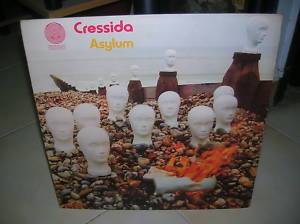
CRESSIDA ASYLUM 1st UK Press Vertigo Swirl Ex N-Mint
£
560
$
742


Favourite Auctions
To save auctions to your favourites, please login
If you don't have an account, please register
Description
CRESSIDA
ASYLUM
This sale is for a Stunning Copy of this very rare Prog Rock Album :
see details below
1st UK PRESSING
Year of Release 1971
VERTIGO SWIRL LABEL
Catalogue Number 6360 025
Matrix Side A
6360025 1Y//1?420 111
Matrix Side B
6360025 2Y//1?420 111
Vinyl:
This Stunning heavy 1st pressed vinyl looks Near Mint and plays Excellent ++, no skips, no jumps and with a deep virgin vinyl gloss
Gatefold Sleeve:
The Unlaminated gatefold Sleeve with the Red Vertigo Swirl Logo is in Excellent condition.
No seam splits. Absolutely Minimal wear to edges and a Solid, Readable Red Text spine.
Made by Howards Printers( Slough) Ltd
Swirl inner sleeve:
Made in England With British Patent No.800513 & 973939 Excellent +
UK Vertigo Swirl Labels:
Mint.
Postage and Packaging details below
Cressida was a British art rock band formed at the tail-end of the 1960s in the shadow of (and their music very much in thrall to) the Moody Blues, with a heavy organ and Mellotron sound courtesy of keyboard player Peter Jennings. The original lineup of Jennings, Angus Cullen (vocals, guitar), John Heyworth (guitar), Kevin McCarthy (bass), and Ian Clark (drums) was signed to Polydor's progressive rock imprint, Vertigo Records. The group had a dense, lyrical sound, and Cullen's singing was of a pleasing, almost pop nature, in a vein similar to Justin Hayward, Paul McCartney, et al.
Their self-titled debut album was filled with hauntingly beautiful melodies and relatively accessible, straightforward song structures. It was somewhat derivative of antecedents such as the Moody Blues, but it did well enough to justify a follow-up in 1971. Heyworth had departed by the time of the second album, entitled Asylum, replaced by John Culley and Paul Martin Layton (of the New Seekers) on guitar, and with Harold McNair added on flute as well. That album, produced by Ossie Byrne, was more ambitious instrumentally and, surprisingly, given Byrne's previous work with the Bee Gees and Eclection, less focused on Cullen's vocals.
By 1972, however, the group had run out of steam and recording contract, and they never really had a chance to develop a history. Ian Clark moved on to a brief stay with Uriah Heep and John Culley became a member of Black Widow.
More highly melodic progressive rock, this time built around longer songs and extended instrumental passages — among the latter, "Munich," which was alternately titled "Munich 1938: Appeasement Was the Cry; Munich 1970: Mine to Do or Die," was surprisingly accessible at nine minutes and change, built on Peter Jennings' extended organ cadenzas embellished with John Culley's crisp electric guitar flourishes, all wrapped around a pleasing array of melodies that easily carry the song's length.
The three extended numbers that comprised the original LP's side two also make for fascinating listening, Angus Cullen's McCartneyesque vocals calling to mind the Moody Blues in their prime, while the band's hard, at times slightly jazzy, instrumental attack evokes echoes of Caravan with, perhaps, a touch of the most energetic of Deep Purple's Jon Lord-spawned classical experiments. The group's downfall may have been their reliance on virtuosity, as opposed to raw wattage and brute force in their attack — with Emerson, Lake & Palmer, Keith Emerson was bringing crowds of 20,000 teenagers at a time to their feet by abusing his organ, while as part of Cressida, Peter Jennings on "Let Them Come When They Will" plays the kind of break that would have wowed them in a club in front of maybe 200 people (while Cullen's singing takes on a resemblance to Jim Morrison in the middle of the track). It's all sort of the difference between relating to one's music and audience on a retail basis, as opposed to wholesale — Cressida never got past the former, and it makes Asylum a very pleasing album but also a very demanding one.
01. Asylum Cullen 3:34
02. Munich (Munich 1938; Appeasment Was the Cry, Munich 1970; Mine to ...) Jennings 9:33
03. Goodbye Post Office Tower Goodbye Cullen 2:50
04. Survivor Cullen 1:34
05. Reprieved Jennings 2:28
06. Lisa Cullen 5:08
07. Summer Weekend of a Lifetime Cullen 3:25
08. Let Them Come When They Will Heyworth 11:46
Record Collector Magazine's Grading Guide:
MINT: The record itself is in brand new condition with no surface marks or deterioration in sound quality. The cover and any extra items such as the lyric sheet, booklet or poster are in perfect condition. Records advertised as Sealed or Unplayed should be Mint.
EXCELLENT: The record shows some signs of having been played, but there is very little lessening in sound quality. The cover and packaging might have slight wear and / or creasing.
VERY GOOD: The record has obviously been played many times, but displays no major deterioration in sound quality, despite noticeable surface marks and the occasional light scratch. Normal wear and tear on the cover or extra items, without any major defects, is acceptable.
GOOD: The record has been played so much that the sound quality has noticeably deteriorated, perhaps with some distortion and mild scratches. The cover and contents suffer from folding, scuffing of edges, spine splits, discolouration, etc.
FAIR: The record is still just playable but has not been cared for properly and displays considerable surface noise; it may even jump. The cover and contents will be torn, stained and / or defaced.
POOR: The record will not play properly due to scratches, bad surface noise, etc. The cover and contents will be badly damaged or partly missing.
BAD: The record is unplayable or might even be broken, and is only of use as a collection filler.
Any Questions Please ask.
This Album will be packed into a record mailer, vinyl removed from sleeve and supported by card stiffeners and protected by a sleeve polycover with FREE POSTAGE
UK Postage as stated
Europe Postage £7.00
Worldwide Postage £12.00
Thank you for looking at the Auction
price rating






![BLANK[FABIAN]/LULLABY ANGEL - THE TENNORS [R/STEADY] 7](https://www.popsike.info/php/thumbnail.php?url=https://www.popsike.pics/pix/20161123/291951211185.jpg)