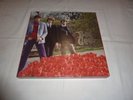
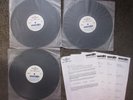
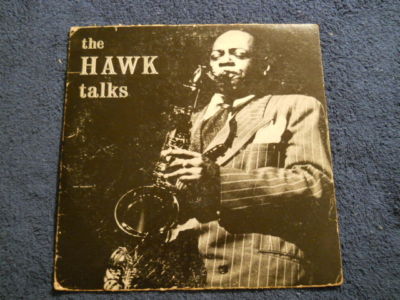
*COLEMAN HAWKINS - The Hawk Talks 10" LP Savoy MG 15039, very nice VG++
$
58


Favourite Auctions
To save auctions to your favourites, please login
If you don't have an account, please register
Description
PLEASE TAKE A LOOK AT MY OTHER eBAY AUCTIONS - ALWAYS EXPECT THE UNEXPECTED
CHECK OUT MY OTHER RARE JAZZ, SOUL AND BLACK POWER LP'S THAT I'VE RECENTLY LISTEDCOLEMAN HAWKINS - "The Hawk Talks" in mono on Savoy MG 15039 (10"). Many jazz luminaries take part on these sessions (undated) Benny Carter, Joe Sullivan, Ulysses Livingston, George Wettling and Buddy Johnson. JOE TURNER handles vocals on How Long and Shake; and JEANIE BURNS sings Easy Rider.
Record Grade:VG++, full gloss, some surface marks which should not materially affect play
Cover Grade: VG-. somewhat above average wear
Labels: Deep red and silver "Long Playing Microgroove"
Coleman Hawkins was the first important tenor saxophonist and he remains one of the greatest of all time. A consistently modern improviser whose knowledge of chords and harmonies was encyclopedic, Hawkins had a 40-year prime (1925-1965) during which he could hold his own with any competitor.
Coleman Hawkins started piano lessons when he was five, switched to cello at age seven, and two years later began on tenor. At a time when the saxophone was considered a novelty instrument, used in vaudeville and as a poor substitute for the trombone in marching bands, Hawkins sought to develop his own sound. A professional when he was 12, Hawkins was playing in a Kansas City theater pit band in 1921, when Mamie Smith hired him to play with her Jazz Hounds. Hawkins was with the blues singer until June 1923, making many records in a background role and he was occasionally heard on instrumentals. After leaving Smith, he freelanced around New York, played briefly with Wilbur Sweatman, and in August 1923 made his first recordings with Fletcher Henderson. When Henderson formed a permanent orchestra in January 1924, Hawkins was his star tenor.
Although (due largely to lack of competition) Coleman Hawkins was the top tenor in jazz in 1924, his staccato runs and use of slap-tonguing sound quite dated today. However, after Louis Armstrong joined Henderson later in the year, Hawkins learned from the cornetist's relaxed legato style and advanced quickly. By 1925, Hawkins was truly a major soloist, and the following year his solo on "Stampede" became influential. Hawk (who doubled in early years on clarinet and bass sax) would be with Fletcher Henderson's Orchestra up to 1934, and during this time he was the obvious pacesetter among tenors; Bud Freeman was about the only tenor who did not sound like a close relative of the hard-toned Hawkins. In addition to his solos with Henderson, Hawkins backed some blues singers, recorded with McKinney's Cotton Pickers, and, with Red McKenzie in 1929, he cut his first classic ballad statement on "One Hour."
By 1934, Coleman Hawkins had tired of the struggling Fletcher Henderson Orchestra and he moved to Europe, spending five years (1934-1939) overseas. He played at first with Jack Hylton's Orchestra in England, and then freelanced throughout the continent. His most famous recording from this period was a 1937 date with Benny Carter, Alix Combille, Andre Ekyan, Django Reinhardt, and Stephane Grappelli that resulted in classic renditions of "Crazy Rhythm" and "Honeysuckle Rose." With World War II coming close, Hawkins returned to the U.S. in 1939. Although Lester Young had emerged with a totally new style on tenor, Hawkins showed that he was still a dominant force by winning a few heated jam sessions. His recording of "Body and Soul" that year became his most famous record. In 1940, he led a big band that failed to catch on, so Hawkins broke it up and became a fixture on 52nd Street. Some of his finest recordings were cut during the first half of the 1940s, including a stunning quartet version of "The Man I Love." Although he was already a 20-year veteran, Hawkins encouraged the younger bop-oriented musicians and did not need to adjust his harmonically advanced style in order to play with them. He used Thelonious Monk in his 1944 quartet; led the first official bop record session (which included Dizzy Gillespie and Don Byas); had Oscar Pettiford, Miles Davis, and Max Roach as sidemen early in their careers; toured in California with a sextet featuring Howard McGhee; and in 1946, utilized J.J. Johnson and Fats Navarro on record dates. Hawkins toured with Jazz at the Philharmonic several times during 1946-1950, visited Europe on a few occasions, and in 1948 recorded the first unaccompanied saxophone solo, "Picasso."
By the early '50s, the Lester Young-influenced Four Brothers sound had become a much greater influence on young tenors than Hawkins' style, and he was considered by some to be out of fashion. However, Hawkins kept on working and occasionally recording, and by the mid-'50s was experiencing a renaissance. The up-and-coming Sonny Rollins considered Hawkins his main influence, Hawk started teaming up regularly with Roy Eldridge in an exciting quintet (their appearance at the 1957 Newport Jazz Festival was notable), and he proved to still be in his prime. Coleman Hawkins appeared in a wide variety of settings, from Red Allen's heated Dixieland band at the Metropole and leading a bop date featuring Idrees Sulieman and J.J. Johnson, to guest appearances on records that included Thelonious Monk, John Coltrane, and (in the early '60s) Max Roach and Eric Dolphy. During the first half of the 1960s, Coleman Hawkins had an opportunity to record with Duke Ellington, collaborated on one somewhat eccentric session with Sonny Rollins, and even did a bossa nova album. By 1965, Hawkins was even showing the influence of John Coltrane in his explorative flights and seemed ageless.
Unfortunately, 1965 was Coleman Hawkins' last good year. Whether it was senility or frustration, Hawkins began to lose interest in life. He practically quit eating, increased his drinking, and quickly wasted away. Other than a surprisingly effective appearance with Jazz at the Philharmonic in early 1969, very little of Hawkins' work during his final three and a half years (a period during which he largely stopped recording) is up to the level one would expect from the great master. However, there are dozens of superb Coleman Hawkins recordings currently available and, as Eddie Jefferson said in his vocalese version of "Body and Soul," "he was the king of the saxophone."
James Moody was an institution in jazz from the late '40s into the 21st century, whether on tenor, flute, occasional alto, or yodeling his way through his "Moody's Mood for Love." After serving in the Air Force (1943-1946), he joined Dizzy Gillespie's bebop orchestra and began a lifelong friendship with the trumpeter. Moody toured Europe with Gillespie and then stayed overseas for several years, working with Miles Davis, Max Roach, and top European players. His 1949 recording of "I'm in the Mood for Love" became a hit in 1952 under the title of "Moody's Mood for Love" with classic vocalese lyrics written by Eddie Jefferson and a best-selling recording by King Pleasure. After returning to the U.S., Moody formed a septet that lasted for five years, recorded extensively for Prestige and Argo, took up the flute, and then from 1963-1968, was a member of Dizzy Gillespie's quintet. He worked in Las Vegas show bands during much of the 1970s before returning to jazz, playing occasionally with Gillespie, mostly working as a leader and recording with Lionel Hampton's Golden Men of Jazz. Moody, who alternated between tenor (which he preferred) and alto throughout his career, had an original sound on both horns. He was also one of the best flutists in jazz. Moody recorded as a leader for numerous labels, including Blue Note, Xanadu, Vogue, Prestige, EmArcy, Mercury, Argo, DJM, Milestone, Perception, MPS, Muse, Vanguard, and Novus. He died of complications from pancreatic cancer on December 9, 2010 in San Diego, CA. James Moody was 85 years old.
All of my records are shipped in sturdy cardboard LP or 45 rpm mailers with appropriate padding (heavy cardboard fillers or bubble wrap or "peanuts" or some combination thereof". With the exception of sealed LP's, all LP's are removed from their outer sleeves to prevent seam splitting. Upon request, I will give your sealed LP's the same treatment sealed, it cannot be returned once opened).
All records are carefully graded. In an attempt to give customers an accurate impression of condition rather than adhere to somewhat arbitrary criteria, I give an "overall presentation" grade, supplemented when necessary with additional remarks. Please refer to my grading system below for a more detailed explanation.
MY GRADING SYSTEMS: I’ve been told that I grade conservatively. My NM (near mint) is my highest grade for opened records (which would also include unplayed records). It’s a 9 or 10 on a 1-10 scale. M- would be equivalent to an 8; VG++ to a 7; VG+ to a 6; VG to a 5; VG- to a 4; G to a 3; F to a 2 and P to a 1. The same scale applies when I grade covers (jackets). Significant defects are specifically noted and taken into consideration in the grade.
GRADING DESCRIPTIONS
RECORDS:
- GRADING is based on the following criteria
- Sealed = store stock new
- Near Mint = like new or near new with only one or two small insignificant defects, a 9 or better on a 1-10 scale
- Near Mint Minus = very nice. Would be Near Mint, except for a couple of light hairlines or scuffs, which do not affect play
- VG++ = still a very nice record with all or nearly all of its original gloss but may have a few more light, surface marks, hairlines, needle tracks or the like which should not materially effect play
- VG+ = a nice, but used record that may have a series of light scuffs or scratches. It probably plays with a few pops, but has no serious problems.
- VG = a well-used record that still should sound OK when played, but may have moderate surface noise, pops, etc.
- VG- = a well-worn record that plays through without skipping, but will do until a better copy comes along.
- Good = not actually good at all but probably will play through but with much in the way of surface noise, pops, crackles, etc. Still, will have no cracks, chips or the like
- Fair = you’re getting this record just to own but not to play
- Poor = the sky’s the limit, generally I will discard a record this bad (and sell the cover, jacket or sleeve alone) unless the label holds some particular interest
VISUAL GRADING: All records are visually graded only unless I state that they are play-graded. Some major labels were pressed on better quality vinyl and will sound better than a record which visually appears the same on "budget" labels which were pressed on lower quality vinyl. Recording techniques also varied. The sound on live albums may be far inferior to studio recordings. There may also be defects in the pressing which are invisible. The point is that an album on a high quality label that was visually graded VG+ may sound better than an album on a budget label that was visually graded Mint- or even Near Mint. Please refer to my return policy, below. But please don’t be shocked if a record visually graded Near Mint doesn’t sound state of the art. If I base my grade on a PLAY GRADE, I will state this specifically in my grading section.
COVERS: There are really too many possible defects regarding covers to be as specific in my definitions as I had been with my record grades. But please keep in mind these general grading guidelines:
- I will give greater weight to the condition of the front cover than back cover when assigning an overall grade
- No cover with a cut out hole or saw mark will be graded Near Mint even if it is still in factory shrink and there is no other wear
- I will not reduce the grade of a cover for stickers which are glued to the jacket by the record company (eg. Contains the hit song Expressway to Your Heart); but will reduce the grade for stickers glued on the cover by stores, previous owners, etc.
- If I write that a cover has a bb hole, I’m talking about a small cut out hole
- A saw mark is a narrow cut in the perimeter of the cover, could be anywhere and vary in length from 1/2” to 2” at the most.
- The overall grade takes into consideration any stated defects. For example, if I grade a cover VG+ and then state it has 6” top and bottom seam splits - I’ve already reduced the grade because of the seam splits. If the seams weren’t split, the cover would be graded higher such as VG++ or Mint-.
Shipping Costs: CURRENT SHIPPING RATES AND POLICIES.
The winning bidder pays for shipping.
DOMESTIC SHIPPING WITHIN THE UNITED STATES: Due to increase in postage rates, I had sometimes been losing money on shipping as I send all records in sturdy professional Bags Unlimited mailers with one or more fillers. Therefore, I am now using the eBay postage calculator to determine postage. This will also result in a more equitable charge for priority mail shipments. Instead of a flat fee, those who live in the southeast and mid-east will reap the benefit of reduced priority mail rates.
DOMESTIC AND INTERNATIONAL SHIPMENTS: COMBINED SHIPPING - Save money when I mail 2 or more records in the same package. Please wait until I send you an invoice or request an invoice when combining two or more records or cd's in one shipment -prior to making payment.
INTERNATIONAL SHIPMENTS: Overseas customers are encouraged to bid. As with U.S. shipments, I will use eBay's postage calculator for all overseas shipments.
Postage to Canada is substantially less than to other countries - if you live in Canada and don't see a separate rate for Canada , please e-mail me and I'll modify the invoice to reflect the lower shipping charges. Surface mail is no longer available for overseas. Express Mail International and Priority Mail International are available - rates are substantially higher than first class international and will be quoted for each purchase if buyer requests this service. Express Mail International or Registered mail is now required for purchases over $100. Generally, Express International costs $35 for 1 album and additional albums are about $5-6 more. Registered costs about $26 for 1 album, about $5 more for each additional album. Registered mail may not be available to certain countries. I am sorry but the increased risks and costs must be passed on to the international buyer. On the bright side of things, Express Mail International will get you the package faster and it is safer. Registered mail is the safest form of shipment (but not as fast as express mail international). So there are benefits to the buyer as well as the seller. Please wait until I send you an invoice or request an invoice when combining two or more records or cd's in one shipment -prior to making payment.
Please check out my other eBay auctions and stores listings.
I’ve been listing all types of records - mostly LP’s - including 50’s and 60’s rock ‘n’ roll, country, folk jazz, blues, personalities, new wave and punk, surf, psych, spoken word, comedy, etc., etc....... I try to list unusual, unique or obscure records, not the ones that you see all the time. While a majority of my listings are albums, you’ll often find a nice selection of 45’s, EP’s or picture sleeves...and an occasional 78 or two.
My return policy: . You may return an item if it's not in the conditon described. You may not return items if you decide you don't like the music. I will return the base price of the item unless I make an error in shipment such as sending you the wrong record or cd. In that case, you will be reimbursed for the cost of the item and shipping both ways. In addition, the item must be returned in its original condition , i.e. the way it was shipped when it left my hands. While a very high percentage of my records arrive safe and sound (I use professional mailers and a filler or two, more for 78’s), they occasionally are damaged in transit. If that happens, I won’t accept the return of the record or other item.
Sealed Records: After a sealed record is paid for, I will gladly open it before mailing to make sure that the record is new & unplayed. If the record is not, I will give a full refund. Even though it is easy to spot most resealed records from the 50's and 60's [I will mention that in the desription if it looks like a possibility], not all records from the 70's & 80's are quite as obvious. Please ask for any details about the seal of a particular record & I will be happy to answer.
GOOD LUCK BIDDING AND HAPPY HOLIDAYS.
price rating