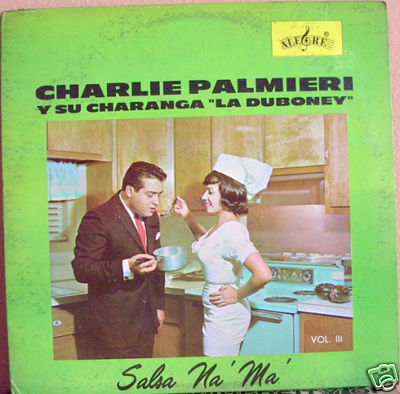
CHARLIE PALMIERI "SALSA NA MA'" Alegre Vol.3 ('64 )HEAR
$
57


Favourite Auctions
To save auctions to your favourites, please login
If you don't have an account, please register
Description
REMARKS: FOR THE SALSA COLLECTOR!! El Gigante Del Teclado y La Duboney
CHARLIE....He formed Charanga 'La Duboney' late '59 with four violins, Pacheco on flute: Gilberto Valdés had been unsuccessful early '50s with charanga format, but Duboney's debut at a New Year's Eve dance launched a craze: they became so popular that they played several dances a night. 'La Duboney' LP debut was Let's Dance The Charanga! '60 on United Artists (reissued as Echoes Of An Era on West Side Latino), with vocalist Vitín Avilés (b 30 Sept. '24, Mayagüez, Puerto Rico); Pacheco left to form his own group. Charlie Switched to Al Santiago's Alegre label for three original and swinging Charanga 'La Duboney' volumes: Pachanga at the Caravana Club , Viva Palmieri and Salsa Na' Ma' Vol. 3 '61-63, as well as contribute tracks to Las Charangas - Pacheco, Palmieri, Fajardo '61.
TRACKS SIDE A:
1. Tiene Sabor [Pachanga]
2. Loco Por Ti [Son Montuño]
3. Amor for Two [Bossa Nova]
4. Noche de Parranda [Cha-Cha-Cha]
5. Hoy Como Ayer [Bolero]
6. Vamanos Guajira
TRACKS SIDE B:
1. Ay Señor [San Montuno]
2. Yerbero [Mambo]
3. Cosas Cositas [Cha-Cha-Cha]
4. Doctor de Fama [Pachanga]
5. Piraguero [Cha-Cha-Cha]
6. Salsa Na' Ma' [Son Montuno]
Vocalists: Willie Torres & Victor Velasquez
WEB REMARKS:
"Salsa Na' Ma', one of the later records from CHARLIE PALMIERI's CHARANGA "La Duboney," is a bright, swinging collection of great pachangas ("Tiene Sabor," "Doctor de Fama") and son montunos ("Loco por Ti," "Ay Señor," the title track). The strings are supple and the flute soars above the arrangement on nearly every track, leading the way for the punchy vocal choruses on most tracks. Palmieri even toys with a bossa nova on the admittedly lightweight "Amor for Two." Songwriters they're definitely not, but great, exciting musicians they most certainly are"
CD Review: This 1963 release is one of the all-time greatest charanga and pachanga recordings ever made. Charlie and his band are at their creative peak here and you get a clear idea of what 1960s Salsa was all about. Al Santiago's production is (as always) brilliant. Buy this CD and pump it up real loud!!!
SALSA?
SALSA ORIGINS By Max Salazar
The popular usage of the word “salsa” for danceable Latin music began in 1933 when Cuban song composer Ignacio Piñerio wrote the song Échale Salsita. According to the late Alfredo Valdés Sr. whom I interviewed in 1974, he said “On July 6, 1933, I married Anita Purmuy, guitarist for the all-female band La Anacaona. I didn’t have a honeymoon because hours later I was on a boat with Nacional (Septeto) headed toward Miami…then on to the Chicago World’s Fair. On the train I rehearsed Ignacio’s new work Échale Salsita. He got the idea after tasting food which lacked the Cuban spices. It was a protest against tasteless food.
During the late 30’s while the Hispanic community was sprouting in Spanish Harlem, Gabriel Oller, proprietor of Tatay’s Spanish Music Center on the corner of 110th Street and 5th Avenue remembers shouts of “échale pique, caliéntalo, menealo que se empelota…” used to describe the thrilling Afro-Cuban dance rhythms of rumbas and guarachas. Salsa remained dormant until 1962 when Secco Records released Joe Cuba’s Stepping Out LP. In Jimmy Sabater’s tune Salsa y Bembé, vocalist Cheo Feliciano wants his main squeeze to add salsa to the bembé (dance) when she dances. The lyrics suggest that there is a request for the dancer to liven up or spice up her performance. “When I wrote this tune,” said Sabater, “I was labeling the music as salsa…you know exciting. When musicians were asked to spice up the music there were shouts of “guataca”. When the band executed the mambo part, I heard shouts of “wapachosa”. These were labels which never caught on. My use of salsa was to describe the music, not the food."
A year later Alegre Records released Charlie Palmieri’s charanga LP Salsa Na Ma. In the Henry Alvarez tune Salsa Na Ma, the chorus of Victor Velasquez and Willie Torres suggest that when they dance with their partners it is Salsa na ma…Que cosa rica (a joy).” However, Al Santiago’s liner notes described the music as salsa when he wrote “La Duboney (Palmieri’s band) is a musical aggregation that functions as an individual unit and possesses that all important ‘sauce’ necessary for satisfying the most demanding of musical tastes. It is for this reason that this LP album offering is titled Salsa Na Ma. On November 20, 1964, the Cal Tjader Quintet plus 5 had just finished recording a long version of Guachi Guaro, another version of Tjader’s first hit recording in 1954, Wachi Wara. After hearing it back, Tjader was unsatisfied, it lacked something, but he did not know what. Creed Taylor, producer of the album (which had no title at that moment) suggested a shorter version and a new title in that Guachi Guaro would be difficult to pronounce and it meant nothing. Tjader invited Willie Bobo to dub the jawbone (quijada). While doing so, his inspirations of Sabor, Sabor, Salsa Ahi Na Ma,not only satisfied Tjader, but gave Tjader the idea for the album’s name Soul Sauce (Salsa del Alma). Bobo explained to Tjader that this track and the others: Pantano, Maramoor, Tanya and Leyte, were fiery, exciting like a well seasoned sauce. Thus the album Soul Sauce exhibits a fork on a plate of red beans and chili alongside an opened bottle of Tabasco sauce with a label on it, Cal Tjader Soul Sauce. This is the third time music is described as salsa and the Mexican Tjader fans of San Francisco began using the word to describe Tjader’s brand of music. It spread to Los Angeles and other cities and its way east via the Spanish, rhythm and blues and jazz programs across the United States which helped Cal Tjader sell 150,000 albums. Prior to this, Latin music had never been aired over stations with different music formats.
Please Follow The Shipping Rates Below:
LPs
1 Item
Xtra Item
Air Mail Media U.S.A
$4.00 (Delivery Confirmation Included)
Add $0.25
Air Mail Priority U.S.A
$8.00 (Delivery Confirmation Included)
Add $1.00
Air Mail Canada
$6.75
Add $2.00
Air Mail Europe
$13.00
Add $3.00
Air Mail Asia
$13.50
Add $3.00
Air Mail Caribbean
$12.00
Add $2.00
Air Mail South America
$12.50
Add $2.50
If Buying More Than 3 Records We Will Inform You The Shipping & Handling....We do combine shipping for multiple purchases.
Insurance Available - Domestic Only:
$1.75 ................ $0.01 to $50
$2.25 ................ $50.01 to $100
$2.75 ................ $100.01 to $200
* We offer a money back + shipping costs guarantee on our records (unless otherwise noted) if you feel the LP was not graded properly. We will issue a full refund upon its return, once our mistake has been verified. We are not responsible for items that get damaged or lost during shipping. Althouh this seldom happens (damage of lost) we have available the insurance option.
Record Grading: Standard guidelines for grading records comes down to a subjective judgment that may vary from person to person. We grade records and LP covers visually AND (when possible) play-tested. We make every effort to give full disclosure (remember that the LP has at least 12 tracks and the grading may vary between each other) and your satisfaction is guaranteed. Don't assume that our vinyl determination of "Very Good+" is the same as yours!
RECORD OR COVER GRADED VG or LESS WILL BE "SOLD AS IS"
MINT: Unplayed, still sealed.
NM RECORDS: are shiny, with no visible defects, they might have one or 2 minor superficial scuff and they should play without any noise. Writing, stickers or other markings cannot appear on the label, nor can any “spindle marks” from someone trying to blindly put the record on the turntable. Major factory defects also must not be present; a record and label obviously pressed off center is not Near Mint. If played, it will do so with no surface noise. (NM records don’t have to be “never played”; a record used on an excellent turntable can remain NM after many plays if the disc is properly cared for.)
NM COVERS:
have no creases, ring wear or seam splits of any kind.
Picture Sleeves: should look as if they never housed a record. This is a great reason to remove your 45s from their picture sleeves and keep them separate. Just keeping the 45 inside the sleeve will cause damage than can reduce the grade of the sleeve.
VG++ (Excellent) RECORDS:
Barely noticeable play wear and background noise. May have surface scuffs and/or superficial marks, which will be inaudible or indiscernible from the background, no scratches. Very nice, flaws noted.
VG++ COVERS:
Artwork is still as close to perfect as can be. Some impression to the cover (minor outer ring wear) but no ink wear! Some slight creases to the corners, but not wrinkled and obtrusive to the eye. The corners can show white (where the artwork pasted slick was) meaning, slight wear. No seam splits or writing on the cover or taped repairs can make this grade.
VG+ RECORDS:
may show some slight signs of wear, including light scuffs or very light scratches that do not affect the listening experience. Slight warps that do not affect the sound are OK. Minor signs of handling are OK, too, such as telltale marks around the center hole, but repeated playing has not misshapen the hole. There may be some very light ring wear or discoloration, but it should be barely noticeable.
VG+ COVERS:
should have only minor wear. A VG+ cover might have some very minor seam wear or a split (less than one inch long) at the bottom, the most vulnerable location. Also, a VG+ cover may have some defacing, such as a cut-out marking. Covers with cut-out markings can never be considered Near Mint.
VG+ PICTURE SLEEVES:
might show some very light creasing where it is obvious that a record once resided (or still does reside). A VG+ picture sleeve might have some very minor seam wear or a split (less than one inch long) at the bottom, the sleeve’s most vulnerable location.
VG RECORDS:
They have more obvious flaws than their counterparts in better shape. They lack most of the original gloss found on factory-fresh records. Groove wear is evident on sight, as are light scratches deep enough to feel with a fingernail. When played, a VG record has surface noise, and some scratches may be audible, especially in soft passages and during a song’s intro and ending. But the noise will not overpower the music otherwise. Minor writing, tape, or a sticker can detract from the label. Many collectors who have jukeboxes will use VG records in them and not think twice. They remain a fine listening experience, just not the same as if it were in better shape.
VG COVERS and PICTURE SLEEVES:
will have many signs of human handling. Ring wear in the middle or along the edges of the cover where the edge of a record would reside, is obvious, though not overwhelming. Some more creases might be visible. Seam splitting will be more obvious; it may appear on all three sides, though it won’t be obvious upon looking. Someone might have written or stamped a price tag on it, too.
RECORDS GRADED VG OR BELOW WILL BE "SOLD AS IS"
Items are to be paid within 7 days (if not paid by that time it will be subject for relisting) of auction close and will be shipped within 48 hours of receipt of payment. Paypal is the preferred method of payment.
Carlos A. Flores 25830 Crippen Dr. Land O' Lakes, FL 34639
price rating