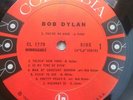
Bob Dylan. Bob Dylan 6 Eye label. CS8579 owned by Robert Shelton. Demonstration.
£
104
$
138


Favourite Auctions
To save auctions to your favourites, please login
If you don't have an account, please register
Description
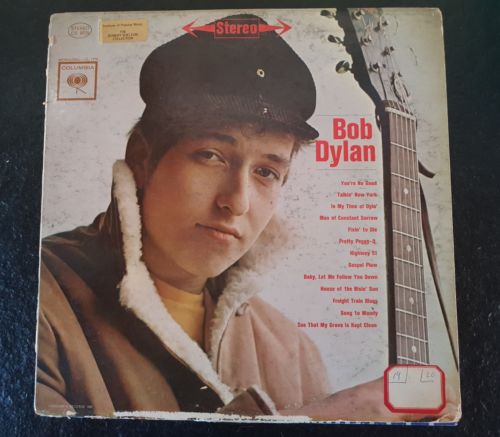
Own a piece of history with Robert Shelton's own personal copy of Bob Dylan's 1st album. As you will know Robert Shelton knew Bob Dylan and wrote the liner notes to this album and the book No Direction Home. (Background on Robert Shelton & this release from the internet are given below). Perhaps Bob gave Shelton this copy! Whilst this is a rare release with great authenticity it was not kept in the best condition. Please see photos. Robert Shelton was a heavy smoker so the cover is discoloured from nicotine in places. The sleeve has some damage and is split out in places. There is also an old sticker on the cover of unknown origin. On the plus side the sleeve and side 2 label have the Demonstration Not For Sale Sticker. I would grade the vinyl as a conservative good to VG. Again on the plus side this is the much rarer stereo pressing. Please note the Institute of Popular Music Robert Shelton Stickers. I have owned this since 1999. I can also provide a photocopy of the original receipt of purchase from that time. The sale was made to help fund a Bob Dylan conference at that time.
Please review ALL the photos.
Please see my other rare acetate listings.
I will post worldwide with tracking and insurance to be determined at the end of the auction. No returns. Please message me with any questions.
Background information from Searching for a Gem.
Bob Dylan" - stereo vinyl LP releases, Columbia CS 8579 (USA), 19 Mar 1962:
The first release of this album came with the red/black "6-eye" CBS "STEREO FIDELITY" labels and is very rare, as stereo was in its infancy and few copies were manufactured. (Most copies of the first release of Bob Dylan were in mono, Columbia CL 1779, see Mono Album Releases.) There were no white label promo releases of this album, the only promos are as shown with a red demo stamp on the rear sleeve and stickers on the labels.
The front sleeve has a red stereo/arrows logo and the picture shows the top of Bob's hat and three tuning pegs on the guitar (the mono sleeve has a lower crop and shows only one peg but much more of Bob's hand). There are two variants of the rear sleeve, the first omits the producer credit for John Hammond below "BOB DYLAN" and the second includes it. I initially thought this was an error that was quickly corrected, but copies exist of the second release record in this sleeve. You're No Good by Jesse Fuller was correctly titled on both the rear sleeve and the record labels.
Background on Robert Shelton.
Robert Shelton, born Robert Shapiro (June 28, 1926, Chicago, Illinois, United States – December 11, 1995, Brighton, England) was a music and film critic.
Shelton helped to launch the career of a then-unknown 20-year-old Bob Dylan. In 1961, Dylan was performing at Gerdes Folk City in the West Village, one of the best-known folk venues in New York, opening for a bluegrass act called the Greenbriar Boys. Shelton's positive review, in The New York Times, brought crucial publicity to Dylan, and led to a Columbia recording contract.[1] Shelton had previously noted Dylan in a review for the New York Times of WRVR's live twelve-hour Hootenanny, July 29th, 1961. “Among the newer promising talents deserving mention are a 20-year-old latter-day Guthrie disciple named Bob Dylan, with a curiously arresting mumbling, country-steeped manner." This was Dylan's first live radio performance.[2]
BiographyEdit
Shelton was born in Chicago in 1926 under the name Robert Shapiro, the son of Joseph and Hannah Shapiro, Russian Jewish immigrants. His father, a research chemist, was born in Minsk and came to the US in 1905. Robert was raised in Chicago, served in the US Army in France during 1944-45, and attended the School of Journalism at Northwestern University. He moved to New York in the 1950s, and soon joined the staff of The New York Times. In 1955 he was one of 30 The New York Times staffers subpoenaed by the Senate Internal Security Subcommittee, who were informed by Times counsel Louis M. Loeb that they would be fired if they took the Fifth Amendment. Shelton refused to answer questions from the committee about any affiliation with the Communist Party or about fellow Times staffer Matilda Landsman, and was indicted by a grand jury for contempt. Because he did not plead the Fifth he was allowed to continue working at the Times but was transferred away from the news department onto the less sensitive entertainment desk, where he became a music critic. Convicted and sentenced to six months in prison, he appealed his conviction and had it reversed on a technicality, only to be indicted, retried, convicted, and have the conviction overturned on a technicality again. After several years of appeals in which he was represented by noted civil liberties lawyer Joseph L. Rauh, Jr. the case was finally dropped in the mid-1960s.
For a decade (1958–1968), Shelton reviewed music, in particular folk music, but also pop and country music, becoming a friend of many of the artists and extending his influence beyond the pages of the Times. He reviewed the inaugural Newport Folk Festival (NFF) for The New York Times and The Nation[3]:116 and edited the program for the influential 1963 NFF under the pen name 'Stacey Williams'.[3]:135He wrote album notes for several artists, including Bob Dylan's first album (credited to 'Stacey Williams').[3]:78 During the early 1960s, Shelton co-edited a magazine, Hootenanny,[3]:102 at the same time as his friend Linda Solomon edited a different magazine titled ABC-TV Hootenanny.
Shelton spent 20 years writing and rewriting his Dylan biography, No Direction Home, The Life and Music of Bob Dylan which was finally published in 1986, after years of arguments with publishers about the style and length of the work. Shelton's intention from the outset was to write a serious cultural study, not a showbiz biography; as a result, he later said his life's work had been "abridged over troubled waters". The title is taken from the lyric of Dylan's hit single, "Like a Rolling Stone". The same title, No Direction Home, was used by Martin Scorsese for his 2005 documentary film about Dylan's career from the beginning to his motorcycle crash in 1966. Other books by Shelton include Electric Muse: The Story Of Folk Into Rock and The Face of Folk Music.
In the late sixties Shelton had moved to the United Kingdom where he lived in South London and then (from 1982) in the South Coast town of Brightonwhere he edited the Arts page of the Brighton Evening Argus[4] and then wrote, mostly about films, for a number of other publications up to his death. In 1996, Shelton's papers, and his collection of books, records and research material were donated to the Institute of Popular Music at the University of Liverpool.[5]
price rating