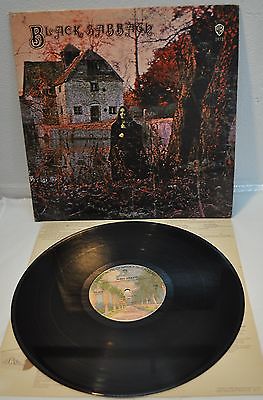
Black Sabbath Debut Album WB1871 Palm Label 1A/1B Stamper NM-/VG+ LP
$
25


Favourite Auctions
To save auctions to your favourites, please login
If you don't have an account, please register
Description
marquee_dsounde Store
end_display_feedback_code_window
Marquee D'Sounde
Rare and Collectible Records and Books
Providing the finest available since 1974 !
***********************
Black Sabbath
Self Titled Debut Album
************************
Record Information
***********************
Check the pictures and feedback for one of the nicest copies available on the internet! Original Deep Groove Vinyl Rich Sonic Analog Recording Not A Re-Issue with No UPC Code Stored In Heavy Plastic Outer Sleeve Since Purchase ************************Official Release Information
Label: WB 1871
Released: 1970
Format: 12" vinyl LP (album), 33 1/3 RPM
Disc Condition
Near Mint Minus
Visual Inspection
Plays clean with no snap crackle or pop but show some fine hairline surface scratches
Cover Condition
Very Good Plus
Visual Inspection
Some cover wear
Dead Wax Information
(A) WS 1871-A 39728 1-B
(B) WS 1871-B 39729 1-A
Why Pressing/Dead wax information is important?
Like a knife, the more times the master cuts into vinyl the duller it gets. Each subsequent pressing gets duller, rolling out the crisp cut of the original pressing. This results in less sonic resonance. The first pressings are the truest duplication of what the master engineer intended.
The mastering also matter. The Mastering engineer critically listens to the tape recording, making critical adjustment to them as he goes. This can create very different listening experiences from disc to disc. This is why you see Re-Mastered so often, to improve (or sometime the opposite) the original sound.
*************************
Artist Information
*************************
Black Sabbath is the eponymous debut studio album by English rock band Black Sabbath. Released on 13 February 1970 in the United Kingdom and on 1 June 1970 in the United States, the album reached number eight on the UK Albums Chart and number 23 on the Billboard charts.
Although it was poorly received by most contemporary music critics, Black Sabbath has since been credited with significantly influencing the development of heavy metal music.
According to Black Sabbath guitarist and founder member Tony Iommi, the group's debut album was recorded in a single day on 16 October 1969.The session lasted twelve hours. Iommi said: "We just went in the studio and did it in a day, we played our live set and that was it. We actually thought a whole day was quite a long time, then off we went the next day to play for £20 in Switzerland." Aside from the bells, thunder and rain sound effects added to the beginning of the opening track, and the double-tracked guitar solos on "N.I.B.," there were virtually no overdubs added to the album. Iommi recalls recording live: "We thought, 'We have two days to do it and one of the days is mixing.' So we played live. Ozzy (Osbourne) was singing at the same time, we just put him in a separate booth and off we went. We never had a second run of most of the stuff."
Key to the band's new sound on the album is Iommi's distinctive playing style that he developed after a welding accident at the age of 17 in which the tips of the middle fingers of his fretting hand were severed. Iommi created a pair of false fingertips using plastic from a dish detergent bottle and detuned the strings on his guitar to make it easier for him to bend the strings, creating a massive, heavy sound. "I'd play a load of chords and I'd have to play fifths because I couldn't play fourths because of my fingers," Iommi explained to Phil Alexander in Mojo in 2013. "That helped me develop my style of playing, bending the strings and hitting the open string at the same time just to make the sound wilder." In the same article bassist Geezer Butler added, "Back then the bass player was supposed to do all these melodic runs, but I didn't know how to do that because I'd been a guitarist, so all I did was follow Tony's riff. That made the sound heavier."
Iommi began recording the album with a white Fender Stratocaster, his guitar of choice at the time, but a malfunctioning pickup forced him to finish recording with a Gibson SG, a guitar he had recently purchased as a backup but had "never really played". The SG was a right-handed model which the left-handed Iommi played upside down. Soon after recording the album, he met a right-handed guitarist who was playing a left-handed SG upside down, and the two agreed to swap guitars; this is the SG that Iommi modified and later "put out to pasture" at the Hard Rock Cafe.
Sabbath vocalist Ozzy Osbourne has always spoken fondly of the recording of the band's debut album, stating in his autobiography I Am Ozzy, "Once we'd finished, we spent a couple hours double-tracking some of the guitar and vocals, and that was that. Done. We were in the pub in time for last orders. It can't have taken any longer than twelve hours in total. That's how albums should be made, in my opinion." Drummer Bill Ward agrees, telling Guitar World in 2001, "I think the first album is just absolutely incredible. It's naïve, and there's an absolute sense of unity - it's not contrived in any way, shape or form. We weren't old enough to be clever. I love it all, including the mistakes!" In an interview for the Classic Albums series in 2010 Butler added, "It was literally live in the studio. I mean, (producer) Rodger Bain, I think he's a genius the way he captured the band in such a short time." In his autobiography Iron Man: My Journey Through Heaven & Hell with Black Sabbath, Iommi plays down the producer's role, insisting, "We didn't choose to work with Roger Bain, he was chosen for us...He was good to have around, but we didn't really get a lot of advice from him. He maybe suggested a couple of things, but the songs were already fairly structured and sorted."
According to AllMusic's Steve Huey, Black Sabbath marks "the birth of heavy metal as we now know it". In his opinion, the album "transcends its clear roots in blues-rock and psychedelica to become something more". He ascribes its "sonic ugliness" as a reflection of "the bleak industrial nightmare" of the group's hometown, Birmingham, England. Huey notes the first side's allusions to themes characteristic of heavy metal, including evil, paganism, and the occult, "as filtered through horror films and the writings of J.R.R. Tolkien, H.P. Lovecraft, and Dennis Wheatley." He characterizes side two as "given over to loose blues-rock jamming learned through" the English rock band Cream.
In the opinion of the author and former Metal Maniacs magazine editor Jeff Wagner, Black Sabbath is the "generally accepted starting point" when heavy metal "became distinct from rock and roll". In his opinion, the album transfigured blues rock into "something uglier, found deeper gravity via mournful singing and a sinister rhythmic pulse". According to Rolling Stone magazine, "the album that arguably invented heavy metal was built on thunderous blues-rock".[9] Sputnikmusic's Mike Stagno notes that Black Sabbath's combined elements of rock, jazz and blues, with heavy distortion created one of the most influential albums in the history of heavy metal.[10] In retrospect, Black Sabbath has been lauded as perhaps the first true heavy metal album. It has also been credited as the first record in the stoner rock and goth genres.
Taking a broader perspective, Pete Prown of Vintage Guitar Magazine says, "The debut Black Sabbath album of 1970 was a watershed moment in heavy rock, but it was part of a larger trend of artists, producers, and engineers already moving towards the sound we now call hard rock and heavy metal. The previous year had already seen authentic, metal-edged music from Led Zeppelin ("Whole Lotta Love," "Heartbreaker") and the Jeff Beck Group ("Plynth"), as well as the new trio Mountain, which played a breakthrough performance at the Woodstock festival in August, 1969. Sabbath's debut LP in the UK (Feb. 1970) was matched a few weeks later by Mountain's Climbing album and its proto-metal hit, 'Mississippi Queen.' So while Black Sabbath was a crucial band in heavy metal's arrival, it's important to remember they were not alone. The year 1970 further saw pivotal early metal releases from Deep Purple and Uriah Heep, as well as Sabbath's own Paranoid album that fall. Even the track 'Immigrant Song' from Led Zeppelin III can be reasonably categorized as metal."
Black Sabbath?'?s music and lyrics were quite dark for the time. The opening track is based almost entirely on a tritone interval played at slow tempo on the electric guitar.[15] In the 2010 Classic Albums documentary on the making of the band's second album Paranoid, Geezer Butler claims the riff was inspired by "Mars, the Bringer of War," a movement in Gustav Holst's The Planets. Iommi reinterpreted the riff slightly and redefined the band's direction. Ward told Classic Albums, "When Oz sang 'What is this that stands before me?' it became completely different...this was a different lyric now, this was a different feel. I was playing drums to the words." The song's lyrics concern a "figure in black" which bassist Geezer Butler claims to have seen after waking up from a nightmare. In the liner notes to the band's 1998 live album Reunion the bassist remembers:
I'd been raised a Catholic so I totally believed in the Devil. There was a weekly magazine called Man, Myth and Magic that I started reading which was all about Satan and stuff. That and books by Aleister Crowley and Denis Wheatley, especially The Devil Rides Out...I'd moved into this flat I'd painted black with inverted crosses everywhere. Ozzy gave me this 16th Century book about magic that he'd stolen from somewhere. I put it in the airing cupboard because I wasn't sure about it. Later that night I woke up and saw this black shadow at the end of the bed. It was a horrible presence that frightened the life out of me! I ran to the airing cupboard to throw the book out, but the book had disappeared. After that I gave up all that stuff. It scared me shitless.
Similarly, the lyrics of the song "N.I.B." are written from the point of view of Lucifer, who falls in love with a human woman and "becomes a better person" according to lyricist Butler. Contrary to popular belief, the name of that song is not an abbreviation for "Nativity in Black"; according to Osbourne's autobiography it is merely a reference to drummer Bill Ward's pointed goatee at the time, which was shaped as a pen-nib. The lyrics of two other songs on the album were written about stories with mythological themes. "Behind the Wall of Sleep" is a reference to the H. P. Lovecraft short story Beyond the Wall of Sleep, while "The Wizard" was inspired by the character of Gandalf from The Hobbit and The Lord of the Rings. The latter includes harmonica performed by Osbourne. The band also recorded a cover of "Evil Woman", a song that had been an American hit for the band Crow. In his autobiography, Iommi admits the band reluctantly agreed to do the song at the behest of their manager Jim Simpson, who insisted they record something commercial.
The Black Sabbath album cover features a depiction of Mapledurham Watermill, situated on the River Thames in Oxfordshire, England. Standing in front of the watermill is a figure dressed in black. The name of the woman pictured on the front cover is forgotten, though guitarist Iommi says that she once showed up backstage at a Black Sabbath show and introduced herself.
The inner gatefold sleeve of the original release was designed by Keith McMillan (credited as Marcus Keef) and featured an inverted cross with a poem written inside of it. Allegedly, the band were upset when they discovered this, as it fuelled allegations that they were Satanists or Occultists; however, in Osbourne's memoir, he says that to the best of his knowledge nobody was upset with the inclusion. "Suddenly we had all these crazy people turning up at shows," Iommi remembered in Mojo in 2013. "I think Alex Sanders (high priest of the Wiccan religion) turned up at a gig once. It was all quite strange, really." The album was not packaged with a gatefold cover in the US. In the liner notes to Reunion, Phil Alexander states, "Unbeknownst to the band, Black Sabbath was launched in the US with a party with the head of the Church of Satan, Anton Lavey, presiding over the proceedings...All of a sudden Sabbath were Satan's Right Hand Men."
Black Sabbath was recorded for Fontana Records, but prior to release the record company elected to switch the band to another of their labels, Vertigo Records, which housed the company's more progressive acts. Released on Friday the 13th February 1970 by Vertigo Records, Black Sabbath reached number eight on the UK Album Chart. Following its United States release in June 1970 by Warner Bros. Records, the album reached number 23 on the Billboard 200, where it remained for more than a year and sold one million copies.
Black Sabbath received primarily negative reviews from contemporary music critics. Rolling Stone?'?s Lester Bangs described the band as, "just like Cream! But worse," and he dismissed the album as "a shuck – despite the murky song titles and some inane lyrics that sound like Vanilla Fudge paying doggerel tribute to Aleister Crowley, the album has nothing to do with spiritualism, the occult, or anything much except stiff recitations of Cream clichés." Robert Christgau, writing for The Village Voice, panned the album as "bullshit necromancy." He later described it as a reflection of "the worst of the counterculture," including "drug-impaired reaction time" and "long solos."
Negative early reviews are starkly contrasted by later critics, who recognized it as a significant milestone in the development of heavy metal music. In his retrospective review for AllMusic, Huey said that Black Sabbath was a highly innovative debut album with several classic metal songs, including the title track, which he felt had the "most definitive heavy metal riffs of all time." Huey was also impressed by how the band's "slowed-down, murky guitar rock bludgeons the listener in an almost hallucinatory fashion, reveling in its own dazed, druggy state of consciousness." In The Rolling Stone Album Guide (2004), the journalist Scott Seward highlighted Bain's grandiose production on "an album that eats hippies for breakfast." In the opinion of Mike Stagno of Sputnikmusic, "both fans of blues influenced hard rock and heavy metal of all sorts should find something they like on the album." BBC Music's Pete Marsh referred to Black Sabbath as an "album that changed the face of rock music." In Mick Wall's book Black Sabbath: Symptom of the Universe, Butler reflects, "The London press absolutely hated us when we made it 'cos they'd never written an article about us, they didn't know of us. When our first album, the first week, went straight into the charts, the London press went, like, what the hell's going on here? And they've hated us ever since."
In 1989, Kerrang! ranked Black Sabbath number 31 on their "100 Greatest Heavy Metal Albums of All Time". In 1994, it was ranked number 12 in Colin Larkin's Top 50 Heavy Metal Albums. Larkin praised the album's "crushing atmosphere of doom," which he described as "intense and relentless." In 2000, Q magazine included Black Sabbath in their list of the "Best Metal Albums of All Time", stating: "[This album] was to prove so influential it remains a template for metal bands three decades on." In 2005, it was ranked number 238 on Rolling Stone magazine's list of The 500 Greatest Albums of All Time;[4] it was ranked number 243 in a revised edition of the list in 2012.[39] Rolling Stone ranked Black Sabbath number 44 in their list of the 100 Best Debut Albums of All Time, describing the title track as the song that "would define the sound of a thousand bands."
Original North American Warner Bros. Records pressings of Black Sabbath quote incorrect running times for "Wicked World" and the "Warning" medley (4:30 and 14:32, respectively). These pressings also credit the album's original songs using the band members' given names: Anthony Iommi, John Osbourne, Terence Butler, and William Ward.
*********************
International Buyers Welcome
Please Note:
Import duties, taxes, and charges are not included in the item price or shipping cost. These charges are the buyer's responsibility.
Please check with your country's customs office to determine what these additional costs will be prior to bidding or buying.
***********************
All records are shipped in Heavy duty record shipping boxes with inner cardboad support, record removed from cover to prevent splitting seams during shipping.
No charge for shipping on all records after the first purchase. 1-50 all ship for the one shipping charge!
And as always, if you are not satisfied with our description of the condition of your purchase - we offer a full refund and pay shipping to return the item !
*********************
A little about me and the items I sell
*********************
I started collecting records and music memorabilia in about 1968. While traipsing around Southeast Asia for Uncle Sam, music was that lifeline to home and the world we came from. When I returned home to New Jersey, I became involved in the music industry and music became a passion. Needless to say I am not a kid anymore and I want to find good homes for these treasures and not see them end up at the Yard Sale of my life! What you see at my store is a collection of these treasures. Over the past 30 years I have sold off many very rare and hard to find items and have many, many more to offer. My passion for the rarest of rare and the finest quality available is still reflected in what you are offered here! Enjoy!!
Marquee D'Sounde ?
The Marquee D'Sounde was a music promotion company that I formed in the 70's. An obvious play on words, with the Marquis' De Sade and Marquee of Sound. It promoted a variety of music related venues, hence the Marquee for displaying our offerings. At record trade shows in the late 70's and early 80's as well as in Goldmine magazine the name Marquee D'Sounde became synonymous with the best quality available in collectibles! As you can see from the Feedback, I provide Quality Items and fast reliable service with secure packaging. Many buyers are repeat buyers!
*********************
A Brief Discussion On Condition
*********************
Historically sealed albums have been selling for huge prices simply because they are sealed. Sealed albums are in many cases a later pressing bought in some bargain bin or reissues that have since gone out of print. Prime examples are the ones with the “Nice Price” stickers. You can be assured these are later pressings off of old masters. Not always but quite frequently. Rarely did the first pressing of any record make it to the bargain bin unless the record was a flop. That’s not to say that a flop back then isn’t a treasure today. We find that frequently and in those cases a sealed album is a treasure.
Back in the day every record distributor had a sealing machine and would reseal albums. These would end up in the bargain bins. That is why you see the stretching on the corners of many of them offered on eBay. Original sealed albums will usually be squared on the cover and not have signs of stretching around the corners. Unless you plan on leaving the album sealed and reselling it, you are better off with a true Near Mint to Mint pressing from a reputable record dealer. You know what you get.
All of these claims regarding complicated record cleaning systems mean you are getting records that have not had the care they should have had. If the record was cared for properly it won't need these complicated cleanings! A quick spin on the VPI will remove any soiling not caused by abuse.
A properly cared for album (NM or M) should look as close as possible to the record that came out when it was first opened.
Most records come from my personal collection accumulated during my years in the music industry. When purchased new or received as a promotional copy, the album or single was placed in a plastic outer sleeve and sometimes a plastic inner sleeve. When possible the records will include these plastic sleeves.
Many were never played!
I rate rather conservatively but work closely with Goldmine standards. My Near Mint ratings are generally what everybody else rates as Mint or Brand New.
I try very hard to give accurate descriptions of the records and check them prior to shipment to ensure that the condition advertised is indeed what I ship. If there is something that I missed I will notify you prior to shipment. In turn, if you receive your record and the condition is not what you expected, let me know and we will arrange to return the record with a full refund.
Shipment Information
All records are carefully packaged and shipped in heavy duty commercial grade #200 corrugated Record shipping boxes!
PayPal—eBay's service to make fast, easy, and secure payments for your eBay purchases!Buyer Instructions
Payments:
All payments are expected within 10 days. All payments must be received in US funds. Preferred payment method is Paypal.
Feedback:
I will leave feedback for you once I have received confirmation that you have received your item and that the item met your expectations. Our transaction is not over until you are satisfied. Once you leave feedback, I will leave positive feedback for you.
Contact me if there are any problems or questions.
Thank you for stopping by!!
Be sure to add me to your favorites because I have thousands more rare and wonderful albums, singles and memorabilia coming!
Looking for that special album, CD or single? Email me and I'll let you know if it is available!!
price rating