Baseball Crowd SPEEDY Q SOUND EFFECTS TV Radio SHOW Rooster Crows GENNETT 7915
$
50


Favourite Auctions
To save auctions to your favourites, please login
If you don't have an account, please register
Description
Click this link for more great SOUND EFFECT RECORDS in my other listings!
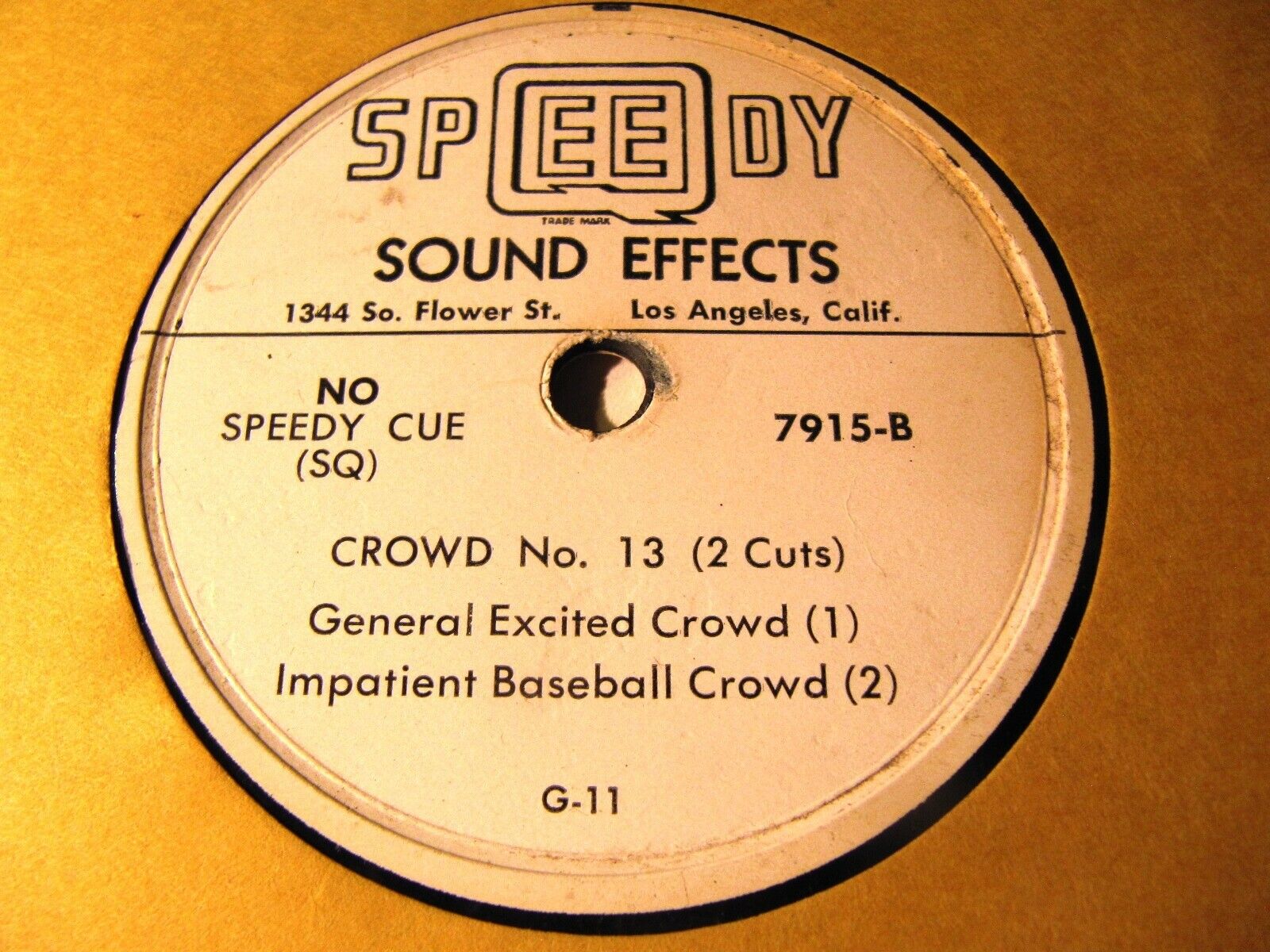
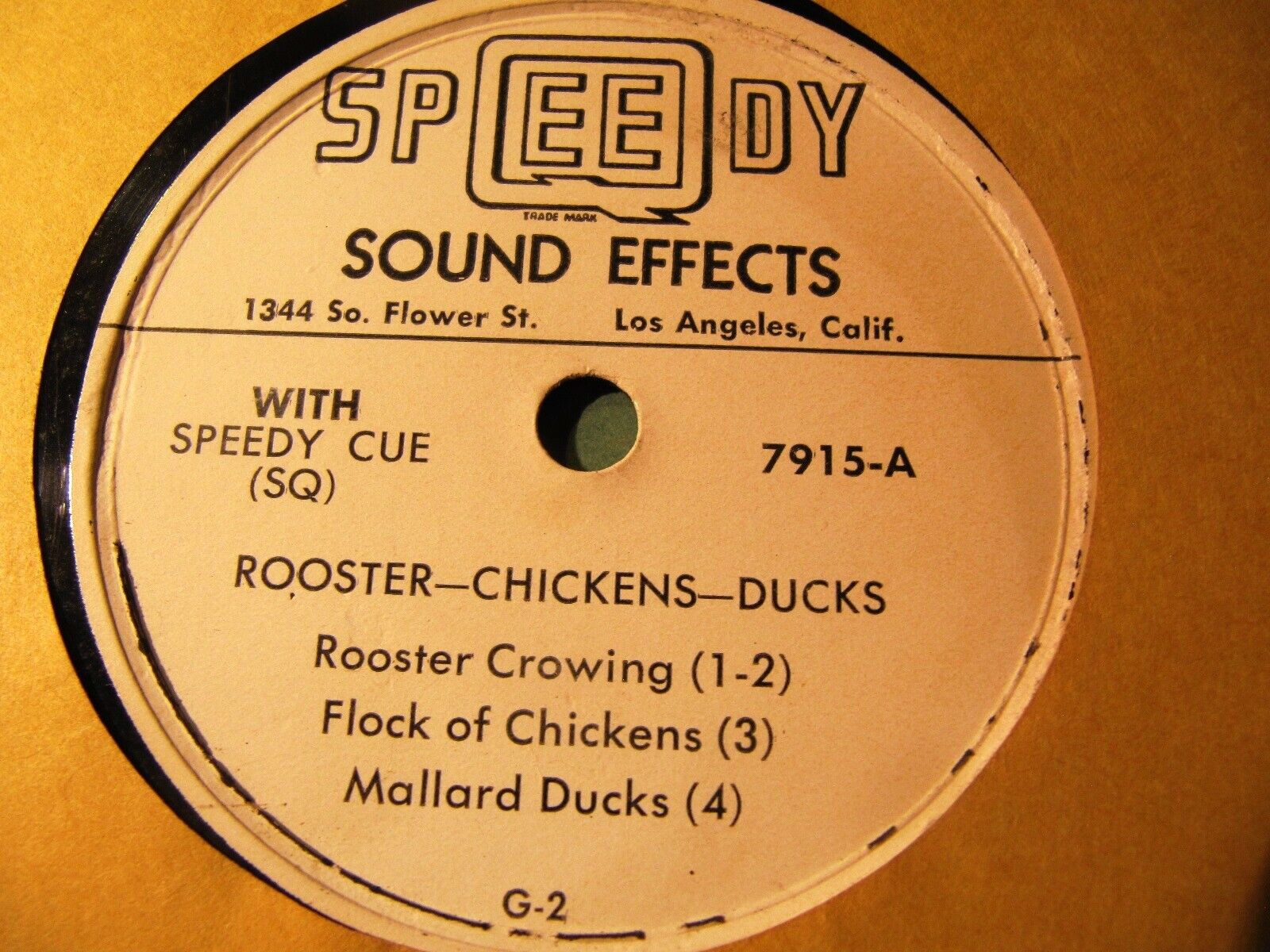
Speedy Q Sound Effects 78 rpm record, part of the GENNETT Sound Effects Library, which was renamed as Speedy Q in the 1940s
Speedy Cue refers to a proprietary method of cueing the bands on the sound effect record.
These are actual period recordings of the subjects which were used as sound effects for old time radio and TV shows.
Speedy Q Sound Effects Record 7915
NO Speedy Cue (SQ)
These seem to be on-location actual recordings
CROWD NO 13 2 Cuts
General Excited Crowd
Impatient Baseball Crowd
WITH Speedy Cue (SQ)
Rooster - Chicken - Ducks
Rooster crowing
Flock of Chicken
Mallard Ducks
Please see top of the page for condition
The Gennett Sound Effects series is what kept the company alive during the 30s into the 40s, both under their name and as Speedy-Q. Thomas J. Valentino was in charge of this for much of its history, and Valentino himself went into business in the 1940s as Major Sound Effects Records.
Gennett kept upgrading it's library (thus the different series) to match the times.
The sounds of autos and airplanes, among other recorded effects, changed over time. It wouldn't do to have a WW1 Fokker effect behind a small WW2 fighter, after all.
Gennett sound effects was Frank Buck’s “Bring ‘Em Back Alive,” which used animal noises that Harry Jr. recorded at the Cincinnati Zoo. Gennett recalled that he was allowed to stay overnight on the zoo grounds but was ordered to remain in his car to avoid being shot by the zoo’s guards. He was also warned that his cables could spook the giraffes, who might mistake them for snakes.
Some recordings, like the boxing-match, railroad, and airplane-noise sides, were straightforward live captures, unstaged and untinkered-with. But in many other cases, Harry Jr.’s creativity and technical expertise came into play. The “Alley Cat” record employed a human imitator, but “Braying Mule” used the real thing, with a bit of coaxing.
Harry Gennett, Jr., and the Gennett Sound Effects Records
(1928 – 1956) By Allan Sutton
In November 1956, Harry Gennett Jr. (the son of Gennett Records president Harry Sr.) recalled his involvement with the Gennett Sound Effects records for a reporter from the Richmond, Indiana Palladium-Item. Much of the following information came from his recollections, supplemented by data from the Gennett ledger sheets.
______________
Gennett Record’s sound-effects program was launched in 1928 as a client service for the Hannaphone Company, a Philadelphia-based theater-management company. On November 21, it was announced that Hannaphone had contracted with Gennett to produce sound-effects records for use with motion pictures.
Harry Gennett apparently already had such a venture in mind at the time of the Hannaphone announcement. Sound-effects recording began to appear regularly in the Gennett ledgers beginning on October 16, 1928, [2] several of which were played for a gathering of the Richmond Foreman’s Club at which Gennett announced the deal. [3]
Demand for sound-effects recordings quickly mushroomed as producers of sound films began dubbing pre-recorded sound effects into their soundtracks. Gennett’s offerings included “Hog Calling Contest,” “Poultry—Roosters and Geese Predominant,” “American Can Factory,” “Electric Washing Machine—Not Much Suds,” “Single Man Walking Through Sand and Gravel,” “News Room—Confusion of Sounds,” “Winds Howling–Continuous,” “Auto Crashes with Screams,” “Auto Race with Crashes,” and the ominous “Railroad Comes Through the Middle of the House.” [4]
.
Gennett’s original mobile recording laboratory. The truck was outfitted with assistance from William C. Kaeuper, woodworking supervisor of the Richmond, Indiana, plant.
.
The sound-effects operation was quickly handed off to Harry Gennett’s son, Harry Jr., along with Richmond plant manager Robert Conner. The corner of Eighth and Main in Richmond was a favored spot for early recording sessions, providing numerous recordings of street and railroad sounds, factory whistles, and the occasional car wreck.
But Gennett and Conner also traveled widely in their pursuit of sound. In 1929, they and William C. Kaeuper (the plant’s woodworking supervisor) equipped a large panel truck with what Harry Jr. recalled as “a ton” of recording equipment [5] and began taking to the road — at first, just scouting around the Richmond area, but later (after recording equipment became sufficiently compact to transport in a car) traveling across the country. They recorded the mission bells in Santa Barbara, California, [6] Hopi Indian dances in New Mexico (with the recording equipment hidden in nearby vegetation), [7] and braying mules in the Rocky Mountains of Colorado.
In later years, as recording equipment became more portable, Gennett and Conner employed a car as their mobile unit and traveled widely. Here, it’s parked in front of the Santa Barbara Mission in California.
.
Among the films employing Gennett sound effects was Frank Buck’s “Bring ‘Em Back Alive,” which used animal noises that Harry Jr. recorded at the Cincinnati Zoo. Gennett recalled that he was allowed to stay overnight on the zoo grounds but was ordered to remain in his car to avoid being shot by the zoo’s guards. He was also warned that his cables could spook the giraffes, who might mistake them for snakes.
Some recordings, like the boxing-match, railroad, and airplane-noise sides, were straightforward live captures, unstaged and untinkered-with. But in many other cases, Harry Jr.’s creativity and technical expertise came into play. The “Alley Cat” record employed a human imitator, but “Braying Mule” used the real thing, with a bit of coaxing. Gennett recalled having a boy lead one mule away from the herd, causing “a loud voice of disapproval” from the others. Studio personnel were recruited to re-create a medieval battle and other chaotic scenes, and Gennett sometimes tested new noise-makers in the main factory, much to the displeasure of some employees.
Thunder effects were obtained by recording shotgun blasts, then dubbing the results at a slower speed, which Gennett claimed gave better results than the real thing. To create the gear-shifting effect in “Automobile Continuously Running” (reportedly a top seller), Gennett simply altered the recording speed while the car remained stationery. Gennett also became a master of overdubbing. One of his most popular efforts combined a long tire screech and collision noises (the latter recorded live on a Richmond street) with the existing “Automobile Continuously Running” recording to create a sensational car-crash record. [8]
.
The original 1928 sound-effects label (upper left); a sound-effects recording on the Gennett Electrical Transcription label, marketed for radio use (upper right); an Electrical Transcription test pressing (lower left); and the later-1930s version of the sound-effects label (lower right)
.
Some attempts at staging backfired, but probably none so badly as when Gennett and Conner accidentally set the recording-studio building on fire in an attempt to capture crackling flames on disc. [9] There were human perils to be dealt with as well, including a suspicious local patrolman who fired a shot their way while they were parked on a country road one dark night.
When Gennett could not obtain a desired effect, he dubbed recordings from other sources, perhaps not always legally. He paid K. I. Sakai of Tokyo for his recording of “Japanese Traffic Noise,” but there is no indication in the ledger that he paid for or sought permission from Victor to use two of their recordings, which he dubbed and cobbled together as “Traffic Noises of England, with Big Ben.” [10]
The sound-effects records helped to keep the Gennett operation afloat after Harry Gennett, Sr., discontinued commercial record production in 1934. However, demand for the records declined after the 1930s, as special-effects recording techniques became more sophisticated. Still, the operation remained in business (later under the “Speedy-Q” name) into the mid-1950s. In his 1956 interview, Gennett reported that he still received the occasional order.
price rating