BRUCE SPRINGSTEEN - THE SEEGER SESSIONS - 180 Gram - MINT SEALED - Vinyl LP
£
20
$
27


Favourite Auctions
To save auctions to your favourites, please login
If you don't have an account, please register
Description
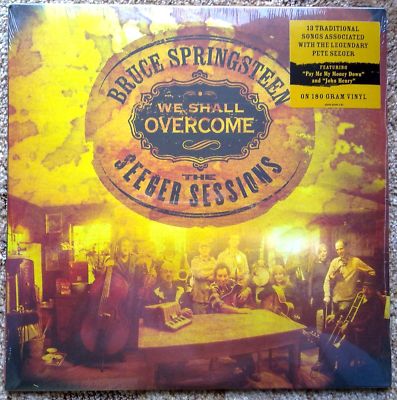
BRUCE SPRINGSTEEN
"WE SHALL OVERCOME
THE SEEGER SESSIONS"
MINT SEALED
180 Gram
Double LP
Vinyl LP
2006 original release vinyl LP on the SONY/COLUMBIA record label Cat n# 82876834391 Made in USA
The album cover is in MINT condition. NEW
The vinyl itself is in MINT condition UNPLAYED SEALED.
If you are not fully satisfied you may return this album with a full refund inc postage.If you need anymore information and pictures please get in touch, thanks.
Sorry if the shipping charges seem a bit high, the reason being i use heavy/strong packaging
THIS IS AS GOOD EXAMPLE OF WELL LOOKED AFTER OLD LP RECORD
Full track list
Side One
1."Old Dan Tucker" 2:31
2."Jesse James" (Billy Gashade) 3:47
3."Mrs. McGrath" 4:19
4."O Mary Don't You Weep" 6:05 .
Side Two
5."John Henry" 5:07
6."Erie Canal" (Thomas S. Allen) 4:03
7."Jacob's Ladder" 4:28 .
Side Three
8."My Oklahoma Home" (Bill and Agnes "Sis" Cunningham) 6:03
9."Eyes on the Prize" (Traditional; additional lyrics by Alice Wine) 5:16
10."Shenandoah" 4:52 .
Side Four
11."Pay Me My Money Down" 4:32
12."We Shall Overcome" (Rev. Charles Tindley (lyrics); Adaptation by Guy Carawan, Frank Hamilton, Zilphia Horton, Pete Seeger) 4:53
13."Froggie Went A-Courtin'" 4:33 .
All songs traditional or public domain with unknown songwriters, arranged by Bruce Springsteen, unless otherwise noted .
The Band
Bruce Springsteen – lead vocals, guitar, harmonica, B-3 organ, and percussion
Sam Bardfeld – violin
Art Baron – tuba
Frank Bruno – guitar
Jeremy Chatzky – upright bass
Mark Clifford – banjo
Larry Eagle – drums and percussion
Charles Giordano – B-3 organ, piano, and accordion
Ed Manion – saxophone
Mark Pender – trumpet, backing vocals
Richie "La Bamba" Rosenberg – trombone, backing vocals
Patti Scialfa – backing vocals
Soozie Tyrell – violin, backing vocals .
History
This is Springsteen's first and so far only album of non-Springsteen material and contains his interpretation of thirteen folk music songs made popular by activist folk musician Pete Seeger. Oddly, none of the selections were written by Pete Seeger.
The record began in 1997, when Springsteen recorded "We Shall Overcome" for the Where Have All the Flowers Gone: the Songs of Pete Seeger tribute album, released the following year. Springsteen had not known much about Seeger given his rock and roll upbringing and orientation, and proceeded to investigate and listen to his music.[8] While playing them in his house, his 10-year-old daughter said, "Hey, that sounds like fun," which caused Springsteen to get interested in further exploring the material and genre.[9]
Via Soozie Tyrell, the violinist in the E Street Band, Springsteen hooked up with a group of lesser-known musicians from New Jersey and New York, and they recorded in an informal, large band setting in Springsteen's New Jersey farm.[8] In addition to Tyrell, previous Springsteen associates The Miami Horns as well as wife Patti Scialfa augmented the proceedings. This group would become The Sessions Band.
The album was Springsteen's second consecutive non-E Street Band, non-rock music project. The critical reception to the album was very positive, with E! Online calling it his "best album since Nebraska [10] and Allmusic labeling it "rambunctious, freewheeling, [and] positively joyous".[11] PopMatters called it a "a sonic transfusion on the order of the Mermaid Avenue records",[12] which were Woody Guthrie songs recorded by Billy Bragg and Wilco. Seeger himself was pleased by result, saying "It was a great honor. He's an extraordinary person, as well as an extraordinary singer."[9]
The album, like its predecessor Devils and Dust, has been released on DualDisc, in a CD/DVD double disc set, and as a set of two vinyl records.
For the DualDisc and CD/DVD sets, the full album is on the CD(-side), while the DVD(-side) side features a PCM Stereo version of the album and a short film about the making and recording of the album. Two bonus songs also appear on the DVD(-side).
The subsequent Bruce Springsteen with The Seeger Sessions Band Tour took this musical approach even further.
On October 3, 2006, the album was reissued as We Shall Overcome: The Seeger Sessions - American Land Edition with five additional tracks (the two bonus tracks from before and three new numbers that had been introduced and heavily featured on the tour), new videos, an expanded documentary and liner notes. Rather than a DualDisc release, the American Land Edition was released with separate CD and DVDs. Added sales were minimal.
The album won the Grammy Award for Best Traditional Folk Album at the 49th Grammy Awards held in February 2007.
The album had sold 700,000 copies in the United States by January 2009;[13] the RIAA certified it with gold record status.
REVIEW
Bruce Springsteen: We Shall Overcome: The Seeger Sessions
By Jeff Vrabel 24 April 2006
The Stone Pony London is a cruel and thankless place to hang out these days.
And as the pre-eminent message board for all things Springsteen, it’s probably also the Web’s most accurate barometer for the buzz surrounding Bruce’s new folkie record, and a cursory scan reveals that talk ranges from cautiously optimistic to a level at which some of these people might now, as you read this, be marching to Springsteen’s Jersey farmhouse with pitchforks and lit torches to kill his ponies. “Maybe it would have been better if he had gone out and hired the best folk, fiddle, horn and string musicians to experiment with instead of hiring his fucking wife, her slutty friends and other Jerseyites who are about as folk as Michael Bloomberg to play on this heap,” goes one typically grammatically entertaining post.
Why such edge and darkness? Ostensibly, it’s because, one: We Shall Overcome is the second consecutive record where Springsteen has left the E Streeters at home; two: It’s his first all-covers album ever and; three: Apparently, largely, because he sings with a twang on it.
But what the pouting misses is that We Shall Overcome—twang or not—is a hoot and a holler, an old-timey, jubilant, front-porch throwdown and a carnival of the kind of Americana that the conservative right throught it detected in Born in the U.S.A. This is American music first, rock second, and folk maybe second or third or fourth. Tracks like “Old Dan Tucker”, “Oh Mary Don’t You Weep” and “Pay Me My Money Down” simply leap out of the speakers on the power of their ragged vocals, boogie-woogie pianos, banjos, fiddles, booming horn sections, a washboard (I think), Bruce shouting out live band directions and apparently several man-sized jugs of whiskey.
An idea hatched when Bruce contributed the song “We Shall Overcome” to a 1998 Pete Seeger tribute record, The Seeger Sessions was conceived as a new-millennium retelling of songs popularized by the folk icon, but it’s an album that’s about a thousand times more fun than that might suggest. (I’ll admit, the idea gave me initial pause, especially when a leak of “John Henry” revealed that its intro sounded exactly like the one to the theme of Cletus the Slack-Jawed Yokel). Springsteen insists in the liner notes that the idea was to capture not music being written but music being made. Hence, these tracks were laid down in just days, sans rehearsals, with 17 people who really didn’t know each other. The only E Streeters who got the call were the red-headed women: Soozie Tyrell, the violinist Bruce added for The Rising and the one who assembled the band, and Patti Scialfa, because otherwise, breakfasts at the Springsteen house would have probably been really awkward.
But this isn’t a hoary breathing of air into faded songs; this is a sonic transfusion on the order of the Mermaid Avenue records, its most obvious ancestors (though another is Mellencamp’s underrated Trouble No More), and Springsteen has an affinity for these songs you can almost taste. “Old Dan Tucker” is a soaring folk-rocker heavy on the second half of that description, “Jesse James” revs up quickly in telling the outlaw’s tale and “Froggie’ Went a Courtin’” is driven by percussion that seems to involve Bruce slapping his six-string. And the violin-powered “Oh Mary Don’t You Weep” demands to be listened to at full volume, with Bruce simultaneously channels Tom Waits and history of gospel (yes, even in digging through the folk songbook, Bruce dug up another Mary. The man’s an animal!)
Smarty-pants writers and cable TV hosts may shuffle through We Shall Overcome looking for political over-or-undertones, but they’ll likely be disappointed. By now, even the corpse of Ronald Reagan knows Bruce is no longer keeping his politics secret, and throwing Pete Seeger into the mix certainly won’t entertain the aging chunk of his fan base that’s drifted to the red. But you’ll find no anti-Bush stuff on this record, nor even any the cautious, somewhat muted commentary of last year’s relatively rigid Devils and Dust (which, it should be noted, sounds about half as alive as this record does). When Bruce and band rev up the zydeco/Dixieland/French Quarter machine for a boom-pah version of “Jacob’s Ladder”, the music—like all New Orleans stuff these days, massive and jubilant and impossible to hear without a wave of melancholy—does the talking so Bruce doesn’t have to. That said, it’s fundamentally impossible to listen to tracks like “Mrs. McGrath”, an ancient Irish fable about a woman whose son loses half his body to war, and “My Oklahoma Home”, in which a man returns home to find his wife and crops blown away, and not draw reflexive parallels to Iraq and Katrina. “All foreign wars, I do proclaim/ Live on blood and a mother’s pain,” Springsteen sings in his singular crag in “Mrs. McGrath”, but he rather gently leaves it at that.
But this is probably several thousands words’ worth of more thinking than the project was intended to conjure up. What we have here is a side project, a toss-off, a lark. Springsteen’s studio work is so meticulously calculated, honed, edited and re-honed again (here’s a guy who by my unscientific count has junked at least six full records, and left his two most famous unreleased songs off of his four-disc outtake box), that hearing such a breezy, drinky effort is both fun as hell and a breath of fresh air. In many ways, it’s about time. .
Thanks for taking the time to look at this auction
RECORD COLLECTOR GRADING SYSTEM
In order to assist everyone who buys and sells rare discs, Record Collector magazine has originated a set of standards for the condition
of second-hand records, cassettes and CDs. Anyone buying or selling records through the magazine must use our conditions to state what
amount of wear and tear the disc, its sleeve and/or contents have been subject to. The seven standard condition categories, and a description
of what each one means, are listed below:
MINT: The record itself is in brand new condition with no surface marks
or deterioration in sound quality. The cover and any extra items such
as the lyric sheet, booklet or poster are in perfect condition. Records
advertised as Sealed or Unplayed should be Mint.
EXCELLENT: The record shows some signs of having been played, but there
is very little lessening in sound quality. The cover and packaging
might have slight wear and/or creasing.
VERY GOOD: The record has obviously been played many times, but
displays no major deterioration in sound quality, despite noticeable
surface marks and the occasional light scratch. Normal wear and tear on
the cover or extra items, without any major defects, is acceptable.
GOOD: The record has been played so much that the sound quality has
noticeably deteriorated, perhaps with some distortion and mild
scratches. The cover and contents suffer from folding, scuffing of
edges, spine splits, discoloration, etc.
FAIR: The record is still just playable but has not been cared for
properly and displays considerable surface noise; it may even jump.
The cover and contents will be torn, stained and/or defaced.
POOR: The record will not play properly due to scratches, bad surface
noise, etc. The cover and contents will be badly damaged or partly
missing.
BAD: The record is unplayable or might even be broken, and is only of use as a collection-filler.
price rating