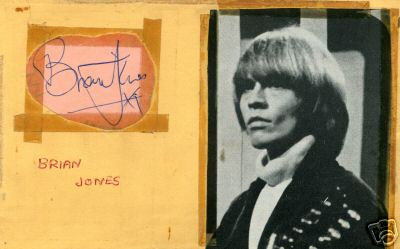
BRIAN JONES Rolling Stones Original autograph 100%
£
87
$
115


Favourite Auctions
To save auctions to your favourites, please login
If you don't have an account, please register
Description
FOUNDER OF THE WORLD FAMOUS ROLLING STONES WHO DIED YOUNG IN VERY MYSTERIOUS CIRCUMSTANCES THIS AUTOGRAPH IS 100% THE REAL DEAL THE HARDEST STONES AUTOGRAPH TO OBTAIN.
Jones was born in the Park Nursing Home in Cheltenham, Gloucestershire, during World War II. Jones suffered from asthma his entire life. His parents, Lewis Blount and Louisa Beatrice Jones, were of Welsh descent, and middle-class residents of the town. Brian had two sisters: Pamela, who was born on 3 October 1943 and died on 14 October 1945 of leukemia, and Barbara, who was born in 1946.[1]
Brian's parents were both very interested in music, and it seems their interest had a profound effect on young Brian. In addition to his job as an aeronautical engineer, Brian's father played both piano and organ, and led the choir at the local church. Jones's mother Louisa was a piano teacher and started teaching her son the instrument at a very young age. Eventually Brian required formal lessons as he progressed too quickly for her to continue teaching him. He soon learned how to read music, and eventually took up the clarinet, becoming first clarinet in his school orchestra at 14.[1]
In 1957 Jones was first exposed to the jazz musician Charlie Parker; this sparked a lifelong interest in jazz music and Jones persuaded his parents to buy him a saxophone. As with many instruments he attempted to learn, Jones initially played endlessly, only to find he became somewhat bored with the instrument after a while, and finally would search for another instrument to play. Two years later his parents gave him his first acoustic guitar as a present for his 17th birthday.[1]
Attending local schools including Dean Close School, from 1949 to 1953 and Cheltenham Grammar School for Boys, where he started in September 1953 after easily passing the Eleven-plus Jones was known as an exceptional student, getting very high marks in all of his classes while doing relatively little work. He enjoyed badminton and diving but otherwise was not very skilled at sports. However he found his schooling to be too regimented and formal, and refused to conform when he reached adolescence. He was known to eschew wearing the school uniforms, refusing to wear his mortarboard, and angering teachers with his behaviour. As a result, he remained very popular and well-liked with the students. This open hostility towards authority figures got him suspended from school on two separate occasions.[1]
Dick Hattrell, a childhood friend of Brian's, is quoted as saying about the guitarist:
“ He was a rebel without a cause, but when examinations came he was brilliant.[1] ”In 1957 Jones obtained nine O-levels in his exams.
All this, and his popularity with the other school pupils, came to an end in the spring of 1959, when at the age of 17 Jones impregnated his girlfriend, a 16-year-old Cheltenham schoolgirl named Valerie. She was four months younger than Jones, who encouraged her to have an abortion. After this she wanted no further contact with Brian and instead chose to have the baby boy adopted.[1] The child, named Simon, was given to an infertile couple upon his birth and Brian quit school in disgrace and left home, travelling throughout northern Europe, including Scandinavia, for the summer. During this time, Jones later claimed, he lived something of a bohemian lifestyle, busking and playing guitar on the streets for money, living off the kindness of others. Simon never met his biological father.
While Jones was fond of telling others about his trip throughout Europe, it remains uncertain as to how much of his story is real and how much is embellishment. Other friends and acquaintances spoke of Jones merely staying with relatives outside the UK, yet to hear it from the musician himself, he had no money, no home, no friends and no family after he left England.
Upon his return, Jones became much more interested in various types of music. He was taught classical music at a young age, and he always preferred blues (particularly Muddy Waters and Robert Johnson); however, he soon took an interest in country, jazz, and rock 'n roll. He began playing at local blues and jazz clubs in addition to busking and working various odd jobs, and used the money he earned to buy more instruments. He was also known to steal small amounts of money to pay for cigarettes, which got him fired from jobs on several occasions.
Despite the unwanted attention he received from impregnating his girlfriend at a young age, Jones showed no signs of changing his lifestyle. A second child, whom Jones named Julian Mark Andrews (his mother being Jones's then-girlfriend Pat Andrews), was born in October 1961. He sold his record collection the day his son was born to buy flowers for Pat and clothes for the newborn and lived with them for a while.
[edit] Forming the Rolling Stones
Jones eventually left Cheltenham completely and moved to London where he met and befriended fellow musicians Alexis Korner, future Manfred Mann singer Paul Jones, future Cream bassist Jack Bruce and others who made up the small London Rhythm n' Blues scene that the Rolling Stones soon dominated and spearheaded. He became a proficient blues musician, for a brief time christening himself "Elmo Lewis", and Bill Wyman claimed he was one of the first guitarists in the UK to play slide guitar.
In the spring of 1962, Jones recruited Ian "Stu" Stewart and singer Mick Jagger into his band — who, with Jagger's childhood friend Keith Richards, met Jones when he and Paul Jones were featured playing Elmore James' "Dust My Broom" with Korner's band at The Ealing Club. On his initiative, Jagger brought guitarist Richards with him to the rehearsals; Richards then joined the band. Jones's and Stewart's acceptance of Richards and the Chuck Berry songs he wanted to play coincided with the departure of blues purists Geoff Bradford and Brian Knight, who had no tolerance for Chuck Berry. As Keith Richards tells it, it was Jones who came up with the name "The Rollin' Stones" (later with the 'g') while on the phone with a venue owner.
“ The voice on the other end of the line obviously said, 'What are you called?' Panic. 'The Best Of Muddy Waters' album was lying on the floor — and Track One was 'Rollin' Stone Blues.'[2] ”The Stones had their first gig on 12 July 1962 in the Marquee Club in London with the following line-up: Jagger, Richards, Jones, Stewart, bass player Dick Taylor (later of The Pretty Things) and drummer Tony Chapman.
Throughout much of 1962 and 1963 Jones, Jagger and Richards shared an apartment (referred to by Richards as "a beautiful dump")[2] in Chelsea, London at 102 Edith Grove with James Phelge, a future photographer whose last name would later be used in some of the band's writing credits. While they lived there, Jones and Richards spent day after day playing guitar while listening to blues records (most notably Jimmy Reed, Muddy Waters & Howlin' Wolf), and Jones showed Jagger how to play the harmonica properly.
The four Rollin' Stones then went searching for a steady bassist and drummer, and after several auditions and try-outs they settled on Bill Wyman on bass (mainly because he had two large VOX AC30 guitar amps and cigarettes). After having played with Mick Avory later of the Kinks, Tony Chapman and Carlo Little for a few gigs, they chose jazz-influenced Charlie Watts, considered by fellow musicians to be one of the best drummers of the London music scene, from the Alexis Korner group Blues, Inc. to play drums.
Watts described Brian's role in these early days:
“ Brian was very instrumental in pushing the band at the beginning. Keith and I would look at him and say he was barmy. It was a crusade to him, a) to get us on the stage in a club and be paid a half-crown and b) to be billed as an R&B band.[2] ”The group played at local blues and jazz clubs around London, eventually forming a solid fan base despite strong resistance from traditional jazz musicians who felt threatened by the Stones's popularity. While Mick Jagger was the lead singer, Jones, in the group's embryonic period, was the leader - promoting the band, getting them shows around London, and negotiating with venue owners. Jones would often act more as an entertainer in these early days, playing several instruments including vocals, rhythm guitar, slide guitar, and harmonica.
During live performances around this time, and especially at the Crawdaddy Club in Richmond, Jones was frequently a more animated and engaging performer than even Mick Jagger. Jagger initially stood still while singing - mainly by necessity, as there was hardly any room for him to move at all.[2]
While acting as business manager, Jones arranged to have himself paid 5 pounds sterling more than the other members of the group, a practice which did not sit well with the rest of the band and created resentment against him.[citation needed]
Fame and Fortune
As the Stones' popularity grew, they came to the attention of Andrew Loog Oldham, who met the band in April 1963 at the suggestion of Record Mirror music writer Peter Jones (no relation) and soon became, with Eric Eastman, their co-manager. Oldham, who had worked briefly as the Beatles publicist, was an admirer of Anthony Burgess' novel A Clockwork Orange, as well as the film Expresso Bongo, cultivated an image for the band as unruly and slightly menacing, a kind of blues-inflected, rough-edged answer to the more amiable Beatles, using the novel's protagonist and his gang as his inspiration. It was Oldham who coined the phrase "Would you let your daughter marry a Rolling Stone?" Piano player Ian Stewart was pushed into the background by Oldham for two main reasons: Oldham felt that Stewart, a somewhat burly Scotsman, did not fit in with the image he wanted of the group; and Oldham felt that six group members were too many for audiences to remember clearly. Stewart remained the Stones' road manager and principal keyboard player until his death in 1985.
Oldham's arrival also marked the beginning of Jones' own slow estrangement from the band, one which saw his prominent role progressively diminished as Oldham sought to shift the Stones's centre of gravity away from Jones and towards Jagger and Richards.
Until this time all of the songs in the group's repertoire were either blues covers or instrumentals credited to "Nanker Phelge" — a credit that indicated the song was a Jagger/Jones/Richards/Watts/Wyman composition. Oldham, and everybody in the group, recognised the financial advantages of writing one's own songs, as exemplified by the Lennon/McCartney team, as well as the simple fact that playing covers won't keep a band in the limelight for years to come. Further, Oldham wanted to make Jagger's onstage charisma and flamboyance a central focus of the band's live performances. Jones saw his influence over the Stones's direction slide as their repertoire comprised fewer of the blues covers he would have preferred, and more Jagger-and-Richards-penned originals, and as Oldham began asserting increasing managerial control, displacing Jones from another key role.
On 23 July 1964 Jones fathered another child out of wedlock, this time to girlfriend Linda Lawrence. Jones named this child Julian Brian Lawrence. (Julian would adopt the surname Leitch after Lawrence married the folk singer Donovan on 2 October 1970.) Jones is said to have named both sons Julian in tribute to the jazz saxophonist Julian "Cannonball" Adderley.
Jones playing his custom mando-guitarThroughout his career, Jones showed a musical aptitude, having the ability to play a myriad of instruments, due to his training on the piano and clarinet in his youth. As soon as the Stones earned enough money to record in professional, well equipped recording studios like Olympic Studio and the RCA and Sunset Sound Recorders studios in Los Angeles, Jones started experimenting with different wind and stringed instruments at a rapid pace. Throughout his years with the band he played guitar, slide guitar, piano, sitar, tamboura, organ, dulcimer, mellotron, xylophone, marimba, recorder, clarinet and several other instruments. In total he is known to have played at least 15 instruments with the Stones. Brian's signature guitar is a teardrop-shaped prototype Vox Phantom Mark III, though he used many others throughout his career, being fond of Gibson models (various Firebirds, ES-330, and Les Paul models) as well, along with the Rickenbacker 12-String model made famous by George Harrison.
Brian contributed significantly to the 1960's sound of the Stones, playing slide guitar on "I Wanna Be Your Man," "Little Red Rooster," "Doncha Bother Me," "No Expectations," "I Can't Be Satisfied," and "I'm Moving On," the main guitar riff on "The Last Time," "Get Off of My Cloud," "19th Nervous Breakdown", and "Mona", sitar on "Paint It Black", tamboura on "Street Fighting Man", marimba on "Under My Thumb", "Out Of Time," and "Ride On, Baby," recorder on "Ruby Tuesday," brass on "Something Happened To Me Yesterday," dulcimer on "Lady Jane" and "I Am Waiting," accordion on "Backstreet Girl," mellotron on "2000 Light Years from Home," "She's A Rainbow," and "We Love You," saxophone and mellotron on "Citadel," and autoharp on "You Got the Silver." It was Brian Jones who played blues harp ("harmonica") on most of the Stones's recordings throughout the 1960s. He contributed to two Beatles songs: "You Know My Name (Look Up The Number)", on which he played saxophone, and "Yellow Submarine", in which he hit two pieces of glass together.
In the Stones' early years, Jones was also a harmony singer for the Stones, particularly from 1962–1964. Notable examples are "I Wanna Be Your Man" and "Walking The Dog." Jones' backing vocals can also be prominently heard on "Come On," "Bye Bye Johnny," ""Money"," "Empty Heart" (alongside Jagger and Richards), and others.
Jones and Keith Richards excelled on what is known as "guitar weaving," later dubbed the Ancient Form of Weaving, that has become a signature part of the sound of the Rolling Stones throughout their career. It involves both guitarists playing rhythm and lead parts at the same time, without ever really differentiating between the two styles. This style of playing is also known as the "Chicago" style, as it can be heard on albums by Jimmy Reed, Muddy Waters and Howlin' Wolf, with Hubert Sumlin as the main exponent.
Keith Richards maintains that what he and Jones called "guitar weaving" grew out of this period, from listening to Jimmy Reed albums:
“ We listened to the teamwork, trying to work out what was going on in those records; how you could play together with two guitars and make it sound like four or five.[2] ”Jones and Richards perfected what they heard on the '50s Chicago Blues albums. The best examples can be heard on the first album The Rolling Stones and Out of Our Heads. Starting with the 1966 album Aftermath, the 1967 albums Between the Buttons and Their Satanic Majesties Request showcase Jones's multi-instrumental talents throughout. The 1969 album Let it Bleed has Jones mostly missing, instead featuring guitar weaving by either Richards alone or with session musicians such as Ry Cooder and Dave Mason.
In November 1968 Jones purchased Cotchford Farm in East Sussex, the former home of Winnie the Pooh author A. A. Milne.
[edit] Estrangement from the Rolling Stones
The hard days on the road, the money and fame, and the feeling of being alienated from the group resulted in Jones' greater and greater indulgence in drugs and alcohol. He frequently used LSD, cocaine and cannabis, and was known to be a heavy drinker. Though clearly a drug user, he was known to avoid heroin.
Brian in a photo taken by Linda Eastman- later Linda McCartneyThese indulgences did nothing positive for Jones's physical health (he suffered from asthma, and was never a very health-conscious individual). On several occasions he was in the hospital while the rest of the group was elsewhere, doubtlessly contributing to his paranoia and physically separating him from his bandmates.
Jones was arrested for drug use for the first time on 10 May 1967, shortly after the Redlands incident at Richards' Sussex home. Authorities found marijuana, cocaine, and methamphetamine in Jones's possession. He confessed to marijuana use but claimed he did not use hard drugs. Like the arrests of his bandmates, protesters appeared outside the court demanding that Jones be freed, and he was not kept in jail for long. He was fined, given probation, and ordered to see a counselor.
In June 1967, Jones attended the Monterey Pop Festival. He attended the festival with singer Nico, with whom he had a brief romantic relationship. Here he met Frank Zappa and Dennis Hopper, and went on stage to introduce the Jimi Hendrix Experience. One review referred to Jones as "the unofficial 'king' of the festival."
Jagger and Richards grew increasingly hostile towards Jones, who became alienated from the rest of the group.[citation needed] Although by many accounts Jones was often a friendly and outgoing person, other band members — including Bill Wyman — commented that Jones could often be cruel and extremely difficult to get along with. By most accounts, Jones's attitude changed frequently, one minute being caring and generous, the next making an effort to anger everyone.
As bandmate Wyman observed in his book Stone Alone,
“ There were two Brians…one was introverted, shy, sensitive, deep-thinking…the other was a preening peacock, gregarious, artistic, desperately needing assurance from his peers…he pushed every friendship to the limit and way beyond. ”Tensions grew between Jagger, Richards, and Jones, and his heavy drug use and drinking did not help matters. His contributions with the Rolling Stones would become more sporadic even as he began some projects outside the group. Keith Richards began to play more lead guitar. Jones, bored with the instrument, would usually find something exotic to play, though he was frequently absent from recording sessions. Jones's gradual decline in contributions started around 1967 and continued until May 1968, when he recorded his last substantial contributions to Stones songs. Clips of Jones in the 1967 promotional film for "We Love You" show him slumped and barely able to keep his eyes open, most likely due to the effects of Mandrax (quaalude), a popular recreational drug on the scene at the time. However, Jones maintained close relationships with many others outside of the Stones camp, including Jim Morrison, Bob Dylan, John Lennon, Jimi Hendrix, George Harrison, and Steve Marriott.
Life continued to get more difficult for Jones. In March 1967, Jones's girlfriend Anita Pallenberg ran off with Richards while Jones was in hospital, severely damaging Jones and Richards's friendship. Pallenberg later claimed that Jones was hospitalised after a fight the two had during which Jones hit her and broke his wrist; although as Richards remembers it, Brian simply "fell ill."[2]
Richards later made the following remarks about the incident:
“ That was the final nail in the coffin with me and Brian. He'd never forgive me for that and I don't blame him, but, hell, shit happens.[2] ” The Rolling Stones on the cover of their 1968 single "Jumpin' Jack Flash," Brian Jones in center.Jones's last substantial sessions with the Stones were in the spring and summer of 1968, when the Stones produced the classic "Jumpin' Jack Flash" and the Beggars Banquet album. A relaxed Jones can be seen in the Jean-Luc Godard film One Plus One, playing acoustic guitar, chatting and sharing cigarettes with Richards, although Jones is generally neglected in the music making process. The film chronicles the making of the song "Sympathy for the Devil." While he played an acoustic guitar for the backing track, it is not included in the final version, though occasionally audible in the film through the microphones of the film crew.
At this time, it was becoming clear that Jones was not long for the group. Whereas before he would normally play multiple instruments on nearly every track, he was no longer a ubiquitous presence on the album, only appearing on about half of the tracks. He plays acoustic slide guitar on "No Expectations," harmonica on "Dear Doctor" and "Prodigal Son," tamboura on "Street Fighting Man", and mellotron on the fade-out of "Stray Cat Blues."
Jones's last formal appearance with the Stones was in the December 1968 The Rolling Stones Rock and Roll Circus, a part-concert, part-circus act film organized by the band. It went unreleased for 25 years due to Mick Jagger being unhappy with the band's performance as compared to other bands in the film, such as Jethro Tull, The Who, and Taj Mahal. In the film Jones appears uninterested and at times intoxicated. While introducing concert pianist Julius Katchen, his speech was slurred and inarticulate. During the Stones set he appears distant from the group and his playing is inaudible except for a shaky rendition of "No Expectations." Extra material on the DVD release of the film indicates that almost everyone at the concert knew that the end of Jones's time with the Stones was near, and Pete Townshend of The Who even states that he thought it would be Jones's last musical live performance.
price rating

![BLANK[P.B]/LINGER ON - PRINCE BUSTER [SKA INST] 7](https://www.popsike.info/php/thumbnail.php?url=https://www.popsike.pics/pix/20120223/290674966629.jpg)