BOB MARLEY & THE WAILERS "EXODUS" RARE1977 ISLAND 12" PROMO SINGLE MINT-/EX OOP
$
37



Favourite Auctions
To save auctions to your favourites, please login
If you don't have an account, please register
Description
NOTE: LIMITED INTERNATIONAL SHIPPING AT THIS TIME DUE TO THE VIRUS. CHECK TO MAKE SURE I SHIP TO YOUR COUNTRY BEFORE PURCHASING!! THANK YOU!
THESE 12”/LP RECORDS COME FROM MY PERSONAL COLLECTION, SOME ARE PROMO’S FROM THE NATIONAL RADIO NETWORK I WAS AT FOR 19 YEARS OTHERS FROM RECORD STORES, SWAPS,YARD SALES,CHARITY SHOPS, ETC.….ALL OF MY RECORDS COME IN A PROTECTIVE PLASTIC OUTER SLEEVE…MEDIA MAIL IN THE U.S. $4 COVERS THAT AS WELL AS THE COST OF THE RECORD MAILER….I DO COMBINE SHIPPING, .50 EACH FOR THE U.S. FOR EACH ADDITIONAL RECORD..WHEN I CLICK ON EBAY’S “USED” THAT ONLY MEANS THE RECORD IS OPENED, IN MOST CASES IT IS UNPLAYED SO “NEW” IN THAT SENSE. I USE THE GOLDMINE STANDARD GRADING SYSTEM. CHECK OUT MY OTHER AUCTIONS. THANKS! SORRY FOR ANY BLURRY PICTURES THIS IS THE ITEM YOU ARE BIDDING ON. ALL RECORDS MAIL OUT INSIDE A PROTECTIVE PLASTIC OUTER SLEEVE WITH CARD BOARD BACKING. IF YOU HAVE ANY QUESTIONS PLEASE ASK/MESSAGE ME. NOTE: eBay HAS TAKEN IT UPON THEMSELVES TO REMOVE WHAT THEY CALL “OUTSIDE” LINKS, THESE ARE IN THE HTML DESCRIPTION, AND CAN'T EVEN BE SEEN IN MY ITEM DESCRIPTION, SO FROM NOW ON IF YOU WANT TO KNOW MORE ABOUT THE ITEM &/OR ARTIST LOOK 'EM UP, ON WIKI, OR OTHER SOURCES ETC. (SORRY 'BOUT THAT!).NOTE: I DO NOT ACCEPT "BEST OFFERS" I WANT EVERYONE TO HAVE A FAIR SHOT AT WHAT I AM SELLING. THANKS! I DO COMBINE SHIPPING!
NOTE: I AM RELISITING A LOT OF 12” SINGLES AND I DO COMBINE SHIPPING.
AM SELLING A FEW OF THESE FOR A FRIEND WHO WORKED IN THE N.Y. STUDIOS OF THE NETWORK
ARTIST: BOB MARLEY & THE WAILERS
TITLE: “EXODUS
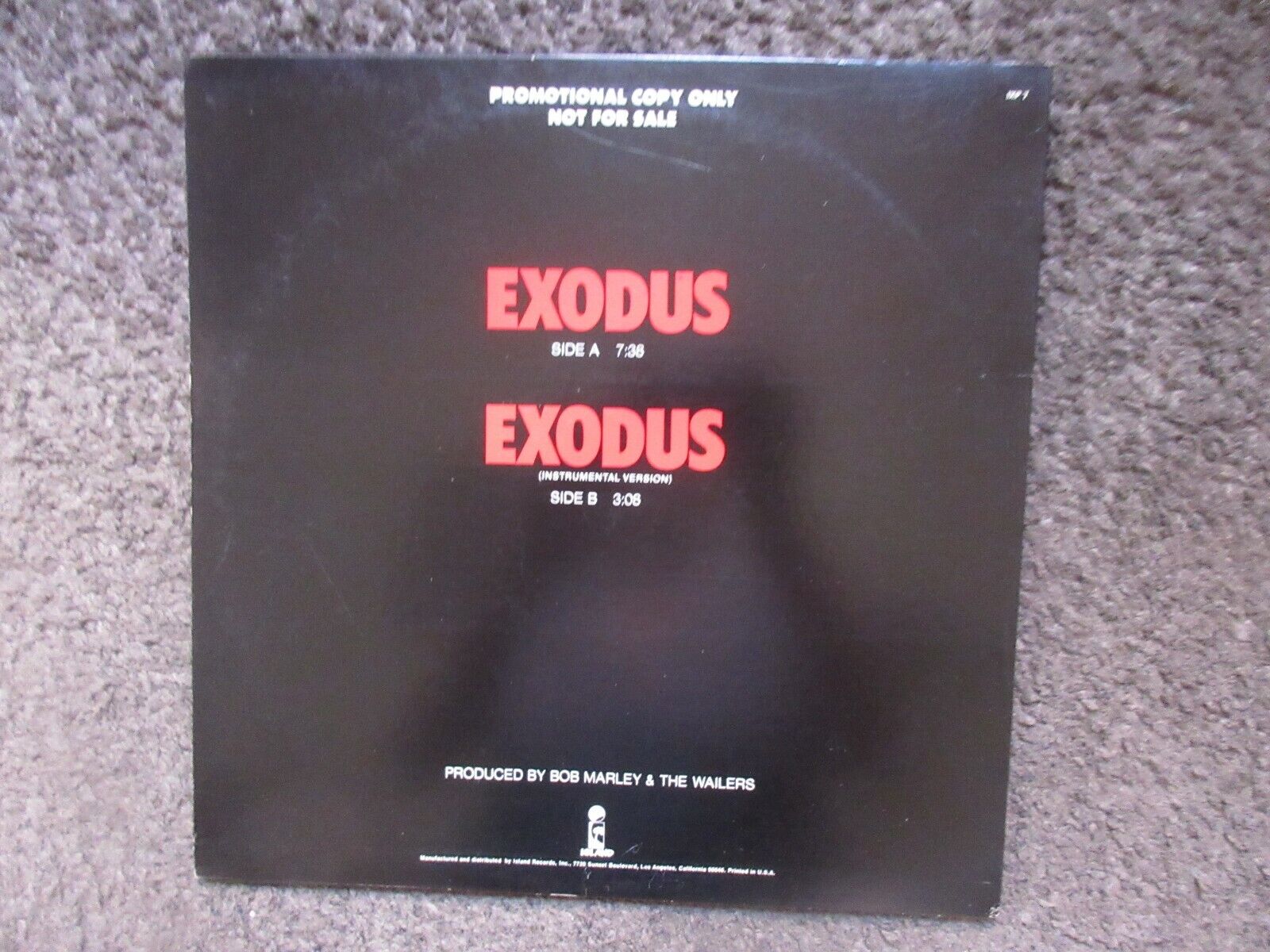
TRACK LISTING (SEE PHOTOS & BELOW):
SIDE 1. LP VERSION (7:38) SIDE 2. INSTRUMENTAL VERSION (3:08)
LABLE: ISLAND RECORDS
CAT.#- 1XP-7
YEAR: 1977
PROMO: YES
VINYL CONDITION: THIS RECORD IS IN MINT/MINT- THERE ARE NO NICKS, SCRATCHES, “LINES” BLEMS, FINGERPRINTS. NICE SHINEY LUSTER TO THE VINYL. BOTH LABELS ARE IN MINT CONDITION. LOOKS AND PLAYS BRAND NEW.
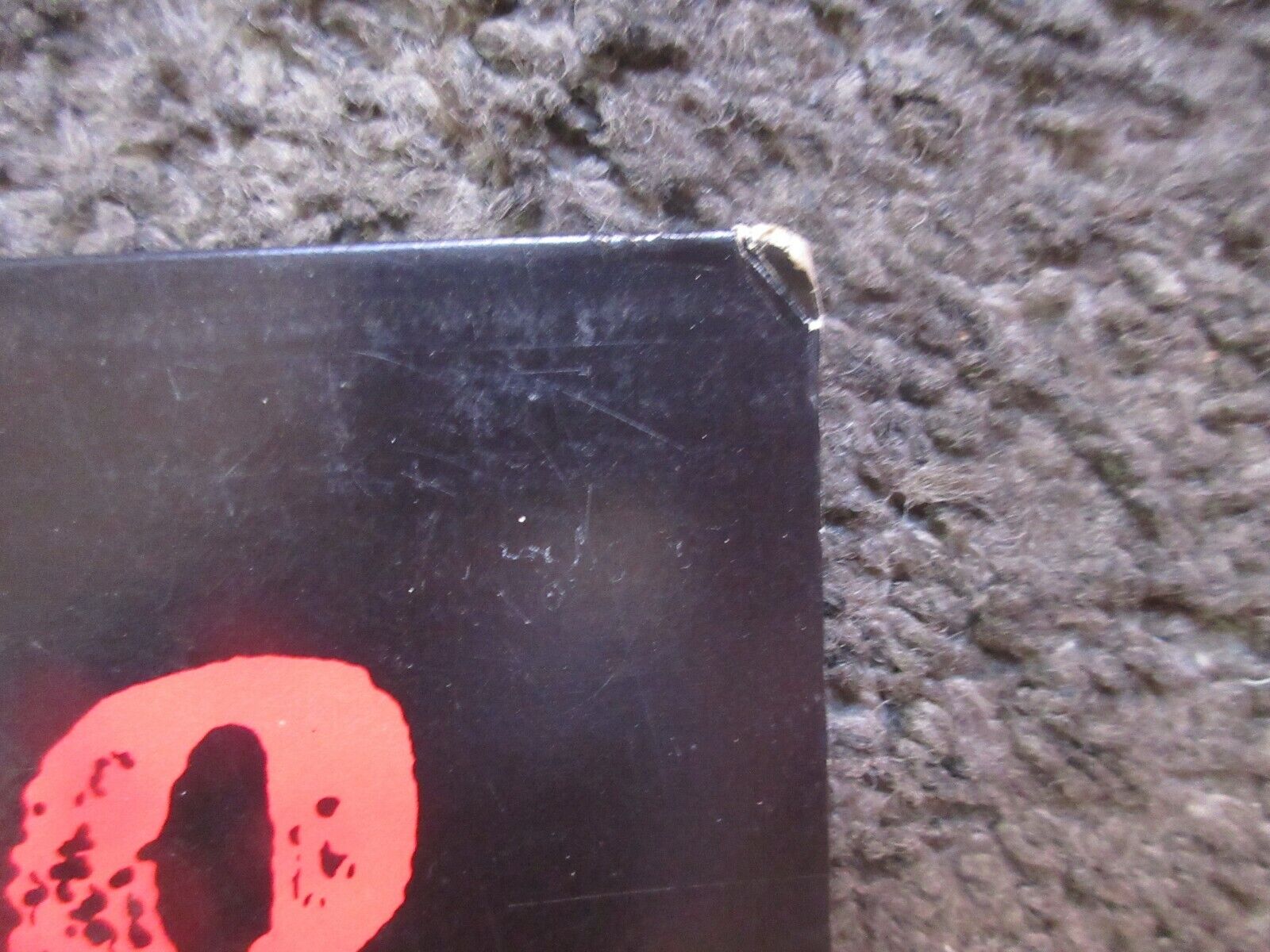
JACKET CONDITION: THE JACKET IS EX/EX- CONDITION, NICE CLEAN STRAIGHT EDGES, NO WRITING, TEARS, OR RIPS. THERE'S A COUPLE OF LIGHT CORNER “DINGS” AND LIGHT EDGE WEAR (SEE PHOTOS).
MORE INFO: THIS RECORD IS OUT OF PRINT. FROM THE MUSIC LIBRARY OF A NATIONAL RADIO NETWORK. NOT SOLD TO THE GENERAL PUBLIC. PRINTED ON THE JACKET IS “LIMITED EDITION-PROMOTIONAL COPY NOT FOR SALE”
ARTIST INFO:
Bob Marley: Rock Hall's reggae legend
What would modern music be without Bob Marley's influence? Rock Hall's reggae master made rock and roll grow up and grow better.
-
Updated:
Feb 6, 2020
Original:
Aug 17, 2011
If the induction of Bob Marley into the Hall of Fame in 1994 proved one thing, it was that rock ’n’ roll had finally grown up. Or, at least, that it had grown out of the juvenile name-calling with which it had amused itself for the previous four decades.
Like the loud-mouthed spotty kid in the playground of everybody’s past, rock, in its youth, was a sanctimonious little beast. On the one hand, it was so insecure within its own self belief that it was forever trying to “better” itself by being seen with the cool kids ... orchestras, opera lovers, playwrights and so on; and on the other, it thought nothing of hurling insults at those it perceived could be teased for cheap laughs — disco, teenyboppers, crooners, and, oddly for such an international language, anybody unfortunate enough to have been born outside the Anglo-American universe.
It was not a xenophobic dislike; or, at least, it was not knowingly so. Prior to the early 1990s, you could count on one hand the number of successful Black rock ’n’ roll performers. World Music was still a genre waiting to happen, and the nature of the music industry in general ensured that few bands from mainland Europe, Asia or even Japan and Australia, were going to get a fair shake of the commercial stick in America. And the fact that most readers of a certain age can still remember the names of every exception to that rule (Golden Earring, Focus, Kraftwerk and the Sadistic Mika Band) is evidence enough of that.
So, when elements of both the American and British music press started to champion Bob Marley in the mid-1970s, most hard-core rock fans took one look at the press release — a Jamaican born Rastafarian who played reggae music— and turned their ears off on the spot. Because reggae, in the 1970s, wasn’t simply the kid in the corner of the schoolyard who was bullied by its playmates every single day. The teachers and school governors picked on it as well.
It all sounds the same.
It doesn’t have a tune.
It doesn’t have good words (and you couldn’t understand them if it did).
It’s not music.
It wasn’t simply a different world back then. It was a different planet; and if you don’t believe me, ask Chris Blackwell, whose Island Records released Bob Marley and the Wailers’ “Catch A Fire: LP in 1973. Keyboard player John “Rabbit” Bundrick of Traffic and Muscle Shoals guitarist Wayne Perkins were drafted in to add rocking overdubs to the finished disc, “to make the record more accessible to rock audiences ... because reggae at that time ... didn’t have the respect that I felt it should have. People didn’t recognize the musicianship that existed within it.”
Thirty-six years on from Marley’s commercial breakthrough, 30 years on from his death and 17 years after his induction into the Hall of Fame, Blackwell’s words, too, seem like a relic from a different age. So does the argument, loudly raised in the music press of the day, that Marley himself had nothing to do with his own popularity; that it was Eric Clapton, scoring a massive hit with the Wailers’ “I Shot The Sheriff,” who first pushed his boat out. Clapton had hits with a lot of other people’s music too, but when was the last time you saw a J.J. Cale poster on sale in Wal-Mart? Today, it seems as though no discussion of modern music can pass without reference to Bob Marley’s influence, no examination of its popularity could be considered without his mention, and no visit to the local record store would be complete without a quick glance up the reggae aisle, to see how many more dubious compilations of oft-recycled oldies have hit the streets since last time.
During his own lifetime, Bob Marley released just 11 “new” albums, plus one dub set and two live collections. Of these, just three — 1970’s oddly-titled “The Best Of The Wailers” and “Soul Rebel” and 1972’s “Soul Revolution” — predate the band’s arrival at Island Records (earlier recordings, including more than 100 tracks cut at Studio One, would not see long playing action until the 1970s were already in full swing); and it is these that account for the vast majority of the budget reissues, repackagings and remasters with which one could now stock a medium sized record store with Marley alone.
The Island catalog has, fittingly, been treated with considerably greater respect, the current crop of available CDs being the same bonus stacked remasters that were unleashed earlier this century. Every one of these albums, however, has done its bit to chip another few splinters away from the old rocking notion that reggae wasn’t really music. No matter how shoddily packaged the latest collection of oldies and out-takes might be, the sheer quality of Marley and the Wailers’ music shines through.
It shines, too, through the manifold interpretations of his music that have percolated into the western consciousness in the decades since Johnny Nash scored a hit with Marley’s “Stir It Up” in 1972. From Johnny Cash and Joe Strummer’s fragile reinvention of “Redemption Song,” to Sinead O’Connor’s Saturday Night Live-inflaming delivery of “War;” from punk rockers Stiff Little Fingers’ fiery take on “Johnny Was” to Annie Lennox’s plaintive “Waiting In Vain,” Marley is now ranked among the most-covered songwriters of the rock ’n’ roll era, and, once again, one of the best loved — a process that culminated with Marley’s recognition by the Hall of Fame in 1994, but that peaked, perhaps, with his induction into the Songwriters Hall of Fame last year.
That is how far reggae has come since Marley’s breakthrough. Today, nobody knocks reggae for its perceived lack of musical quality, lyrical depth or political impact, not with songs the strength of ... well, all of the above, but many more too... ranged against them; and nobody knocks Bob Marley, either.
Of course, we still have a long way to go, at least if the Hall of Fame is the yardstick with which we judge things. Chris Blackwell was inducted in 2001, for services that included (but by no means were limited to) his tireless work to popularize reggae during its years in the outside; and Jimmy Cliff, too, has been recognized. But otherwise, Jamaica has not troubled the induction committee in the slightest.
How come? To argue that these are the only reggae performers in 50 years of the music’s history to have made the same impact on the overall music scene as ... well, name almost any other inductee you choose, but let’s say The Police, who themselves started life as a reggae parody band, is as blinkered (at best) and blindly prejudiced (at worst) as the detractors who held the music down in the first place.
It was only fitting, however, that Marley was the first to be included, and, for a long time, was reggae’s only inclusion. Without him, the music might still be a backwater, a cultural oddity whose cult appeal floats somewhere between the electric bazouki and the symphonic sounds of a game of horseshoes. Bob Marley was born to a Jamaican mother and English father in 1945, but was raised by his mother alone, first in the rural village of Nine Miles, St. Anns, then in the capital city of Kingston. There, he and another boy from Nine Miles, Neville “Bunny” Livingston, first began singing together while Marley, encouraged by another friend, the young Desmond Dekker, began appearing at area talent contests.
He cut his first solo single in 1962; formed the Wailers in 1963 and, by the time “Catch A Fire” was recorded, Marley had been a Jamaican star for almost 10 years, cutting singles (and those three LPs) with some of the most significant producers in town — Coxsone Dodd, Lee Perry, Lesley Kong, Bunny Lee — while blazing with a political zeal that simultaneously marked Marley out as one of Jamaica’s most volatile performers.
A devout Rastafarian, a strident rebel, a fearless campaigner, his best recordings (and, indeed, his life’s objectives) burn with an affirmative fire that spreads so far beyond the narrow parameters of 20th/21st century politics and correctness that many of his original fans and supporters feel personally affronted by the fame which now attends him, aware that it is as much a product of the Marley marketing machine as it is a reflection of the man himself.
That the modern machine has utterly emasculated Marley is beyond doubt. Gone from the public record is the ghetto kid who dreamed of Che Guevara and the Black Panthers, and pinned their posters up in the Wailers’ Soul Shack record store in Kingston; who believed in freedom, and the fighting which it necessitated, and dressed the part on an early album sleeve; whose heroes were James Brown and Mohammed Ali; whose sacrament was marijuana. Instead, the Bob Marley who surveys his kingdom today is smiling benevolence, a shining sun, a waving palm tree, and a string of hits which tumble out of polite radio like candy from a gumball machine. Of course it has assured his immortality. But it has also demeaned him beyond recognition. Bob Marley was worth far more.
LIMITED INTERNATIONAL SHIPPING AT THIS TIME. THE $4 FLAT RATE MEDIA MAIL IN THE U.S. INCLUDES THE COST OF THE MAILER.THANKS!
I DO COMBINE DOMESTIC SHIPPING……….
CHECK OUT MY OTHER AUCTIONS
PLEASE PAY FOR ALL ITEMS WITHIN 7 DAYS, OR MESSAGE ME TO EXPLAIN WHY YOU CAN’T, (IF YOU ARE BIDDING OR PLAN TO BID ON OTHER ITEMS) I WILL DO A ONE WEEK WAIT FROM THE DATE OF THE END OF THE FIRST AUCTION WIN, TO COMBINE SHIPPING ON ITEMS, AFTER THAT I NEED PAYMENT IN FULL AND WILL MAIL OUT THE ITEMS , EVEN IF YOU ARE BIDDING ON OTHERS, THUS BEGINS A NEW BILLING/SHIPPING CYCLE. THIS CASH FLOW IS MY SOURCE OF INCOME FOR PAYING RENT/BILLS, ETC. IF YOU HAVE WON AN ITEM AND I DO NOT HEAR FROM YOU ONE WAY OR THE OTHER WITHIN 7 DAYS I WILL OPEN AN “UNPAID ITEM CASE”, IN ORDER TO FREE UP THE ITEM FOR A POSSIBLE RE-LISTING OR A “SECOND CHANCE OFFER”. PLEASE WHEN YOU WIN AN ITEM TRY AND PAY FOR IT IN A TIMELY FASHION OR LET ME KNOW YOU ARE LOOKING AT OTHER ITEMS I HAVE LISTED, I MAIL ITEMS OUT WITHIN ONE WORKING DAYS ONCE PAYMENT IS RECEIVED.
NEW NOTE TO ALL POTENTIAL BIDDERS PLEASE! DO NOT BID IF YOU HAVE NO INTENTION OF PAYING FOR AN ITEM YOU MIGHT WIN. I DO NOT LIKE OPENING UNPAID ITEM CASES BUT I WILL IF YOU NEGLECT TO PAY AND I WILL PUT YOU ON MY “BLOCKED BIDDER” LIST.
price rating

![U2: i still haven't found [+GERMAN PROMOSHEET ], Islan.. PROMO 7](https://www.popsike.info/php/thumbnail.php?url=https://www.popsike.pics/pix/20130407/230959667316.jpg)