BLUES 45: BRO. JOHN SELLERS on EBONY (KOKOMO ARNOLD)
$
50


Favourite Auctions
To save auctions to your favourites, please login
If you don't have an account, please register
Description
This is one of several 45s we’re auctioning from that most eccentric of all blues labels, Ebony Records, the Chicago label operated by noted producer J. Mayo “Ink” Williams (known for his prewar recording work for Black Swan, Paramount, Decca et al). Williams was trying to keep up with the times in the ‘50s and ‘60s and did some interesting new sessions in Chicago but he had such a fondness for some of his earlier productions that he overdubbed new instruments or vocals on them, or retitled them, among other hard-to-decipher maneuvers, including reusing the same record release numbers on several different releases. The name of the label changed at times too, apparently depending on what partner was involved with Williams at the time. EBONY was always in big letters, but it might be Ebony High-Fidelity Records, Ebony Productions Records, Ebony South Center Records, Ebony Foundation Records, Ebony St. Louis Jimmy Records, Ebony Soul Sound Records, Ebony New Sounds Records, or Inks Ebony Records Ltd. I’m looking for Ebony releases to complete my collection too, especially the Birmingham Jr. and Harmonica “Blues King” Harris 45s, so anyone who has these to sell or trade, please contact me. And if anyone knows of any heirs of Williams, they have some big money coming that has accumulated at BMI.
This auction is for:
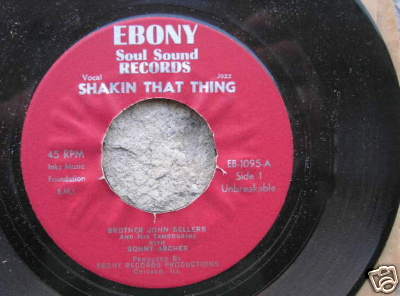
Brother John Sellers And His Tambourine With Sonny Archer
EB-1095-A Shakin That Thing
b/w
Brother John Sellers And His Tambourine With Soul Sister Caldonia
EB-1095-B Busy Bootin
Ebony Soul Sound Records 1095
Produced by Ebony Records Productions
Chicago, Ill.
Shakin That Thing features Sellers’ singing and tambourine, plus congas (by Sonny Archer?), overdubbed over the July 9, 1936 Kokomo Arnold recording Shake That Thing (Decca 7212), featuring Arnold on vocal & guitar and unknown piano (poss. Peetie Wheatstraw, acc. To Blues & Gospel Records 1890-1942). Sellers urges listeners to do various dances -- the Popcorn, the Boogaloo, and the Monkey, which would date the overdubbing to c. 1969 (the year James Brown had a hit with "The Popcorn").
Arnold also recorded Busy Bootin’ (Decca 7139, April 18, 1935) but this is a newer recording, with trumpet, saxes, piano, string bass, and guitar with vocals by Sellers and “Soul Sister Caldonia” (Caldonia Palmer). This seems to be the same track listed in The Blues Discography 1943-1970 as Busy Bootin! And You Can’t Come In by Cal “Caldonia” Palmer with Little Brother’s Jazz Band, with vocals by Sellers and Palmer, on Ebony 1040 and on an apparently different release of Ebony 1095, which also has "Shakin' That Thing" on the flip side, credited to “Brother John” with Little Brother’s Jazz Band (Little Brother Montgomery, p; LeRoi Nabors, tp; Ransom Knowling, b; Jack “Cowboy” Cooley, d; Robert Jr. Lockwood, g). (The band also includes a couple of saxophones.) Date in the book is given as c. 1960.
Busty Bootin' is a good, swinging track, with trumpet solo by LeRoi Nabors. The guitarist -- the legendary Robert Lockwood, according to the discography -- is barely audible, just strumming chords to the rhythm.
Record in VG+ condition, with labels wrinkled.
Records are visually graded.
LP & 45 RECORD GRADING
Goldmine Grading Guide © Goldmine Magazine.
Mint (M): Absolutely perfect in every way -- certainly never played, possibly even still sealed.
Near Mint (NM or M-): A nearly perfect record, showing no obvious sign of wear. A 45 rpm sleeve has no more than the most minor defects, such as almost invisible ring wear or other signs of slight handling. An LP jacket has no creases, folds, seam splits or any other noticeable similar defect. No cut-out holes, either. The same is true of any other inserts, such as posters, lyric sleeves, and the like. Basically, Near Mint looks as if you just got it home from a new record store and removed the shrink wrap.
Very Good Plus (VG+): Shows some signs that it was played and otherwise handled by a previous owner who took good care of it. Record surfaces may show some slight signs of wear and may have slight scuffs or very light scratches that don't affect one's listening experience. Slight warps that do not affect the sound are OK. The label may have some ring wear or discoloration, but is should be barely noticeable. The center hole is not misshapen by repeated play. Picture sleeves and LP inner sleeves will have some slight wear, lightly turn-up corners, or a slight seam-split. An LP jacket may have slight signs of wear also and may be marred by a cut-out hole, indentation or corner indicating it was taken out of print and sold at a discount.
Very Good (VG): Many of the defects found in a VG+ record are more pronounced in a VG disc. Surface noise is evident upon playing, especially in soft passages and during the song's intro and fade, but will not overpower the music otherwise. Groove wear will start to be noticeable, as will light scratches (deep enough to feel with a fingernail) that will affect the sound. Labels may be marred by writing, or have tape or stickers (or their residue) attached. The same will be true of picture sleeves or LP covers. However, it will not have all of these problems at the same time, only two or three of them.
Good (G), Good Plus (G+): Good does not mean bad! A record in Good or Good Plus condition can be put onto a turntable and will play through without skipping. But it will have significant surface noise and scratches and visible groove wear. A jacket or sleeve has seam splits, especially at the bottom or on the spine. Tape, writing, ring wear or other defects will start to overwhelm the object.
Poor (P), Fair (F): The record is cracked, badly warped, and won't play through without skipping or repeating. The picture sleeve is water damaged, split on all three seams and heavily marred by wear and/or writing. The LP jacket barely keeps the LP inside it. Inner sleeves are fully seam split, and written upon.
--------------------------
[+ and – denote in-between grades. Grades with a slash in between indicate the condition of Side A/Side B.]
Other grading codes (from VJM and other sources):
LIB = Library copy. These albums have been reassembled in library binding format: the jackets have been taped around the edges, and the records are in a separate inner sleeve. Records and printed inserts are placed inside a stiff plastic Gaylord record holder. Library stamps and markings have been applied.
LIB, NOC = Library copy as above but with no original cover; only the record remains in the plastic record holder.
aud = audible
bb = bb hole in cover
boot = bootleg
cc = cut corner
co = cut-out
coh = cut-out hole punched in cover or label
cr = crack
cvr = cover
DJ = DJ or promotional copy
eb = edge bite
ec = edge chip
ef = edge flake
ep = extended play
fade = faded label
gr = groove [10g = 10 grooves]
hc/hlc = hairline crack
inaud = inaudible
lbl = label
lc = lamination crack
ld = label damage
m = mono
nap = not affecting play
non-lp = not on full-length LP or CD
oc = original cast recording
ost = original soundtrack
po = punch out
promo = promotional copy
ps = picture sleeve (45s)
re (also ri) = reissue
rf = rough
rw = ring wear
s = stereo
sc = scratched cover
scfs = scuffs
scr = scratch
sfc = surface
sl = slight
slt wrp = slight warp
sm = saw mark (cut-out mark)
sm splt = seam split
soc = sticker on cover
sol = sticker on label
sr = slight ring wear on cover
ss = still sealed
t = tear on cover
toc = tape on cover
tol = tape on label
va = various artists
wlp = white label promo
woc = writing on cover
wol = writing on label
xoc = “X” written on cover
xol = “X” written on label
-----------
See our eBay store (Bluesoterica.com Mail Order) for more blues, R&B, soul, funk, jazz, rock, world/ethnic, soundtrack, pop, folk, C&W, comedy, dance, spoken word & gospel records, CDs, books & magazines, concert posters, photos & musical memorabilia.
We have signed copies of "The Voice of the Blues: Classic Interviews from Living Blues Magazine" (Routledge, 2002, edited by Jim O'Neal and Amy van Singel). "The Voice of the Blues" is a collection of interviews conducted from 1967/68 to 1981, originally published in Living Blues, America's first blues magazine, with chapters expanded for this book to include introductions, postscripts, editors' notes, and previously unpublished questions and answers from several interviews. Includes interviews with Muddy Waters, Jimmy Reed, John Lee Hooker, Little Walter & Louis Myers, T-Bone Walker, Freddie King, Little Milton, Georgia Tom Dorsey, Houston Stackhouse, Eddie Boyd, Little Esther Phillips, and Sleepy John Estes & Hammie Nixon. 427 pages, paperback, with Foreword by Peter Guralnick, 43 photos and detailed index. Other books available on WYNONIE HARRIS, BIG JAY McNEELY, L.A. VOCAL GROUPS, ELMORE JAMES, JOSH WHITE, STAX RECORDS, BUDDY HOLLY, and more.
Back issues of Living Blues Magazine also available from our eBay store: Go to Bluesoterica.com (mail order page) for contents of each issue.
WANTED: 45s and LPs (blues, R&B, soul, funk, rockabilly, rock 'n' roll, jazz & gospel) from Kansas City, St. Louis, Arkansas, Alabama & Mississippi; also independent or obscure local releases of blues, R&B, and funk on 45 or LP from Wichita, Louisville, Omaha, Minneapolis, Des Moines, Indianapolis, Milwaukee, Toledo, Cleveland, Baton Rouge, Miami, San Antonio, Houston, Phoenix, Oakland, etc.; also world music, especially African and Caribbean records, Maori show bands, Tex-Mex funk and soul, and Indo Rock.
Jim O'Neal, BLUESOTERICA.COM MAIL ORDER, 3516 Holmes St., Kansas City MO 64109. (816) 931-0383. e-mail Stackhouse232@aol.com.
price rating