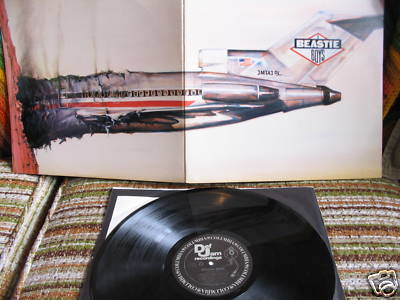
BEASTIE BOYS License to Ill Original 1986 Def Jam NM GF
$
31


Favourite Auctions
To save auctions to your favourites, please login
If you don't have an account, please register
Description
The Beasties' classic first LP.
Featuring hit party songs like "Fight for Your Right", "Brass Monkey", etc.
Original Def Jam 1986.
(See Goldmine Grading below)
The record is Near Mint, with a few light marks from sliding in and out of the paper sleeve.
The gatefold cover is also Near Mint.
Tracks:
Side One
1. Rhymin & Stealin
2. The New Style
3. She's Crafty
4. Posse in Effect
5. Slow Ride
6. Girls
7. Fight For Your Right
Side Two
1. No Sleep Till Brooklyn
2. Paul Revere
3. Hold it Now, Hit it
4. Brass Monkey
5. Slow and Low
6. Time to Get Ill
AMG Review by Stephen Thomas Erlewine
Perhaps Licensed to Ill was inevitable -- a white group blending rock and rap, giving them the first number one album in hip-hop history. But that reading of the album's history gives a short shrift to the Beastie Boys; producer Rick Rubin and his label, Def Jam; and this remarkable record, since mixing metal and hip-hop isn't necessarily an easy thing to do. Just sampling and scratching Sabbath and Zeppelin to hip-hop beats does not make for an automatically good record, though there is a visceral thrill to hearing those muscular riffs put into overdrive with scratching. But, much of that is due to the producing skills of Rick Rubin, a metalhead who formed Def Jam Records with Russell Simmons and had previously flirted with this sound on Run-D.M.C.'s Raising Hell, not to mention a few singles and one-offs with the Beasties prior to this record. He made rap rock, but to give him lone credit for Licensed to Ill (as some have) is misleading, since that very same combination would not have been as powerful, nor would it have aged so well -- aged into a rock classic -- if it weren't for the Beastie Boys, who fuel this record through their passion for subcultures, pop culture, jokes, and the intoxicating power of wordplay. At the time, it wasn't immediately apparent that their obnoxious patter was part of a persona (a fate that would later plague Eminem), but the years have clarified that this was a joke -- although, listening to the cajoling rhymes, filled with clear parodies and absurdities, it's hard to imagine the offense that some took at the time. Which, naturally, is the credit of not just the music -- they don't call it the devil's music for nothing -- but the wild imagination of the Beasties, whose rhymes sear into consciousness through their gonzo humor and gleeful delivery. There hasn't been a funnier, more infectious record in pop music than this, and it's not because the group is mocking rappers (in all honesty, the truly twisted barbs are hurled at frat boys and lager lads), but because they've already created their own universe and points of reference, where it's as funny to spit out absurdist rhymes and pound out "Fight for Your Right (To Party)" as it is to send up street-corner doo wop with "Girls." Then, there is the overpowering loudness of the record -- operating from the axis of where metal, punk, and rap meet, there never has been a record this heavy and nimble, drunk on its own power yet giddy with what they're getting away with. There is a sense of genuine discovery, of creating new music, that remains years later, after countless plays, countless misinterpretations, countless rip-off acts, even countless apologies from the Beasties, who seemed guilty by how intoxicating the sound of it is, how it makes beer-soaked hedonism sound like the apogee of human experience. And maybe it is, maybe it isn't, but in either case, Licensed to Ill reigns tall among the greatest records of its time.
(Note: I never use "Mint" for anything but a sealed record.)
GOLDMINE GRADING
MINT ---- It should appear to be perfect. No scuffs or scratches, blotches or stains, labels or writing, tears or splits. Mint means perfect.
NEAR MINT ---- Otherwise mint but has one or two tiny inconsequential flaws that do not affect play. Covers should be close to perfect with minor signs of wear or age just becoming evident: slight ring-wear, minor denting to a corner, or writing on the cover should all be noted properly.
VERY GOOD PLUS ---- The record has been handled and played infrequently or very carefully. Not too far from perfect. On a disc, there may be light paper scuffs from sliding in and out of a sleeve or the vinyl or some of the original luster may be lost. A slight scratch that did not affect play would be acceptably VG+ for most collectors.
VERY GOOD ---- Record displays visible signs of handling and playing, such as loss of vinyl luster, light surface scratches, groove wear and spindle trails. Some audible surface noise, but should not overwhelm the musical experience. Usually a cover is VG when one or two of these problems are evident: ring wear, seam splits, bent corners, loss of gloss, stains, etc.
GOOD ---- Well played with little luster and significant surface noise. Despite defects, record should still play all the way through without skipping. Several cover flaws will be apparent, but should not obliterate the artwork.
POOR ---- Any record or cover that does not qualify for the above "Good" grading should be seen as Poor. Several cover flaws.
price rating


![...And Justice for All [ 2 LP] by Metallica (Vinyl, Sep-1988, Elektra...](https://www.popsike.info/php/thumbnail.php?url=https://www.popsike.pics/pix/20231002/256241062626.jpg)